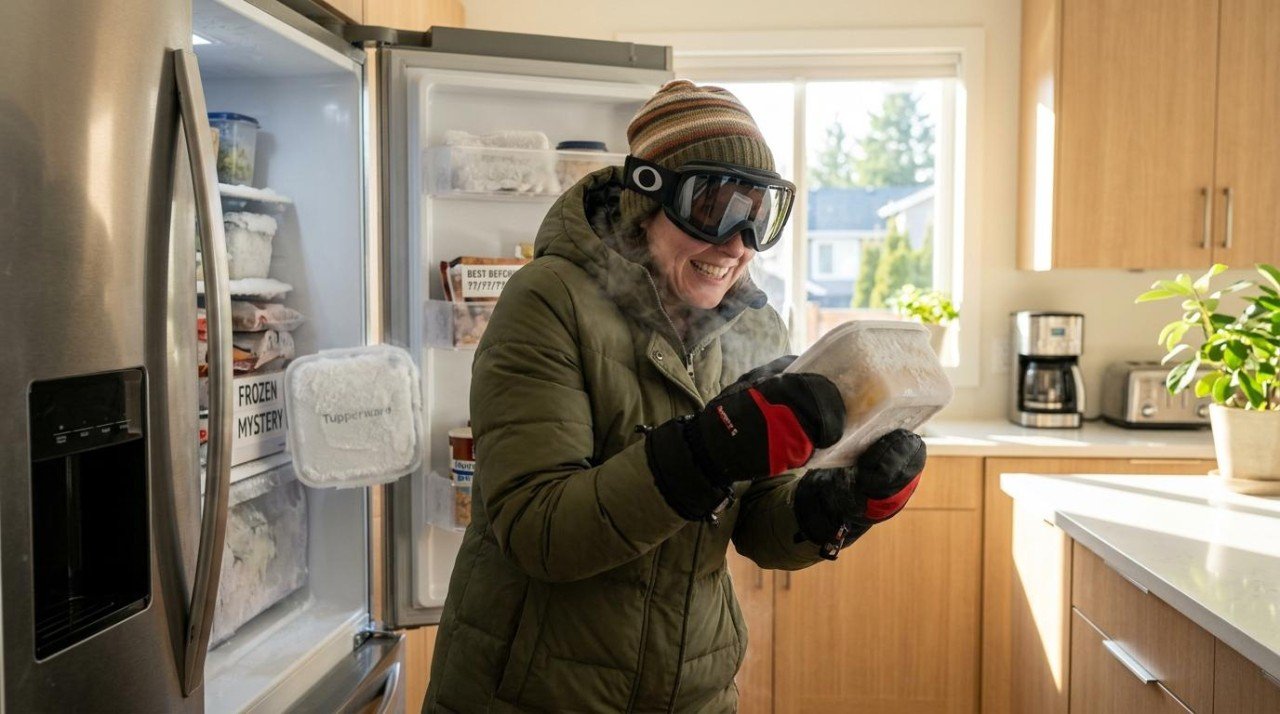
Think about the most useful thing in your kitchen. Not the stove, not the good knife — the freezer. It is the one appliance that can quite literally stop time. A pot of chili you made on Sunday can sit frozen for months and emerge, on some future Tuesday when you are exhausted and staring down a takeout menu, as a hot homemade dinner you do not have to cook. That is not an exaggeration. The freezer is a time machine. The problem is that most of us use it like a junk drawer: a place where mystery bags of food go to be forgotten, freezer-burned, and eventually thrown away.
Used with even a little intention, your freezer becomes something much more valuable — emergency dinner insurance. It is the thing standing between a tired weeknight and another $40 delivery order. Here is how to actually use it that way, backed by what the food-safety science says really happens when you freeze food.
The quiet cost of the empty-handed weeknight
The reason this matters goes beyond convenience. When there is nothing ready to eat, two expensive things tend to happen: food you already bought spoils in the fridge, and you spend money ordering something instead. Americans are remarkably good at both. According to the U.S. Environmental Protection Agency, over one-third of the food produced in the United States is never eaten. And a 2025 EPA analysis put a hard number on the household share of that: the cost of food waste comes to about $728 per consumer per year — roughly $2,913 for a household of four, or $56 every single week.
A lot of that waste is the wilted spinach and the leftovers nobody got around to eating. The freezer is the single most effective tool you have for rescuing both before they hit the trash. The half-pot of soup you would normally let languish in the fridge for five days and then guiltily pour out? Freeze it on day one, and you have converted a near-certain loss into a future dinner.
First, let's kill the "frozen is worse" myth
There is a stubborn belief that frozen food is a nutritional downgrade from fresh. For home cooking, it mostly is not — and understanding why makes you a lot more willing to use your freezer.
Start with the food itself. The USDA's Food Safety and Inspection Service is blunt about it: "The freezing process itself does not destroy nutrients." In meat and poultry, they note, there is little change in nutrient value during freezer storage. Freezing is not cooking — it does not break vitamins down.
What about produce? Here the research is genuinely reassuring. A University of California, Davis study led by Dr. Diane Barrett compared the vitamin content of eight fruits and vegetables — corn, carrots, broccoli, spinach, peas, green beans, strawberries, and blueberries — in fresh-stored versus frozen form. The finding: the nutritional value of frozen produce was generally equal to, and in some cases better than, its fresh counterpart. For several items, including corn, green beans, and blueberries, the frozen versions actually held more vitamin C than fresh produce that had spent a few days in the refrigerator.
That last part is the key. As the Tisch Food Center at Columbia University's Teachers College explains, fresh produce starts losing nutrients the moment it is harvested — transportation and storage trigger respiration and the degradation of water-soluble vitamins like vitamin C and the B vitamins. Frozen fruits and vegetables, by contrast, are typically picked at peak ripeness and frozen within hours, locking in that nutrition. The "fresh" green beans that traveled a week to your store and sat in your crisper for four more days are not automatically winning that contest.
The honest takeaway is the one the Tisch researchers land on: for most people, eating a variety of fruits and vegetables matters far more than agonizing over whether they are fresh or frozen. So when you batch-cook a vegetable-heavy soup and freeze half, you are not serving your future self a sad, depleted meal. You are serving a good one.
How freezing actually keeps food safe
To use your freezer with confidence, it helps to know what it is and isn't doing. Freezing does not kill the bacteria, yeasts, and molds on your food — it presses pause on them. As the USDA puts it, "Freezing keeps food safe by slowing the movement of molecules, causing microbes to enter a dormant stage." At a constant 0°F, those microbes are inactivated; they cannot grow or multiply.
This leads to the single most freeing fact about your freezer: "Food stored constantly at 0°F will always be safe." Frozen food does not "go bad" in the way fridge food does. The storage times you see on charts are about quality — flavor and texture — not safety. A casserole frozen for eight months is still perfectly safe to eat; it just may not taste as good as it did at month two.
The flip side is the catch worth remembering: once food thaws, those dormant microbes wake right back up and start multiplying as if nothing happened. So thawed food is just as perishable as anything fresh and needs to be handled the same way — which is why how you thaw matters as much as how you freeze.
It also means your freezer is genuine insurance against disaster. The USDA notes that a full freezer will hold its temperature for about two days if you simply keep the door shut during a power outage; a half-full one lasts about a day. A well-stocked freezer is more resilient than an empty one.
What to actually put in there
Here is where "junk drawer" turns into "system." The most useful freezer is not full of random leftovers — it is stocked with things you have deliberately banked. Three categories do the heavy lifting:
- Single-portion complete meals. When you make soup, chili, stew, curry, or a casserole, freeze the extra in individual or family-sized portions. This is your true "grab-and-reheat" insurance — dinner with zero assembly required.
- Batch-cooked building blocks. You do not have to freeze whole meals to win. Cooked grains (rice, farro, quinoa), browned ground meat, beans, caramelized onions, roasted vegetables, tomato sauce, and pesto all freeze beautifully and turn a from-scratch dinner into an assembly job. Browned meat plus a bag of frozen rice plus a jar of sauce is a 10-minute dinner.
- Raw ingredients before they turn. Bananas going spotty, herbs about to wilt, bread you won't finish, a glut of berries, the second half of a can of chipotle or tomato paste — these all freeze, and freezing them is how you stop throwing money away.
This is also exactly where a plan turns a freezer stash into a weekly rhythm. If you set aside a little time to batch-cook a couple of components on the weekend, you are essentially pre-paying for several easy dinners. Eat Well Planner now has meal-prep features built for this: it can take your saved recipes, break them into the components worth making ahead, and generate a simple prep-session checklist so a Sunday hour of cooking quietly stocks your week. And because your meal plan and shopping list know what you have already made, you stop re-buying the rice and the chicken that are already sitting in the freezer.
Take the Guesswork Out of Eating Well
Eat Well Planner helps you organize your favorite recipes, plan balanced meals, and automatically generate shopping lists — all in one place. Whether you're tracking macros, managing dietary restrictions, or just trying to stop asking "what's for dinner?", we've got you covered.
Our AI-powered tools can adapt any recipe to your dietary needs, help you discover new meals you'll love, and even log your nutrition effortlessly. It's meal planning made simple.
Start Organizing Your Meals — FreeWhat freezes well — and what really doesn't
Not everything survives the trip. Knowing the difference saves you from disappointment when you defrost something that has turned to mush or split into a curdled mess.
Freezes well: soups, stews, chili, cooked beans, braised and roasted meats, most baked goods, cooked grains, tomato-based sauces, and the components above. Hearty, saucy, and starchy dishes are your friends.
Freezes poorly: the USDA specifically calls out mayonnaise, cream sauce, and lettuce as foods that simply don't freeze well. Clemson Cooperative Extension expands the list: mayonnaise, cream puddings and fillings, custards, gelatin salads, the whites of hard-cooked eggs, and gravies made with wheat flour all break down. Milk-based sauces, Clemson notes, "sometimes curdle and separate," and gravy "tends to separate and curdle when thawed." Raw salad vegetables like lettuce, greens, and tomatoes "lose crispness and become soggy" because their high water content turns to cell-bursting ice.
None of this is dangerous — it is purely a quality issue. And a couple of these have easy workarounds: a curdled milk sauce often comes back together if you stir it while reheating, and a soup with a flour-thickened or creamy base freezes better if you freeze it before adding the dairy and stir the cream in fresh when you reheat.
The three rules that prevent freezer burn
Most freezer disappointment comes down to one villain: air. Freezer burn — those grayish-brown leathery patches — is, per the USDA, "caused by air reaching the surface of the food." The good news is that freezer-burned food "does not make food unsafe, merely dry in spots"; you can cut the affected parts away. But it is easy to avoid in the first place:
- Freeze fast, in a thin layer. Rapid freezing creates small ice crystals; slow freezing creates large ones that rupture cells and make thawed food watery and limp. The USDA's rule of thumb: a portion about two inches thick should freeze solid in roughly two hours. Spread packages out in a single layer rather than stacking them until they are frozen.
- Squeeze out the air. Use airtight, heavy-duty freezer bags, wrap, or rigid containers, and press out as much air as you can. Supermarket meat wrapping is fine for a month or two, but for longer storage, overwrap it.
- Portion before freezing. Freezing in the sizes you will actually use means you thaw only what you need and never refreeze a giant thawed block.
Label it, date it, and keep a list — or it disappears
This is the rule that separates a working freezer from a graveyard. Every single thing that goes in should get a label with what it is and the date it went in. Frozen chili and frozen tomato sauce look identical under a layer of frost; future-you will not remember. A roll of masking tape and a marker is all it takes.
Then keep a simple inventory — a whiteboard on the freezer door, a note on your phone, a scrap of paper. The freezer's great weakness is that it hides its contents; food you cannot see is food you forget, and forgotten food is wasted food. A running list of what's inside (and crossing things off as you eat them) is what keeps your stash in active rotation instead of sinking into the frost at the back. It also means that when you plan the week's meals, you can "shop your freezer" first and build dinners around what you already have — which is the whole point of insurance.
A rough timeline (for quality, not safety)
Since safety isn't the constraint at a steady 0°F, these are just the windows where food tastes its best. From the USDA's freezer storage chart:
- Soups, stews, and cooked meat: 2 to 3 months
- Casseroles: 2 to 3 months
- Cooked poultry: 4 months
- Uncooked ground meat: 3 to 4 months
- Uncooked steaks, chops, and roasts: 4 to 12 months
- Uncooked whole poultry: up to 12 months; poultry parts about 9 months
- Bacon and sausage: 1 to 2 months
- Ham, hot dogs, and lunch meats: 1 to 2 months
Past these windows your food is still safe — it may just have lost some flavor or dried out a bit. If something is a little tired after a long freeze, the USDA's own suggestion is a good one: use it in a soup or stew where it gets a second life.
Thawing without undoing your good work
Because microbes come right back to life as food warms, thawing is the step where safety actually matters. The USDA gives three safe methods: in the refrigerator (the best and most hands-off — plan a day or two ahead), in cold water inside a leak-proof bag (change the water every 30 minutes), or in the microwave (cook it immediately afterward). The one thing never to do is thaw food on the counter, where the outside warms into the bacterial danger zone while the center is still frozen.
Two more handy facts: most soups, stews, casseroles, and even raw meat can be cooked straight from frozen — it just takes about one and a half times as long. And if you thawed something in the fridge and didn't use all of it, you can safely refreeze it, with only a small loss of quality.
Your freezer, finally pulling its weight
None of this requires a chest freezer or a weekend of meal prep. It requires a small shift in how you think about the appliance you already own. Every time you cook, ask whether there is a portion or a component worth banking. Label it, date it, list it. And on the night when you are too tired to think, open the freezer instead of an app — and let past-you, the one who saw this coming, make dinner.
If you want the planning side handled for you, Eat Well Planner ties it all together: save recipes from any website, Instagram reel, or YouTube video, build a weekly meal plan around what's already in your freezer, run a quick prep session to bank the components, and let the auto-generated shopping list make sure you only buy what you don't already have on ice. Your freezer becomes exactly what it was always meant to be — a time machine for dinner.