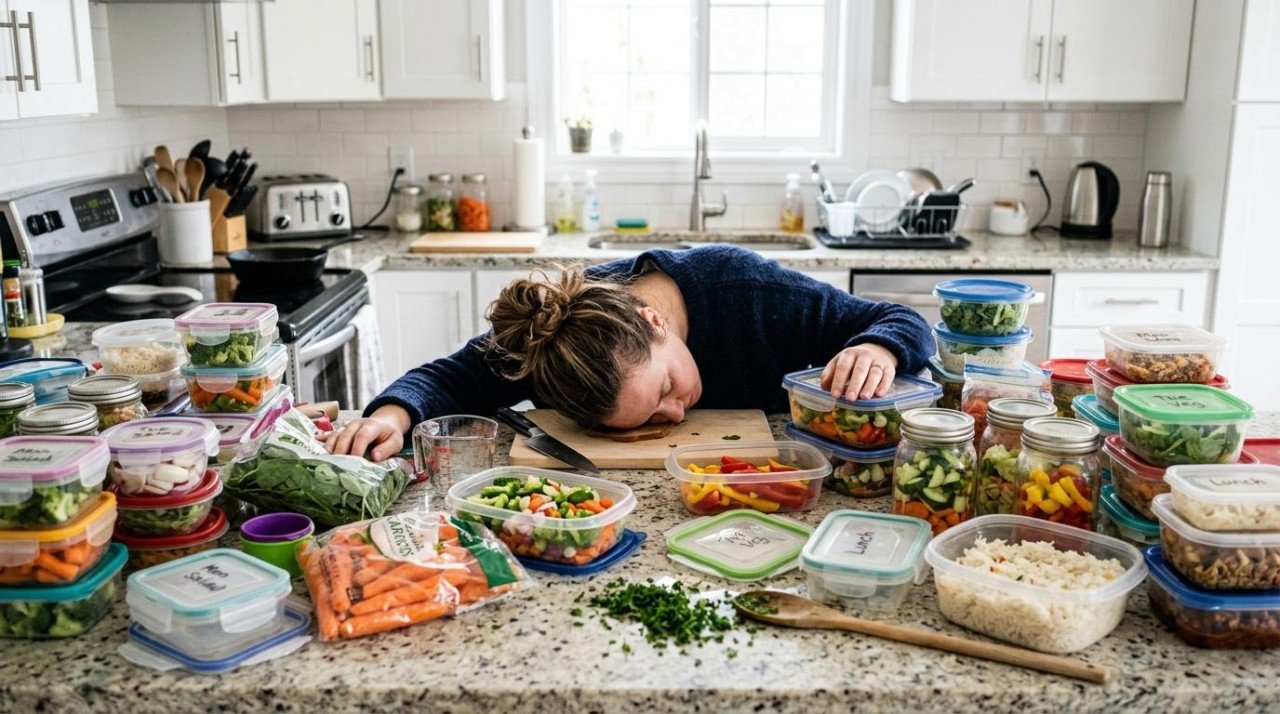
You have seen the photos: a wall of matching glass containers, seven days of color-coded lunches, a kitchen counter that looks like a catering line. The promise of Sunday meal prep is seductive — cook once, eat all week, never think about food again. And for a certain kind of person with a genuinely open Sunday, it works beautifully.
For everyone else, it is a quiet source of guilt. Your Sundays already have soccer games, laundry, a work thing that spilled over, a nap you desperately need, or simply a life that does not include a free four-hour block. So the marathon prep session never happens, and because the all-or-nothing version is the only version you have been sold, you end up doing no batch cooking at all — and ordering takeout on Wednesday because there is nothing ready.
Here is the good news: the marathon is optional. The actual benefit of batch cooking — having real food ready so you do not default to processed convenience meals — does not require a single heroic session. It requires a few cooked components in your fridge. And you can build those in fifteen-minute pockets scattered across a normal, busy week.
The Marathon Model Is Fragile by Design
The problem with cramming all your cooking into one session is not that it is hard in the moment (though it is). The problem is that it is fragile. It has a single point of failure. Miss that one Sunday afternoon — because you are sick, traveling, exhausted, or just human — and your entire week of eating falls apart. One disruption and you are back to square one.
Spreading the work out does the opposite. If your plan is to cook one component on three or four different occasions during the week, missing one of them barely matters. You still have the other three. Consistency built from small, repeatable actions is far more durable than a plan that depends on one perfect block of time you rarely get.
And the small stuff genuinely adds up. What we are really chasing here is the difference between cooking at home and reaching for something processed — and that difference is well documented. In a study of more than 9,000 U.S. adults, Johns Hopkins researchers found that people who cooked dinner at home most nights consumed fewer calories, less sugar, and less fat than those who rarely cooked — and they also ate out more healthfully on the occasions they did. A separate analysis of more than 11,000 UK adults found that people eating home-cooked meals more than five times a week ate roughly two extra servings of fruit and vegetables a day and were 28% less likely to have an overweight BMI than those cooking fewer than three times a week. You do not need a perfect Sunday to get there. You need a fridge with options in it.
Rule One: Double It While You Are Already Cooking
This is the single highest-return habit in this entire post, and it costs you almost nothing.
Whenever you are already making something, make more of it. You are cooking a pot of rice for tonight's dinner? Cook three cups instead of one. Roasting a tray of vegetables? Fill the whole sheet pan, not half. Browning a pound of ground turkey? Do two. The oven is already hot, the pot is already dirty, your hands are already in it — the marginal effort of doubling a batch is close to zero, but you walk away with a second (or third) meal's worth of a component already done.
The mental reframe that makes this stick: you are not doing "meal prep" as a separate chore. You are just cooking dinner slightly bigger. There is no dedicated session to dread, no calendar block to protect. The prep is a free rider on cooking you were doing anyway. Over a week of normal dinners, doubling two or three times leaves you with a surprising amount of ready-to-go food and zero marathon.
Rule Two: Cook One Component, Not a Whole Meal
Full meal prep — assembling seven complete, plated meals — is a lot of work and, honestly, a fast track to being sick of your own food by Thursday. Component prep is smarter and far more flexible.
Instead of building finished meals, you build a small pantry of ready-made building blocks, one at a time, as the week allows:
- A grain or starch: a pot of rice, quinoa, farro, or some roasted potatoes.
- A protein: shredded chicken, a batch of beans or lentils, browned ground meat, hard-boiled eggs, baked tofu.
- Vegetables: a big sheet pan of roasted mixed veg, or a couple of things washed and chopped and ready to cook.
- A sauce or dressing: a jar of vinaigrette, a peanut sauce, a batch of pesto, a good salsa. This is the secret weapon — the same rice and chicken feels like a completely different meal depending on the sauce.
The magic is in the mixing. A grain, a protein, some vegetables, and a sauce is not one meal — it is a grid. Rice plus chicken plus roasted broccoli plus peanut sauce is a bowl on Monday. The same chicken and broccoli with a different sauce, wrapped in a tortilla, is lunch on Tuesday. Beans and roasted veg over the leftover rice is Wednesday. You prepped four components across four short sessions, and you are eating four different-feeling meals. That variety matters: the largest study on this — an analysis of over 40,000 adults — found that people who plan their meals eat a wider variety of foods and have better overall diet quality, precisely the kind of eating that component-mixing produces.
Take the Guesswork Out of Eating Well
Eat Well Planner helps you organize your favorite recipes, plan balanced meals, and automatically generate shopping lists — all in one place. Whether you're tracking macros, managing dietary restrictions, or just trying to stop asking "what's for dinner?", we've got you covered.
Our AI-powered tools can adapt any recipe to your dietary needs, help you discover new meals you'll love, and even log your nutrition effortlessly. It's meal planning made simple.
Start Organizing Your Meals — FreeRule Three: Micro-Batch in the Pockets You Already Have
Once you stop thinking of batch cooking as a block and start thinking of it as a component at a time, fifteen minutes is plenty. And you have more fifteen-minute pockets than you think:
- While the coffee brews and you are half-awake in the morning, throw a tray of vegetables in the oven — roasting is almost entirely hands-off.
- While dinner is simmering tonight, hard-boil a half-dozen eggs on the back burner for the week's breakfasts and snacks.
- Set a pot of rice or a batch of beans going while you help with homework or answer a few emails — it cooks itself.
- Whisk together a jar of dressing while you wait for water to boil. It takes ninety seconds and upgrades every salad and bowl for the next week.
None of these is a "meal prep session." Each is a two-minute setup wedged into time you were spending in or near the kitchen anyway, followed by mostly passive cooking. String three or four of them across a week and you have quietly assembled the same stock of components a Sunday marathon would have produced — without ever clearing an afternoon.
The Boring but Essential Part: Keeping It Safe
Cooking ahead only helps if the food is still good when you go to eat it. A few simple habits, straight from food-safety guidance, keep your batch cooking safe and cut down on waste.
- Cool it down fast. Get cooked food into the refrigerator within two hours of cooking (one hour if your kitchen is above 90 F). Bacteria multiply quickly in the range between 40 F and 140 F, so do not let a pot sit out to cool all evening. To help it chill quickly and evenly, store it in shallow containers no more than three inches deep rather than one deep pot.
- Use the fridge stash within 3 to 4 days. Most cooked leftovers keep safely in the refrigerator for three to four days. Cook your components early in the week and plan to use them, or freeze what you will not get to in time.
- Freeze the overflow. This is where the double-it rule really pays off. Cooked grains, beans, sauces, and cooked proteins freeze well, and while frozen food stays safe far longer, it holds its best quality for about three to four months. Freeze in single-meal portions so you can pull out exactly what you need. A freezer full of labeled, portioned components is the ultimate insurance against a takeout Wednesday.
- Reheat until steaming hot. Bring leftovers back up to 165 F — hot and steaming throughout, not just warm on the edges. Reheat soups and sauces to a boil.
The Real Bottleneck Is the Plan, Not the Cooking
Here is the honest truth about spreading batch cooking across the week: the cooking part is easy. Doubling a pot of rice is easy. The hard part is keeping track. Which components do I already have in the fridge? What was I planning to turn them into? What do I still need to buy? When the answer to those questions lives only in your head, the whole system gets stressful, and stress is what sends people back to the drive-through.
This is exactly the friction a good meal planner removes. When you can see your week laid out — what you are eating each day and which of those meals share components — the "cook one thing at a time" approach suddenly has a map. You know that tonight's doubled batch of chicken is also feeding Tuesday's lunch and Thursday's dinner, so cooking extra feels purposeful instead of random. That kind of forward planning is strongly linked to better eating overall: the same 40,000-person study found meal planners had healthier diets and were less likely to be affected by obesity.
Eat Well Planner is built for exactly this rhythm. Its meal plans are flexible, so you are not locked into cooking everything on one day — you can spread the work across whatever pockets of time your week actually offers and still know precisely what to make each day. You can save the mix-and-match recipes that lean on shared components (that grain, that protein, that sauce), import ones you find on Instagram or YouTube, and let the app build the plan around them. The auto-generated shopping list means you buy exactly the components you need for the week, which cuts both impulse buys and the wilted-produce waste that comes from shopping without a plan. And because it tracks the nutrition of what you are actually eating, you can see that all those small, doubled batches are adding up to a genuinely better week of food.
Start With One Doubled Batch
You do not need a free Sunday. You never did. The all-day prep marathon was always just one way to solve the real problem, which is having good food ready when you are tired and busy. It happens to be the most fragile, most skippable way.
The version that survives a full life is smaller and quieter: cook a little extra whenever you cook, make one component at a time, use the fifteen-minute pockets you already have, and lean on a plan so nothing gets forgotten. This week, pick one dinner you were going to make anyway — and just double it. Notice how much lighter Wednesday feels when there is already a container of something good waiting. That is the whole system. Everything else is just doing it again.
Try planning your week with Eat Well Planner and let your cooking spread out across the days you actually have.