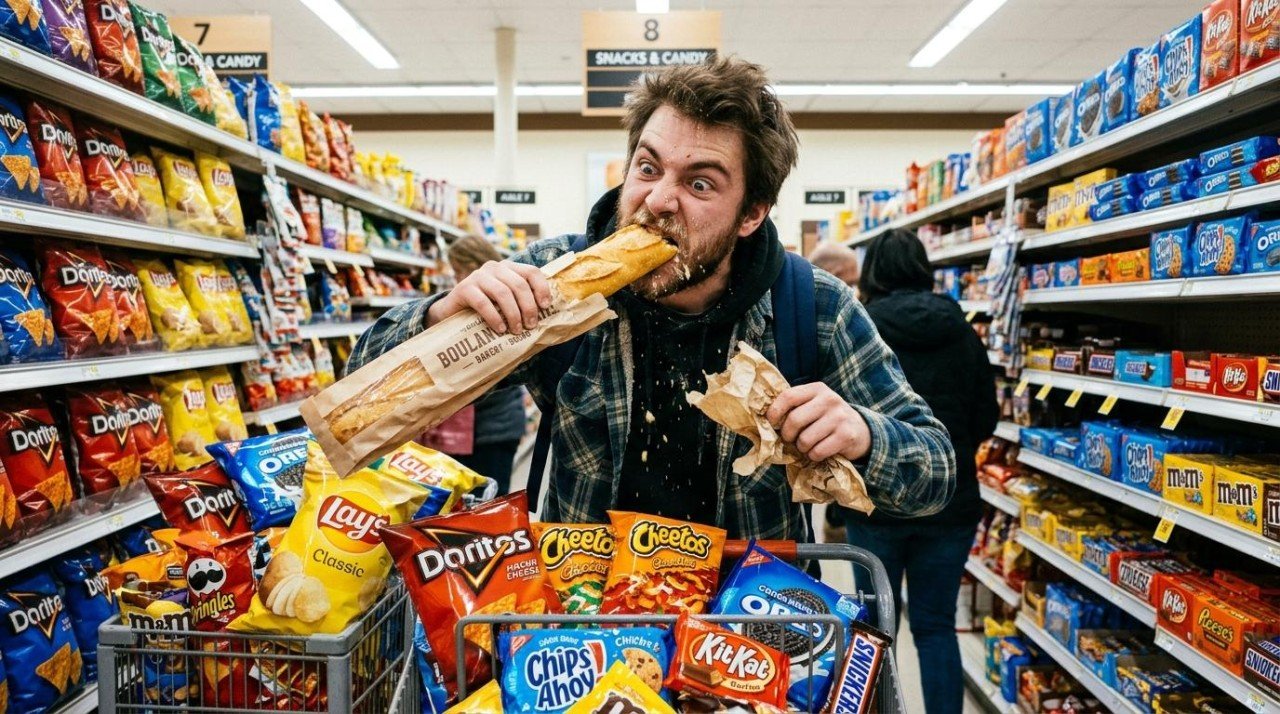
You went in for milk, eggs, and maybe some bananas. Twenty minutes later you are unloading a family-size bag of chips, two candy bars you grabbed at the register, a discounted item you did not know you needed, and a bulk pack of something because the sign said "10 for $10." The receipt is $40 longer than the list in your head.
This is not a personal failure of willpower. Grocery stores are some of the most carefully engineered retail spaces on earth, and a lot of research and money goes into nudging the average cart a little fuller. The good news is that once you understand the handful of tricks at work, they lose most of their power. Here is what the evidence actually shows about how stores shape your shopping — and the small habits that quietly hand control back to you.
Shopping Hungry Really Does Cost You
The oldest piece of grocery advice — never shop on an empty stomach — turns out to be backed by solid science, and the effect is stranger than you would guess.
In a set of studies published in the Proceedings of the National Academy of Sciences by Alison Jing Xu, Norbert Schwarz, and Robert Wyer, hunger did not just make people buy more food. It made them buy more of everything. In one experiment, researchers stopped 81 shoppers on their way out of a department store and matched their receipts to how hungry they felt. Hungrier shoppers had spent about 64 percent more — and much of that extra spending was on non-food items.
To test whether hunger was really the cause, the team ran a controlled version with office supplies. Participants who had not eaten took home about 50 percent more binder clips than those who had just eaten cake — free binder clips, with no food anywhere in sight. As Schwarz put it, the desire to get food seems to "plant the idea of getting stuff in your mind" more broadly. When you are hungry, the internal message "I want food" quietly becomes just "I want." Your brain generalizes the craving, and the shelves are happy to oblige.
The takeaway is refreshingly simple: eat something before you shop. A real meal is ideal, but even a piece of fruit or a handful of nuts in the car is enough to take the edge off the acquisitive mindset that empties your wallet.
The Store Is Designed to Slow You Down
Once you are inside, the layout starts working on you. None of it is random. As explained in this North Dakota State University Extension guide to supermarket psychology, most of the staples you came for — milk, eggs, bread — are pushed to the back and far corners of the store. That is deliberate. To grab a gallon of milk, you have to walk past hundreds of other products, and every aisle you pass is another chance to add something unplanned.
A few other tactics you have almost certainly walked past without noticing:
- Eye level is buy level. The most profitable and heavily marketed brands get the shelves right at adult eye level, where they are easiest to reach for without thinking. Sugary cereals with cartoon mascots, meanwhile, tend to sit lower — right at a child's eye level, about two feet off the floor, where they can do their pestering work.
- Endcaps feel like deals. Those displays at the end of each aisle are prime real estate, and we are wired to assume anything featured there is on sale. Often it is not — the endcap simply gets more eyeballs, and products there can sell many times faster than the same item mid-aisle.
- The checkout gauntlet. Candy, gum, chips, and soda cluster at the register for a reason: after a full trip your decision-making is worn down, and small "why not" purchases feel harmless in the moment.
- Fresh produce up front. Many stores greet you with a wall of vibrant fruits and vegetables. It is a genuinely nice thing to see first — and it also puts you in a warm, abundant, spending-friendly mood before you have picked up a single item.
Even the soundtrack is doing a job. In a classic 1982 study published in the Journal of Marketing, researcher Ronald Milliman played different music in a supermarket on different days and tracked how people shopped. As summarized by Psychologist World, slow-tempo music made shoppers move more slowly through the store, lingering over the shelves, and the store's daily sales rose meaningfully compared with fast-tempo days. Faster music sped people up and out — and they bought less. The pace of the room you are standing in is quietly setting the pace of your cart.
The Anchoring Trick: Why "Limit 12" Makes You Buy More
One of the most reliable tricks stores use is not about layout at all — it is about numbers. Our brains latch onto any figure that is put in front of us and use it as a reference point, even when the number is arbitrary. Marketers call this anchoring, and grocery promotions exploit it constantly.
The definitive demonstration comes from a 1998 field study by Brian Wansink, Robert Kent, and Stephen Hoch. As documented in their research, the team set up an end-aisle display of Campbell's soup at 79 cents a can. When there was no purchase limit, shoppers bought an average of 3.3 cans. When the sign read "Limit 12 per person," average purchases jumped to 7 cans — a 112 percent increase. Nobody actually needed 12 cans of soup. But the number 12 became the anchor, and people adjusted down from it rather than up from their real need of one or two.
The same psychology powers the "10 for $10" sign. At most stores you can buy a single item and still pay one dollar — you are not required to buy ten. But the number ten is the anchor, and it nudges you toward the basket-filling behavior the sign was designed to produce. Multi-buy deals like "buy two, get one free" work the same way: they can be a genuine saving if it is something you use often and will not spoil, but they routinely tip people into buying more than they wanted of things that end up wasted.
The Honest Part: How Much Is Really the Store?
It would be easy to end here with the impression that supermarkets are all-powerful and you are helpless in their grip. The research does not actually support that, and it is worth being clear-eyed about it.
You will often see the claim that impulse buys make up 60 to 70 percent of grocery purchases. When Wharton marketing professor David Bell and colleagues looked closely — tracking roughly 2,945 shoppers making about 18,000 purchases — they found the real figure for unplanned buying was closer to 20 percent of transactions. On slightly more than 60 percent of shopping trips, people did no unplanned buying at all. And when impulse purchases did happen, the biggest predictor was not the store environment — it was the shopper. Self-described "fast and efficient" shoppers were 82 percent less likely to buy on impulse.
That is genuinely good news. It means the store's tricks are real but beatable, and the single most powerful variable is something you control: whether you walk in with a plan. The shoppers who resist temptation are not superhuman. They just tend to know what they came for.
How to Outsmart the Store
You do not need to treat grocery shopping like a battle. A few small habits neutralize most of the psychology described above:
- Eat first. The easiest win there is. Do not shop hungry, tired, or stressed — all three make "I want" louder.
- Bring a list and stick to it. A list is a pre-commitment you make in a calm moment, before the music and the endcaps get a vote. Research on shopping behavior consistently finds that impulse purchases spike late in a trip, especially for shoppers without a list to anchor them. The list is your anchor instead of the store's.
- Check the unit price, not the sticker price. That small print on the shelf tag — price per ounce, per pound, or per 100 count — is the only honest way to compare across package sizes and cut through "bigger looks cheaper" packaging. It is usually tucked in a corner of the label in tiny type. Learning to read unit-price labels is one of the highest-return five-second habits in the store.
- Be skeptical of multi-buy math. Before you grab ten of something, ask whether you would have bought that many at the regular price. If the answer is no, the deal is manufacturing demand, not saving you money — especially for perishables that will rot before you finish them.
- Shop the perimeter — with nuance. The outer ring of most stores holds the fresh produce, dairy, and proteins, so circling it is a decent default for building meals around whole foods. Just do not take it as gospel: plenty of nutritious staples like dried beans, oats, canned tomatoes, frozen vegetables, and nuts live in the center aisles. The goal is more real food, not a rigid rule about which lap to walk.
The thread running through all of these is the same: decisions made before you arrive beat decisions made in the aisle, every time. A plan turns the store's cleverness into background noise.
Take the Guesswork Out of Eating Well
Eat Well Planner helps you organize your favorite recipes, plan balanced meals, and automatically generate shopping lists — all in one place. Whether you're tracking macros, managing dietary restrictions, or just trying to stop asking "what's for dinner?", we've got you covered.
Our AI-powered tools can adapt any recipe to your dietary needs, help you discover new meals you'll love, and even log your nutrition effortlessly. It's meal planning made simple.
Start Organizing Your Meals — FreeWhere a Meal Plan Quietly Does the Work
This is exactly the problem Eat Well Planner is built to solve — not by adding another thing to your to-do list, but by removing the decision fatigue that leaves you improvising in the aisle. When you build a weekly meal plan from recipes you actually want to eat, the app automatically generates an organized shopping list of only the ingredients you need. You walk in with a plan already made in a calm moment at home, which is precisely the condition the research says protects you from impulse buying.
A ready-made list does a few things at once. It keeps you focused on real ingredients for meals you have decided on, so the endcaps and checkout candy have far less to grab onto. It cuts food waste, because you are buying to a plan instead of guessing and over-buying. And because the meals are already chosen and the ingredients already accounted for, reaching for ultra-processed convenience food stops being the path of least resistance — the easy option is now the one you planned.
If temptation in the store is still your weak point, there is one more tool the evidence strongly supports: order online. A Cornell study of nearly 2 million shopping trips, published in Marketing Science, found that online grocery baskets contained up to 7 percent fewer impulse purchases like candy, baked goods, and chips than in-store carts. You cannot be ambushed by an endcap you never walk past. The one catch the same study flagged: online shoppers also bought about 13 percent fewer fresh vegetables, likely because produce is harder to browse on a screen. The fix is easy — plan your produce deliberately (a good meal plan already does this for you) so the healthy stuff does not quietly fall out of the cart.
The Bottom Line
Supermarkets are designed to sell, and the tactics are real: hunger loosens your grip, the layout keeps you walking, the music slows you down, and clever numbers nudge you to buy more than you need. But none of it is destiny. The research is clear that the biggest factor in whether you leave with a cart full of unplanned purchases is not the store — it is you, and whether you showed up with a plan.
Eat something first. Bring a list. Check the unit price. Question the too-good deal. Do those four things and the whole psychological apparatus of the modern grocery store mostly deflates. You get to keep your money, your fridge fills up with food you will actually eat, and the trip gets faster and calmer in the bargain.
Try planning your week with Eat Well Planner and let an auto-generated shopping list do the hard part of staying focused for you.