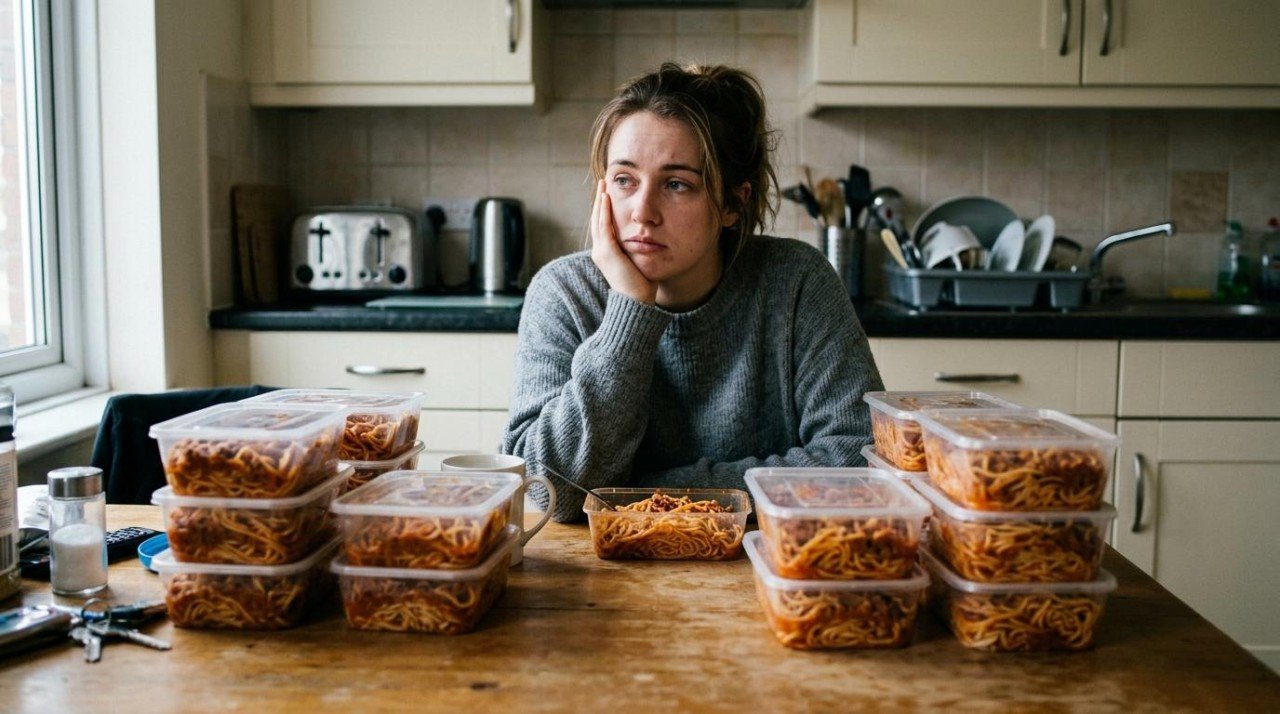
Cooking for one has a strange reputation. On paper it should be the easiest kind of cooking there is — one set of tastes to please, one appetite to fill, no negotiating over what's for dinner. In practice, a lot of people who live alone find it the most discouraging. You buy a bunch of cilantro for one recipe and watch the other 90% liquefy in the crisper drawer. You cook a "quick weeknight dinner" that turns out to serve four, so you eat the same thing until you can't look at it anymore. Half a loaf goes stale, half a can of coconut milk grows fuzz, and eventually the math starts to feel obvious: why bother, when a takeout order is right there and nothing gets thrown away?
You are very much not alone in this, statistically speaking. According to the U.S. Census Bureau, 27.6% of American households — more than one in four — consisted of a single person in 2020, up from just 7.7% in 1940. That's tens of millions of people standing in kitchens designed, stocked, and sold to as if a family of four were about to sit down. Almost every recipe assumes four servings. Almost every package — the family-size chicken, the two-pound bag of carrots, the loaf of bread — assumes there are mouths to help you finish it. Cooking for one isn't hard because you lack willpower. It's hard because the entire food system is built for somebody else.
The good news is that once you understand why it's wasteful, the fixes are surprisingly mechanical. You don't need more discipline. You need a handful of strategies that make a single-person kitchen work the way it's supposed to.
Why cooking for one wastes more food (and money)
This isn't just a feeling. Smaller households genuinely waste more food per person than larger ones. A widely cited study from Penn State researchers, published in the American Journal of Agricultural Economics, found that the average American household wastes 31.9% of the food it acquires — nearly a third — at an estimated cost of about $1,866 per household every year. And when the researchers looked at household size, the pattern was clear: bigger households waste less per person, because they have more "meal-management options." As the study's authors put it, a household of two might not finish a whole head of cauliflower, whereas a larger household is more likely to eat all of it, maybe in a single meal.
Scale that logic down to one person and the problem sharpens. You're the entire household. Every perishable you buy has exactly one person to eat it before it turns, and every recipe that "makes four" is quietly asking you to either eat four portions or waste three. That structural mismatch is where the money leaks out — not through any personal failing, but through packaging and portioning that were never designed with you in mind.
It also explains the takeout pull. When cooking reliably produces waste and monotony, ordering in starts to look not just easier but genuinely less wasteful, since the restaurant absorbs the leftover-ingredient problem. The trouble is that leaning on takeout and convenience food tends to crowd out the fresh, whole ingredients that make a diet nourishing — and it adds up fast. The way out isn't to shame yourself into cooking more. It's to make cooking for one stop being wasteful in the first place.
Shop like a household of one
Most single-cook waste is decided at the store, before you've cooked anything. The fix is to stop buying in family units and start buying in the amounts you'll actually use.
- Raid the bulk bins. Bulk bins are the single-person cook's best friend, because they let you buy exactly the quantity you need — two tablespoons of walnuts, a third of a cup of arborio rice, a single handful of dried apricots — instead of a bag sized for a dinner party. The same goes for the salad bar and the "loose" produce section: buy one onion, three mushrooms, a single sweet potato, rather than the pre-bagged multipacks.
- Learn to love the frozen aisle. Frozen vegetables and fruit are arguably the best invention for people cooking solo. They don't rot, you use only what you need and reseal the bag, and — contrary to the assumption that frozen is a nutritional downgrade — they hold up remarkably well. A review of the research summarized by Healthline found that frozen produce is nutritionally comparable to fresh, and in some cases even higher in certain vitamins, because it's frozen at peak ripeness while "fresh" produce can lose nutrients during days of shipping and storage. For one person, a bag of frozen spinach or mixed berries that you dip into over three weeks beats a fresh bunch that guilt-trips you from the fridge for four days and then dies.
- Choose ingredients that pull double (and triple) duty. The enemy of the solo cook is the single-purpose ingredient — the jar of a spice you'll use once, the specialty item a recipe demands and nothing else wants. Instead, weight your cart toward versatile staples: eggs, canned beans, canned tomatoes, rice, oats, a bag of frozen mixed vegetables, a block of cheese, a versatile protein like chicken thighs. Then plan so one purchase spans several meals. Buy a bunch of spinach and it can go into eggs one morning, get wilted alongside pasta another night, and finish in a smoothie before it turns.
- Keep a deep, forgiving pantry. Shelf-stable staples don't spoil, so they carry no waste risk. A pantry stocked with canned beans, tuna, tomatoes, broth, pasta, rice, and oats means you can always assemble a real meal without an emergency store run — which is usually the moment takeout wins.
Cook once, eat several times — on purpose
The instinct when you live alone is to cook small: one chicken breast, one cup of rice, a single serving of vegetables. It feels efficient, but it means you're back at the stove every single night, and the effort-to-reward ratio is exactly what makes people give up and order in.
The better move is to flip it. Batch cooking for one doesn't mean eating the same dinner seven nights running — it means cooking components in quantity and combining them differently through the week. Roast a whole tray of vegetables and they become a side tonight, a grain-bowl base tomorrow, and an omelet filling the day after. Cook a big pot of rice or a batch of lentils and portion it out. Make a full pot of soup or chili and freeze most of it in single servings. You've done the work once and bought yourself several nights off.
The freezer is what makes this safe and stress-free, and it's more forgiving than most people realize. According to the USDA's Food Safety and Inspection Service, food kept frozen at 0°F (-18°C) stays safe to eat essentially indefinitely — the storage-time limits you see quoted are about quality, not safety. Freezing doesn't stop flavor and texture from slowly degrading, so there's a practical window, but nothing becomes dangerous just because it sat a while. For cooked leftovers specifically, food-safety guidance from the USDA (via the University of Nebraska–Lincoln) recommends eating them within 3 to 4 days if refrigerated, or freezing them for 2 to 6 months for best quality.
A few habits make freezer batching genuinely painless:
- Portion before you freeze. Freeze in single servings, not one giant brick, so you can pull out exactly one dinner. Muffin tins are great for freezing individual portions of soup or sauce; ice cube trays work for things like tomato paste, pesto, or leftover broth you'd otherwise waste.
- Leave headroom. Liquids expand as they freeze, so leave a little space at the top of each container.
- Label everything. Contents and date, always. A freezer full of anonymous frozen bricks is a freezer you'll never dig into. A freezer of labeled single portions is a personal ready-meal aisle you actually made.
Done consistently, this turns your freezer into a rotating stash of homemade "convenience" dinners — the thing that competes directly with takeout on the nights you're too tired to cook.
Let the planning do the heavy lifting
Everything above — scaling recipes down, planning ingredients so nothing gets stranded, deciding what to batch and freeze — is really one skill: planning. And planning is exactly the part that's tedious to do in your head every week, which is why it so often doesn't happen. This is where having a tool built for it changes the equation.
Eat Well Planner is a free app designed to take that mental load off your plate. You can save recipes you like — imported from any website, Instagram reel, or YouTube video — and then have it build a weekly meal plan that fits a single-person kitchen: recipes scaled to one serving, with intentional planned-leftovers built in so a batch you cook on Sunday is already spoken for later in the week instead of rotting or repeating on you. From that plan it generates an organized shopping list with just the quantities you need, which is the single most effective guard against the family-size overbuying that drives solo food waste. And if a recipe still makes too much, the built-in AI recipe chat can scale it down or suggest a swap for an ingredient you won't otherwise finish. The whole point is to make the "cook fresh at home" option the path of least resistance, so reaching for takeout stops being the easy default.
Take the Guesswork Out of Eating Well
Eat Well Planner helps you organize your favorite recipes, plan balanced meals, and automatically generate shopping lists — all in one place. Whether you're tracking macros, managing dietary restrictions, or just trying to stop asking "what's for dinner?", we've got you covered.
Our AI-powered tools can adapt any recipe to your dietary needs, help you discover new meals you'll love, and even log your nutrition effortlessly. It's meal planning made simple.
Start Organizing Your Meals — FreeEmbrace the assembly meal
Not every meal needs to be cooked, and cooking for one is the perfect place to let go of the idea that dinner has to be a Recipe with a capital R. Some of the most sustainable solo eating comes from assembly meals: no cooking, or barely any, just thoughtfully combining good ingredients you already have.
Think of a "snack plate" dinner — cheese, whole-grain crackers, olives, cherry tomatoes, a hard-boiled egg, a handful of nuts, some fruit. Or a can of good tuna over greens with a squeeze of lemon and a drizzle of olive oil. Or Greek yogurt with berries, oats, and honey. These meals have real virtues for one person: they use up odds and ends before they turn, they require almost no cleanup, and they lean on exactly the versatile, shelf-stable staples that don't go to waste. Giving yourself explicit permission to eat this way on low-energy nights is often what keeps you out of the takeout app.
Build a rotation of forgiving recipes
Finally, it helps to have a small stable of go-to meals that are naturally friendly to cooking for one — the kind that are easy to scale, hard to mess up, and happy to absorb whatever needs using up. A few reliable formats:
- Eggs, any which way. A frittata, omelet, or simple scramble is the ultimate use-it-up meal — it welcomes whatever half-onion, wilting greens, or leftover roasted vegetables are hanging around, cooks in minutes, and scales effortlessly to one.
- Grain bowls. A base of rice, quinoa, or lentils you batch-cooked earlier, plus a protein, plus vegetables (fresh or frozen), plus a sauce. Infinitely variable, so it never gets boring, and built for leftovers by design.
- Stir-fries. Fast, forgiving, and a natural home for frozen mixed vegetables and small amounts of protein. Cook one portion in a single pan in under fifteen minutes.
- Soups and chili. Almost impossible to make in a genuinely small quantity, which is exactly why they're perfect: make a big pot, eat one bowl, freeze the rest in single servings for future you.
- Sheet-pan dinners. A protein and some vegetables roasted together on one tray. Easy to scale to a single portion, and close to zero cleanup.
- Pasta with a freezer-friendly sauce. Cook one serving of pasta; pull one portion of sauce from the batch you froze in a muffin tin. Ten minutes, no waste.
Notice what these have in common: they flex around whatever you have, they scale down cleanly, and several of them lean on batching and the freezer. That's the whole philosophy of cooking well for one, distilled — build meals that forgive a single-person kitchen instead of fighting it.
The takeaway
Cooking for one feels wasteful because the food system is genuinely stacked against solo cooks — the recipes, the packaging, and the portions all assume a bigger table. But the problem is structural, not personal, and structural problems have practical fixes. Shop in the amounts you'll actually use, lean on the freezer aisle and the bulk bins, cook components once and eat them several ways, keep the freezer stocked with single-serving meals you made yourself, and give yourself permission to assemble a dinner instead of cooking one. Do that, and eating well for one stops being the hard, wasteful option and becomes the easy, satisfying default — no takeout guilt, no crisper-drawer graveyard, and a lot less money in the trash.