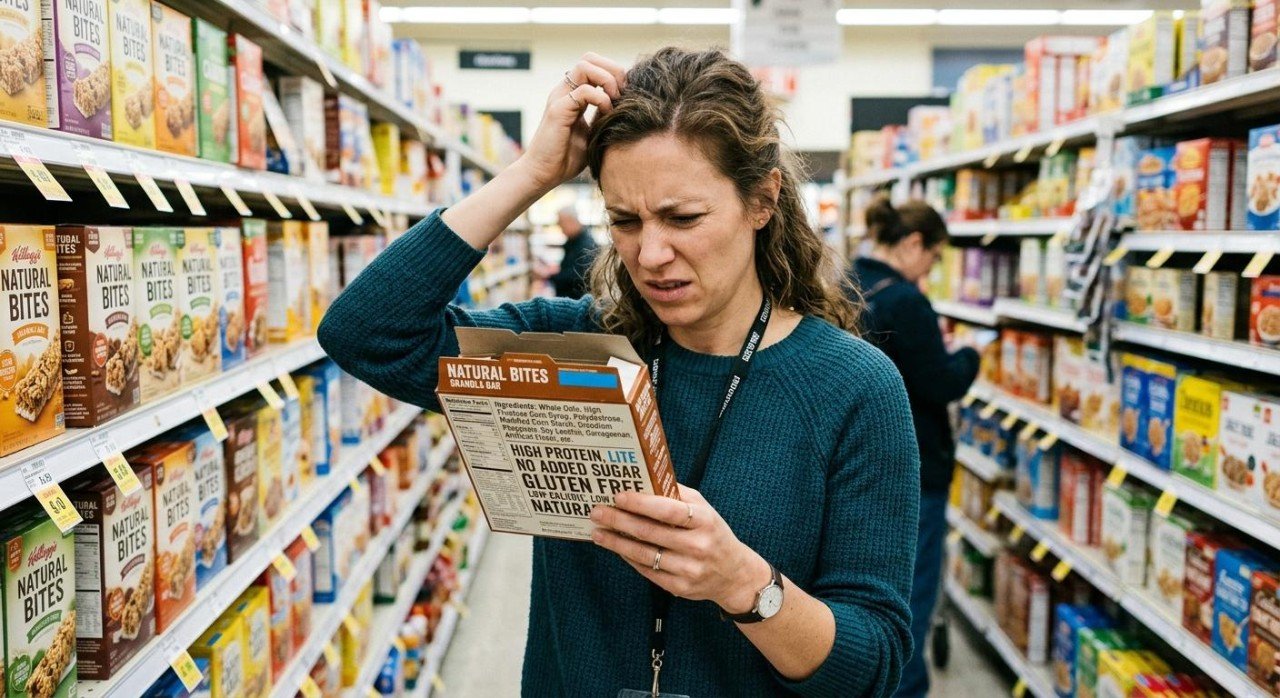
You pick up a box of cereal. The front says "wholegrain," "high protein," and "no artificial colors." It looks like a healthy choice. Then you flip it over, scan the ingredient list, and find sugar listed three times under three different names, a dozen additives you can't pronounce, and a serving size so small it bears no resemblance to what you'd actually pour into a bowl.
Food labels are required by law. They're supposed to help you make informed choices. But the gap between what labels technically disclose and what most shoppers actually understand is enormous — and food manufacturers know exactly how to exploit it. This isn't about conspiracy. It's about marketing departments working within the rules to make products look as appealing as possible, while the information that would change your mind gets buried in fine print.
Here's how to read past the marketing and see what's really in your food.
The Nutrition Facts Panel: What to Actually Focus On
The nutrition panel is the most regulated part of any food label, and it's where the most useful information lives. But most people either skip it entirely or fixate on the wrong numbers.
Here's what deserves your attention:
- Calories — useful as a rough guide, but only in context. A 200-calorie handful of nuts is not the same as a 200-calorie packet of sweets. The source matters more than the number.
- Saturated fat — consistently linked to cardiovascular risk when consumed in excess. This is more informative than total fat, since unsaturated fats from nuts, olive oil, and oily fish are actively beneficial.
- Added sugars — the updated Nutrition Facts label in the US now distinguishes added sugars from naturally occurring ones. This is one of the most useful numbers on the entire panel. The recommended daily limit is about 25g (6 teaspoons) for women and 38g (9 teaspoons) for men, according to the American Heart Association.
- Sodium — easy to overconsume from packaged foods, even ones that don't taste particularly salty. A single ready meal can contain half your daily recommended intake.
- Fiber — one of the few numbers where higher is almost always better. Most people fall well short of the recommended 25-30g per day.
What you can mostly ignore: total fat (the type matters more than the total), total carbohydrates on their own (fiber and added sugars tell you more), and percentage daily values for vitamins unless you're tracking a specific deficiency.
The Serving Size Trick
Every number on the nutrition panel is tied to the serving size — and that serving size may have very little to do with how much you actually eat.
The US Food and Drug Administration updated its serving size regulations to better reflect actual consumption patterns, since the previous standards were based on dietary surveys from the late 1970s and 1980s. Under the new rules, ice cream servings went from half a cup to two-thirds of a cup, and soda servings went from 8 ounces to 12. But many packaged foods still use serving sizes that are smaller than what most people eat in one sitting.
A bag of chips labelled as containing "2.5 servings" is a single bag that most people eat in one go. A muffin sold as a single item might list its nutrition for half a muffin. A bottle of juice that looks like one drink might technically be two servings. The calorie, sugar, and sodium numbers suddenly double when you account for how much you actually consume.
The fix is simple but requires a habit: always check the serving size first, then mentally adjust. If a cereal lists 150 calories per 30g serving and you pour 60g into your bowl, you're eating 300 calories. Products that are "reasonably consumed at one eating occasion" — a single bottle, a single bag — now have to show nutrition for the entire container, but not all products fall into that category.
The Ingredient List: Your Most Honest Source of Truth
If the nutrition panel tells you what's in the food numerically, the ingredient list tells you what the food actually is. Ingredients are listed in descending order by weight — the first ingredient is the one there's the most of, and the last is the least.
This ordering is more revealing than most people realize. If "sugar" or one of its aliases appears in the first three ingredients, that product is substantially sugar. If "whole wheat flour" is the first ingredient but "enriched wheat flour" (which is refined white flour) is the second, the product may be more refined than it appears. If the list starts with a real food — chicken, oats, tomatoes — and stays short, you're generally in good territory.
A useful rule of thumb: if the ingredient list is short enough to read in a few seconds and contains words you'd find in a kitchen, it's probably a reasonable choice. If it runs to 30+ items and includes things like diacetyl tartaric acid esters of mono- and diglycerides, you're looking at a heavily processed product — regardless of what the front of the pack claims.
The Sugar Shell Game
Sugar is where food labelling gets genuinely deceptive. Not because manufacturers are breaking the law, but because the rules allow them to scatter sugar across the ingredient list under different names — making it harder to spot how much is really in the product.
According to researchers at the University of California, San Francisco, there are at least 61 different names for sugar used on food labels. Some are obvious — honey, molasses, corn syrup. Others are less so: maltodextrin, dextrose, barley malt, rice syrup, evaporated cane juice, turbinado, muscovado, ethyl maltol. The CDC notes that any ingredient ending in "-ose" (glucose, fructose, maltose, sucrose, dextrose, lactose) is a sugar.
Here's why this matters in practice: ingredients are listed by weight, so if a manufacturer uses three different types of sugar — say, cane sugar, corn syrup, and dextrose — each one appears further down the list than if the total sugar were listed as a single ingredient. Sugar that would otherwise be the first ingredient gets split into three entries that each look minor.
The result is that added sugar appears in roughly 74% of packaged foods in supermarkets — including many products you wouldn't think of as sweet. The CDC's list of surprising sources includes ketchup, jarred pasta sauce, barbecue sauce, salad dressings, flavored yogurt, granola, instant oatmeal, and bread. A George Institute for Global Health study found that two-thirds of all packaged supermarket foods contain added sugars, and that switching to lower-sugar alternatives in just a few product categories — yogurt, granola, sauces — could eliminate kilograms of added sugar from a person's annual intake.
Health Claims That Sound Better Than They Are
The front of a food package is a billboard. The back is the fine print. Most shoppers spend far more time looking at the front, which is exactly why manufacturers invest heavily in claims that sound healthy without necessarily being meaningful.
"Natural"
This is perhaps the most misleading word in food marketing. In the US, the FDA has no formal definition or regulation for "natural" on food labels. The agency's informal policy is that it won't object to the term as long as a food contains no added color, artificial flavors, or synthetic substances — but this is a loose guideline, not a binding rule. A product labelled "natural" can still contain highly processed ingredients like high-fructose corn syrup, as long as those ingredients are technically derived from natural sources. The USDA does regulate "natural" on meat and poultry (requiring no artificial ingredients and minimal processing), but for everything else, the term is essentially marketing language.
"Light" or "Lite"
This one is actually regulated. Under FDA rules, a "light" product must have either 50% less fat or one-third fewer calories than the reference version of that food. That sounds straightforward, but in practice the reference food matters enormously. If the original product is extremely high in fat, the "light" version may still contain a substantial amount. And manufacturers sometimes compensate for reduced fat by adding more sugar or sodium to maintain flavor — so the "light" version may not actually be healthier overall. Always check the nutrition panel rather than trusting the claim.
"High Protein"
Under FDA regulations, a product can be labelled "high in protein" if it contains 20% or more of the daily value per serving — which works out to at least 10g of protein per serving based on a 50g daily value. A "good source of protein" requires 10-19% of the daily value, or roughly 5-10g per serving.
The issue isn't the protein content itself — it's what comes along with it. A "high protein" cereal bar might deliver 10g of protein alongside 15g of added sugar and a list of emulsifiers and flavorings. The protein claim draws your eye away from everything else. If you're looking for protein, check what the protein comes from (whole foods like nuts and seeds versus protein isolates and additives) and what else is in the product.
"Wholegrain" or "Made with Whole Grains"
This is one of the more confusing label claims because there's no mandated minimum percentage of whole grain required in the US. A product can say "made with whole grains" while containing mostly refined flour. Research published in Public Health Nutrition found that 43-51% of consumers overstated the whole grain content when looking at products labelled with whole grain claims but actually composed primarily of refined grains. The researchers concluded that "the frequency of consumer misunderstanding of grain product labels was high."
The ingredient list is your best check: if "whole wheat flour" or "whole oats" is the first ingredient, the product is genuinely wholegrain-forward. If the first ingredient is "enriched wheat flour" and a whole grain appears further down the list, the wholegrain content is likely minimal.
"Healthy"
The FDA finalised an updated definition of "healthy" in December 2024, replacing outdated 1990s criteria. Under the new rule (compliance required by February 2028), a food must contain a meaningful amount from at least one food group recommended by the Dietary Guidelines for Americans — fruits, vegetables, whole grains, dairy, or protein foods — and stay below specified limits for added sugars, saturated fat, and sodium. It's a significant improvement, but the claim remains voluntary: manufacturers choose whether to use it, meaning plenty of genuinely healthy foods won't carry the label while some borderline products might.
Traffic Light Labels: The At-a-Glance Shortcut
If you shop in the UK, you've likely seen the color-coded traffic light labels on the front of packages. Recommended by the UK Food Standards Agency, this voluntary system uses red, amber, and green to show at a glance whether a product is high, medium, or low in four key nutrients: fat, saturated fat, sugars, and salt.
The thresholds per 100g are:
- Fat: green (low) is 3g or less, amber (medium) is 3.1-17.5g, red (high) is more than 17.5g
- Saturated fat: green is 1.5g or less, amber is 1.6-5g, red is more than 5g
- Sugars: green is 5g or less, amber is 5.1-22.5g, red is more than 22.5g
- Salt: green is 0.3g or less, amber is 0.31-1.5g, red is more than 1.5g
The system isn't perfect — it doesn't account for ingredient quality, processing methods, or beneficial nutrients — but it's a genuinely useful quick filter. A product with multiple reds deserves a closer look at the full nutrition panel and ingredient list before it goes in your trolley. The more greens, the better the nutritional profile at a glance.
In the US, the FDA has proposed its own front-of-package nutrition labelling system that would flag levels of saturated fat, sodium, and added sugars, though the final format and timeline are still being determined.
How to Spot Ultra-Processed Foods From the Label
Ultra-processed foods — classified as Group 4 under the NOVA food classification system — are products made primarily from industrial formulations of extracted substances and additives, with little or no intact food. Think soft drinks, packaged snacks, instant noodles, reconstituted meat products, and most ready meals.
You don't need to memorise the NOVA system to spot them. Just scan the ingredient list for these red flags:
- Ingredients you wouldn't find in a home kitchen — high-fructose corn syrup, hydrogenated oils, protein isolates (soy protein isolate, whey protein concentrate), maltodextrin, invert sugar, modified starch
- Cosmetic additives — emulsifiers (mono- and diglycerides, carrageenan, soy lecithin), flavor enhancers (monosodium glutamate), artificial colors (Red 40, Yellow 5, caramel color), thickeners, anti-foaming agents, and glazing agents
- A long ingredient list — ultra-processed products typically have 10 or more ingredients, many of which serve a manufacturing function rather than a nutritional one
- Multiple forms of sugar or fat — if a product contains three different sweeteners and two different oils, it was engineered in a lab, not prepared in a kitchen
The tricky part is that ultra-processed foods often carry health claims on the front of the pack. A breakfast cereal can be "wholegrain" and "fortified with vitamins" while still being ultra-processed due to its long list of added sugars, flavorings, and emulsifiers. The health claim isn't a lie — but it's not the full story either.
The most reliable way to reduce ultra-processed food in your diet is to cook more meals from scratch using whole ingredients. That doesn't mean spending hours in the kitchen — it means having a plan and the right recipes on hand. Tools like Eat Well Planner make this more practical by letting you save recipes from anywhere, generate meal plans around whole foods, and create shopping lists automatically — so the default is a home-cooked meal rather than whatever's fastest in the freezer aisle.
Take the Guesswork Out of Eating Well
Eat Well Planner helps you organize your favorite recipes, plan balanced meals, and automatically generate shopping lists — all in one place. Whether you're tracking macros, managing dietary restrictions, or just trying to stop asking "what's for dinner?", we've got you covered.
Our AI-powered tools can adapt any recipe to your dietary needs, help you discover new meals you'll love, and even log your nutrition effortlessly. It's meal planning made simple.
Start Organizing Your Meals — FreeYour Quick-Reference Cheat Sheet
When you're standing in a supermarket aisle with thirty seconds to decide, here's what to check:
- Flip the package over. Ignore the front — it's advertising.
- Check the ingredient list first. Short list, recognisable ingredients, real food at the top = good sign. Long list, multiple sugars, words ending in "-ose," unpronounceable additives = ultra-processed.
- Look at the serving size. Is it realistic? If not, mentally multiply the nutrition numbers to match what you'd actually eat.
- Check added sugars. Aim for products with low or zero added sugars, especially in items that shouldn't need sweetening (bread, pasta sauce, yogurt).
- Scan for sodium. Anything above 600mg per serving is high. Processed and packaged foods are where most excess sodium hides.
- Use traffic lights if available. Multiple reds = proceed with caution. Multiple greens = generally a reasonable choice.
- Be sceptical of front-of-pack claims. "Natural" means almost nothing. "Wholegrain" might mean 5% whole grain. "Light" might be compensated with extra sugar. The ingredient list and nutrition panel tell you what the marketing won't.
The Bigger Picture
Learning to decode food labels is a genuinely useful skill — it helps you make better choices for everyday packaged items like bread, yogurt, sauces, and snacks. But there's an even simpler approach that sidesteps the entire labelling game: eat more foods that don't need a label at all.
Fresh vegetables, fruits, whole grains, eggs, fish, meat, legumes, nuts, and seeds don't come with ingredient lists because they are the ingredient. The more of your diet that comes from these whole foods, the less time you need to spend parsing labels and the less room there is for ultra-processed products to sneak in.
The challenge, as always, is the planning. Knowing you should eat more whole foods is easy. Actually having the right ingredients in the fridge on a Tuesday evening when you're tired and hungry is the hard part. That's where having a system helps — whether it's a weekly meal plan, a reliable shopping list, or a collection of quick recipes you can turn to without thinking. Eat Well Planner is built around exactly this idea: it handles the meal planning, recipe organisation, and shopping lists so that cooking with real ingredients becomes the path of least resistance rather than the ambitious option you never quite get around to.
The best food label is no food label. But when you do need to read one, now you know where to look — and what to ignore.