It is 5 p.m. The day has chewed you up, you are standing in front of an open fridge, and the most exhausting question of the entire day is waiting for you: what's for dinner? You have ingredients. You have recipes saved somewhere. You are perfectly capable of cooking. And yet the decision itself feels like lifting something heavy. So you close the fridge, order takeout again, or default to the same beige pasta you have made nine times this month.
If that scene feels familiar, the problem is almost never that you do not know how to cook or do not care about eating well. The problem is the decision — and there is a beautifully simple, decades-old kitchen trick that shrinks it down to almost nothing without turning your week into bland repetition. It is called theme nights, and once you set it up, the nightly "what's for dinner?" interrogation mostly goes away.
Why deciding what to eat is so draining
Choosing dinner from scratch every single night is harder than it looks, because it is not one decision — it is a cascade of them. What protein? What cuisine? Do we have the ingredients? Is it quick enough? Will the kids eat it? Did we have something similar yesterday? Each little sub-question costs a sliver of mental energy, and you are spending that energy at the exact moment of day when you have the least of it left.
Psychologists have a name for the mental wear of making choice after choice: decision fatigue. As the decisions pile up across a day, people tend to make worse choices, lean on whatever the easy default is, or avoid deciding altogether. At dinnertime, the easy default is rarely the roasted vegetables and salmon — it is the drive-through, the delivery app, or the cereal bowl.
There is also a well-documented quirk in how humans handle too many options. In a now-classic study, researchers Sheena Iyengar and Mark Lepper set up a tasting booth in a grocery store. When shoppers were offered 24 different jams, only 3% bought a jar; when the display was trimmed to 6 jams, 40% bought one — roughly ten times as many. More choice looked more appealing, but it actually made people freeze. Your fridge is the 24-jam display. A theme is the 6-jam display. Narrowing the field is not a limitation; it is what makes a decision feel doable.
What theme nights actually are
The idea is almost embarrassingly simple: instead of choosing a meal from the infinite universe of possible dinners, you assign each night of the week a loose category. Not a fixed recipe — a theme. For example:
- Monday — Meatless / big-veggie night
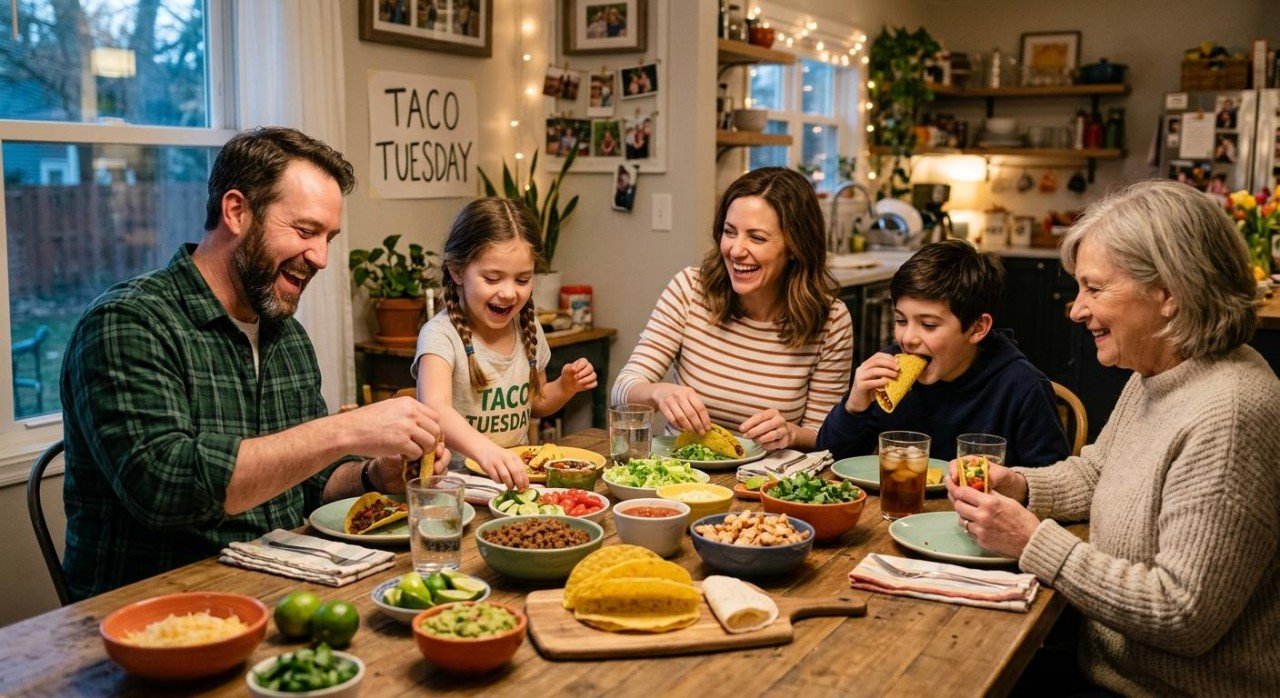
- Tuesday — Taco night (yes, the famous one)
- Wednesday — Stir-fry night
- Thursday — Pasta or grain-bowl night
- Friday — Sheet-pan night
- Saturday — Soup-and-bread night
- Sunday — Roast or "cook something a little bigger" night
The magic is that the theme answers the hardest part of the question for you. On Wednesday, you are not asking "what should I make?" — you already know it is a stir-fry. All that is left is the small, fun decision of which stir-fry: chicken and broccoli this week, shrimp and snap peas next, tofu and peppers the week after. You have gone from an overwhelming open question to a quick, pleasant one. That is the whole trick, and it is why families have quietly run on "Taco Tuesday" and "Friday pizza night" for generations.
Crucially, a theme is a container, not a cage. "Taco night" can mean ground beef tacos, fish tacos, slow-cooked carnitas, black bean and sweet potato tacos, or just a build-your-own bar of toppings. "Soup night" spans minestrone, lentil, chicken noodle, and a creamy roasted tomato. The theme keeps the decision small while the rotating recipes keep the food from ever getting boring.
Fewer decisions, more consistency
Here is the part that matters for your health, not just your sanity: when the decision gets easier, you actually follow through more often. And cooking at home more often is one of the most reliable predictors of a better diet.
A large study of more than 40,000 French adults found that people who planned their meals had higher overall diet quality, more variety in their food, and lower rates of obesity than those who did not plan. The researchers suggested meal planning helps precisely because it offsets the time pressure and decision-making that otherwise push people toward convenience food.
Cooking at home itself does a lot of heavy lifting. In a UK cohort of more than 11,000 adults, people who ate home-cooked meals more than five times a week — compared with less than three — ate about 62 grams more fruit and 98 grams more vegetables a day, and were 28% less likely to be in the overweight BMI range. A nationally representative US analysis of nearly 9,600 adults found the same direction of effect: households that cooked dinner 6 to 7 nights a week consumed fewer daily calories, less sugar, and less fat than those who rarely cooked — and the benefit held whether or not people were even trying to lose weight.
None of this requires fancy cooking. It requires showing up to the stove consistently — and consistency is exactly what a system protects and a fragile burst of motivation does not. Theme nights make showing up the path of least resistance, because the decision that usually derails you has already been made.
Keeping it fresh: rotate recipes inside each theme
The one real risk with theme nights is monotony — if Tuesday is always the exact same tacos, even a good meal gets tired. The fix is to treat each theme as a small, rotating shortlist. You do not need 30 stir-fry recipes; you need four or five you genuinely like, cycled so each one comes around only every few weeks. That is enough variety that nothing feels repetitive, but few enough that you are never starting from a blank page.
This is exactly the kind of tedious organizing that a tool can take off your hands. With Eat Well Planner, you can save recipes from anywhere — a website, an Instagram reel, a YouTube video — into your own recipe book, and the app pulls out the ingredients and nutrition automatically. From there it can build a themed weekly plan and suggest a different recipe to fill each night's theme, so "stir-fry night" never lands on the same dish two weeks running. When you settle on the week, it rolls every ingredient into an organized shopping list, so the plan actually makes it from your head to your cart. The structure of theme nights is yours; the busywork of filling and shopping for it is handled.
Take the Guesswork Out of Eating Well
Eat Well Planner helps you organize your favorite recipes, plan balanced meals, and automatically generate shopping lists — all in one place. Whether you're tracking macros, managing dietary restrictions, or just trying to stop asking "what's for dinner?", we've got you covered.
Our AI-powered tools can adapt any recipe to your dietary needs, help you discover new meals you'll love, and even log your nutrition effortlessly. It's meal planning made simple.
Start Organizing Your Meals — FreeHow to build your own themed week
There is no official template — the best themed week is the one that fits your real life. Here is a simple way to build yours:
- Start from what you already cook. Look back at the meals you made over the last month. You will almost certainly spot natural clusters — a few pasta dishes, a couple of stir-fries, the tacos you always come back to. Those clusters are your themes. You are formalizing habits you already have, not inventing new ones.
- Pick five to seven loose categories. Broad is better than specific. "Sheet-pan night" gives you far more room than "chicken with broccoli." Good general-purpose themes: taco/Mexican, pasta or noodles, stir-fry, soup, sheet-pan, grain bowls, meatless, breakfast-for-dinner, and a "leftovers / clear the fridge" night.
- Match themes to the day's energy. Put your fastest themes on your busiest nights. If Wednesday is chaos, that is a 20-minute stir-fry or breakfast-for-dinner night, not the slow-roast. Save the bigger cook for a day you actually have time.
- Build a short recipe bench for each. Aim for four or five recipes per theme. That is the sweet spot: enough to stay interesting, few enough to stay easy.
- Leave one night fully open. A "leftovers" or "fend for yourself" night keeps the system from feeling rigid and uses up food before it goes bad — which also cuts waste.
Notice that this is not a rigid meal plan that collapses the first time life interferes. If Thursday's plan falls through, you have not failed at anything — you just make a different pasta, or swap two nights around. The theme survives even when a specific dinner does not.
Why a flexible system beats willpower
The reason theme nights work long-term is that they turn cooking into a habit rather than a nightly act of willpower. Research on how habits form is reassuring here: in a study following people as they tried to build a new daily behavior, it took a median of about 66 days for the behavior to become automatic — and, importantly, missing a day here or there did not derail the process. Habits are built by repeating something in a consistent context, which is precisely what a weekly rhythm provides. "It's Tuesday, so it's tacos" is a cue and a routine doing the work your tired brain no longer has to.
That forgiveness matters. Diets fail when one slip feels like total failure. A system does not have that cliff — order pizza on a rough Friday and the structure is still there waiting for you on Saturday. You are not starting over; you are just picking the rhythm back up.
Getting the family on board
Theme nights are also an easy sell to the rest of the household, because they offer the thing families actually want: predictability with a say in the details. Kids can get genuinely invested in "their" night — letting a child pick which stir-fry or assemble their own taco gives them ownership without giving you 30 new decisions.
And the payoff of eating together is well worth protecting. A study of nearly 2,400 children found that those who always ate family meals together consumed about 125 grams more fruit and vegetables a day — roughly 1.5 extra portions — than children who never did. Strikingly, even eating together just once or twice a week was linked to meaningfully higher intake. A reliable dinner rhythm is one of the simplest ways to make those shared meals happen more often, instead of everyone grazing separately because no one knew what the plan was.
To win buy-in, let everyone claim or name a night, keep at least one reliable crowd-pleaser in every theme's rotation, and treat the open "leftovers" night as a release valve so no one feels trapped. People rarely resist structure that still leaves room for their favorites.
The bottom line
The daily "what's for dinner?" question is exhausting not because cooking is hard, but because deciding, from scratch, at the worst possible time of day, is hard. Theme nights solve that by shrinking an overwhelming open question into a small, even enjoyable one. You keep all the variety you want by rotating recipes inside each theme; you lose only the paralysis.
Give your week a loose shape, build a short bench of recipes for each night, and leave yourself room to flex. You will cook more, eat better, waste less, and reclaim a little piece of every evening that the open-fridge stare used to swallow.
Ready to give your week a rhythm? Build a themed meal plan with Eat Well Planner, let it suggest a fresh recipe for each night's theme, and turn the plan into a ready-made shopping list — so the only thing left to decide is which stir-fry sounds good tonight.