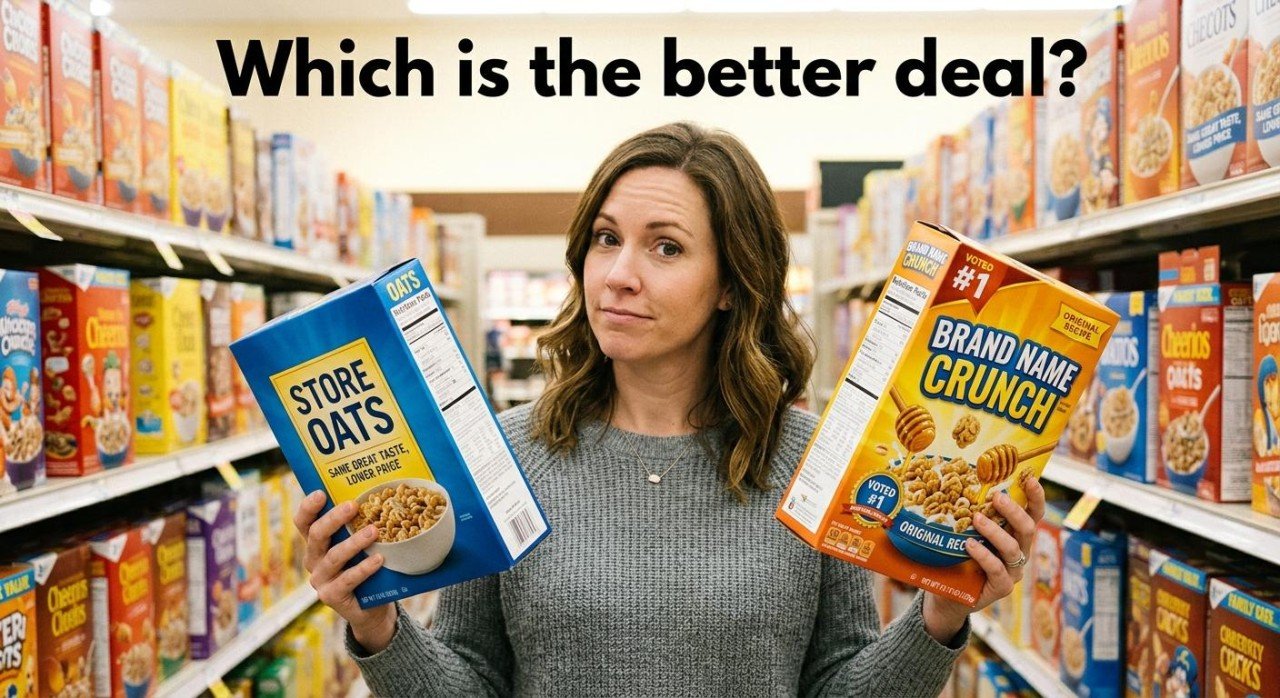
Stand in any grocery aisle and you will see the same product twice: the familiar name brand at eye level, and the store's own version a few inches away for noticeably less. For years, a lot of us quietly assumed the cheaper one was a compromise — fine in a pinch, but not as good. That instinct is costing American households real money, and most of the time it is simply wrong.
Store brands (also called private label or own brand) have quietly become one of the smartest ways to cut a grocery bill without eating worse. But the picture is not black and white. A handful of categories really do reward paying more, and the trick is knowing which is which. Here is what the evidence actually says, and a category-by-category cheat sheet you can use on your next shopping trip.
The Savings Are Bigger Than You Think
Store brands typically cost 25 to 30 percent less than their name-brand counterparts, according to Consumer Reports. That gap has been widening, too. A 2024 analysis from Numerator found that the price difference between private-label and national brands has grown by 38 percent since 2019, with shoppers now paying over two dollars more, on average, for a national-brand product than for the store-brand equivalent.
Spread across a full cart, week after week, that adds up fast. One expert quoted by Consumer Reports estimated that a family of four could save roughly $5,000 a year by buying private label wherever it makes sense.
Shoppers have clearly gotten the message. Numerator reports that 99 percent of U.S. households now buy private-label products, and in grocery specifically that figure is essentially universal. Store brands captured a 22.9 percent unit share and a 20.4 percent dollar share of sales in the first half of 2024, according to the Private Label Manufacturers Association — and they are growing while national brands flatten or shrink. This is no longer the bargain-bin corner of the store. It is a fifth of everything sold.
Why the Store Brand Is Often the Same Product
The most surprising part is what is actually in the package. In a lot of cases, the store brand and the name brand roll off the same production lines.
This is an open industry practice called dual branding, where the company that makes a famous national brand also produces a retailer's budget version. Research from Dartmouth's Tuck School of Business found that more than 70 percent of the private-label suppliers it studied were national-brand manufacturers — the same companies making both the premium product and the store-brand alternative, often in closely related categories. A company that makes a well-known toaster pastry, for example, might also produce the supermarket's own-label version.
There is a second, even stronger reason many staples are genuinely interchangeable: federal law. The FDA maintains standards of identity for many common foods, which are regulatory definitions spelling out exactly what a product must contain to be sold under a given name. Any product labeled milk, canned fruit, or milk chocolate has to meet the same minimum composition requirements regardless of who makes it. Milk chocolate, for instance, must contain a defined minimum percentage of milkfat to legally call itself milk chocolate. For these regulated staples, the brand on the label cannot change what is legally required to be inside.
Add it up and a clear principle emerges: for simple, single-ingredient or tightly regulated foods — canned beans, plain frozen vegetables, rolled oats, flour, sugar, baking soda, milk — the store brand is very often nutritionally identical and frequently made by the very same manufacturer. Paying extra buys you a logo and a marketing budget, not better food.
Where Name Brands Still Earn Their Price
Now the honest caveat, because "store brands are always just as good" is a myth in the other direction. Coming off the same factory does not guarantee an identical recipe — a manufacturer can run different formulas for the premium and budget lines — and taste does sometimes diverge.
Consumer Reports put this to the test in a blind taste-off of 19 store-brand versus name-brand product pairs. The results were genuinely mixed: store brands tied the name brand in 10 cases, the name brand won 8, and the store brand won outright only once (a chicken broth that beat its pricier rival). Name brands edged out the store version on items like cookie-dough ice cream and orange juice, where recipe and ingredient quality showed up on the palate. Even so, the average savings across all the products tested was about 25 percent — meaning that even when a name brand tasted slightly better, you were often paying a steep premium for a small edge.
The takeaway is not that name brands are better. It is that the gap depends heavily on the category. Highly processed and recipe-driven foods — things with long ingredient lists, complex flavor, or a texture that is hard to nail — are where a beloved name brand is most likely to actually taste different. Spices are another example: while everyday cooking spices are usually fine in store-brand form, a cheaper spice can also mean an older, less potent one, and for a spice meant to be the star of a dish — a good smoked paprika, real vanilla, saffron — freshness and quality are worth paying for.
The Skill That Saves the Most: Read the Label, Not the Logo
Here is the one habit that turns all of this into money in your pocket. Instead of judging by the front of the package — the design, the familiar name, the implied quality — flip both products around and compare the two things that actually matter:
- The ingredient list. For a true apples-to-apples staple, the lists should be nearly identical. Store-brand canned chickpeas that read "chickpeas, water, salt" are the same food as the name brand reading the same thing. If the cheaper option suddenly adds fillers, extra sugar, or thickeners the name brand does not have, that is a real difference worth weighing.
- The Nutrition Facts panel. Compare serving size, fiber, protein, added sugar, and sodium side by side. For regulated and single-ingredient foods, you will usually find them the same. For mixed or processed products, the numbers occasionally reveal that the store brand is cutting a corner — or, just as often, that it is the better choice.
This one comparison cuts through every marketing trick. The packaging is designed to make you feel something; the back label tells you what you are actually buying. Train yourself to glance at it and you will quickly learn which switches are free wins and which are not.
A Category-by-Category Cheat Sheet
To make it concrete, here is a quick guide to where switching to store brand is almost always a safe win, where it is worth a quick taste-test, and where the name brand may genuinely earn its keep.
Switch with confidence (nearly identical, big savings)
- Canned beans, tomatoes, and broth — simple ingredient lists, often the same product
- Plain frozen vegetables and fruit — frozen at peak ripeness regardless of brand
- Rolled oats, flour, sugar, baking soda, cornstarch — single-ingredient pantry staples
- Milk, butter, plain yogurt, eggs, and basic cheeses — dairy is tightly regulated, and Consumer Reports specifically flags milk, cheese, and eggs as strong store-brand buys
- Spices and dried herbs for everyday cooking — fine for background flavor; just check the fill level and buy in amounts you will use before they fade
- Bottled water, club soda, and basic coffee
- Paper goods, foil, and cleaning supplies — not food, but the same logic and some of the steepest discounts
Taste-test once, then decide
- Pasta sauce, salad dressing, and condiments — recipes vary, but store brands frequently win; the broth in the Consumer Reports test beat its name-brand rival
- Crackers, cereal, and snack foods — often nearly identical, occasionally not
- Ice cream and frozen meals — texture and richness can differ, so try before you commit your loyalty
Where the name brand may be worth it
- A signature spice meant to shine — fresh, high-quality saffron, vanilla, or a specialty paprika
- A specific product you love for its exact recipe — if a particular ice cream or sauce is non-negotiable for you, that is a perfectly good reason to keep buying it
Notice that the "splurge" column is short. For the overwhelming majority of a normal grocery list — produce, dairy, pantry staples, frozen basics — the store brand is the rational default, and the name brand is the exception you make on purpose.
Take the Guesswork Out of Eating Well
Eat Well Planner helps you organize your favorite recipes, plan balanced meals, and automatically generate shopping lists — all in one place. Whether you're tracking macros, managing dietary restrictions, or just trying to stop asking "what's for dinner?", we've got you covered.
Our AI-powered tools can adapt any recipe to your dietary needs, help you discover new meals you'll love, and even log your nutrition effortlessly. It's meal planning made simple.
Start Organizing Your Meals — FreeMake the Food the Point, Not the Brand
The reason brand loyalty quietly drains budgets is that most of us shop on autopilot, reaching for the familiar logo because deciding fresh every time is exhausting. The fix is to organize your shopping around the food — the actual ingredients a recipe needs — rather than around specific brands.
That is exactly how Eat Well Planner is built. When you plan your week, the app generates an organized shopping list of the ingredients your recipes call for — "canned chickpeas," "rolled oats," "frozen spinach" — not "Brand X chickpeas." That small shift hands the brand decision back to you at the shelf, where you can grab the store-brand version of a staple and only reach for a name brand when you have a real reason to. Because the recipes focus on whole, simple ingredients, the bulk of your list lands squarely in the "switch with confidence" zone, and the savings compound week after week.
Planning ahead helps in a second way, too. When you walk in with a list built around meals you are actually going to cook, you buy what you need and skip the impulse grabs — which are disproportionately pricey, heavily branded, ultra-processed items. A plan plus a willingness to read the label, rather than the logo, is most of the battle.
The Bottom Line
Store brands are not a downgrade — for most of your cart, they are the same food at a meaningfully lower price, sometimes made by the very same company and held to the same federal standards. The savings are real, growing, and used by nearly every household in the country. Reserve the premium spend for the few places it genuinely shows up: a spice you want to taste, or a specific product you truly love. Everywhere else, flip the package over, compare the label, and keep the difference.
Ready to build a grocery list around real ingredients instead of brand names? Try organizing your meals with Eat Well Planner — plan your week, auto-generate your shopping list, and shop smarter without sacrificing nutrition or taste.