Few parenting milestones come wrapped in as much conflicting advice as starting solids. One book swears by silky purees and a careful one-food-at-a-time march through the rainbow. A friend insists you should hand the baby a roasted carrot stick and let them go for it. Your aunt is alarmed you haven't started cereal yet, and a stranger on the internet is alarmed that you might. It's a lot of noise for what is, at heart, a pretty joyful moment: your baby tasting real food for the first time.
Here's the reassuring truth that the research keeps pointing to: there is no single right way to do this. The method you pick matters far less than starting at the right time, prioritizing a few key nutrients, keeping things safe, and offering variety with a relaxed, repeat-it-often attitude. Let's walk through what the evidence actually says, so you can tune out the noise and enjoy the squished-banana-on-the-forehead phase.
First, is your baby actually ready?
The big shift in recent years is around timing. Both the American Academy of Pediatrics and the CDC recommend introducing solids at about 6 months, alongside continued breast milk or formula. The CDC is explicit that "introducing foods before 4 months is not recommended." Age is a useful guidepost, but it's developmental readiness that really tells you it's time.
Look for a cluster of signs rather than any one of them. According to the CDC, a baby who's ready can usually:
- Sit up alone or with a little support, and control their head and neck
- Open their mouth when food is offered
- Swallow food rather than push it back out onto their chin
- Bring objects (and food) to their mouth
- Move food from the front to the back of their tongue to swallow
That last one matters. Young babies have a tongue-thrust reflex that pushes food out — protective when they're tiny, frustrating when you're trying to feed them. As it fades, food starts going down instead of out. The UK's NHS boils it down to three signs: staying in a sitting position with a steady head, coordinating eyes, hands and mouth to pick food up and bring it to their mouth, and swallowing food rather than spitting it back. If your baby can't yet do these things, there's no rush. A few more weeks of milk won't set them back.
Why those first foods matter more than the method
Before we get into baby-led weaning versus purees, it's worth knowing that what you offer in those early months is more important than how you offer it — largely because of one mineral: iron.
Babies are born with a store of iron that starts running low around the six-month mark, right as they're growing fast and breast milk alone no longer covers their needs. That's why the AAP advises parents to "include foods that provide iron and zinc, such as baby food made with meat or iron-fortified cereals." Good early options include pureed or finely minced meat and poultry, iron-fortified infant cereal, well-cooked beans and lentils, tofu, and fish. Whether those iron-rich foods arrive on a spoon or as soft finger food is up to you — the point is that they show up regularly.
Baby-led weaning vs. purees: what's the actual difference?
Strip away the dogma and the two approaches are simpler than they sound.
Traditional purees (spoon-feeding)
You start with smooth, mashed, or pureed foods on a spoon and gradually move to thicker, lumpier textures and then soft finger foods. The appeal: it can feel more controlled, you can see roughly how much your baby ate, and many parents find it less nerve-wracking at the very start. The thing to watch is getting stuck on smooth purees for too long — babies need to meet lumps and textures to learn to chew, ideally well before their first birthday.
Baby-led weaning (BLW)
Here you skip purees and offer soft, graspable pieces of food from the start, letting your baby feed themselves. As the NHS describes it, baby-led weaning "means giving your baby only finger foods and letting them feed themselves from the start instead of feeding them puréed or mashed food on a spoon." Fans love that it lets babies explore textures, practice fine motor skills, regulate their own appetite, and join in family meals early. The trade-offs: it's messier, harder to gauge intake at first, and it makes a lot of parents nervous about choking (more on that below).
The combined approach — what most families actually do
In real kitchens, the line between these two is blurry. Plenty of parents spoon-feed some yogurt or iron-fortified cereal and put a few strips of soft-cooked vegetable on the tray. This mix-and-match style is completely legitimate. The NHS sums up the whole debate in five words: "There's no right or wrong way." You can lean toward one method, switch as your baby changes, or do a bit of both at the same meal. Your baby will not file a complaint.
But isn't baby-led weaning a choking risk?
This is the fear that keeps parents up at night, so let's address it directly. The reassuring news is that the research has not found baby-led weaning to be riskier for choking than spoon-feeding. In one 2018 study in the Journal of Human Nutrition and Dietetics of 1,151 mothers, 13.6% of infants had ever choked — but there was "no significant association between weaning style and ever choking." Strikingly, the highest frequency of choking on finger foods occurred in the babies who were offered finger foods least often, hinting that practice with textures may help rather than hurt.
A crucial caveat: the structured baby-led approaches studied in research all came packaged with safety guidance. Self-feeding isn't a free-for-all. The protective factor isn't the method — it's following sound safety practices, which apply no matter how you feed.
It also helps enormously to know the difference between gagging and choking, because you will see gagging, and it can be alarming if you're not expecting it. As the NHS explains, "gagging is a normal reflex as your baby learns to chew and swallow solid foods." The quick tells:
- Gagging is loud. Your baby may make noise, cough, splutter, water at the eyes, push their tongue forward, or even bring food back up. It's their built-in system pushing food away from the airway, and it's a normal part of learning.
- Choking is quiet. A genuinely choking baby often can't make much sound at all, and may change color. This is the situation that needs immediate action.
Whichever method you choose, a few non-negotiables dramatically cut the risk:
- Always stay with your baby and keep them sitting upright while they eat — never propped, reclined, or eating in a moving car or stroller.
- Skip the classic choking hazards. The NHS specifically flags "hard foods like whole nuts, or raw carrot or apple." Also avoid whole grapes and cherry tomatoes (quarter them lengthwise), chunks of hot dog, popcorn, and sticky globs of nut butter.
- Offer finger foods cut into pieces big enough to grab — about the size of your own finger — that are soft enough to squash between your fingers.
- Take an infant CPR and choking-response class if you can. The confidence is worth it.
- Don't add salt or sugar to your baby's food, and skip honey entirely until after their first birthday.
Allergens: the advice that completely flipped
If your own parents raised you to avoid peanuts and eggs until toddlerhood, brace yourself, because the guidance has reversed. We now have strong evidence that introducing common allergens early — rather than delaying them — helps prevent food allergies.
The landmark LEAP study, published in The New England Journal of Medicine in 2015, followed more than 600 high-risk infants (babies with severe eczema, egg allergy, or both). Some were given peanut-containing foods regularly from infancy; others avoided peanut entirely. By age 5, 17.2% of the avoidance group had developed a peanut allergy, compared with just 3.2% of the group that ate peanut — roughly an 80% reduction in relative risk. That's a remarkable result for a simple dietary change.
Reflecting this, the AAP now states there is "no evidence that waiting to introduce baby-safe (soft) foods, such as eggs, dairy, soy, peanut products or fish, beyond 4 to 6 months of age prevents food allergy." The practical takeaway: once your baby is happily eating a few first foods, introduce common allergens — peanut (as smooth peanut butter thinned with water or mixed into other food, never whole nuts or thick spoonfuls), well-cooked egg, dairy, wheat, soy, and fish — one at a time, in small amounts, so you can watch for any reaction.
One important exception: if your baby has severe eczema or a known egg allergy, they're at higher risk, and the CDC advises you to "talk with your child's doctor or nurse about when and how to safely introduce foods with peanuts" rather than going it alone.
Variety and repetition beat any single method
Here's the part that takes the pressure off entirely. The biggest predictors of a good eater aren't whether you spoon-fed or went baby-led — they're variety and repeated exposure.
Babies are wired to be wary of new flavors, and that's normal, not a verdict on your cooking. The fix is simply offering a food again. And again. In one well-known study summarized in a systematic review of how infants learn about food, "eight exposures to a disliked vegetable were sufficient to increase intake in 7-month-olds, an effect that was sustained for at least 9 months in two-thirds of the children." The same review notes that "increasing variety and frequency of vegetable offering between 6 and 12 months, when children are most receptive, may promote vegetable consumption" later on — and that babies exposed to a wide variety early were more willing to try new vegetables years afterward.
So if your baby spits out broccoli today, that's not a no — it's a "not yet." Keep it in the rotation, stay casual, and don't turn it into a battle. The goal in this first stretch isn't to fill them up (milk is still doing that). It's to introduce as many flavors and textures as you reasonably can, calmly and repeatedly.
One family meal, gently adapted
You don't need to run a separate baby-food kitchen. The most sustainable approach for most families is to cook one meal and adapt a portion for the baby — softening the texture, skipping the salt, and cutting it into safe shapes. The lentil curry you're making for dinner? A few spoonfuls of the soft lentils, mashed, are a perfect iron-rich first food. Roasting vegetables for the family? Pull a few finger-sized, fork-soft pieces before you season the rest.
This is exactly where a little planning turns a stressful guessing game into a calm routine, and it's the part Eat Well Planner is built to make easier. You can set up a separate profile for your baby alongside the rest of the family, so when you plan the week's meals you can think through which family dishes adapt naturally into baby-friendly versions — and make sure iron-rich foods and a real spread of vegetables, fruits, grains, and proteins are turning up across the week rather than the same two purees on repeat. Because every saved recipe carries its nutrition breakdown, it's easy to spot whether you're actually hitting that iron goal or just hoping you are. And the auto-generated shopping list means the soft pears, the lentils, and the iron-fortified cereal are on the list before you're standing in the store wondering what to grab.
Take the Guesswork Out of Eating Well
Eat Well Planner helps you organize your favorite recipes, plan balanced meals, and automatically generate shopping lists — all in one place. Whether you're tracking macros, managing dietary restrictions, or just trying to stop asking "what's for dinner?", we've got you covered.
Our AI-powered tools can adapt any recipe to your dietary needs, help you discover new meals you'll love, and even log your nutrition effortlessly. It's meal planning made simple.
Start Organizing Your Meals — FreeKeeping it low-pressure (the most important part)
If you take one thing from all of this, let it be that mealtimes set the emotional tone for your child's relationship with food — and a relaxed tone matters more than a perfect technique. Babies are remarkably good at regulating how much they eat when we let them. Your job is to decide what healthy options to offer and when; their job is to decide whether and how much.
A few habits that keep the pressure low:
- Follow your baby's cues. Turning the head away, clamping the mouth shut, or losing interest usually means "done." Pushing past that teaches kids to override their own fullness.
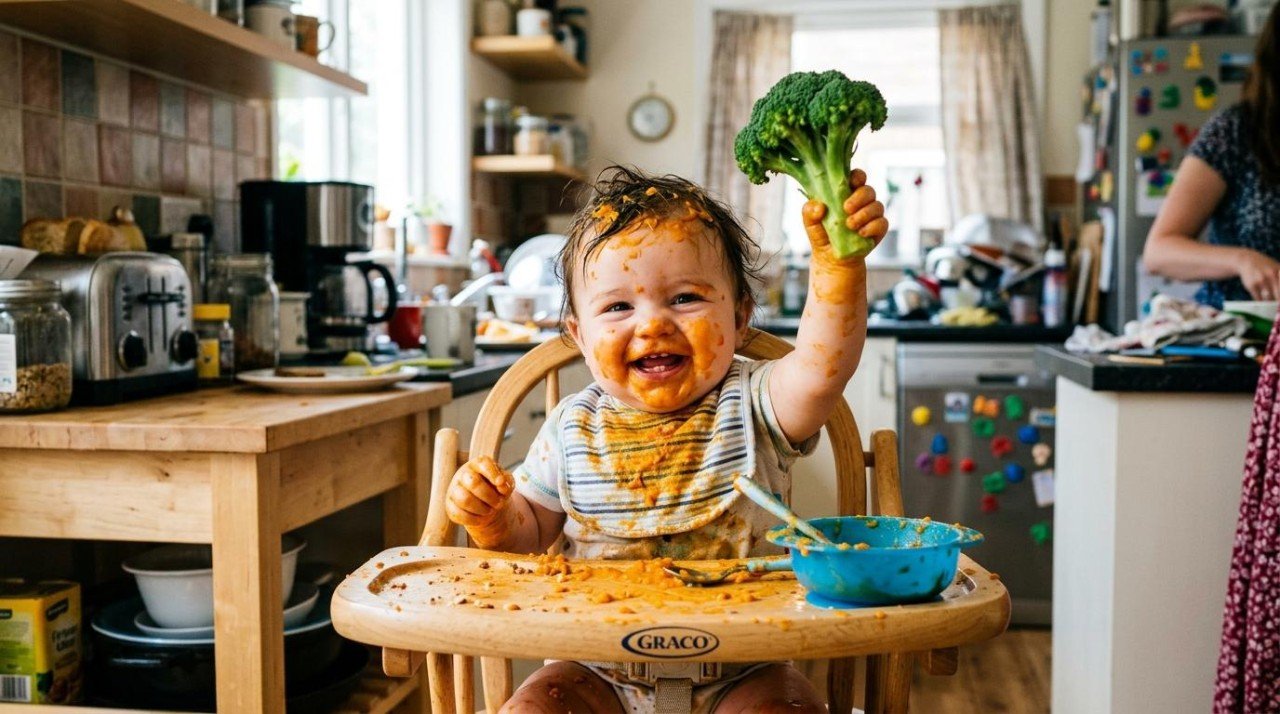
- Expect mess, and embrace it. Smearing, dropping, and squishing is how babies learn about food. A splat mat and low expectations go a long way.
- Eat together when you can. Babies learn by watching you enjoy the same foods. Family meals are one of the most powerful tools you have.
- Drop the clean-plate mindset. There's no quota to hit at this age. A few bites of something new is a genuine win.
- Let go of the comparison. Some babies dive in; others take weeks to warm up. Both are normal.
The bottom line
Baby-led weaning or purees, all-in or a relaxed mix of both — the method is genuinely yours to choose. What the evidence asks of you is much simpler: wait for the signs of readiness around six months, prioritize iron-rich foods, introduce common allergens early and safely, follow basic choking precautions, and offer a wide variety of foods over and over without making it a thing. Do that, and you're giving your baby an excellent start, whichever spoon — or no spoon — you reach for.
This stage is short, surprisingly fun, and far more forgiving than the internet would have you believe. Keep it safe, keep it varied, and keep it light.
Ready to make feeding the whole family — baby included — feel less like a daily scramble? Try planning your meals with Eat Well Planner and let it handle the recipes, nutrition, and shopping list so you can focus on the fun part.