Quick test: right now, without getting up, could you find the recipe for that dinner you swore you would make? The one your coworker raved about, or the glossy sheet-pan thing from a magazine in a waiting room, or the reel that stopped your thumb at 11 p.m.? Where is it, exactly?
For most of us the honest answer is "somewhere." It is a screenshot buried in a camera roll of 12,000 photos. It is a browser bookmark in a folder you have not opened since 2022. It is saved in an app, forwarded in an email, scribbled on the back of an envelope, dog-eared in a cookbook, or living in that one kitchen drawer where takeout menus, twist ties, and recipe clippings go to compost together. Your recipes are not lost, exactly. They are just scattered across nine different places, which turns out to be functionally the same thing.
A Collection You Can't See Is a Collection You Don't Use
Here is the quietly painful part: the recipes you save are not the recipes you cook. The saving feels productive — a tiny hit of "I am the kind of person who will make this" — but the cooking rarely follows. The clip gets a bookmark and a mental gold star, and then dinner is the same thing it was last Tuesday.
The data backs up the gap. In HelloFresh's State of Home Cooking report, based on a survey of 5,000 U.S. adults in June 2025, 86% of people described themselves as "meal repeaters" who eat the same meals over and over at least some of the time, and 58% pointed to being tired of the same recipes as a reason they expect to cook less in the year ahead. Strikingly, 52% had not tried a single new food or ingredient in the past month. We are drowning in saved inspiration and eating off a rotation of five dishes.
It is not that people lack ideas — it is that the ideas are unreachable at the only moment that counts: 6 p.m., kid melting down, fridge open, brain empty. A separate survey of 2,004 Americans conducted by OnePoll for Jennie-O found that 37% felt burnt out by cooking, with the top reason being making the same types of food again and again. The cure for that boredom is presumably sitting in your screenshots. You just cannot get to it.
Why Fragmentation Quietly Wins
Scattering your recipes does not just make them annoying to find. It actively works against you, for reasons that have less to do with willpower than with how attention and effort work.
Start with the saving itself. Researchers at Carnegie Mellon who studied tab and bookmark overload identified what they called a "blackhole effect": people keep tabs and saved items open because "as soon as something went out of sight, it was gone," in the words of professor Aniket Kittur. We hoard saved links as a hedge against forgetting — but the pile grows faster than we ever process it. (In that same research, about 25% of participants said they had crashed a browser or computer from sheer tab volume.) A "saved" folder with 400 unlabeled items is not a library. It is a place things go to be safely forgotten.
Then there is the moment of cooking, which is where decision fatigue takes over. A 2025 narrative review in the journal Nutrients describes how, as we burn through the day's decisions, we "shift to fast, automatic, and impulsive decision-making" and become "more susceptible to external cues, advertisements, and convenience-driven prompts", defaulting to whatever takes the least mental effort. If pulling up a recipe means swiping through three apps, an email inbox, and a drawer, that effort tax gets paid at the worst possible time — and the path of least resistance becomes a delivery app or a box of something processed.
This load is real and measurable. Kroger's data science arm, 84.51°, ran a two-year quarterly survey from early 2022 to early 2024 tracking whether people felt they had the mental energy to deal with food. Among Gen Z, the share reporting they lacked that energy peaked at 30% in late 2023 — versus just 5% to 7% for Baby Boomers, who tend to cook from established routines. Every extra place you have to look is a small tax on an energy budget that, for a lot of people, is already overdrawn.
And fragmentation has a literal price. When you cannot see what you already meant to cook, you shop without a plan, double-buy, and let good food rot. The EPA estimates that 30 to 40% of the U.S. food supply goes uneaten, with roughly 349 pounds of food per person leaving the supply chain as waste in 2019. A scattered recipe collection is a small but steady contributor: the spinach you bought for a recipe you forgot you saved is the spinach that liquefies in the crisper drawer.
Take the Guesswork Out of Eating Well
Eat Well Planner helps you organize your favorite recipes, plan balanced meals, and automatically generate shopping lists — all in one place. Whether you're tracking macros, managing dietary restrictions, or just trying to stop asking "what's for dinner?", we've got you covered.
Our AI-powered tools can adapt any recipe to your dietary needs, help you discover new meals you'll love, and even log your nutrition effortlessly. It's meal planning made simple.
Start Organizing Your Meals — FreeThe Fix: One Searchable Home
The solution is not more willpower or a better bookmarking system inside each app. It is consolidation — pulling every recipe out of its silo and into a single place you actually open, where you can search, plan, and shop from all of them at once. The goal is simple: when the question "what should I cook?" arrives, there is exactly one place to look, and it answers fast.
You do not have to do it all in an afternoon. The trick is to handle each source once, with a repeatable move, so the chaos drains in the background over a couple of weeks. Here is how to digitize and consolidate each of the usual suspects.
Phone screenshots
Screenshots are the worst offenders because they are invisible. A picture of a recipe is just pixels — your phone cannot search the text inside it, so it sinks into the camera roll the moment you take the next photo of your dog. Go through your photos once, find the food, and re-home each one into your recipe collection where the actual text and ingredients get captured. Then delete the screenshot. The relief of a leaner camera roll is its own reward.
Browser bookmarks and open tabs
Open that graveyard bookmarks folder and the 14 cooking tabs you have been guiltily keeping alive. For each one, save the recipe into your central collection and close the tab. Most recipe URLs can be imported in seconds, ingredients and all — which means you finally get to close the tab without that blackhole panic of losing it forever.
Social media saves (Instagram, TikTok, YouTube)
Your saved reels and "Watch Later" playlists are the most fragile of all, because they live on someone else's account and can vanish when a creator deletes a post or an audio license expires. Pull the keepers out now. The best tools can import directly from an Instagram post, a TikTok, or a YouTube cooking video and extract the ingredients and steps into editable text — so the recipe survives even if the original clip does not.
Email forwards and newsletters
The recipe your aunt forwarded, the newsletter dish you meant to try — search your inbox for "recipe," "dinner," or that friend's name, and move the good ones over. Then they are out of a 40,000-email pile and into a place built to hold them.
Cookbooks and magazine tears
You do not need to digitize an entire cookbook. Just photograph the handful of pages you actually cook from — the four dog-eared, sauce-splattered ones — and pull them in so they sit alongside everything else. The physical book stays on the shelf; the recipes you use join the searchable rotation.
That one drawer
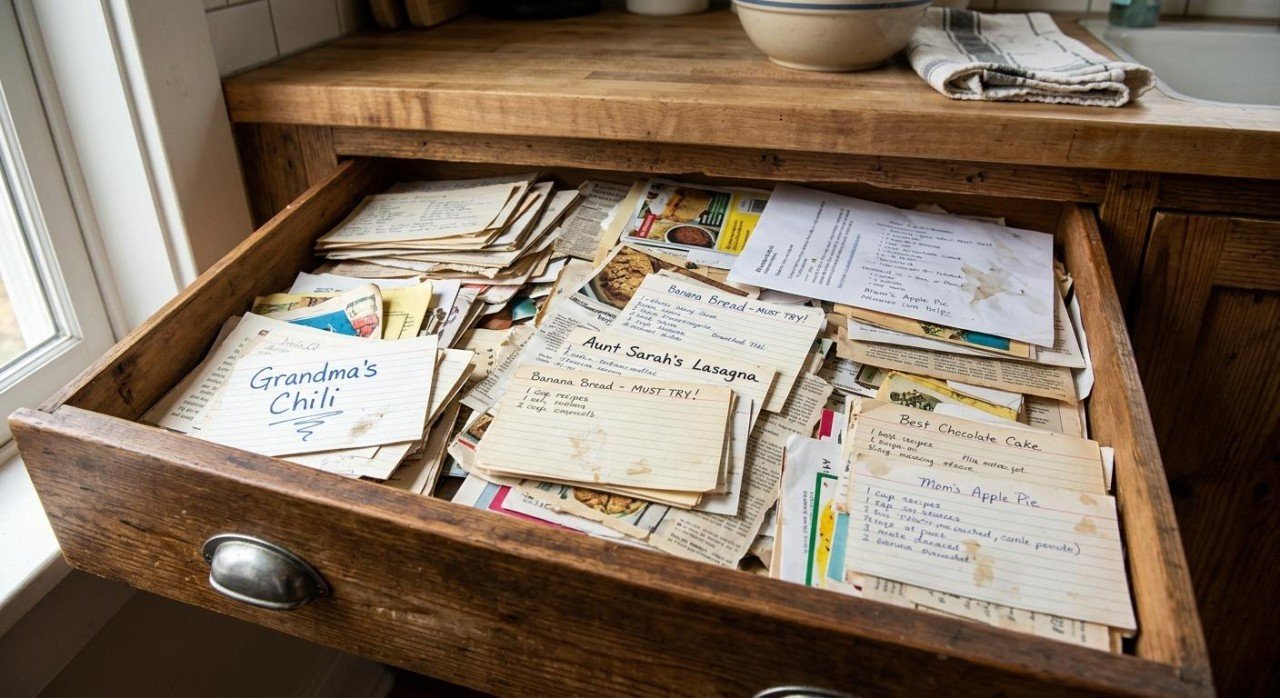
The handwritten cards, the clippings, the index card from a relative. These are the highest-stakes items in the whole pile because they are irreplaceable — paper fades, ink smears, and a single card can be lost for good. Snap a photo of each one and bring it into your collection so the recipe is safe even if the paper is not. (These family recipes deserve their own careful treatment, which is a whole project in itself — but step one is always: get a copy off the paper.)
What "One Home" Should Actually Do
A folder full of screenshots in one app is still just a folder. The point of consolidating is not tidiness for its own sake — it is to make the collection do work for you. A genuinely useful recipe home should:
- Be searchable by name and ingredient, so "what can I make with the chicken and that half a cabbage?" has an answer in five seconds, not five minutes.
- Capture the actual recipe — ingredients, steps, and ideally nutrition — as editable text, not a flat image you cannot search or scale.
- Accept recipes from anywhere — a URL, a social video, a photo of a card — so there is no source you cannot fold in.
- Turn the collection into meals by helping you plan a week and build a shopping list, so your saved recipes finally make it onto the table instead of just into storage.
That last point is the one that closes the loop. The reason a consolidated collection beats nine scattered ones is not just findability — it is that you can plan from it. When this week's dinners are already chosen from recipes you love and the ingredients are already on a list, reaching for processed convenience food stops being the easy default. The plan becomes the path of least resistance, which is exactly the direction you want decision fatigue pushing you.
This is the whole idea behind Eat Well Planner. You can import recipes from any website URL, an Instagram post or reel, a YouTube video, or a photo, and the AI pulls out the ingredients, steps, and nutrition automatically — so every screenshot, bookmark, and drawer clipping lands in one searchable book. From there it builds personalized weekly meal plans out of the recipes you have saved and generates an organized shopping list to match. The recipes you collect stop being a museum of good intentions and start being dinner.
Start With One Source
You do not have to excavate every drawer this weekend. Pick the single worst offender — for most people that is the camera roll or the saved-reels folder — and move just those recipes into one home. Even that small act changes something: the next time you wonder what to cook, you will have one place to look, and the answer will be sitting right there, finally cookable.
The recipes were never the problem. The scattering was. Pull them together, and the food you have been meaning to make for months is suddenly, almost magically, within reach.
Bring all your scattered recipes into one organized home with Eat Well Planner — and turn the pile of someday into this week's dinners.