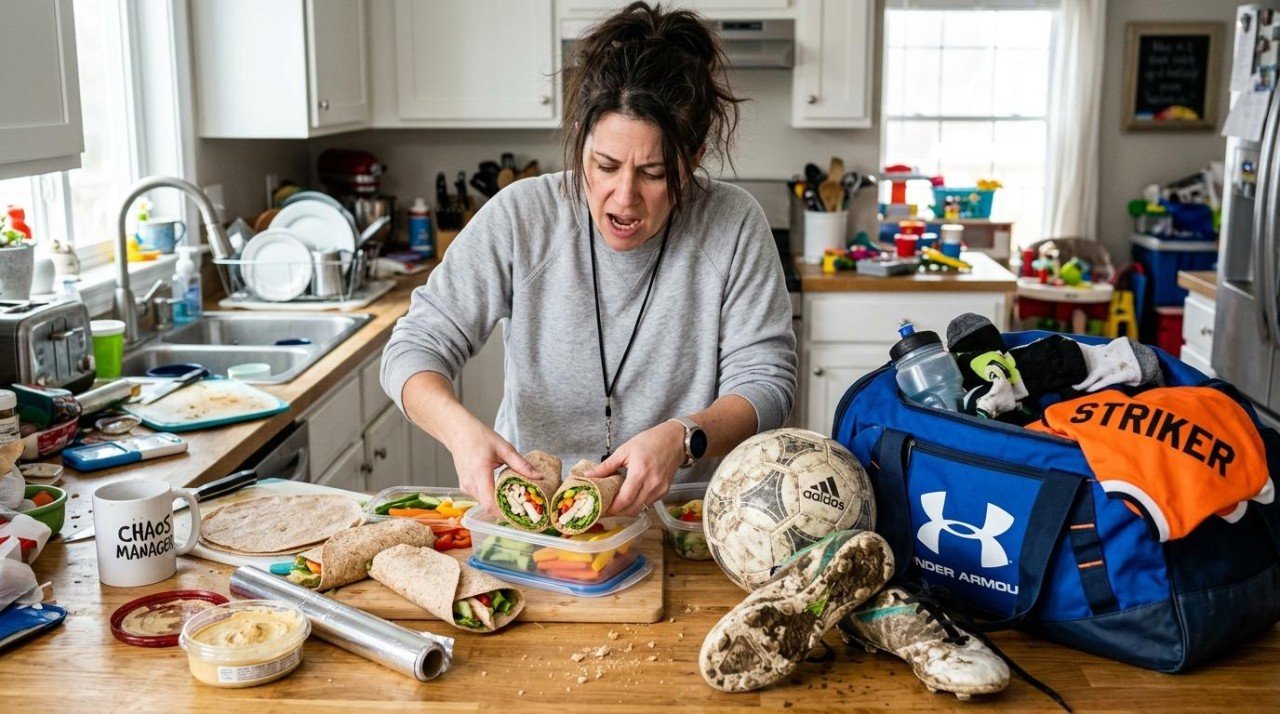
It is 5:45 on a Tuesday. One kid has soccer at 6:00, the other has a band rehearsal that runs until 7:30, and you have exactly eleven minutes between drop-offs. The fridge has ingredients but no plan, and there is a drive-through with a glowing menu board conveniently located between the field and home. You already know how this ends.
If that scene feels familiar, you are in very good company. About 27.3 million American kids ages 6 to 17 play organized sports or take after-school lessons, roughly 55% of that age group, according to the Aspen Institute's Project Play. All those practices, games, and recitals add up to a calendar where dinner keeps landing in the worst possible window. The good news: with a little front-loading, you can feed a hungry young athlete real food on the most chaotic night of the week, no fryer required.
The Drive-Through Default (and Why It Sneaks Up on You)
Nobody plans to eat fast food four nights a week. It happens because the schedule outruns the plan. When the University of Michigan's C.S. Mott Children's Hospital surveyed a nationally representative group of parents, 43% said they were simply too busy to cook, 22% pointed to stress, and 72% agreed that fast food is a good family option when they are short on time. Notably, 85% of those same parents acknowledged that fast food is not healthy for their kids. The gap between what we know and what we do is not a willpower failure. It is a logistics failure.
And it adds up. Federal data from the CDC shows that children and adolescents get an average of 13.8% of their daily calories from fast food, with more than a third (36.3%) eating it on any given day. For teenagers the figure climbs to 16.7%. On the days kids eat out, research consistently finds they take in more calories, more added sugar, and more sodium, and fewer fruits, vegetables, and fiber than on days they eat at home. None of this means a drive-through dinner now and then is a catastrophe. It means that when busy nights become the rule rather than the exception, the default quietly reshapes a child's whole diet.
The fix is not heroic willpower at 5:45. It is making the healthy option the easy option before the rush even starts.
Make-Ahead and Slow-Cooker Dinners That Greet You at the Door
The single most powerful move for a sports family is to shift the cooking to a time when you are not also driving, refereeing homework, and finding a missing shin guard. A meal that is ready the moment you walk in beats a drive-through every time, because the only thing fast food actually sells you is timing.
A few approaches that do the heavy lifting:
- The slow cooker or multi-cooker. Load it in the morning and walk into a finished dinner: chili, chicken and rice, lentil soup, pulled chicken for tacos, a hearty minestrone. A few safety habits keep it foolproof: thaw meat before it goes in rather than starting from frozen, fill the pot between half and two-thirds full so it cooks evenly, and refrigerate leftovers within two hours of finishing.
- Batch and freeze. Double a recipe on a calmer night and freeze half in meal-sized portions. A frozen casserole, a bag of soup, or pre-portioned cooked grains turns a frantic Tuesday into a reheating job.
- Sheet-pan and one-pot dinners. For nights you are actually home to cook, a single tray of chicken thighs and vegetables or a one-pot pasta keeps active cooking and cleanup to a minimum.
- Assemble-ahead components. Cook a pot of rice, roast a tray of vegetables, and grill a few chicken breasts on Sunday. Through the week those parts recombine into bowls, wraps, and quesadillas in minutes.
The thread connecting all of these is the same: decide and prep when you have a moment to think, so that the busy evening only requires reheating, not deciding. The deciding is the part that breaks down when everyone is hungry and the clock is against you.
This is exactly where a little structure pays off. Eat Well Planner lets you map your dinners against the week's actual calendar, so you can flag the practice-and-game nights and deliberately slot a slow-cooker or freezer meal there instead of hoping something comes together. It builds the shopping list automatically from that plan, which keeps the make-ahead staples in the house so the plan can survive contact with a real Tuesday.
Take the Guesswork Out of Eating Well
Eat Well Planner helps you organize your favorite recipes, plan balanced meals, and automatically generate shopping lists — all in one place. Whether you're tracking macros, managing dietary restrictions, or just trying to stop asking "what's for dinner?", we've got you covered.
Our AI-powered tools can adapt any recipe to your dietary needs, help you discover new meals you'll love, and even log your nutrition effortlessly. It's meal planning made simple.
Start Organizing Your Meals — FreeFueling a Young Athlete the Real-Food Way
Kids who are running, jumping, and sprinting for two hours have genuine fuel needs, and the answer is rarely a neon sports bar. According to a review of sport nutrition for young athletes, the timing matters as much as the food:
- Before activity: A balanced meal works best eaten at least three hours ahead, with carbohydrates as the centerpiece, some protein, and not too much fat or fiber (which slow digestion and can upset the stomach). Closer to game time, a light snack one to two hours before works well: fresh or dried fruit, a bowl of cereal with milk, or a fruit smoothie.
- During longer activity: For most practices under an hour, water is plenty. Only when activity runs well past an hour, especially in heat, do sports drinks earn their place, and even then the review points to roughly 150 to 300 mL of fluid every 15 to 20 minutes.
- After activity: Recovery foods combining carbohydrates and protein are most effective within about 30 minutes, then again one to two hours later. The review names simple options like graham crackers with peanut butter, yogurt with fruit, or cheese with fruit.
The American Academy of Pediatrics makes the same point in plain terms for harried parents. Their guidance for busy sports families leans on small, frequent, real-food snacks rather than one big pre-game meal, and singles out plain favorites: apples, oranges, bananas, grapes, dried fruit and nuts, hard-boiled eggs, unsweetened applesauce, and a half sandwich on whole-grain bread. For recovery, the AAP calls chocolate milk an excellent option, since it delivers the carbs and protein muscles want in a form kids will actually drink. The same article notes that most young athletes eating a balanced diet do not need protein supplements at all.
The reassuring takeaway is that fueling a child athlete does not require specialized products. A banana before, a turkey-and-cheese wrap and a carton of milk after, and a water bottle throughout will out-perform most of what is sold in shiny wrappers at the concession stand.
Grab-and-Go Meals That Actually Travel
Some nights there is no walking back through the door before everyone needs to eat. That is where portable, balanced food earns its keep. The goal is something that holds up in a bag, survives a warm car, and combines a carbohydrate, a protein, and some produce so it actually sustains a kid through a game and the homework that follows.
A handful of reliable options:
- Wrap roll-ups. A whole-grain tortilla with turkey or hummus, cheese, and shredded vegetables, rolled and cut into pinwheels. Easy to eat one-handed on a sideline.
- Bento-style boxes. A compartment box with cubed chicken or hard-boiled eggs, whole-grain crackers, cheese, cherry tomatoes, cucumber, and grapes. It covers every food group and feels like a treat.
- Overnight oats or yogurt parfaits in a jar. Layer oats or plain yogurt with fruit and a spoonful of nut butter the night before. Sturdy, filling, and great for early or late activities.
- Pasta or grain salad. Whole-grain pasta or quinoa tossed with beans, chopped vegetables, and a simple vinaigrette holds beautifully at room temperature and travels in any container.
- DIY snack packs. The AAP's own suggestion: pre-portion the foods your kids already like, a bag of sliced apple, a handful of nuts, a couple of hard-boiled eggs, so the grab-and-go choice is already made.
- Heartier handhelds. A cold frittata square, a bean-and-cheese quesadilla cut into wedges, or half a peanut butter and banana sandwich all eat well without utensils.
Pack a small insulated bag with an ice pack for the perishable items, and keep a couple of shelf-stable backups, a banana, a packet of nut butter, a whole-grain granola bar, permanently in the car. Those backups are what stand between you and the drive-through on the night everything runs late.
When Everyone Eats at a Different Time
The other reality of sports-night life is that the family rarely sits down together at 6:00. One kid eats before practice, one eats after, and the adults grab something in between. Staggered eating is not a failure; it just needs a strategy so it does not collapse into everyone foraging separately.
A few tactics keep a staggered evening sane:
- Cook once, serve in waves. A slow-cooker dinner or a big tray bake can hold safely and be portioned out as each person arrives home, rather than cooking three separate meals.
- Split the meal around the activity. Give the athlete a carb-forward mini-meal before they leave, then have their protein and vegetables waiting for when they get back. The full dinner just arrives in two installments.
- Build a flexible base. A pot of chili, a tray of roasted vegetables and grains, or a taco bar lets each person assemble a plate whenever they land, with the same core ingredients.
- Protect one anchor meal. If weeknight dinners are scattered, claim a different slot, a shared breakfast, or a relaxed weekend lunch, as the table everyone shows up to.
Why Holding On to the Shared Table Is Worth It
It is tempting, on a packed schedule, to let family meals quietly disappear. But the research on eating together is hard to ignore, and the bar for benefit is lower than you might think. A 2023 randomized clinical trial published in JAMA Network Open found that simply extending family meals by about 10 minutes led children aged 6 to 11 to eat significantly more fruits and vegetables, roughly an extra portion's worth, with no nagging required. The researchers noted that a single additional daily portion of produce is associated with a 6% to 7% lower risk of cardiometabolic disease. Ten unhurried minutes is a remarkably small lever for that kind of payoff.
You will not get a leisurely sit-down every night during a busy season, and that is fine. The point is that shared meals are valuable enough to defend a few times a week, even if they happen at 8:00, or at the kitchen counter, or on a Saturday. Eating together is not an all-or-nothing ritual; it is a habit worth protecting in whatever windows your calendar allows.
Pulling It Together
Feeding a family through a sports-heavy season really comes down to four moves: cook ahead so dinner is waiting when you walk in, fuel young athletes with simple real food rather than specialty products, keep genuinely portable meals on hand for the nights you eat on the go, and protect a shared table when you can. Each one shifts a decision out of the frantic 5:45 window and into a calmer moment when you can actually make a good choice.
That shift is where a planning tool earns its place. With Eat Well Planner, you can lay your meals over the week's real schedule, flag the practice nights for make-ahead or slow-cooker dinners, and let the app build a shopping list that keeps your portable staples and recovery snacks stocked. You can import a slow-cooker recipe straight from a video you saw, ask the built-in recipe chat to scale it for a hungry team or swap an ingredient for a dietary need, and see the nutrition behind each meal so you know your athlete is actually fueled. The busy season will still be busy, but dinner no longer has to be the thing that falls apart.
Try mapping your week's meals around your family's schedule with Eat Well Planner, and let the plan, not the drive-through, decide what is for dinner.