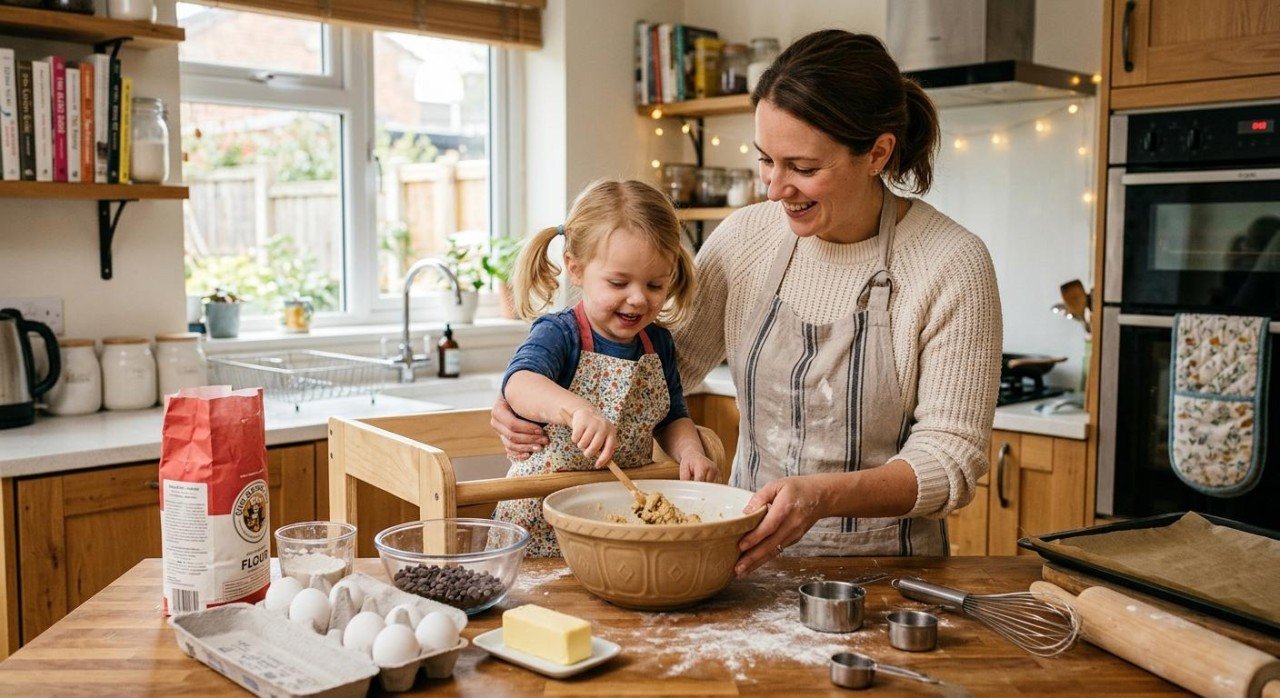
There's a particular kind of optimism that leads a parent to hand a two-year-old a wooden spoon and a bowl of batter. About ninety seconds later, that optimism is usually wearing flour. If you've ever invited your toddler to "help" in the kitchen and immediately regretted it, you are in excellent company — and the good news is that the mess you're cleaning up is doing more good than you think.
Cooking with little ones is genuinely worth the chaos. Not in a vague, feel-good way, but in measurable ones: kids who help make food are more willing to eat it, they build motor and language skills while they stir, and the time spent together is the kind of low-pressure connection that's hard to manufacture any other way. The trick isn't avoiding the mess. It's setting things up so the mess stays small, the expectations stay realistic, and nobody — toddler or parent — ends up in tears.
Why It's Worth the Mess
Start with the payoff, because it's bigger than most parents realize. When children are involved in preparing a meal, they eat more of it. In a controlled study of 47 children aged 6 to 10, kids who helped cook a lunch of pasta, breaded chicken, cauliflower, and salad ate 76% more salad and took in about 24% more calories from the meal than children whose parents cooked the same food alone. The children who cooked also reported feeling more positive and more in control afterward — a reminder that the emotional payoff is real, not just the nutritional one.
That "I helped make it, so I'll try it" effect shows up again and again. A nursery-based program in Scotland called Big Chef Little Chef had parents and children aged 3 to 5 cook together over four weekly sessions, with lots of hands-on exposure to green vegetables. Compared to a group that just attended a healthy-eating talk, the cooking group's food-fussiness scores dropped significantly (from 3.0 to 2.6) and their willingness to try both raw and cooked green vegetables rose. The kids who got their hands dirty were measurably less picky afterward.
This matters because picky eating isn't a character flaw — it's a normal developmental stage, and the way through it is exposure. A systematic review of infants and toddlers found that repeatedly offering a vegetable or fruit, roughly once a day for 8 to 10 days or more, reliably increases how much a young child will accept it. Cooking together is one of the most natural ways to rack up those exposures. A toddler who washes the broccoli, watches it turn bright green in the pan, and sets it on the table has "met" that vegetable several times before it ever reaches their mouth.
The benefits go well beyond the plate. Utah State University Extension notes that involving kids in cooking increases their willingness to try new foods, with one study finding child helpers ate an extra serving of vegetables a day, and that the American Academy of Pediatrics encourages using the kitchen to teach counting, fractions, measuring, science, vocabulary, and following directions. Scooping and pouring strengthen the small hand muscles toddlers will later need for holding a pencil. Waiting for a timer is a lesson in self-control. Naming ingredients builds vocabulary. The kitchen is, accidentally, one of the best preschool classrooms in your house.
And then there's the simplest benefit of all: time together. Frequent shared meals are linked to a long list of good outcomes for kids. An umbrella review of 41 systematic reviews found that more frequent family meals were associated with better diet quality, lower BMI, and better psychosocial wellbeing — children eating together three or more times a week had about 12% lower odds of obesity. Cooking together is the on-ramp to eating together.
Right-Sizing the Job: What Toddlers Can Actually Do
Most kitchen meltdowns happen because a child has been handed a task that's either too hard or too boring. The fix is matching the job to the age. Here's what tends to work, drawn from age-appropriate activity guidance from South Dakota State University Extension.
Around age 2, keep it simple, safe, and satisfyingly repetitive:
- Tearing salad greens or fresh herbs into a bowl
- Washing fruits and vegetables in a small pan of water (toddlers love water; lean into it)
- Breaking apart broccoli and cauliflower florets, or pulling grapes off the stem
- Shaking ingredients — like a homemade dressing or pudding — in a small jar with a tight lid
- Wiping the table, carrying unbreakable ingredients from counter to counter, and tossing scraps in the trash
Around ages 3 to 4, their coordination has caught up enough for more:
- Peeling hard-boiled eggs, bananas, or oranges
- Measuring with cups and spoons (a fantastic stealth math lesson)
- Cutting soft foods like banana or cheese with a kid-safe or plastic knife
- Stirring batter, mashing soft fruit or potato with a fork, and pouring pre-measured liquids
- Setting and clearing the table
Two principles make all of this go smoother. First, give your toddler a real job, not a fake one — kids can tell the difference, and a genuine contribution is what builds the pride that makes them eat the food. Second, prep the hard parts yourself before you invite them in. Pre-measure ingredients into little bowls, get the sharp knives and hot pans out of reach, and decide which one or two steps are "their" steps. You're the head chef; they're the line cook on a very short menu.
Managing the Mess and Keeping It Safe
You will not achieve zero mess. Aim instead for contained mess. A few setups make a real difference:
- Lower the workspace. A sturdy step stool or a toddler kitchen tower brings them up to counter height safely, or set them up at their own little table. A child reaching up over their head has far less control than one working at chest level.
- Define the zone. A rimmed baking sheet or a large cutting board under their bowl catches spills and gives them a visual boundary for where the "work" happens.
- Dress for it. An apron or just an old shirt, sleeves pushed up, and the expectation — out loud — that getting messy is part of cooking. It lowers everyone's stress.
- Make cleanup part of the recipe. Toddlers genuinely enjoy wiping tables and "washing" dishes. Build it in as the final, celebrated step rather than an afterthought.
On safety, a few non-negotiables: close supervision the entire time, child-sized tools that match their ability, and keeping the youngest helpers well away from the stove, oven, knives, and electrical appliances. Teach hand-washing before you start and after touching raw ingredients. Steer clear of raw meat, raw eggs in batter, and small round hard foods that are choking hazards. The guiding idea from the extension experts is straightforward: child-sized equipment, close supervision, and tasks matched to the child's developmental stage are what keep cooking safe.
Take the Guesswork Out of Eating Well
Eat Well Planner helps you organize your favorite recipes, plan balanced meals, and automatically generate shopping lists — all in one place. Whether you're tracking macros, managing dietary restrictions, or just trying to stop asking "what's for dinner?", we've got you covered.
Our AI-powered tools can adapt any recipe to your dietary needs, help you discover new meals you'll love, and even log your nutrition effortlessly. It's meal planning made simple.
Start Organizing Your Meals — FreeSetting Realistic Expectations (For You)
Here's the mindset shift that saves parents the most frustration: when you cook with a toddler, the goal is not dinner. The goal is the experience. Dinner is a bonus.
That means choosing a night when you're not racing a hungry-baby clock, accepting that everything takes three times longer, and letting "good enough" be the standard for the food itself. The cookies will be lumpy. The smoothie will have a suspicious amount of spinach concentrated on one side. The toddler will lose interest exactly halfway through and wander off, and that's fine — you can finish the rest. A few more reassurances worth internalizing:
- They don't have to eat it that day. Remember, acceptance can take 8 to 10 exposures or more. Helping cook a food they don't touch tonight still counts as progress.
- Short attention spans are normal. Five focused minutes of stirring is a win. You're not running a culinary boot camp.
- Some days will flop entirely. Tiredness, hunger, and toddler moods are real. Bail out cheerfully and try again another day.
- The skill builds slowly. The two-year-old who only tears lettuce becomes the five-year-old who cracks eggs becomes the ten-year-old who can make breakfast. You're playing a long game.
Recipes That Tolerate "Help"
Some foods are forgiving of small, enthusiastic hands. Others — anything requiring precision, hot oil, or careful timing — are not. Lean hard toward the forgiving end:
- Overnight oats or yogurt parfaits. Layering, sprinkling, and pouring, with zero heat and no exact ratios. A toddler can build their own in a jar.
- Smoothies. They drop in pre-washed fruit and frozen veg; you run the blender. Sneaky greens and a great way to "meet" new produce.
- Homemade pizza on flatbread or pita. Spreading sauce, sprinkling cheese, and arranging toppings is practically designed for toddler hands — and choosing their own toppings makes them far more likely to eat it.
- Muffins, banana bread, and pancakes. Mashing bananas, dumping pre-measured dry ingredients, and stirring (lumps are not just okay, they're better for muffins).
- Big colorful salads. Tearing lettuce, scattering chopped veg, shaking up the dressing in a jar. This is the exact scenario from the research where kids ate dramatically more salad.
- Energy balls and no-bake bites. Rolling oat-and-nut-butter mixtures into balls is essentially sanctioned playing with food.
Where Eat Well Planner Fits
The biggest barrier to cooking with a toddler usually isn't the toddler — it's that by the time you've figured out what to make, decided whether you have the ingredients, and mustered the energy, the window has closed and you're reaching for something quick and packaged instead. Having a plan in place is what turns "maybe we'll cook together this week" into something that actually happens.
That's the gap Eat Well Planner is built to close. You can save the kinds of forgiving, kid-friendly recipes above — importing them straight from a website, an Instagram reel, or a YouTube video — into one searchable recipe book, then have the app build a weekly meal plan around the nights you actually have time to cook together. It generates an organized shopping list automatically, so the ingredients for Saturday's toddler-assisted pizza are in the house before the weekend, not a frantic afterthought. And because the recipes are already chosen and the shopping is already done, fresh-cooked food becomes the path of least resistance instead of the ambitious plan that never survives a real week.
If your child has a dietary need — or is going through a phase where they'll only eat beige food — the built-in AI recipe chat can suggest swaps and simpler variations, so a recipe you found can flex to fit your family without you having to start from scratch.
The Takeaway
Cooking with a toddler is messy, slow, and occasionally absurd. It's also one of the more efficient things you can do for their eating: more willingness to try vegetables, broader food acceptance, sharper motor and language skills, and a standing invitation to eat together as a family — all of which the research backs up. You don't need to be patient about the flour on the floor or precious about the lopsided muffins. You just need a forgiving recipe, an age-right job, low expectations for the food, and a little bit of a plan. Hand over the wooden spoon. The mess is temporary; the habits last a lot longer.
Plan a week of simple, kid-friendly meals with Eat Well Planner and make cooking together the easy choice, even on busy days.