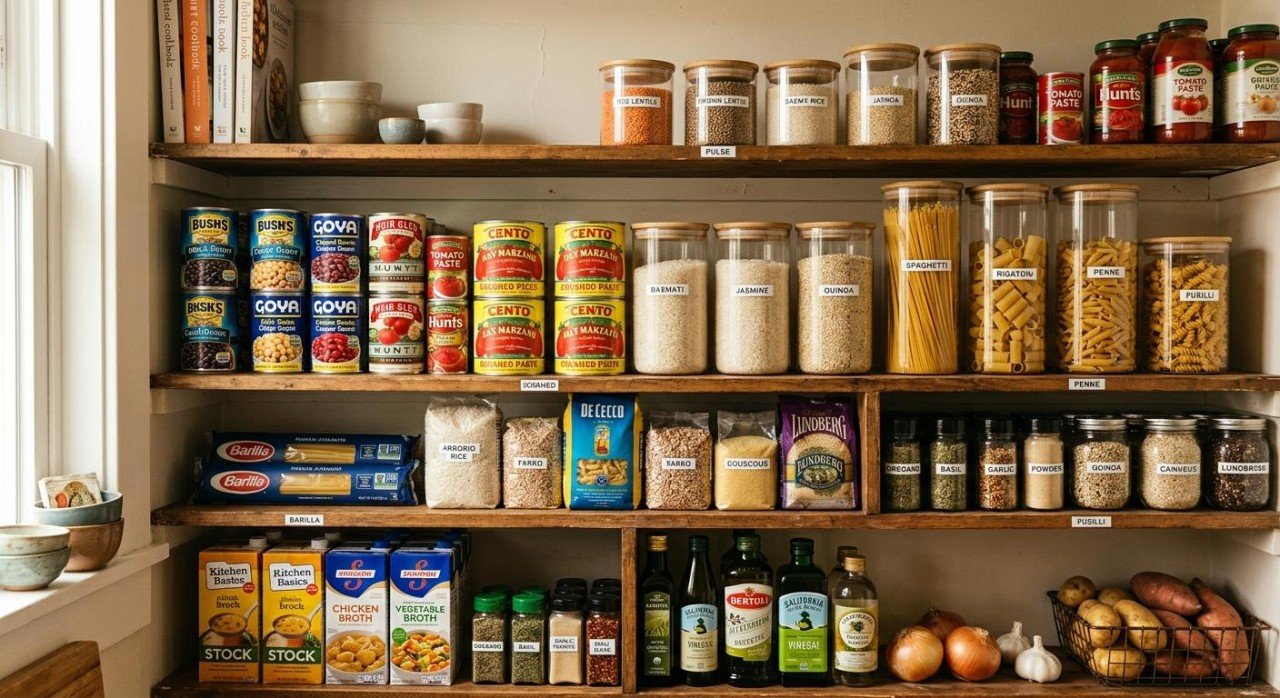
It's 6:15 p.m. You open the cupboard and stare at a shelf that is objectively full of food — cans, boxes, bags, jars — and your brain returns its verdict anyway: there's nothing to eat. Twenty minutes later you're scrolling a delivery app or pouring cereal for dinner, while a perfectly good supply of ingredients sits in the dark.
Here's the thing: that shelf almost certainly does contain dinner. What's missing isn't food — it's a system. A working pantry isn't a random accumulation of cans you bought once for a recipe you made once. It's a small, deliberate set of staples chosen because they combine with each other, plus a handful of formulas that turn them into real meals, plus a restocking habit that means the key pieces are never missing. Build those three things and "nothing to eat" stops being a sentence you say.
This post walks through all three: the staple list, the meal formulas, and the restocking system — plus four pantry dinners you can make tonight with no shopping trip.
Why "Nothing to Eat" Is a Systems Problem
The moment that decides what you eat tonight isn't lunchtime, and it isn't the weekend grocery run. It's the tired, hungry, decision-fatigued moment when you walk into the kitchen. Whatever is easiest in that moment usually wins. If the easiest option is takeout, takeout wins. If the easiest option is a meal you can assemble from shelves and freezer in 20 minutes, that wins instead.
That swing matters more than it feels like it does. In a study of more than 9,500 U.S. adults, researchers at Johns Hopkins found that people who cooked dinner at home six to seven nights a week consumed fewer calories, less fat, and about 16 fewer grams of sugar per day than people who cooked once a week or less — and the frequent cooks also relied less on fast food, frozen dinners, and ready-to-eat meals. Cooking at home more often is one of the most reliable levers for eating better, and a stocked pantry is what makes cooking at home possible on the nights you didn't plan for.
There's a financial case too. According to ReFED's analysis of U.S. food waste, the average American spent over $760 in 2024 on food that went uneaten, and consumer food waste accounts for almost half of all surplus food in the country. Shelf-stable and frozen staples are the antidote to a big chunk of that: canned beans don't wilt by Thursday, frozen spinach doesn't turn to sludge in the crisper drawer, and rice doesn't care that your week got chaotic. A pantry-first kitchen wastes less almost by definition.
The Pantry Is Healthier Than Its Reputation
There's a lingering idea that "real" healthy eating happens in the produce aisle and anything from a can or the freezer is a compromise. The research says otherwise — emphatically.
Canned beans hold their own against any health food. A 2024 analysis of national nutrition survey data (NHANES 2001–2018) found that adults whose eating patterns included more beans and chickpeas had significantly higher diet-quality scores, ate more fiber, potassium, magnesium, and iron, and had lower BMI and smaller waist circumference than non-consumers. The same paper notes that canned beans account for roughly 75% of beans sold at U.S. retail — so this isn't a finding about people soaking heirloom beans from scratch. It's about the can on your shelf.
That fiber matters more than almost any nutrient you could name. Per a review of the Dietary Guidelines' treatment of pulses and fiber, more than 90% of American women and 97% of men don't meet recommended fiber intakes — a shortfall the Dietary Guidelines flag as a public health concern because low fiber raises chronic disease risk. Beans and lentils are among the densest whole-food fiber sources that exist, and they live happily on a shelf for years.
Canned tomatoes are arguably better than fresh for one key nutrient. Tomatoes are the major dietary source of lycopene, an antioxidant studied for heart and prostate health — and heat processing makes it more absorbable, not less. Ohio State University researchers found that heating tomato sauce with a little oil restructured lycopene into a form the body takes up more readily; in their trial, participants absorbed 55% more lycopene from the heat-and-oil-processed sauce than from regular sauce. Your canned crushed tomatoes, simmered with olive oil and garlic, are doing exactly what that study describes.
Canned fish is a nutrition outlier. A 2023 review in Frontiers in Nutrition describes sardines as delivering close to a gram of EPA and DHA omega-3s per 3.5-ounce serving, along with so much calcium (thanks to the soft, edible bones) that the same serving matches the calcium in roughly 13 ounces of milk — plus vitamin D, iron, potassium, and magnesium. Canned salmon and tuna bring serious protein and omega-3s too. Few foods this cheap and this shelf-stable carry that nutritional load.
Frozen vegetables are not lesser vegetables. In a UC Davis study comparing fresh and frozen produce across eight fruits and vegetables — including broccoli, spinach, peas, and green beans — the majority showed no significant difference between fresh and frozen in minerals, fiber, or phenolic compounds. Vegetables for freezing are typically processed within hours of harvest, while "fresh" produce may spend days in transit and a week in your fridge losing quality. The freezer is a legitimate produce aisle.
The Staple List: What to Actually Stock
You don't need a prepper's stockpile. You need a tight roster where everything earns its shelf space by combining with everything else. Here's the list, by category:
Beans, lentils, and grains
- Canned beans — black beans, chickpeas, and white beans (cannellini or great northern) cover almost every cuisine. Keep 4–6 cans.
- Red lentils — cook from dry in about 15 minutes, no soaking. The fastest legume there is.
- Rice — whatever kind your household actually eats. Brown for fiber, white for speed, or both.
- Pasta — a long shape and a short shape. Whole-wheat if your crew will eat it.
- Oats and/or a sturdy grain like farro or quinoa for bowls and breakfasts.
Cans and jars
- Canned tomatoes — crushed and diced. The backbone of soups, sauces, skillets, and curries. Keep 3–4 cans.
- Canned fish — tuna, salmon, and/or sardines.
- Broth or stock — cartons, cans, or bouillon paste. Bouillon takes almost no space and never goes bad before you use it.
- Coconut milk — one can turns lentils and frozen vegetables into a curry.
- A jarred flavor bomb or two — salsa, curry paste, pesto, olives, or marinated artichokes. These do disproportionate work.
Oils, acids, and condiments
- Olive oil and a neutral oil for high-heat cooking.
- Vinegar — red wine, rice, or apple cider. Acid is what makes pantry meals taste finished.
- Soy sauce, hot sauce, mustard, and tahini or peanut butter — between them, these unlock half the world's flavor profiles.
Spices that earn their keep
- Cumin, smoked paprika, chili powder, oregano, curry powder, red pepper flakes, garlic powder, cinnamon, and good old salt and black pepper. That's nine jars, and it's enough.
The freezer (it's part of the pantry)
- Frozen vegetables — spinach, peas, broccoli, corn, and a stir-fry blend.
- Frozen fruit — for smoothies and oatmeal.
- A backup protein — shrimp, chicken thighs, or a pack of frozen edamame.
Long-keeping fresh things
- Onions, garlic, potatoes, and carrots — weeks of shelf or fridge life, and they make everything else taste like cooking happened.
- Eggs and a hard cheese like Parmesan — technically fridge items, but they keep for weeks and finish more pantry meals than anything else.
- Lemons or limes — they last a few weeks and a squeeze of citrus rescues almost any dish.
Pantry Math: The Formula That Turns Shelves Into Dinner
The reason a full cupboard reads as "nothing to eat" is that cans don't look like meals. A recipe tells you exactly what to do; a shelf just sits there. The fix is to stop thinking in recipes and start thinking in slots. Nearly every fast, satisfying dinner is the same five-part sentence:
- Base — rice, pasta, grains, potatoes, or toast.
- Protein — beans, lentils, canned fish, eggs, or that freezer backup.
- Vegetable — frozen anything, or the onions and carrots in the basket.
- Flavor system — pick a lane: olive oil + garlic + tomatoes + oregano (Italian-ish); soy + ginger + sesame (stir-fry-ish); cumin + chili + lime + salsa (Tex-Mex-ish); curry powder or paste + coconut milk (curry-ish).
- Finisher — something bright or rich at the end: a squeeze of lemon, a splash of vinegar, grated Parmesan, a fried egg, hot sauce, or a spoon of yogurt.
Run the formula and the shelf transforms. Chickpeas + canned tomatoes + cumin + rice is one dinner. The same chickpeas + pasta + garlic + olive oil + lemon is a different one. Black beans + salsa + rice + a fried egg is a third. You're not storing fifteen cans; you're storing a few dozen dinner combinations.
Four Pantry Dinners to Prove It Works
These are templates, not strict recipes — each one flexes around what you actually have. All four feed about four people in 30 minutes or less.
1. The white bean and tomato skillet
Soften a sliced onion and a few cloves of garlic in olive oil. Add a can of crushed tomatoes, a pinch of red pepper flakes, and oregano; simmer 10 minutes. Stir in two drained cans of white beans and a few handfuls of frozen spinach until heated through. Finish with Parmesan and serve over toast, rice, or pasta. Flex it: swap chickpeas for white beans, add a fried egg on top, or stir in pesto instead of oregano.
2. The pantry pasta
While pasta boils, warm olive oil with sliced garlic and red pepper flakes. Add a drained can of tuna or sardines (or chickpeas for a meatless night) and a cup of frozen peas. Toss with the pasta, a splash of the starchy pasta water, lemon juice, and black pepper. Flex it: add olives or capers from the flavor-bomb shelf, or stir in a spoonful of pesto.
3. The anything fried rice
Heat neutral oil in your widest pan. Add a bag of frozen stir-fry vegetables (or peas and corn and diced carrot) and cook until the water is gone and they start to brown. Push aside, scramble two or three eggs in the pan, then add cooked rice — day-old is best, but freshly cooked works. Season with soy sauce and a few drops of sesame oil if you have it. Flex it: add frozen shrimp or edamame, finish with hot sauce.
4. The red lentil soup that tastes like effort
Soften an onion and garlic in oil with a tablespoon of curry powder. Add a cup of red lentils, a can of diced tomatoes, and four cups of broth. Simmer about 15 minutes until the lentils collapse, then stir in a can of coconut milk and any frozen greens. Finish with lime or lemon. Flex it: skip the coconut milk and finish with a swirl of yogurt; add diced carrots or potatoes with the lentils.
The Restocking System: Never Hit Empty
A pantry only delivers "you always have dinner" if the workhorses are always there. That takes a system, not a memory. Three habits do it:
1. Set par levels for the workhorses. A par level is restaurant-speak for "the minimum amount I always keep on hand." Yours might be: four cans of beans, three cans of tomatoes, one backup bag of rice, two bags of frozen vegetables, one jar of salsa. Write the list once. It's maybe fifteen items.
2. List it when you open it, not when it's gone. The moment you open your last can of tomatoes or scoop into the backup bag of rice, that item goes on the shopping list — before you even cook. This is the entire trick. You're never restocking from empty, so the pantry never has a hole in it on the night you need it.
3. Rotate, don't excavate. New cans go in the back, older ones come forward. Shelf-stable staples are forgiving — Utah State University Extension notes that commercially canned foods keep their best quality until the date code on the can — usually two to five years, with high-acid foods having a shorter shelf life than low-acid ones — and remain safe even longer as long as the seal is unbroken. Store them somewhere cool and dry, and a twice-a-year "use it up" week takes care of anything drifting toward the back of the shelf.
Take the Guesswork Out of Eating Well
Eat Well Planner helps you organize your favorite recipes, plan balanced meals, and automatically generate shopping lists — all in one place. Whether you're tracking macros, managing dietary restrictions, or just trying to stop asking "what's for dinner?", we've got you covered.
Our AI-powered tools can adapt any recipe to your dietary needs, help you discover new meals you'll love, and even log your nutrition effortlessly. It's meal planning made simple.
Start Organizing Your Meals — FreeLet Your Pantry and Your Planner Talk to Each Other
The system above runs fine on paper and a pen taped to the fridge. But this is exactly the kind of low-grade bookkeeping that software should be doing for you, and it's what Eat Well Planner was built around.
The "what can I make with what's on hand" question — the one you're really asking when you stare into the cupboard — is something the app answers directly: search your saved recipe book by the ingredients you have, or ask the AI recipe chat what to do with two cans of chickpeas, a can of tomatoes, and half a bag of rice. When you find pantry-formula recipes you love out in the wild — a one-pan chickpea skillet on Instagram, a fried rice method on YouTube — you can import them straight into your recipe book, so your collection grows around ingredients you always have.
The restocking side gets easier too. Pantry staples can live on your shopping list alongside the fresh ingredients your weekly meal plan generates, so beans, tomatoes, and frozen vegetables get replenished in the same trip that covers the week's planned dinners — no separate "pantry run," no arriving home to discover you're out of the one can the recipe needed. And because the AI builds meal plans from recipes you already cook, your plan naturally leans on the staples sitting on your shelf instead of demanding a basket of specialty ingredients.
The Payoff: Dinner Stops Being a Daily Emergency
A working pantry changes the default. The question at 6:15 stops being "what do we do about dinner?" — with its undertone of mild crisis — and becomes "which of the five things we can always make sounds good?" That's a much smaller question. It gets answered in seconds, costs a few dollars a serving, wastes almost nothing, and lands a bean-, vegetable-, and whole-grain-heavy meal on the table on exactly the nights you'd otherwise have ordered out.
Start small: pick the four template dinners above, stock the staples they need plus a couple of flexes, and set your par levels. That's one focused grocery trip. From then on, the answer to "what's for dinner?" is already on the shelf.
Want the planning side handled too? Try Eat Well Planner — import the recipes you love, get AI meal plans built from them, and keep your pantry staples on an auto-generated shopping list.