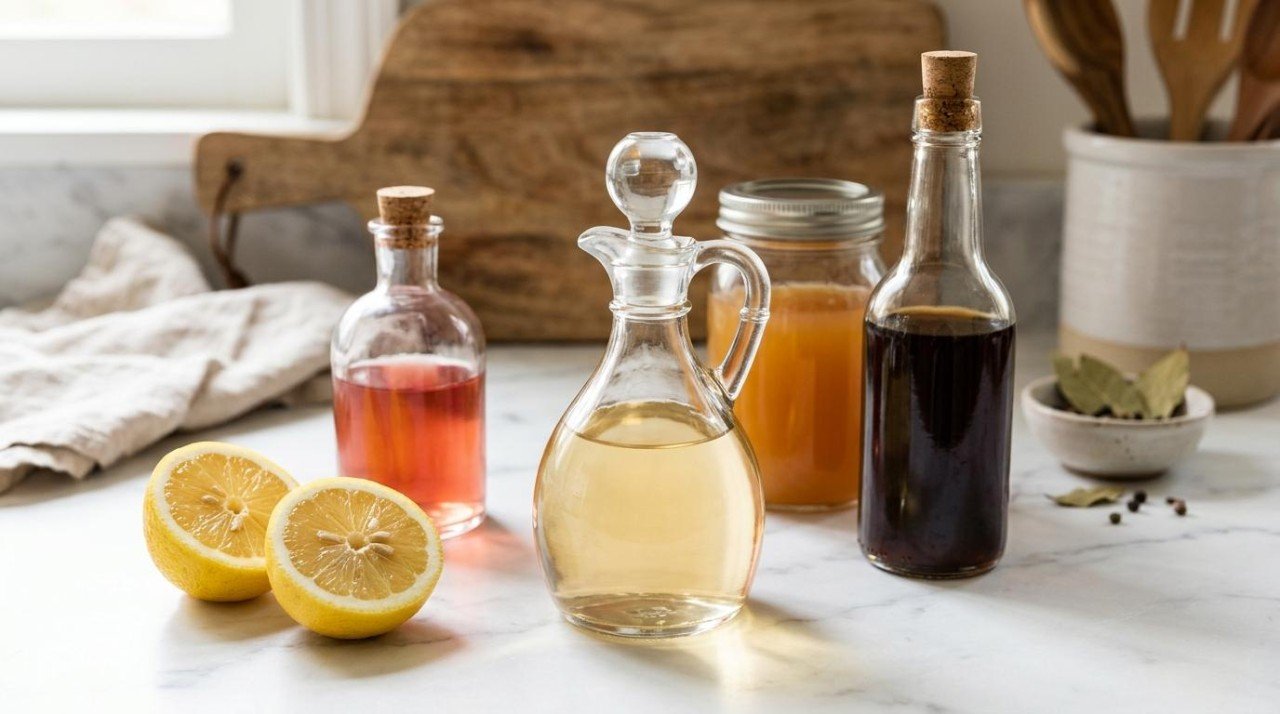
The shallots are minced, the butter is cold and cubed, and the recipe says to start with a quarter cup of white wine vinegar. The bottle is empty. Before you give up on the sauce, know that white wine vinegar is one of the easiest things in the kitchen to replace. Most pantries have at least one acid that will stand in for it, and a couple of them are close enough that nobody will notice.
White wine vinegar is white wine that bacteria have fermented into acetic acid. America's Test Kitchen describes it as "crisp and acidic, with 'subtle sweetness' and 'lemony' flavors". That is the profile to match: clean, bright acid, a little fruit, no color, and nothing strong enough to take over the dish. It is why recipes reach for it in vinaigrettes, pan sauces, beurre blanc, and pale pickles, where a darker or louder vinegar would show.
The best substitute depends on the job. A vinaigrette or a marinade will forgive almost any swap. A delicate butter sauce wants something mild and clear. And pickling for the pantry is the one place with real safety rules. The substitutes below run from most versatile to most specialized, with sections on each use case after them.
The Quick List
- Champagne vinegar — the closest match in flavor and color; pour it 1:1
- Unseasoned rice vinegar — milder and clear; great in dressings and slaws
- Apple cider vinegar — the bottle most people have; fruity and a solid 1:1 swap
- Sherry vinegar — deeper and nuttier; often an upgrade in vinaigrettes
- Red wine vinegar — nearly identical in flavor, just pink
- White balsamic vinegar — pale and gently sweet; good in salads and glazes
- Lemon juice — bright and easy for dressings, marinades, and butter sauces; never for canning
- Distilled white vinegar + white wine — the DIY rebuild when you have both
- Distilled white vinegar — blunt but it works, especially in cooked dishes and pickles
Champagne Vinegar
- Swap: 1:1
- Best for: Vinaigrettes, beurre blanc, seafood, spring vegetables, anything delicate
- Skip it for: Nothing, really — it is only second to the original
Champagne vinegar is made the same way as white wine vinegar, just from the grapes that go into sparkling wine. ATK's tasters called it "clean" and "mineral-y", which puts it very close to white wine vinegar, maybe a touch lighter. It is clear, mild, and behaves the same way in a dish, so you can pour it in without adjusting anything.
The only reason it is not more widely used is that fewer kitchens keep it. If you have a bottle, this is the answer for every recipe on this page, including the fussy ones like beurre blanc where the acid needs to taste clean.
Unseasoned Rice Vinegar
- Swap: 1:1, then add up to a third more to taste
- Best for: Vinaigrettes, slaws, cucumber salads, light marinades, quick pickles for the fridge
- Skip it for: Canning, unless the label says at least 5 percent acidity
Rice vinegar is the gentlest vinegar on the list, with what ATK describes as a "'malty' sweetness and mild acidity". It is clear, which keeps a creamy dressing or a pale potato salad looking right, and its softer edge works well anywhere white wine vinegar is supporting, not starring. Many bottles sit closer to 4 percent acidity than 5, so if the dish tastes a little flat, add another splash. Check the label as you go.
Make sure the bottle says unseasoned (or just "rice vinegar"). Seasoned rice vinegar has added sugar and salt for sushi rice, and it will quietly sweeten and salt your recipe. If seasoned is all you have, it can work in a dressing, but cut back on any sugar and salt the recipe calls for. Our rice vinegar substitutes guide covers the swap in the other direction.
Apple Cider Vinegar
- Swap: 1:1
- Best for: Marinades, slaws, potato salad, bean and grain salads, barbecue sauce, quick pickles
- Skip it for: Delicate butter sauces and very pale pickles, where its golden color and apple flavor show
This is the bottle most likely to be in your pantry, and it is a reliable swap. ATK calls it "fruity and balanced", and that fruit is why it fills in for white wine vinegar much better than plain distilled vinegar does. You trade grape for apple. In a coleslaw, a pork marinade, a potato salad, or a pot of greens, that often tastes like a choice rather than a compromise.
Most US bottles are labeled 5 percent acidity, so a 1:1 swap keeps the balance of the recipe. Two things to keep in mind: unfiltered cider vinegar is cloudy and slightly stronger in flavor, and its amber color can tint a white sauce. For those two reasons, use filtered cider vinegar when the look of the dish matters. More on this bottle in our apple cider vinegar substitutes guide.
Sherry Vinegar
- Swap: Start with ¾ as much, then taste and add up to 1:1
- Best for: Vinaigrettes, roasted vegetables, lentil salads, gazpacho, mushroom dishes, pan sauces for pork or chicken
- Skip it for: Beurre blanc and pale pickles, where its color and toasty flavor take over
Sherry vinegar is the swap that most often improves a dish rather than just saving it. ATK describes it as "'warm' and 'toasty,' with a 'brown-sugary' sweetness". In a vinaigrette for roasted vegetables, bitter greens, or a lentil salad, that depth is a gain. It is darker and fuller than white wine vinegar, though, so it is not the right pick when the recipe wants something clean and invisible.
It can also be stronger. Genuine Spanish sherry vinegar, Vinagre de Jerez, "must have a minimum of 7 degrees acidity", which is stronger than many supermarket wine vinegars. Check your white wine vinegar's label to compare. Its rounded flavor hides that well, but start a little short and taste before you add the rest.
Red Wine Vinegar
- Swap: 1:1
- Best for: Vinaigrettes, marinades, bean salads, braises, tomato dishes
- Skip it for: White sauces, pale pickles, and anything where a pink tint would look wrong
Red wine vinegar is the same product made from a different wine, so its acidity and how it acts in a dish are nearly identical. Red tastes a little fruitier and fuller, but once garlic, mustard, or herbs are in the bowl, the difference is small. In a vinaigrette, a marinade, or a bean salad, pour it 1:1.
Color is the catch. Red wine vinegar will turn a creamy dressing faintly pink and give a beurre blanc or a jar of pickled cauliflower a rosy tint. In a dish where that does not matter, it is one of the best swaps on this page. For the reverse problem, see our red wine vinegar substitutes guide.
White Balsamic Vinegar
- Swap: 1:1, and cut back on any sugar or honey in the recipe
- Best for: Fruit salads, salads with goat cheese or nuts, glazes for roasted vegetables, light marinades
- Skip it for: Pickles, beurre blanc, and savory dressings that should taste sharp, not sweet
White balsamic (sometimes sold as "white balsamic condiment") is pale gold, mild, and noticeably sweeter than white wine vinegar. That makes it a nice swap in a salad with fruit, cheese, or toasted nuts, where a little sweetness helps, and a poor one in recipes that rely on a crisp, sour edge. If the dressing tastes too soft, a squeeze of lemon brings the brightness back.
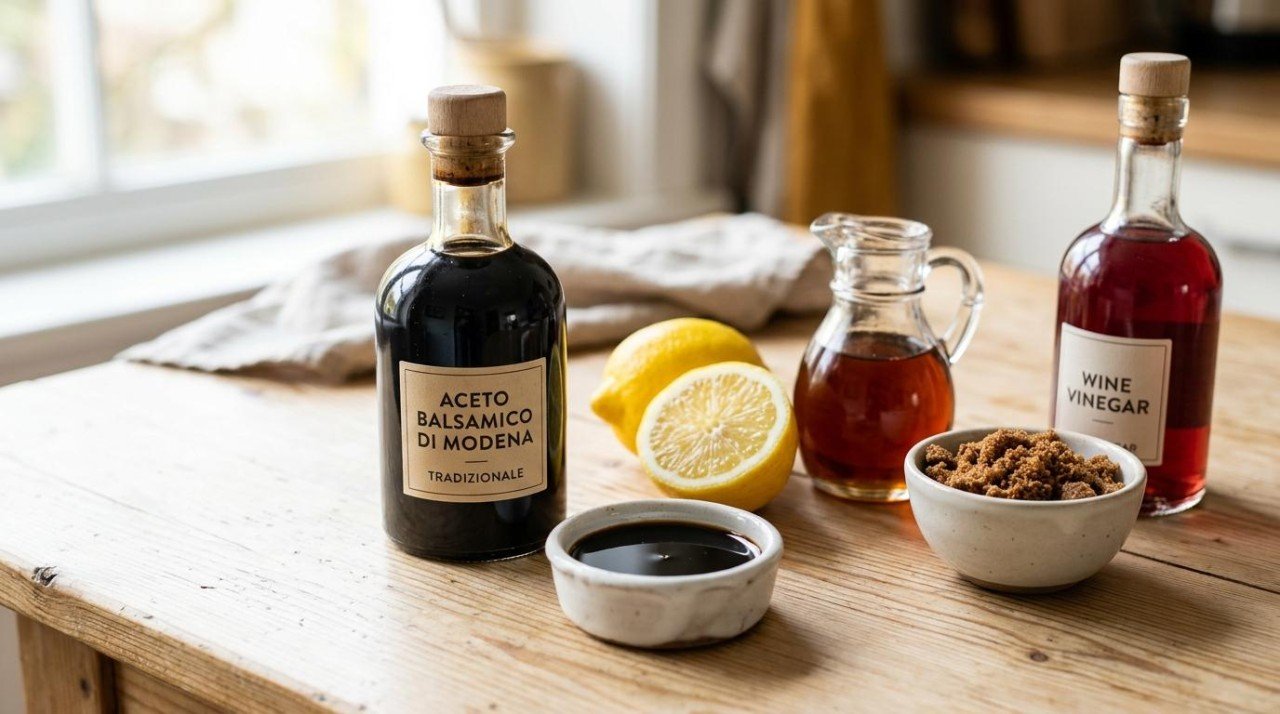
Do not confuse it with regular dark balsamic. Dark balsamic is thicker, sweeter, and will turn a pale dish brown. It can work in a bold marinade, but it is a much bigger change than any other swap here. Our balsamic vinegar substitutes guide explains the difference.
Lemon Juice
- Swap: 1:1
- Best for: Vinaigrettes, chicken and fish marinades, grain salads, hummus and dips, butter sauces
- Skip it for: Canning, and long marinades for delicate fish
No vinegar at all? Lemon juice is the swap, and in many recipes it is a lateral move rather than a compromise. A lemon vinaigrette, a chicken marinade, or a grain salad made with lemon instead of white wine vinegar tastes brighter and fresher. It is also a classic acid for beurre blanc: the sauce's base is traditionally made from white wine, vinegar or lemon juice, boiled down with shallots. Lemon tastes like lemon, of course, so use it where that fits.
Fresh lemons are fine for cooking but not for shelf-stable jars. Kansas State University's extension explains that fresh lemons have "an inconsistent acid, or pH, level" that can vary even within the same variety, which is a real problem when acid is what keeps the jar safe. Lime juice works the same way at 1:1 in dressings and marinades, with a more tropical flavor.
Distilled White Vinegar + White Wine
- Swap: ¼ cup white wine vinegar → 3 tablespoons distilled white vinegar + 1 tablespoon dry white wine
- Best for: Vinaigrettes, pan sauces, beurre blanc, marinades
- Skip it for: Pickling and canning — the wine dilutes the acid
This rebuilds white wine vinegar from its parts: plain white vinegar for the acid, a splash of dry white wine for the fruit. On its own, distilled vinegar tastes harsh and empty; the wine is what fixes that. Any dry white you would drink works — Sauvignon Blanc and Pinot Grigio are good picks — but skip anything sweet. If you can let the mixture sit for a few minutes before using it, the flavors blend better.
Two honest notes. You are adding a little alcohol, which cooks off in a sauce or reduction but stays in a raw dressing. At a tablespoon spread across a whole salad, that is trivial for most people, but worth knowing. And because wine is far less acidic than vinegar, the blend is weaker than the real thing. Use it for flavor, not for preserving. If you are short on the white wine too, our white wine substitutes guide has more options.
Distilled White Vinegar
- Swap: About ¾ as much in dressings, plus a small pinch of sugar; 1:1 in cooked dishes and pickles
- Best for: Pickles and canning, braises, beans, barbecue sauce, hot sauces
- Skip it for: Simple vinaigrettes and butter sauces where its harshness has nowhere to hide
Everyone has this bottle. ATK sums it up as "a colorless liquid with high acidity" — all sour, none of the fruit. In a long-cooked dish, a barbecue sauce, or a brine, that does not matter at all; pour it 1:1. In a raw dressing, pull back to about three-quarters of the amount and add a pinch of sugar to round off the edge. Better yet, add a splash of white wine and you have the DIY blend above.
It is also the safest swap for canning, since it is clear, consistent, and labeled at a known acidity. More on that below.
Best Swaps for Vinaigrettes
Dressings are where most white wine vinegar ends up, and they are the most forgiving place to substitute. A classic vinaigrette is about 3 parts oil to 1 part vinegar, plus Dijon, a little shallot, salt, and pepper, and the mustard and shallot do a lot of the flavor work. In order of preference:
- Champagne vinegar at 1:1 — the faithful version
- Sherry vinegar at ¾ to 1:1 — richer; great with roasted vegetables, lentils, and bitter greens
- Unseasoned rice vinegar at 1:1 or a bit more — softer; nice for tender lettuces and cucumber salads
- Lemon juice at 1:1 — for Mediterranean, grain, and chicken salads
- Apple cider vinegar at 1:1 — for slaws, potato salads, and salads with apples or pears
Whatever you use, taste the dressing on a leaf, not off a spoon. The oil-to-acid balance reads very differently on greens, and that is where you decide whether it needs another splash. If you are also out of Dijon mustard or shallots, we have guides for those too.
Best Swaps for Beurre Blanc and Pan Sauces
This is where white wine vinegar earns its place. In beurre blanc, wine and vinegar are boiled down with very finely chopped shallots "until the acids are well concentrated," and then cold butter is whisked in. The concentrated acid helps keep the butter creamy instead of oily. The same reduction shows up in béarnaise and some hollandaise recipes. Because the acid is reduced and concentrated, its flavor ends up front and center, so the swap matters more here than anywhere else.
- First choice: champagne vinegar at 1:1
- Second choice: lemon juice at 1:1, which gives a brighter, lemony sauce that is lovely with fish
- Third choice: the white vinegar + white wine blend, or unseasoned rice vinegar at 1:1
- Avoid: sherry, red wine, and balsamic vinegars, which will color the sauce; cider vinegar is passable but tastes of apple
For a quick pan sauce after searing chicken or pork, the rules are looser: deglaze with any of the vinegars on this page, add a little stock, and finish with butter. Sherry vinegar is especially good with pork and mushrooms.
Best Swaps for Marinades
Marinades are easy, because the acid mostly flavors the surface of the food while garlic, herbs, oil, and salt carry the rest. Any swap here works. A few good pairings:
- Chicken and pork: apple cider vinegar, lemon juice, or sherry vinegar
- Fish and shrimp: lemon juice, lime juice, or champagne vinegar — and keep it to 15 to 30 minutes, since acid starts to firm up the surface of delicate seafood
- Vegetables and tofu: rice vinegar or cider vinegar
Best Swaps for Pickling (Read This First)
Pickling is the one place not to improvise, because in a canned pickle the acid is the preservative, not just a seasoning.
For shelf-stable, canned pickles, Penn State Extension is clear that vinegar used for pickling must be at least 5 percent acidity, and that you should not dilute it with water unless a research-tested recipe tells you to. That rules out the vinegar-and-wine blend, lemon juice, homemade vinegar, and any rice vinegar labeled below 5 percent. Penn State also groups wine vinegars with the specialty vinegars to "use these only when specified in a research-tested recipe", and when a tested recipe does not name a type, you "may safely use either white or cider vinegar as long as it is labeled as 5% acidity."
So if a tested recipe calls for white wine vinegar and you are out, swap in a commercial vinegar labeled with at least the same acidity and keep everything else exactly as written. Distilled white vinegar is the safest pick, and Penn State notes that white vinegar is "preferred when light color is desired for making fruit or cauliflower pickles." Cider vinegar at 5 percent works too, but it can darken pale vegetables. Never cut the amount of vinegar or swap in lemon juice.
Quick refrigerator pickles are a different story. A jar of pickled shallots, cucumber spears for the week, or pickled red onions for tacos are not relying on acid for long-term safety, so any vinegar works. Rice vinegar gives a mild, gently sweet pickle; cider vinegar gives a fruitier one.
The Healthier Angle: Acid Is a Salt-Saver
None of these swaps changes the nutrition of a dish much. Wine vinegars are close to zero: a tablespoon of red wine vinegar, for example, has about 3 calories and 1 mg of sodium by USDA data, and white wine, champagne, and cider vinegars are in the same range. The swap that does add something is balsamic: a tablespoon of regular balsamic carries 14 calories and about 2.4 g of sugar. White balsamic is usually sweet as well, so check the label if you are pouring it freely. Seasoned rice vinegar adds both sugar and sodium.
The real benefit is less about which acid you choose and more about using one in the first place. A splash of vinegar or lemon at the end makes food taste brighter and better seasoned, which is one of the easiest ways to use less salt without anyone noticing. (More on that in salt, fat, acid, heat.) It is also a good reason to make vinaigrette at home. A regular bottled Italian dressing runs about 146 mg of sodium and 1.6 g of sugar per tablespoon by USDA data, while a homemade one has exactly what you put in it. A dressing you like is also what keeps you coming back to salads, and our guide to building a salad that keeps you full covers the rest of the bowl.
Vinegar is also the start of quick pickles, which are an easy way to get more vegetables on the table: a jar of pickled onions, carrots, or cucumbers makes a plain grain bowl or sandwich better all week. Note that quick vinegar pickles are not fermented and do not contain live cultures; if that is what you are after, our fermented foods guide explains the difference.
If you want to see what a swap does to a specific recipe, Eat Well Planner is built for it. The Recipe Playground lets you change an ingredient — white wine vinegar to white balsamic, or a teaspoon of salt down to half with an extra splash of lemon — and watch the nutrition score update live, with a delta for each change. And Make It Healthier suggests swaps for any recipe and checks each one with a calculator to confirm the real gain before showing it to you.
Take the Guesswork Out of Eating Well
Eat Well Planner helps you organize your favorite recipes, plan balanced meals, and automatically generate shopping lists — all in one place. Whether you're tracking macros, managing dietary restrictions, or just trying to stop asking "what's for dinner?", we've got you covered.
Our AI-powered tools can adapt any recipe to your dietary needs, help you discover new meals you'll love, and even log your nutrition effortlessly. It's meal planning made simple.
Start Organizing Your Meals — FreeWhat Not to Use
- White wine on its own — it has only a fraction of vinegar's acidity. Your dressing will taste like wine and oil, not vinaigrette. It only works mixed with a vinegar.
- Dark balsamic in a pale or delicate dish — it turns a beurre blanc or a creamy dressing brown and sweet.
- Malt vinegar — ATK calls it "a bit aggressive for most vinaigrettes". Great on fries, wrong almost everywhere white wine vinegar goes.
- Seasoned rice vinegar, unadjusted — the added sugar and salt will quietly rewrite your recipe.
- Cleaning vinegar — sold at higher acidity and not meant for food. If the label does not say it is for cooking, leave it under the sink.
- Lemon juice or diluted blends in canning — the acid level is unreliable or too low for shelf-stable jars. Use a commercial vinegar labeled at least 5 percent.
- Leaving the acid out — the worst option. A vinaigrette without acid is just oil, and a beurre blanc without it is melted butter that will not stay creamy.
The Short Version
Have champagne vinegar? Use it 1:1 and move on. Otherwise, rice vinegar or apple cider vinegar will cover most dressings, slaws, and marinades at 1:1. Sherry vinegar is the upgrade for hearty salads and roasted vegetables. Red wine vinegar works anywhere a pink tint is fine. Lemon juice is great for dressings, fish, and beurre blanc. Canning? Use a commercial vinegar labeled at least 5 percent acidity — distilled white is the safest — and nothing else.
A guide can only tell you what usually works. If you are not sure which of these suits the dish in front of you, the Eat Well Planner recipe chat can answer that with your full recipe in context. Ask "I am out of white wine vinegar, what should I use in this?" and it will weigh the swap against everything else in the recipe — the butter, the herbs, whether it is going into a jar — rather than guessing in the abstract. It is free, and so is the rest of the app.