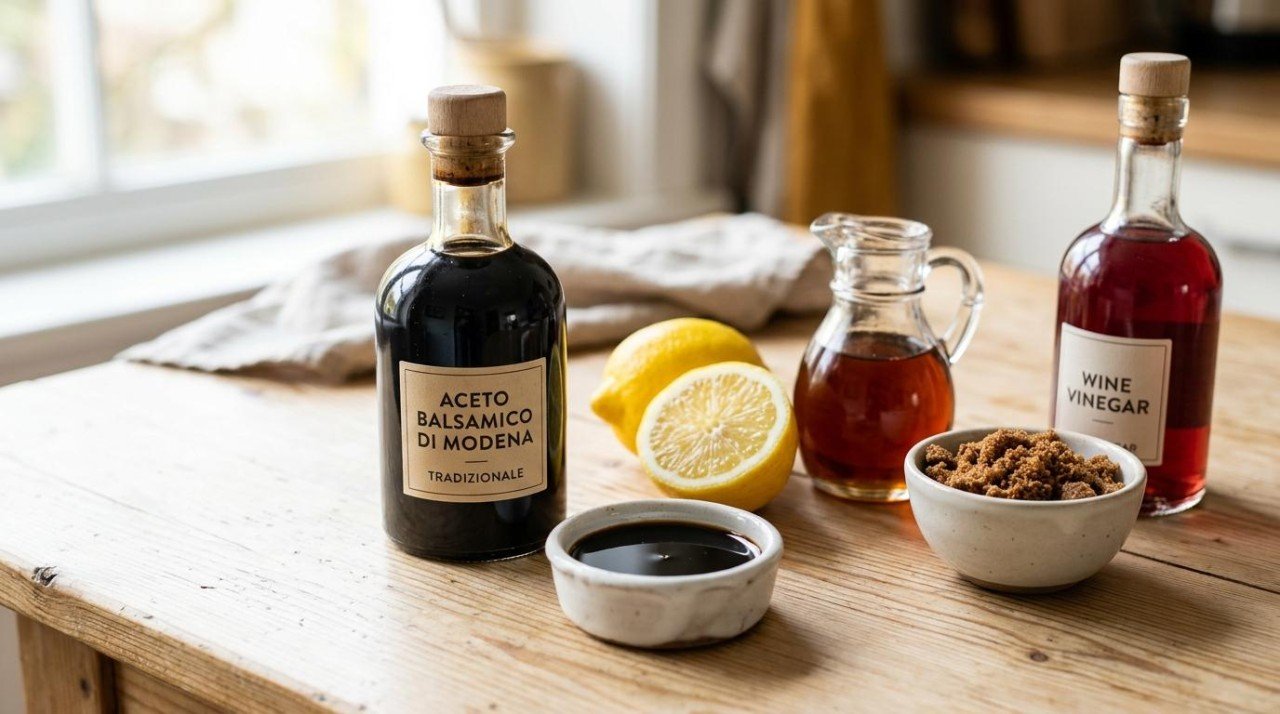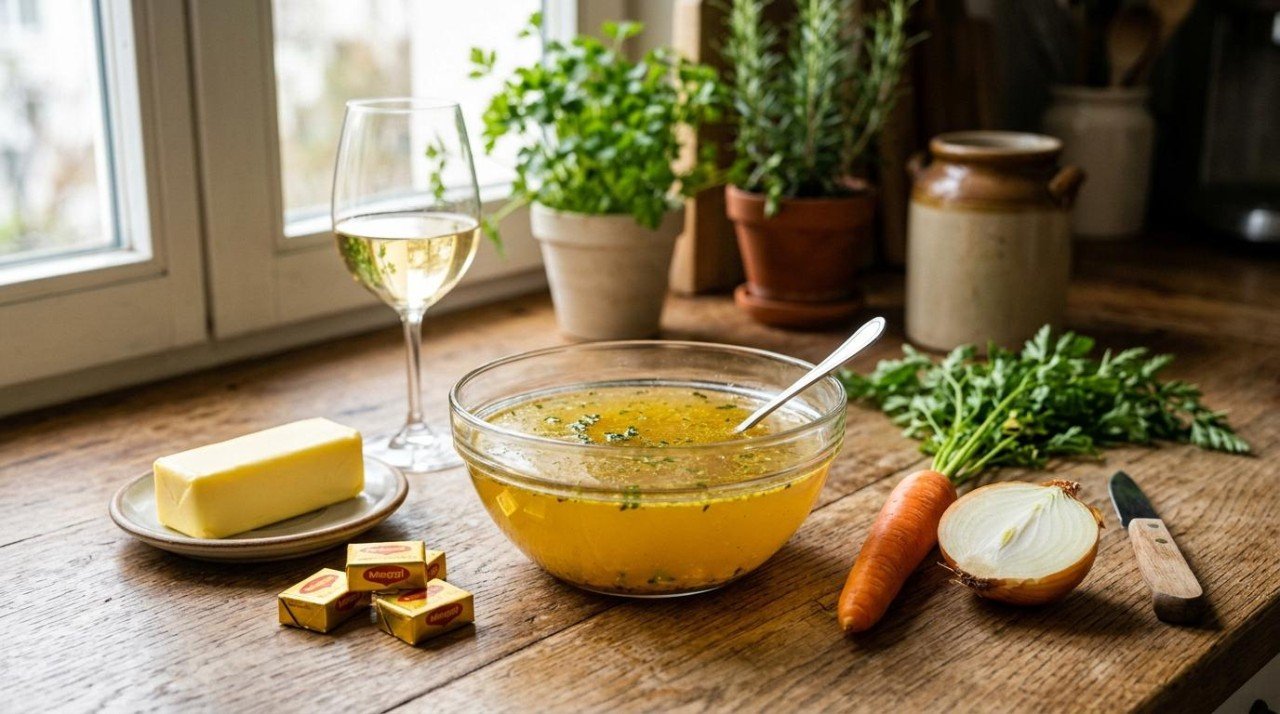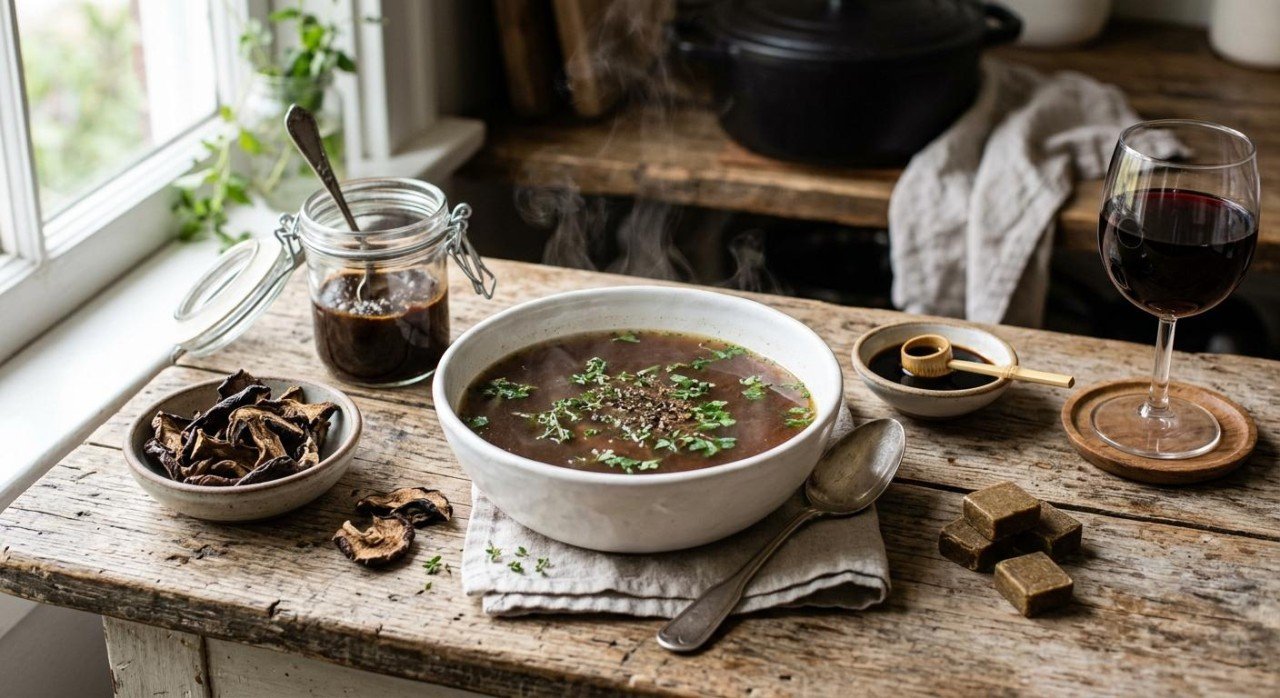
The chuck roast is browned, the onions have gone soft and sticky, the recipe says "add 3 cups beef broth" — and the pantry has a carton of chicken broth, a jar of something, and no beef broth at all. Do not panic, and do not run to the store. Beef broth is one of the easier ingredients to rebuild, and in a few cases the stand-in is better than the carton.
That last part is not a stretch. America's Test Kitchen's tasting of supermarket beef broths opened with the line "Commercial beef broths contain almost no beef." Federal rules only require a product labeled beef broth to hit 135 parts moisture to 1 part protein, and half the products they tested had 1 gram of protein or less per cup. The savory flavor mostly comes from yeast extract and other glutamate-rich flavorings, plus a lot of salt. So what you are really replacing is three things: savory depth, a dark roasted color, and sodium. All three are easy to put back.
Which swap is best depends on the dish. A long-simmered stew makes much of its own flavor and forgives almost anything. A French onion soup, where the broth is the dish, needs the strongest stand-in you have. A pan sauce or gravy boils its liquid down, which concentrates every milligram of salt you put in. Substitutes below run from most versatile to most specialized, with a use-case cheat sheet after them.
The Quick List
- Beef base (the paste in a jar) — the best all-around stand-in; ATK's top-rated "beef broth"
- Beef bouillon cubes or granules — the pantry backup; watch the salt and read the box
- Chicken broth + soy sauce + Worcestershire — the swap most people can make right now
- Mushroom broth — the best vegetarian swap, with about half the sodium
- Vegetable broth + tomato paste — a meatless route to dark, savory depth
- Beef bone broth — 1:1 with real protein, but you season it yourself
- Dried mushroom soaking liquid — the deepest umami on the list, zero sodium
- Water + browned aromatics — the "I have nothing" broth, better than it sounds
- Red wine + water — for stews, braises, and pan sauces, never a whole soup pot
- Dark beer — up to half the liquid in a beef stew or chili
Beef Base (the Paste in a Jar)
- Swap: 1 teaspoon base dissolved in 1 cup hot water = 1 cup broth
- Best for: Everything — stews, braises, French onion soup, gravy, pan sauces
- Skip it for: Nothing, though use a little less in anything that reduces hard
- Health notes: Better Than Bouillon Roasted Beef Base carries 680 mg sodium and 1 g protein per teaspoon — roughly in line with a cup of carton broth
If you keep one beef broth backup in the house, make it this. When America's Test Kitchen tasted ten supermarket beef broths, the winner was not a carton at all but Better Than Bouillon Roasted Beef Base, which tasters said had fuller flavor than the boxed broths, at about 16 cents a cup. It keeps for months in the fridge and takes up a fraction of the space of a shelf of cartons.
The paste also does something a carton cannot: you can use it undiluted. Half a teaspoon stirred straight into a gravy, a pan of mushrooms, or a pot of chili that tastes a little flat adds beefy depth without adding any liquid. Just be honest with yourself about the salt — that half teaspoon is about 340 mg — and season the rest of the dish after it goes in.
Beef Bouillon Cubes or Granules
- Swap: Follow the box. Herb-Ox cubes are made for 1 cup of boiling water; Knorr beef cubes are built for 2 cups each. Mixing these up is the number one way this swap goes wrong.
- Best for: Stews, soups, braises, rice and grains
- Skip it for: French onion soup if you have anything better — the broth is the whole dish there, and cube flavor is one-note
- Health notes: One Herb-Ox beef cube carries 960 mg sodium and 0 g protein
Cubes and granules are the reliable fallback, and in a stew with a browned roast, onions, carrots, and two hours of simmering, almost nobody will taste the difference. They are saltier and flatter than a good base, with more "beef flavor" than actual beef, but the pot does the rest of the work.
Two adjustments make them much better. First, in anything that reduces — a pan sauce, a gravy, a braise you boil down at the end — use about three quarters of what the box says and salt at the end. Second, a cube by itself is thin. A teaspoon of tomato paste or a few drops of Worcestershire stirred in with it gives the broth some of the roasted depth the cube is missing.
Chicken Broth + Soy Sauce + Worcestershire
- Swap: 1 cup chicken broth + 1 teaspoon soy sauce + ½ teaspoon Worcestershire sauce
- Best for: Stews, braises, pot roast, gravy, French onion soup in a pinch
- Skip it for: Nothing major — it is a strong all-rounder
- Health notes: Adds roughly 360 mg sodium per cup on top of the chicken broth, so use low-sodium chicken broth if you have it
This is the swap most kitchens can make tonight, and it is surprisingly convincing. Chicken broth supplies the body and the basic savory base. Soy sauce brings deep color and a fermented, meaty saltiness. Worcestershire adds the tangy, slightly funky backbone that makes beef dishes taste like beef dishes — it is built on anchovies and tamarind, which is exactly the savory-sour edge beef broth tends to have.
Plain chicken broth on its own also works in a long-cooked stew, and many cooks actually prefer it — ATK's own beef stew writeup reaches for chicken broth "favored over tinny canned beef broth." The soy and Worcestershire matter most in dishes where the broth has to carry the flavor on its own, like French onion soup or a quick gravy. For more on why the chicken carton works so well as a base, see our chicken broth substitutes guide.
On the numbers: a teaspoon of soy sauce runs about 291 mg of sodium, and a tablespoon of Worcestershire sauce has 208 mg, so the half teaspoon in this swap adds only about 70 mg. Paired with regular chicken broth you land somewhat above a cup of beef broth; paired with low-sodium chicken broth, comfortably below it.
Mushroom Broth
- Swap: 1:1; add 1 teaspoon soy sauce per cup if the dish needs more color and depth
- Best for: Vegetarian French onion soup, mushroom or barley soup, stews, gravy, braised vegetables
- Skip it for: Light dishes where an earthy flavor would stand out
- Health notes: Pacific Foods Organic Mushroom Broth has 440 mg sodium per cup — about half of regular beef broth's 830 mg
Mushroom broth is the best vegetarian stand-in for beef broth, and it is not close. Mushrooms are naturally rich in glutamates, the same savory compounds that commercial beef broths get from yeast extract — ATK found yeast extract in all ten broths they tested, and one runner-up was even marked down for tasting "mushroomy" rather than beefy. In other words, a lot of what you think of as beef broth flavor is already mushroom-adjacent. (If the word glutamate makes you nervous, our post on why MSG was framed is a good read.)
Store-bought mushroom broth tends to be lighter in color than beef broth, so in a dish where color matters — French onion soup, a dark gravy — the teaspoon of soy sauce is worth adding. It deepens the color and rounds out the flavor at the same time.
Vegetable Broth + Tomato Paste
- Swap: 1 cup vegetable broth + 1 teaspoon tomato paste + 1 teaspoon soy sauce. Fry the tomato paste in the pot's oil for a minute until it darkens before adding the broth.
- Best for: Stews, chili, braised beans, vegetable soups, pot pie filling
- Skip it for: French onion soup, where vegetable broth's sweetness doubles up on the caramelized onions
Plain vegetable broth is a weak beef broth substitute: it is sweet and vegetal where beef broth is dark and roasted. The fix is to add back the two missing things. Tomato paste cooked in fat until it turns brick-red develops the roasted, almost meaty notes beef broth is known for, and soy sauce adds the savory depth and color.
This swap shines in anything already full of tomatoes and vegetables — a chili, a vegetable-heavy beef stew, a pot of braised beans. It struggles most in dishes that are simple and brothy, where vegetable broth's sweetness has nowhere to hide.
Beef Bone Broth
- Swap: 1:1, then taste and salt
- Best for: Stews, braises, soups, gravy — anywhere you want more body
- Skip it for: Nothing culinary; just do not expect it to be seasoned for you
- Health notes: A real upgrade. Meijer beef bone broth has 9 g protein and 230 mg sodium per cup, against 2 g and 830 mg for regular Swanson beef broth
Bone broth is simmered long enough to pull protein and collagen out of the bones, so it has more body than carton broth, actual beef flavor, and in that comparison more than four times the protein at well under a third of the sodium. It is also the one swap that tends to make a gravy or a pan sauce better rather than just acceptable, because the gelatin gives the sauce a glossy, spoon-coating texture as it reduces.
The catch is the same low sodium that makes it the healthier pick. Drop it into a recipe that was written around salty carton broth and the dish will taste flat until you season it. Taste at the end and salt to taste — you will almost always use less than the carton would have added. Brands vary a lot in protein and sodium, so check the label of the one you buy.
Dried Mushroom Soaking Liquid
- Swap: Steep ½ ounce dried porcini or shiitake in 2 cups boiling water for 20 to 30 minutes. Strain through a coffee filter or paper-towel-lined sieve, then use 1:1 with ½ teaspoon soy sauce and a pinch of salt per cup.
- Best for: French onion soup, beef or mushroom stew, gravy, braises, barley soup
- Skip it for: Anything that should taste light or bright
- Health notes: Zero sodium until you add it, so you control the salt completely
This is the swap that can beat a carton of beef broth outright. Dried porcini and shiitake are glutamate bombs, and their soaking liquid is dark, earthy, and deeply savory — closer in character to a long-simmered homemade beef stock than most of what is sold as beef broth. It is a classic trick in vegetarian French onion soup for exactly that reason.
Two rules. Strain carefully, because dried mushrooms carry grit that sinks to the bottom of the bowl, and sand in a soup is worse than any broth substitute. And do not throw away the mushrooms — chop them and add them to the dish.
Water + Browned Aromatics
- Swap: For 4 cups: brown 1 chopped onion in 1 tablespoon oil until deep golden, stir in 1 tablespoon tomato paste and cook 1 minute, add 4 cups water, 1 tablespoon soy sauce, 1 teaspoon Worcestershire, a bay leaf, and ½ teaspoon salt. Simmer 15 to 20 minutes and strain (or leave the onion in).
- Best for: Stews, braises, soups, chili — anything with time to simmer
- Skip it for: A pan sauce you need in two minutes
Beef broth's character comes from browning, and browning is something you can do in your own pot. Onion cooked past soft into deep golden, plus tomato paste toasted in the fat, gives you the roasted sweetness and color that carton broth imitates with flavorings. Soy and Worcestershire bring the savory depth. The result is not beef broth, but in a stew or chili it does the same job, and you know exactly how much salt went in.
Also remember that if your recipe starts by browning beef, the pot is already making broth. The browned bits stuck to the bottom of the pan — the fond — are concentrated meat flavor. Deglaze them with your liquid, whatever it is, and scrape them up. In a long braise with well-browned meat, even plain salted water does a respectable job.
Red Wine + Water
- Swap: ¼ cup dry red wine + ¾ cup water per cup of broth; simmer at least a few minutes before the dish moves on
- Best for: Beef stew, pot roast, short ribs, pan sauces, deglazing
- Skip it for: Replacing all the liquid in a soup — straight wine is sour, boozy, and purple
Wine brings acidity, fruit, and color, but none of broth's savory body, so it works as part of the liquid rather than all of it. Many beef braises already call for both — boeuf bourguignon is a pot of wine and broth — so in those dishes, leaning a little harder on the wine and adding a teaspoon of soy sauce or a spoonful of beef base usually fills the gap. Our red wine substitutes guide covers the reverse problem.
The simmer matters. Wine added late tastes raw and harsh; a few minutes of bubbling cooks off the sharp edge and leaves the good flavor behind.
Dark Beer
- Swap: Replace up to half the beef broth with a stout, porter, or brown ale; make up the rest with any broth or water plus a teaspoon of soy sauce per cup
- Best for: Beef stew, chili, pot roast, onion gravy for sausages
- Skip it for: Light soups and quick pan sauces, where the bitterness has no time to mellow
Dark beer brings a roasted, malty depth that sits very close to what people like about beef broth, which is why Belgian carbonnade and Irish stews are built on it. Long simmering softens its bitterness into something round and rich. Avoid hoppy beers like IPAs, which turn harsh and bitter as they cook down.
A Bonus Trick: Gelatin for Body
Homemade beef stock gets its silky, lip-coating body from gelatin pulled out of the bones. Carton broth and every substitute above except bone broth lack it, which is why a substitute gravy can taste right but feel thin. The fix is cheap: bloom 1 teaspoon of unflavored gelatin per cup of liquid in a little cold water, then stir it into the hot pot. America's Test Kitchen's quick beef broth uses exactly this ratio — 8 teaspoons of gelatin for 2 quarts — alongside a pound of browned ground beef to give store-bought broth real body. It is worth knowing for pan sauces, French onion soup, and any stew that seems watery. (Out of gelatin too? Our gelatin substitutes guide has you covered.)
Which Swap for Which Dish
Stews, Braises, and Pot Roast
The most forgiving category. You are browning meat, cooking aromatics, and simmering for hours, so the pot builds much of its own flavor. Chicken broth plus soy and Worcestershire is excellent here, as are base, bouillon, bone broth, and red wine or dark beer for up to part of the liquid. Even water works if you brown the meat well and season properly.
French Onion Soup
The least forgiving dish, because the broth is most of what you eat. Reach for beef base first, then bone broth or a mix of half chicken broth and half beef base. For a vegetarian version, use mushroom broth or dried mushroom soaking liquid with a teaspoon of soy sauce per cup. Avoid plain vegetable broth here: caramelized onions are already very sweet, and a sweet broth makes the whole bowl taste like dessert.
Soups (Vegetable Beef, Barley, Chili)
Almost anything works, because a soup keeps its liquid and dilutes the salt across servings. Vegetable broth plus tomato paste suits tomato-based soups and chili. Mushroom broth is a natural match for beef and barley soup.
Gravies and Pan Sauces
These reduce, so sodium concentrates fast — this is where a full-strength bouillon cube turns a gravy into a salt lick. Use bone broth, low-sodium chicken broth plus soy, or mushroom liquid, and season at the very end. If you have pan drippings, use them: they are the best beef flavor in the kitchen. A teaspoon of gelatin per cup gives a reduced sauce its glossy, restaurant-style body. For a standard gravy, 2 tablespoons fat and 2 tablespoons flour per cup of liquid will thicken whichever substitute you choose.
The Sodium Question, Honestly
Beef broth's sodium varies more than people realize, and it is the thing most likely to make a substitute go wrong. Here is how the options stack up per cup:
- Herb-Ox beef bouillon cube: 960 mg
- Swanson beef broth: 830 mg
- Better Than Bouillon beef base (1 teaspoon): 680 mg
- Homemade beef stock: 475 mg, with 4.7 g protein
- Pacific Foods mushroom broth: 440 mg
- Swanson low-sodium beef broth: 409 mg
- Meijer beef bone broth: 230 mg, with 9 g protein
- Dried mushroom soaking liquid: essentially 0 mg until you salt it
A cup of regular beef broth delivers more than a third of a day's recommended sodium limit, and a typical stew uses three or four cups. That is not a reason to avoid it — that sodium is spread across several servings — but it does lead to two practical rules:
- If the recipe reduces the liquid, start low-sodium and salt at the end. Pan sauces, gravies, and braises that boil down concentrate everything you added at the start.
- If the liquid stays in the dish, sodium matters less. A soup eaten as-is spreads the sodium across the pot.
The genuinely healthier move is to pick the lower-sodium option — bone broth, mushroom liquid, low-sodium broth — and season at the end when you can taste it. Bone broth in particular is a straight upgrade: more protein, more body, and a fraction of the sodium, for no loss of flavor once the dish is salted properly.
Which Swap Fits Your Recipe?
A guide can tell you that chicken broth plus soy sauce works in a stew and that vegetable broth is the wrong call for French onion soup. It cannot tell you what to do with your recipe. That is where Eat Well Planner helps: the AI recipe chat has your actual recipe in front of it, so "I'm making this pot roast and I'm out of beef broth — what should I use?" gets an answer built around your ingredients, your cook time, and how much the liquid reduces. Need the whole dish vegetarian? Recipe Variations can rewrite it with mushroom broth and the other swaps already worked in.
If you are swapping for sodium rather than an empty pantry, the Recipe Playground lets you try the change and watch the nutrition update live, with a per-edit delta showing exactly what moving from carton broth to bone broth did to the dish. And Make It Healthier suggests swaps like these on its own, with a calculator verifying the real nutritional gain before anything is suggested.
Take the Guesswork Out of Eating Well
Eat Well Planner helps you organize your favorite recipes, plan balanced meals, and automatically generate shopping lists — all in one place. Whether you're tracking macros, managing dietary restrictions, or just trying to stop asking "what's for dinner?", we've got you covered.
Our AI-powered tools can adapt any recipe to your dietary needs, help you discover new meals you'll love, and even log your nutrition effortlessly. It's meal planning made simple.
Start Organizing Your Meals — FreeWhat Not to Use
- Doubling the bouillon "for more flavor." You get more salt, not more beef.
- Straight wine or beer as all the liquid. Wine turns a soup sour and purple; a whole pot of beer can go bitter. Keep wine to a quarter and beer to half.
- Consommé or condensed beef broth at full strength. Condensed products are made to be diluted. Follow the can's directions — usually equal parts water — or you will badly over-salt the dish.
- Plain vegetable broth in French onion soup. Too sweet on top of caramelized onions. Use mushroom broth instead.
- Liquid smoke or "browning sauce" to fake color. A drop of browning sauce is harmless, but neither adds the savory depth you are actually missing, and liquid smoke takes over a dish fast.
The Short Version
Beef base is the best backup to keep around, bouillon is fine if you read the box, and chicken broth with a teaspoon of soy sauce and a dash of Worcestershire is the swap almost everyone can make right now. For a vegetarian version, reach for mushroom broth or dried mushroom liquid. For the healthiest pick, use bone broth and salt it yourself. Keep wine to a quarter of the liquid, beer to half, and in anything that reduces, salt at the end.
And if you would rather not solve this mid-recipe again: Eat Well Planner is free, keeps all your recipes in one searchable place, and turns your weekly meal plan into a shopping list automatically — which is how the broth ends up in the pantry before the recipe calls for it.