The onions are softening, the rice is toasted, the recipe says "add 4 cups chicken broth" — and the carton in the pantry is empty. Good news: this is one of the most forgiving substitutions in the kitchen. You almost certainly have something that works right now.
Here is the useful thing to understand first. Store-bought chicken broth is mostly salty, savory water. A cup of a typical supermarket chicken broth has about 10 calories, 1 gram of protein, and 860 mg of sodium. It is not carrying the dish nutritionally — it is carrying salt and a savory background note. Once you know that, the substitution gets a lot less scary, because salt and savory depth are easy to rebuild.
Which swap is best depends on the job. A pot of soup will forgive almost anything. A risotto or a pan sauce reduces its liquid down, which concentrates whatever salt you put in it — so those dishes care a great deal about what you reach for. Substitutes below are ordered from most versatile to most specialized.
The Quick List
- Bouillon cube or granules — the pantry MVP; broth in 30 seconds, just watch the salt
- Chicken base (the paste in a jar) — same idea, noticeably better flavor
- Vegetable broth — straight 1:1 swap, barely a compromise
- Water + butter + aromatics — 15 minutes turns water into something worth eating
- Any other broth you have — beef, turkey, mushroom; all fine with a caveat
- Dried mushroom soaking liquid — the umami pick; deep, meaty, vegetarian
- Bone broth — 1:1 with a real protein bonus, but season it yourself
- Water + a spoon of miso or soy sauce — instant savory depth from the fridge door
- White wine + water — for pan sauces and risotto only, never a whole pot
- Plain water — genuinely fine more often than you would think
Bouillon Cubes or Granules
- Swap: Follow the box, not a blog. Herb-Ox says 1 cube per 1 cup of boiling water; Knorr's cubes are made for 2 cups each. Getting this backwards is the single most common way this swap goes wrong.
- Best for: Everything — soups, risotto, braises, grains, gravy
- Skip it for: Nothing, but see the sodium note below before you use it in anything that reduces
- Health notes: One Herb-Ox cube carries 1,020 mg of sodium — about 20 percent more than a cup of regular broth
This is the answer for most people most of the time, and there is no shame in it. Dissolve, stir, carry on. The flavor is more one-note than a good carton broth — saltier and rounder, with less actual chicken character — but in a dish with onions, garlic, herbs, and a protein in it, almost nobody could pick it out.
The one real trap is salt. Because a cube is engineered to make plain water taste like something, it front-loads sodium. If your recipe is going to reduce the liquid — risotto, a pan sauce, a braise you will boil down at the end — use about ¾ of what the box says and salt at the end instead. If you are cooking for someone watching sodium, Herb-Ox also makes a sodium-free granulated version at 0 mg, which lets you do the salting yourself.
Chicken Base (the Paste in a Jar)
- Swap: 1 teaspoon per 1 cup of hot water = 1 cup broth
- Best for: Everything a cube does, but better — especially soups and risotto where the broth flavor is front and center
- Skip it for: Nothing
- Health notes: 680 mg sodium per teaspoon; a reduced-sodium version runs about 500 mg
If you keep one broth backup in the house, make it this. Better Than Bouillon and similar jarred bases are concentrated cooked chicken rather than mostly-salt cubes, and the difference shows. America's Test Kitchen rated it their Best Buy in a supermarket broth lineup — beaten only by an actual liquid stock.
Bonus: because it is a paste, you can also use it undiluted as a seasoning. A half teaspoon stirred into a pan of vegetables or a gravy adds savory depth without adding liquid, which is a trick a carton of broth simply cannot do.
Vegetable Broth
- Swap: 1:1
- Best for: Soups, stews, risotto, grains, braises, gravy — essentially everything
- Skip it for: Dishes where chicken flavor is the entire point, like a clear chicken noodle soup
- Health notes: Nutritionally a wash — the same brand's vegetable broth has 801 mg sodium and 0 g protein per cup against chicken's 860 mg and 1 g
Pour it in and stop worrying. This is the closest thing to a no-thought swap on the list, and it has the side benefit of making the dish vegetarian if nothing else in it is not.
The one difference worth knowing: vegetable broth is usually sweeter and more vegetal, because carrot and onion do the heavy lifting. In a tomato soup or a risotto that reads as a plus. In something meant to taste distinctly of chicken it reads as slightly off — not bad, just not the same dish. A splash of soy sauce or a squeeze of lemon at the end closes most of that gap.
Water + Butter + Aromatics
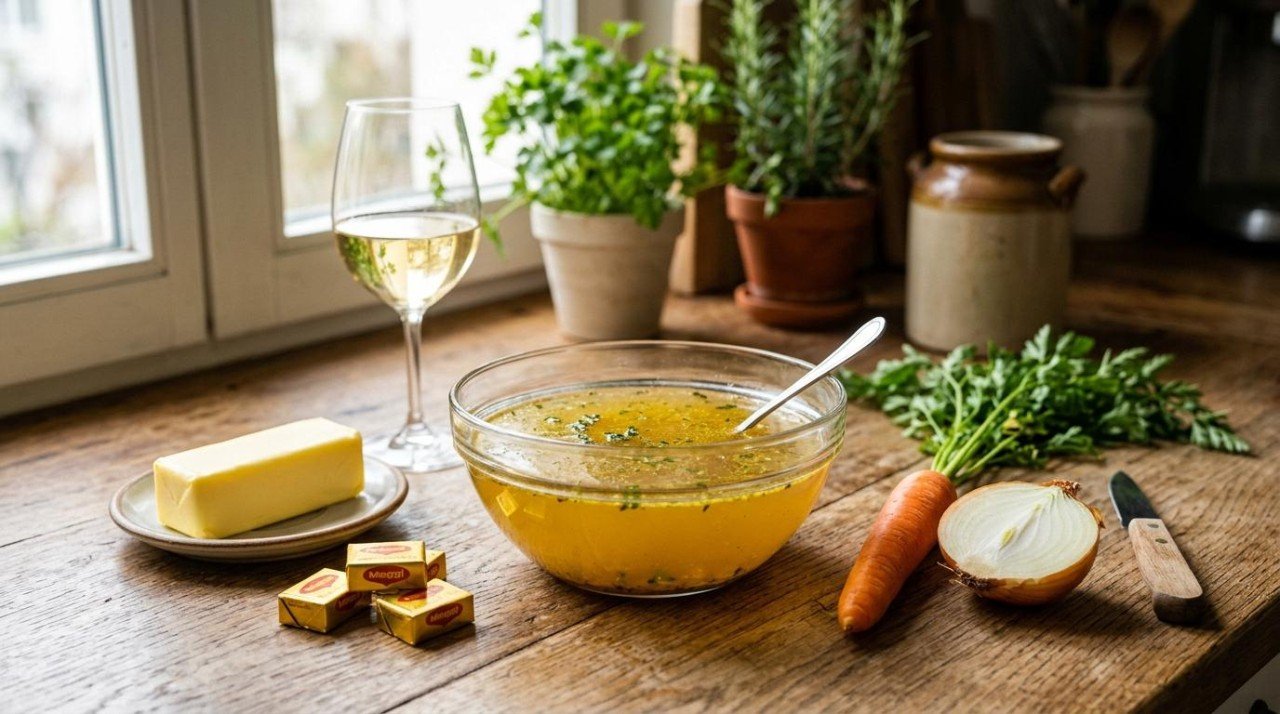
- Swap: Per 4 cups water: 1 tablespoon butter or olive oil, ½ onion roughly chopped, 1 smashed garlic clove, a carrot or celery rib if you have one, a bay leaf, and ¼ teaspoon salt per cup. Simmer 15 to 20 minutes, strain.
- Best for: Soups, braises, beans, grains — anything with time to simmer
- Skip it for: A pan sauce you need in 90 seconds
This is the swap that turns "I have nothing" into "I have broth," and it is better than it sounds because it rebuilds the two things broth actually contributes. The aromatics supply the savory background. The fat matters more than people expect: a lot of what reads as richness in broth is dissolved fat, and a tablespoon of butter gives thin liquid a body and mouthfeel that plain water never has. Harvard's own vegetable stock recipe works on exactly this logic — onions, leeks, and garlic sweated in oil, then simmered.
The salt is the part people underdo. That ¼ teaspoon per cup is roughly 575 mg of sodium, which lands right inside the 400 to 700 mg per cup range America's Test Kitchen found tasted best balanced in commercial broths. Season it like broth and it behaves like broth. Season it like water and you will spend the rest of the recipe wondering what is missing.
Any Other Broth You Have
- Swap: 1:1
- Best for: Turkey (a dead ringer), mushroom, or vegetable in nearly anything; beef in dark, hearty dishes
- Skip it for: Beef broth in anything pale or delicate — it will bully the dish and tint it brown
Turkey broth is the closest match on the shelf and needs no discussion. Beef broth is the one to think about: it is much darker and more assertive, so it disappears happily into a beef stew, French onion soup, or a mushroom risotto, and ruins a light spring soup. If beef is all you have and the dish is delicate, cut it — half beef broth, half water — and it usually behaves.
Dried Mushroom Soaking Liquid
- Swap: Steep 1 ounce dried mushrooms in 1 cup boiling water for 30 minutes for an intense mushroom broth, then dilute to taste — usually about ½ cup of it plus enough water to reach the volume your recipe wants. Strain through a coffee filter or paper-towel-lined sieve; grit sinks to the bottom.
- Best for: Risotto, mushroom or barley soup, braises, gravy, pan sauces, anything earthy
- Skip it for: Light, bright dishes — lemon-chicken soup, a delicate broth you sip
- Health notes: No sodium at all until you add it, so you control the salt completely
This is the swap that can genuinely beat the original. Dried mushrooms are loaded with glutamates — the same savory compounds that make broth taste like broth in the first place, and the reason so many commercial broths list yeast extract on the label (a story we dug into in the case for MSG). Harvard's vegetable stock throws in an ounce of dried mushrooms for exactly this reason.
Two notes. Do not throw away the mushrooms — chop them into the dish. And do not skip the straining, because dried mushrooms carry sand, and sand in a risotto is unforgivable in a way that a missing carton of broth never was.
Bone Broth
- Swap: 1:1, then taste for salt
- Best for: Soups, braises, grains, risotto — anywhere you want a richer body
- Skip it for: Nothing culinary; just do not expect it to be seasoned for you
- Health notes: A real upgrade — one cup of Kettle & Fire chicken bone broth has 10 g protein and 240 mg sodium, versus 1 g and 860 mg for regular broth
Bone broth is simmered long enough to pull collagen and protein out of the bones, which gives it more body and, in that example, ten times the protein of a standard carton at under a third of the sodium. It also sets a subtle gel in the fridge, which is a sign it worked, not a sign it spoiled.
Two honest caveats. First, low sodium cuts both ways: swap it 1:1 into a soup recipe written around salty broth and the result will taste flat until you salt it yourself. Taste and season at the end. Second, the wellness claims outrun the evidence — the protein is real and worth having, but bone broth is not a collagen supplement in a carton, and the amino acid content varies enormously between products. Treat the extra protein as the benefit and ignore the rest of the marketing.
Water + a Spoon of Miso or Soy Sauce
- Swap: 1 teaspoon soy sauce or 1 teaspoon white miso whisked into 1 cup hot water
- Best for: Noodle soups, braises, grains, stir-fry sauces, gravy
- Skip it for: Cream soups and pale dishes — soy sauce turns things gray-brown
- Health notes: Regular soy sauce runs about 291 mg sodium per teaspoon, so you land well below carton broth
Both are fermented and packed with glutamates, so they do the savory job of broth in about ten seconds. Miso is the more versatile of the two — it stays lighter in color and adds a faint sweetness. Whisk it into warm rather than boiling water and stir it in near the end of cooking; hard boiling dulls it.
White Wine + Water
- Swap: ¼ cup dry white wine plus ¾ cup water per cup of broth, and simmer at least a minute or two before the dish goes further
- Best for: Pan sauces, deglazing, risotto, seafood dishes, braises
- Skip it for: Replacing all the liquid in a soup — a pot made with straight wine is sour and boozy
Wine is not a broth substitute so much as a broth rescue: it brings acidity and aromatic complexity, but none of broth's savory body, and it is far more assertive than any broth. That is why the ratio is a quarter, not half, and never all. Many risotto and pan sauce recipes already call for a splash of wine, so this is really just extending something the dish wanted anyway.
The simmer is not optional. Wine added at the end tastes raw and sharp; a couple of minutes of bubbling cooks off the harsh edge and leaves the good part behind. Pair this with any of the swaps above — wine plus water plus half a bouillon cube is a genuinely good pan sauce base.
Plain Water
- Swap: 1:1, plus about ¼ teaspoon salt per cup
- Best for: Braises, beans, stews, and any dish with a browned protein, plenty of aromatics, or a long cook
- Skip it for: Dishes where broth is the dish — chicken noodle soup, a simple risotto, a clear consommé
Water gets treated as the failure case, and it usually is not. If you have browned chicken thighs in the pot, softened onions and garlic in the fat, and you are about to simmer for 40 minutes, the pot is going to make its own broth. Adding a carton would be gilding the lily.
Where water actually fails is dishes with a short cook time and nothing else generating flavor — a 20-minute risotto has no chance to build depth, so the broth has to bring it. Rule of thumb: the more browning, aromatics, and time in the recipe, the less the broth matters. And if you do go with water, add the salt. Broth was doing that job.
The Sodium Question, Honestly
This is the part most substitution advice skips, and it is the part that actually decides whether your dinner is over-salted.
Regular chicken broth runs about 860 mg of sodium per cup — more than a third of a day's recommended limit in one cup, and most recipes use four. A bouillon cube can run higher still at around 1,020 mg. Homemade chicken stock, by contrast, comes in around 343 mg per cup with 6 g of protein, because you salt it yourself and nobody is engineering it to taste good straight from the carton.
Two practical rules follow from that:
- If the recipe reduces the liquid, go low-sodium and salt at the end. Risotto, pan sauces, and reduced braises concentrate every milligram you added at the start. This is where "just use a bouillon cube" turns dinner into a salt lick.
- If the liquid stays in the dish, sodium matters less. A pot of soup you eat as-is dilutes it across servings, so a cube or regular broth is fine.
The genuinely useful move is to reach for the unsalted option — sodium-free bouillon, bone broth, mushroom liquid, or water — and add salt yourself at the end, when you can taste it. You will almost always use less than the carton would have.
Which Swap Fits Your Recipe?
A post can tell you that bone broth is a 1:1 swap and that wine belongs in a pan sauce but not a soup pot. What it cannot tell you is what happens to your recipe. That is where Eat Well Planner helps: the AI recipe chat has your actual recipe in front of it, so "I'm making this risotto and I'm out of chicken broth — what should I use?" gets an answer built around your ingredients, your cook time, and how much the liquid reduces.
If the swap is about sodium rather than an empty pantry, the Recipe Playground lets you make the change and watch the nutrition update live, with a per-edit delta showing exactly what dropping regular broth for a low-sodium base did. And Make It Healthier proposes swaps like these on its own — with a calculator verifying the real nutritional gain before it suggests anything, so you are not taking a chatbot's word for it.
Take the Guesswork Out of Eating Well
Eat Well Planner helps you organize your favorite recipes, plan balanced meals, and automatically generate shopping lists — all in one place. Whether you're tracking macros, managing dietary restrictions, or just trying to stop asking "what's for dinner?", we've got you covered.
Our AI-powered tools can adapt any recipe to your dietary needs, help you discover new meals you'll love, and even log your nutrition effortlessly. It's meal planning made simple.
Start Organizing Your Meals — FreeWhat Not to Use
- Straight wine, beer, or spirits. Fine as a splash, disastrous as the whole liquid. Alcohol needs dilution and a simmer.
- Milk or cream. Different job entirely. They will curdle in an acidic pot and they do not deliver savory depth.
- The liquid from canned beans or vegetables. Tempting, but it is usually just salty water with a tinny edge. Bean cooking liquid you made yourself is great; the can is not.
- Fish stock or dashi in a Western dish. Excellent broths, but they are unmistakably of the sea. Fine in a noodle bowl; wrong in chicken and dumplings.
- Doubling the bouillon "for more flavor." You will not get more chicken flavor. You will get more salt.
The Short Version
Reach for a bouillon cube or chicken base if you have one, vegetable broth if you have that, and water plus butter plus a few aromatics if the cupboard is genuinely bare — that last one is far better than its reputation. Save the mushroom liquid for anything earthy, keep wine to a quarter of the liquid, and remember that broth's main contribution is salt, so whatever you use, taste at the end and season it yourself.
And if you would rather not solve this at 6pm on a Tuesday again: Eat Well Planner is free, keeps all your recipes in one searchable place, and turns your meal plan into a shopping list automatically — which is how the broth ends up in the pantry before the recipe needs it.