The curry is nearly done, the stir-fry is waiting, and the rice canister is empty. Or maybe the rice is right there and you just want the meal to do a little more for you than white rice does.
Either way, you are in luck: white rice is one of the easiest staples in the kitchen to replace. It is a mild, fluffy, slightly sticky base whose main job is to soak up whatever is happening around it. Plenty of things do that job, and a few of them do it while adding fiber and protein that white rice simply does not have.
The catch is cook time and texture. Some swaps are faster than rice, some take twice as long, and a couple behave so differently that they change the dish rather than fill in for it. Below, each option comes with an exact ratio, a real cook time, and an honest note on what it is good for and where it falls apart.
The Quick List
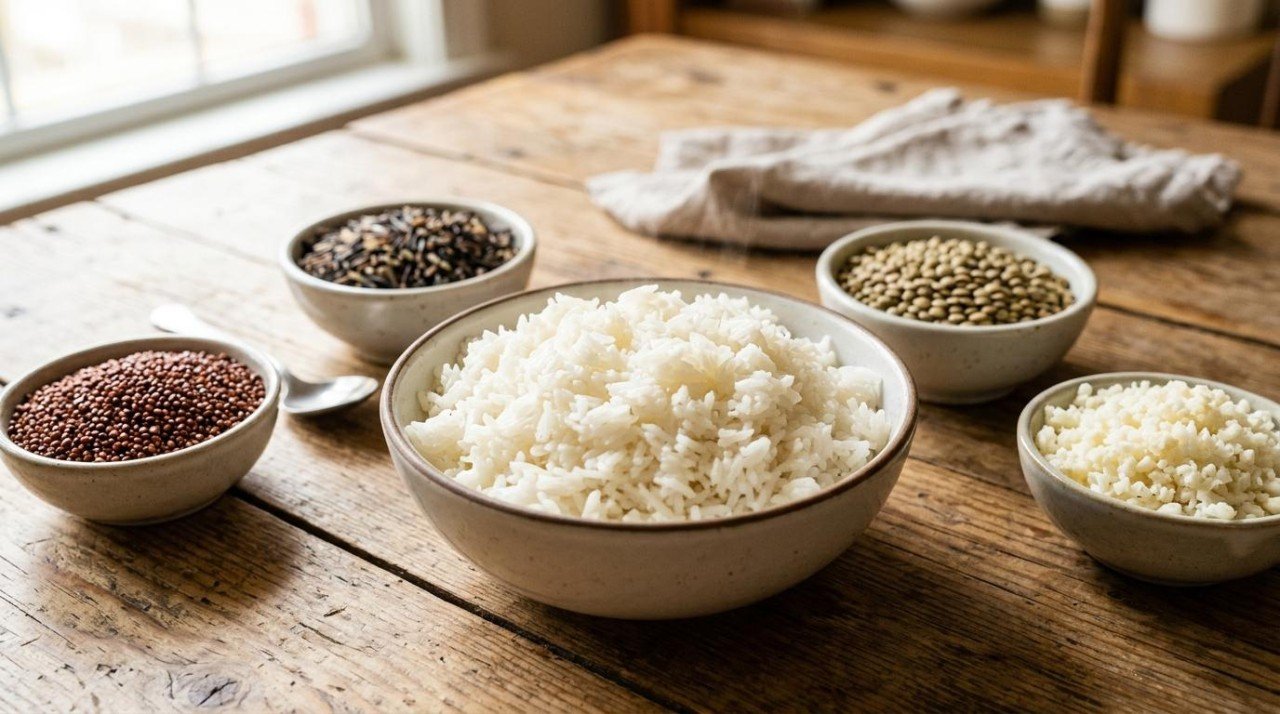
- Brown rice — the closest swap; same grain, same dishes, just 45 minutes instead of 18
- Quinoa — the best all-around upgrade: complete protein, nearly nine times the fiber, ready in 15 minutes
- Bulgur — the fastest whole grain in the pantry, and the fiber champion of this list
- Couscous — quickest of all at 5 minutes, but it is refined pasta, not a nutrition upgrade
- Farro — chewy and nutty; the best base for grain bowls and salads
- Pearl barley — plump and slightly creamy, with the soluble fiber that makes it worth the pot
- Cauliflower rice — the lightest option by a mile, and the most different from rice
- Lentils — a protein powerhouse that turns a side dish into most of a meal
- Wild rice — dark, chewy, and dramatic; best blended rather than solo
- Orzo or small pasta — the fallback that is always in the cupboard and always works
Brown Rice
- Swap: 1 cup white rice → 1 cup brown rice, but use 2 cups water and simmer 45 minutes, then rest 10 minutes off the heat
- Best for: Anything white rice does — curries, burrito bowls, stir-fries, rice and beans
- Skip it for: Sushi, risotto, and anything on the table in 20 minutes
- Health notes: About 3.2 grams of fiber per cooked cup versus 0.6 grams in white, plus four times the magnesium
This is the swap that asks the least of you. It is the same grain with the bran and germ left on, so it behaves like rice, tastes like a nuttier rice, and slots into the same dishes without any rethinking. The only real adjustments are time and patience: it wants roughly twice the simmer and a proper 10-minute rest with the lid on, which is what separates fluffy brown rice from the gluey version that put people off it in the first place.
One honest note, since it comes up: because the bran holds more of it, brown rice carries more inorganic arsenic than white — roughly 48% more in US rice, per a 2025 analysis. That same study found no acute risk to the general adult population, but flagged that children aged 6 to 24 months eating brown rice can exceed previously recommended exposure limits, simply because little kids eat a lot of rice relative to their size. The practical takeaway is not to fear brown rice. It is that rotating through the other grains on this list is worth doing anyway.
Quinoa
- Swap: 1 cup white rice → 1 cup quinoa with 1 3/4 cups water; simmer 15 minutes, rest 10 minutes covered, then fluff. Rinse it first
- Best for: Burrito bowls, grain bowls, curries, salads, stuffed peppers, anything with a sauce to absorb
- Skip it for: Sushi and rice pudding; it will not hold together or turn creamy
- Health notes: 8.1 grams of protein and 5.2 grams of fiber per cooked cup, versus 4.3 grams of protein and 0.6 grams of fiber in white rice, for a comparable 222 calories against 205
If you make one swap from this list a habit, make it this one. Quinoa is the rare upgrade that costs you nothing in convenience: it cooks in 15 minutes, which is faster than white rice, and it is a complete protein containing all nine essential amino acids — unusual for a plant food, and the reason it holds up as the base of a meatless bowl. A cup also brings about 118 milligrams of magnesium against white rice's 19.
Two technique notes decide whether you like it. Rinse it in a fine strainer before cooking — the natural coating (saponin) tastes soapy and bitter if you skip this, and it is the single most common reason people say they do not like quinoa. And respect the covered rest; quinoa that goes straight from simmer to serving is wet, while quinoa that sits 10 minutes off the heat fluffs into separate grains. Texture-wise, expect something slightly poppy rather than soft. It is excellent under saucy food and a little odd as a plain white-rice-shaped side.
Bulgur
- Swap: 1 cup white rice → 1 cup bulgur with 2 cups water, simmered about 12 to 15 minutes until absorbed. For fine bulgur, just cover with boiling water and let it sit 20 minutes
- Best for: Pilafs, salads like tabbouleh, stuffed vegetables, and as a bed for stews and kebabs
- Skip it for: Fried rice and sushi; it is too soft and too small to fry up into separate grains
- Health notes: 8.2 grams of fiber and 151 calories per cooked cup — the most fiber of any grain here, for a quarter fewer calories than white rice
Bulgur is the most underrated item on this list. It is whole wheat that has been parboiled and cracked, which means the hard work is already done and it cooks faster than white rice while keeping the bran. The numbers are genuinely striking: more than 13 times the fiber of white rice, per cup, with fewer calories.
Grind size is the thing to know. Fine bulgur (grade 1) barely needs cooking — a soak in boiling water is enough, which is how tabbouleh works. Medium and coarse grinds want the simmer, and coarse is the one to buy if you want something that eats like a rice pilaf. Flavor is mildly nutty and unmistakably wheaty, so it is a natural under Middle Eastern and Mediterranean food and a slightly strange fit under a Thai curry. It does contain gluten.
Couscous
- Swap: 1 cup white rice → 1 cup couscous plus 1 cup boiling water or broth; cover, sit 5 minutes off the heat, fluff with a fork
- Best for: When dinner is late and you need a base in five minutes — stews, tagines, roasted vegetables
- Skip it for: Fried rice, sushi, anything soupy (it turns to mush), and any time you want the nutrition win
- Health notes: Regular couscous is refined wheat pasta, nutritionally close to white rice. Whole wheat couscous is the version worth buying
Couscous earns its spot on speed alone. It is not a grain at all but tiny pasta, and it does not really cook — you pour boiling liquid over it, walk away for five minutes, and it is done. Use broth instead of water and it tastes like something rather than nothing.
Be clear-eyed about it, though: standard couscous is the one swap here that is not a step up from white rice, so treat it as the fast fallback, not the healthier one. Pearl (Israeli) couscous is bigger, chewier, and actually simmered for 8 to 10 minutes like pasta, which makes it the better bowl base.
Farro
- Swap: 1 cup white rice → 1 cup farro, cooked like pasta in a generous pot of salted water. Pearled farro takes 10 to 20 minutes, semi-pearled 20 to 30, whole farro up to 40 (and may want an overnight soak). Drain when tender but still chewy
- Best for: Grain bowls, hearty salads, soups, and farrotto — the risotto stand-in it does better than any other grain here
- Skip it for: Delicate dishes where you want the base to disappear; farro insists on being noticed
- Health notes: About 5 grams of fiber and 6 grams of protein per 1/4 cup dry, which cooks up to roughly half a cup
Farro is what you reach for when you want the base to be part of the dish rather than a landing pad for it. The grains stay distinct and chewy, with a nutty, faintly sweet flavor that makes cold grain salads taste deliberate instead of like leftovers. Because you drain it like pasta, the ratio is forgiving — a rare thing among grains.
Check the bag for the word pearled, semi-pearled, or whole, because it changes the cook time by up to half an hour. Pearled has had the bran removed for speed (still a fine choice, just less fiber); whole farro keeps everything and rewards you for the wait. If you want the full case for farro and its chewy cousins, our guide to the whole grains you are missing goes deeper. Like bulgur, it contains gluten.
Pearl Barley
- Swap: 1 cup white rice → 1 cup pearl barley with 3 cups water; simmer 25 to 30 minutes and drain any excess
- Best for: Soups and stews, mushroom dishes, warm salads, and a creamy risotto substitute
- Skip it for: Fried rice and any quick weeknight side; it needs the half hour
- Health notes: 6 grams of fiber per cooked cup, much of it the soluble beta-glucan kind linked to lower cholesterol
Barley is plump, chewy, and just starchy enough to lend a soup body, which is why it has been going into pots of stew for a few thousand years. It releases enough starch to turn faintly creamy, making it the easiest risotto stand-in if you are not fussy about tradition.
The reason to bother is beta-glucan, the soluble fiber that barley is unusually rich in. A University of Connecticut review summarized by the Whole Grains Council found that barley significantly lowered total cholesterol, LDL cholesterol, and triglycerides. That is the same fiber that gives oats their reputation, and it is the type most of us eat least of — more on that in our breakdown of the two kinds of fiber. Note that pearl barley has been polished, so hulled barley is the more nutritious version if your store carries it and you have the extra time.
Cauliflower Rice
- Swap: 1 cup cooked white rice → 1 cup riced cauliflower. One medium head makes about 4 cups. Sauté in a hot, dry-ish pan with a little oil for 5 to 8 minutes — add no liquid
- Best for: Under saucy curries and stir-fries, and in fried "rice," where it browns better than you would expect
- Skip it for: Anything that needs the base to soak up liquid — soups, risotto, sushi, rice pudding, burritos that must hold their shape
- Health notes: Roughly 27 calories and 51 milligrams of vitamin C per cup — about 57% of a day's worth — against 205 calories and no vitamin C in white rice
Let us be straight: cauliflower rice is not rice, and pretending otherwise is how people end up disappointed. It is a vegetable cut into rice-sized pieces. What it is genuinely great at is being a light, fresh bed for something intensely flavored, and quietly adding a serving of vegetables to a meal that had none.
Technique is everything here, and the mistake is always moisture. Cauliflower is about 92% water, so a covered pan steams it into gray mush. Use a wide skillet over medium-high heat, spread it thin, and leave it alone long enough to take some color. Squeezing frozen riced cauliflower dry in a clean towel before it hits the pan makes a bigger difference than any other step. It is also excellent cut half-and-half with real rice, which gives you the texture and the vegetables at once.
Lentils
- Swap: 1 cup white rice → 1 cup dried brown or green lentils with 3 cups water; simmer 20 to 25 minutes until tender but intact, then drain. Do not use red lentils — they collapse
- Best for: Bowls, warm salads, curries, and anywhere the rice was propping up a small amount of meat
- Skip it for: A neutral background; lentils have opinions, and they change the dish into a lentil dish
- Health notes: 18 grams of protein and 16 grams of fiber per cooked cup, plus 90% of a day's folate and 37% of a day's iron
Nothing else here comes close on nutrition. A cup of cooked lentils carries more than four times the protein and roughly 27 times the fiber of a cup of white rice, for about 230 calories. It stops being a side dish and becomes the reason the meal is filling — which is exactly why lentils are one of the best nutritional values in the grocery store.
The trade is that this is a real change, not a substitution nobody notices. Brown and green lentils hold their shape and give you an earthy, savory base; French green (Puy) lentils hold up even better and are worth seeking out for salads. Salt them at the end rather than the start so the skins stay tender, and pull them off the heat while they still have a little bite. If you want the middle ground, cook lentils and rice together — the mujadara approach — and you get the protein without giving up the familiar texture.
Wild Rice
- Swap: 1 cup white rice → 1 cup wild rice with 3 cups water; simmer 45 to 50 minutes, until the grains split open, then drain
- Best for: Pilafs, stuffings, hearty salads, and anything with mushrooms or roasted squash
- Skip it for: A mild background, or fast cooking; and it is expensive enough that a whole potful stings
- Health notes: 6.5 grams of protein and 3 grams of fiber per cooked cup, at only 166 calories
Wild rice is not rice — it is the seed of an aquatic grass — and it tastes like it: smoky, tea-like, and assertive, with a chew that stays firm. That strong personality is why the smartest way to use it is blended, at maybe one part wild to three parts brown rice or quinoa, so it flavors the pot without dominating it. The one thing that trips people up is cook time: under-cooked wild rice is unpleasantly hard, so wait until the grains actually burst open and curl.
Orzo and Other Small Pasta
- Swap: 1 cup white rice → 1 cup orzo, boiled in salted water for 8 to 10 minutes and drained; or toast it in butter first and simmer in 2 cups broth for a pilaf
- Best for: Soups, quick pilafs, and getting dinner on the table with what is in the cupboard
- Skip it for: Fried rice, sushi, anything where leftovers need to reheat well
- Health notes: Refined pasta, so nutritionally similar to white rice. Whole wheat orzo closes most of that gap
When the goal is simply to have a starch under the stew tonight, orzo is a perfectly honorable answer, and its rice-like shape means nobody at the table asks questions. The broth-and-toast method makes it taste like you planned it. Just know that it will keep absorbing liquid in the fridge until your leftovers are a solid brick.
Which Swap for Which Dish
The base has a different job depending on what you are making, and that job decides the swap:
- Stir-fry or fried rice: Brown rice, cooked and chilled overnight so it fries into separate grains. Cauliflower rice works too if you keep the pan hot and dry. Quinoa is passable; bulgur and couscous are not
- Curry or stew: Anything absorbent — quinoa, brown rice, bulgur, or barley. Cauliflower rice is fine here because the sauce sits on top rather than soaking in
- Burrito bowls: Quinoa is the standout, and cilantro and lime hide any grain flavor. Half rice, half cauliflower rice is the easy compromise
- Pilaf: Coarse bulgur, farro, or orzo, each toasted in fat first and simmered in broth
- Soup: Barley, farro, or wild rice, which hold their texture instead of dissolving
- Risotto: Pearl barley or farro, both of which release enough starch to go creamy
- Sushi or rice pudding: Nothing on this list. These need short-grain rice's specific starch, and no substitute fakes it
The Upgrade Math (and How to Not Blow It)
Stacked up per cooked cup, the gap is bigger than most people expect. White rice gives you 0.6 grams of fiber and 4.3 grams of protein. Brown rice gives 3.2 and 5.5. Quinoa gives 5.2 and 8.1. Bulgur gives 8.2 grams of fiber. Lentils give 16 grams of fiber and 18 grams of protein. Given that most Americans get roughly half the fiber they need, changing the base of two dinners a week is a genuinely meaningful move — and it costs you nothing you will miss.
Two things make it stick. First, do not go all-or-nothing: cooking half white rice and half quinoa, lentils, or cauliflower rice gets you most of the benefit with none of the household mutiny, and it is how most people actually make the change permanent. Second, remember that every different plant you eat feeds a different set of gut bacteria — swapping in quinoa, then barley, then lentils across a week is not just more fiber, it is more variety, which is the part the research on gut health keeps pointing to.
That is also where Eat Well Planner is useful once you are past the reference-page stage. Its Recipe Playground lets you swap the rice in a saved recipe for quinoa or lentils and watch the nutrition score move before you commit, so you can see exactly what a swap buys you in that dish. Make It Healthier goes further and proposes swaps like these on its own, with a calculator verifying the actual nutritional gain before the suggestion ever reaches you. And Plant Points quietly counts each new plant you rotate in toward the 30-a-week target from the gut microbiome research — which is a much better reason to alternate your grains than guilt.
Take the Guesswork Out of Eating Well
Eat Well Planner helps you organize your favorite recipes, plan balanced meals, and automatically generate shopping lists — all in one place. Whether you're tracking macros, managing dietary restrictions, or just trying to stop asking "what's for dinner?", we've got you covered.
Our AI-powered tools can adapt any recipe to your dietary needs, help you discover new meals you'll love, and even log your nutrition effortlessly. It's meal planning made simple.
Start Organizing Your Meals — FreeWhat Not to Use
- Red lentils in place of rice. They cook down into a puree in about 15 minutes. Wonderful for dal, useless as a grain-shaped base
- Instant or minute rice as a fix for anything but speed. It is pre-cooked and dried, and it goes soft and hollow the second there is sauce on it
- Cauliflower rice in soup. It has no starch to give, it will not thicken anything, and it disintegrates. It is a sauté-pan ingredient
- Quinoa in sushi. It does not have the sticky short-grain starch that makes a roll hold together, no matter how much rice vinegar goes in
- Straight swaps without adjusting the liquid. This is the real failure mode. Barley wants 3 parts water, quinoa 1 3/4, couscous 1. Using rice's ratio on any of them gets you either a scorched pan or soup
The Bottom Line
If you just need dinner on the table, reach for couscous or orzo. If you want the closest thing to rice, use brown rice and give it the full 45 minutes plus a rest. And if you want the swap that pays you back for the rest of the year, make it quinoa or bulgur — both are faster than white rice, both bring real fiber and protein, and neither asks you to change the way you cook.
When you are not sure which one fits the specific thing you are making tonight, that is a good question to ask the AI recipe chat in Eat Well Planner. A blog post can only give you general guidance; the chat can look at your actual recipe and tell you which base suits that dish and how to adjust the liquid and timing for it. And if the swap is worth keeping, Recipe Variations will rewrite the whole recipe with it already worked in, so next time it is just how you make it.