The recipe says two heads of bok choy, and the store had none. Or it had one sad, yellowing head that you left on the shelf. Either way, dinner is still happening, and the good news is that bok choy is one of the easier vegetables to replace, as long as you remember it is really two vegetables in one.
Bok choy has crisp, juicy white stems that need a few minutes of heat and tender green leaves that wilt in under a minute. That split is the whole trick to substituting it. America's Test Kitchen found that for stir-fried bok choy, "throwing the sliced stalks into the pan first gave them the necessary head start": about five minutes for the stalks to turn crisp-tender, then the leaves go in just long enough to wilt. The best substitutes either have the same stem-and-leaf structure (napa cabbage, Swiss chard, other Asian greens) or let you rebuild it from two ingredients (celery plus spinach). Leaf-only swaps work too, but only where the crunch was never the point.
One number to keep handy: by USDA weights, one cup of shredded raw bok choy is about 70 g (2.5 ounces). Most swaps below go 1:1 by weight, which matters a lot for leafy greens: a cup of raw spinach weighs less than half as much as a cup of bok choy, so measuring by the cup will leave you short.
The Quick List
- Other Asian greens (choy sum, tatsoi, Shanghai bok choy) — the closest match for every use; grab whatever the store has
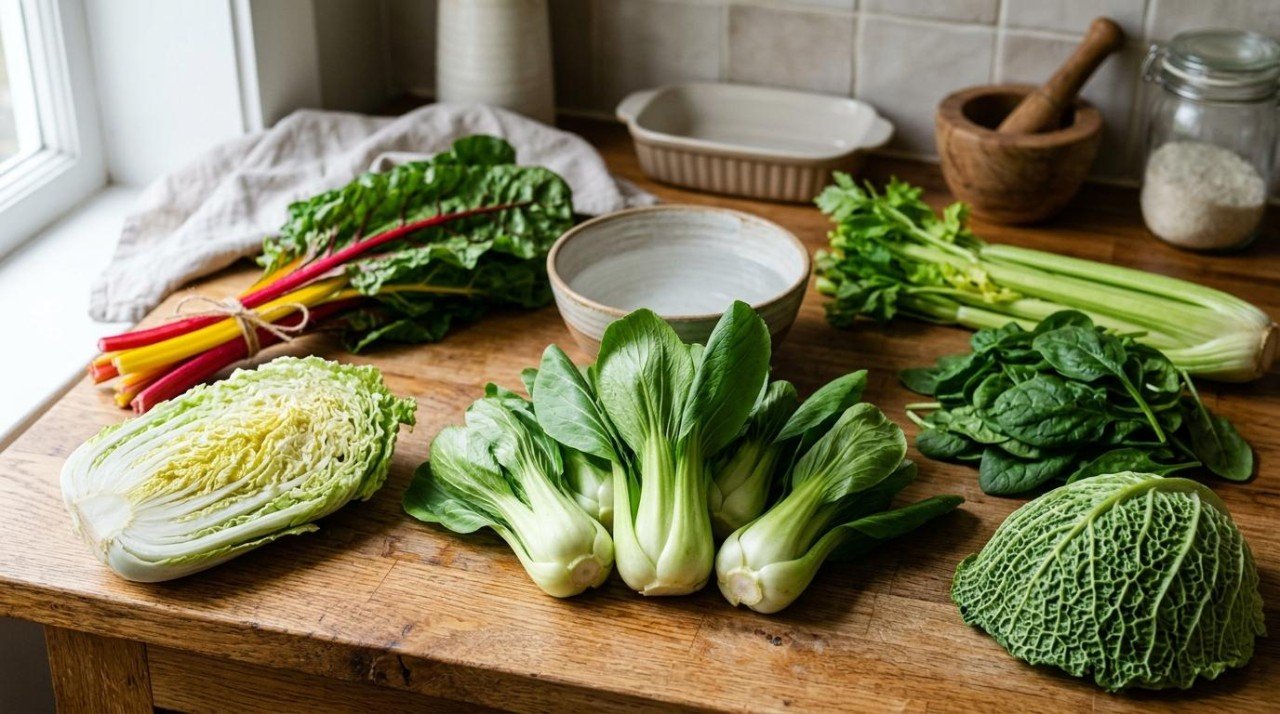
- Napa cabbage — the best widely available swap for stir-fries, soups, dumplings, and slaws
- Swiss chard — crunchy stems plus tender leaves, cooked in two stages just like bok choy
- Celery + spinach — rebuild bok choy from two common ingredients: celery for crunch, spinach for leaves
- Gai lan (Chinese broccoli) — sturdier and slightly bitter; great blanched with oyster sauce or stir-fried
- Green or savoy cabbage — the pantry-shelf option for soups, stir-fries, and slaws; needs more time
- Spinach — leaves only; fine for soups, noodle bowls, and ramen, not for crunch
- Broccoli rabe — a bolder, more bitter swap for garlicky stir-fries and sautés
- Lacinato kale — a hearty leaf for soups and braises that holds up to long simmering
- Zucchini or snow peas — crunch-only stand-ins when you mainly need something green and crisp in a stir-fry
Close Relatives: The Easiest Swaps
Bok choy belongs to a big family of Chinese greens, and if your store has any of them, use it before anything else on this list. They cook the same way and taste close enough that most people will not notice.
Choy Sum, Yu Choy, Tatsoi, and Shanghai Bok Choy
- Swap: 1:1 by weight
- Best for: Everything bok choy does: stir-fries, soups, noodle bowls, steaming, blanching with oyster sauce
- Skip it for: Nothing, really — just adjust the cooking time to how thick the stems are
Shanghai bok choy (also sold as green bok choy or Shanghai baby bok choy) is the pale-green-stemmed version and is a straight swap. Choy sum, also called yu choy, has thinner, rounder stems and sometimes small yellow flowers. The Woks of Life describes it as "much sweeter and more tender, with a texture closer to bok choy," and it can be sautéed, added to soups, stir-fried, or blanched and served with oyster sauce. Because the stems are thinner, cut them into 2-inch lengths and give them only a minute or two before the leaves go in.
Tatsoi is a dark green, spoon-shaped cousin that grows in a flat rosette. The leaves are the main event and the stems are small, so treat it more like a leafy green: add it near the end. Baby tatsoi is also lovely raw in salads where you might have used raw baby bok choy.
Gai Lan (Chinese Broccoli)
- Swap: 1:1 by weight; peel thick stems and cut them thinner than you would bok choy
- Best for: Stir-fries, blanching with oyster sauce, garlic sautés, noodle dishes like pad see ew
- Skip it for: Delicate soups where you want a sweet, mild green, and anything raw
Gai lan has long green stems and dark, thick leaves, with a flavor somewhere between broccoli and a mild mustard green. The stems are denser than bok choy stems, so trim about 1/4 inch off the ends and peel the tough outer skin from the bottom few inches, as The Woks of Life recommends, then slice them on a sharp diagonal. Start the stems 2 to 3 minutes before the leaves. The result is heartier and a little more bitter than bok choy, which is lovely with garlic, ginger, and a good splash of oyster sauce.
For Stir-Fries
In a stir-fry, bok choy brings juicy crunch from the stems and a bit of silky green from the leaves, and it soaks up the sauce. These swaps keep that balance. If you want a refresher on building a stir-fry around whatever you have, our stir-fry formula walks through the order of operations.
Napa Cabbage
- Swap: 1:1 by weight or volume, cut the same way (thick white ribs sliced, leafy tops chopped)
- Best for: Stir-fries, soups, hot pot, dumpling fillings, noodle bowls, raw slaws
- Skip it for: Recipes that serve baby bok choy halved and seared as a side — napa does not hold together that way
This is the swap most people can actually find. Napa is a close relative of bok choy (its Mandarin name, The Woks of Life notes, translates to "big bok choy"), and every leaf has a thick, crunchy white rib and a frilly, tender top. That is the same stem-and-leaf structure you are replacing, so the same two-stage method works: slice the white ribs into 1/2-inch pieces and stir-fry them for 2 to 3 minutes, then add the leafy tops for the last 30 to 60 seconds.
Napa is "large, pale green, and very mild in flavor," and it is a bit more watery than bok choy, so cook it in a very hot pan, do not crowd it, and leave the lid off. America's Test Kitchen found that covering a bok choy stir-fry "made it a bit soupy," and napa is even more prone to it. Expect a softer, sweeter result with a little less snap.
Swiss Chard
- Swap: 1:1 by weight; separate stems and leaves and cook stems first
- Best for: Stir-fries, sautés, soups, braises, grain bowls
- Skip it for: Raw uses and dishes where you want bok choy's mild sweetness front and center
- Health notes: More vitamin A and much more vitamin K per 100 g: 306 mcg vitamin A and 830 mcg vitamin K, against bok choy's 223 mcg and 45.5 mcg
Chard is the best Western stand-in, because it has the same anatomy: wide, crunchy stems and soft leaves that cook at different speeds. Strip the leaves off the stems, slice the stems 1/4 inch thick, and give them 3 to 4 minutes in the pan (they are a little more fibrous than bok choy stems) before adding the chopped leaves for the final minute. Rainbow chard looks especially good in a stir-fry.
The flavor is earthier and slightly mineral, closer to beet greens than cabbage, and the leaves are less sweet. A splash of soy sauce or a squeeze of lime balances it well. One honest note: chard is very high in vitamin K, so if you take warfarin and keep your vitamin K intake steady on purpose, this is a bigger change than it looks. Our guide to food-drug interactions explains why consistency is what matters.
Celery + Spinach
- Swap: For 1 pound of bok choy, use about 1/2 pound sliced celery (roughly 5 to 6 medium stalks) + 1/2 pound baby spinach
- Best for: Stir-fries, fried rice, noodle stir-fries, soups
- Skip it for: Dishes that serve bok choy whole or halved as a side, and anyone who dislikes celery's flavor
If all you have is a regular grocery haul, you can rebuild bok choy from two parts. Celery supplies the juicy, crisp stem (a medium stalk weighs about 40 g, so 5 to 6 stalks is close to half a pound), and spinach supplies the tender leaf. Slice the celery thinly on a diagonal, stir-fry it for 3 to 4 minutes, then toss in the spinach for the last 30 seconds, just until it collapses.
Celery has a stronger, more herbal flavor than bok choy stems, so this combo tastes a little different, but in a dish with garlic, ginger, and soy sauce it fades into the background. Interestingly, bok choy stems are one of the swaps in our celery substitutes guide, so this works in both directions.
Green or Savoy Cabbage
- Swap: 1:1 by weight; slice it thinner than you would bok choy
- Best for: Stir-fries, fried rice, soups, slaws
- Skip it for: Quick-cooking recipes where you cannot give it extra time, and halved-and-seared sides
- Health notes: 2.5 g fiber per 100 g, more than twice bok choy's 1.0 g
Plain green cabbage keeps for weeks in the fridge, which makes it the swap most likely to already be in your kitchen. It is denser and drier than bok choy, so slice it into thin ribbons (about 1/4 inch) and stir-fry it for 4 to 6 minutes, until wilted at the edges with a little crunch left. It will not give you the silky leaf, but it does give you sweetness and texture. Savoy cabbage, with its crinkly leaves, is more tender and closer to bok choy; The Woks of Life notes its flavor is "less harsh than your standard cabbage."
Broccoli Rabe
- Swap: 1:1 by weight; blanch for 1 minute first if you want to tame the bitterness
- Best for: Garlicky stir-fries, sautés, noodle dishes with bold sauces
- Skip it for: Mild soups, kids' dishes, and anything where bok choy's gentle sweetness is the point
- Health notes: 2.7 g fiber per 100 g and a similar amount of calcium (108 mg) to bok choy
Broccoli rabe (rapini) has thin stems, leaves, and small florets, all of which cook quickly. It is noticeably bitter, more so than gai lan, which The Woks of Life calls "sweeter and much less bitter than broccoli rabe." Blanching it in salted boiling water for about a minute, then draining it well, takes the edge off before it hits the wok. Pair it with assertive flavors like garlic, chili, black bean sauce, or oyster sauce, and it is excellent. Pair it with a delicate broth, and it will take over.
Zucchini or Snow Peas (Crunch Only)
- Swap: 1 cup sliced zucchini or trimmed snow peas for every cup of sliced bok choy stems; add a handful of any leafy green if the recipe needs the leaves
- Best for: Stir-fries and fried rice when you just need something green and crisp
- Skip it for: Soups and anything that relies on bok choy's leaves
Sometimes the bok choy in a stir-fry is just there to add a green, crunchy element. In that case, any quick-cooking crisp vegetable will do. Snow peas and sugar snap peas cook in 2 to 3 minutes and stay crunchy; zucchini cut into half-moons takes about the same time but softens faster, so pull it before it goes limp. If zucchini is not around either, our zucchini substitutes guide lists more quick-cooking options.
Take the Guesswork Out of Eating Well
Eat Well Planner helps you organize your favorite recipes, plan balanced meals, and automatically generate shopping lists — all in one place. Whether you're tracking macros, managing dietary restrictions, or just trying to stop asking "what's for dinner?", we've got you covered.
Our AI-powered tools can adapt any recipe to your dietary needs, help you discover new meals you'll love, and even log your nutrition effortlessly. It's meal planning made simple.
Start Organizing Your Meals — FreeFor Soups, Ramen, and Noodle Bowls
In soup, bok choy's job is softer: tender greens and a bit of bite from the stems, added in the last few minutes. That opens the door to leaf-only substitutes, since the broth hides the missing crunch.
Napa Cabbage (Again)
Napa is just as good in soup as in a stir-fry, maybe better. Add the sliced white ribs 3 to 4 minutes before the soup is done and the leafy tops in the last minute. It is the classic choice for hot pot and wonton soup, and it turns sweet and silky in broth. Use it 1:1 by weight.
Spinach
- Swap: 1:1 by weight. By volume, use about 2 cups raw spinach per 1 cup shredded bok choy (a cup of raw spinach weighs only 30 g)
- Best for: Soups, ramen, pho, noodle bowls, congee, egg drop soup
- Skip it for: Stir-fries (unless paired with celery, above) and anything that needs crunch
- Health notes: More folate per 100 g (194 mcg vs bok choy's 66 mcg), but its calcium is poorly absorbed (see the healthier upgrades section below)
Spinach is the simplest leaf-only swap. Add it at the very end: stir it in, turn off the heat, and it will wilt in about 30 seconds. For ramen and noodle bowls, put a handful of raw baby spinach in the bowl and pour the hot broth over it. Do not simmer spinach for long in soup, or it turns army green and slimy, and keep in mind how dramatically it shrinks. A 5-ounce clamshell of baby spinach collapses into barely a cup.
Swiss Chard
Chard works beautifully in heartier soups like miso soup with tofu, white bean soup, or a ginger chicken soup. Add the sliced stems with the other vegetables so they have 5 minutes or so to soften, then stir in the leaves at the end. Its earthy flavor is stronger than bok choy's, so it suits robust broths better than delicate ones.
Lacinato Kale
- Swap: 1:1 by weight, stems removed and leaves sliced into ribbons
- Best for: Brothy soups, stews, braises, and soups you plan to reheat
- Skip it for: Quick stir-fries where you want something tender, and light Asian broths where kale's flavor feels out of place
- Health notes: 4.1 g fiber and 93 mg vitamin C per 100 g, about four times bok choy's fiber and twice its vitamin C
Kale is the one swap that actually improves with time in the pot. Where bok choy goes limp in leftover soup, lacinato (Tuscan or dinosaur) kale stays pleasantly chewy, so it is the best pick for big batches you will eat over several days. Strip the leaves from the tough center ribs (do not use the ribs as a stand-in for bok choy stems; they stay woody), slice the leaves thin, and give them 5 to 8 minutes of simmering.
For Grilled, Seared, or Steamed Baby Bok Choy
When a recipe has you halve baby bok choy and sear, grill, or steam it as a side, you need something that holds together and has a cut face to brown. Few vegetables do this exactly, but these come close:
- Shanghai bok choy or tatsoi heads — the only true match; halve and cook the same way
- Small wedges of napa or savoy cabbage — cut through the core so the leaves stay attached, then sear cut side down and finish with a splash of water and a lid for 2 to 3 minutes
- Halved romaine hearts — sear or grill cut side down for 1 to 2 minutes; they char quickly and stay crisp in the center, so treat them as a fast side rather than a braised one
- Gai lan or broccolini — not halved, but steamed or blanched whole and dressed with oyster sauce and garlic oil, they fill the same spot on the plate
America's Test Kitchen notes that "baby bok choy are best halved and seared," and because their stalks are tender, they cook evenly without separating stems from leaves. Cabbage wedges are thicker and need more time, so add that splash of water and a lid to steam the centers through after browning.
For Raw Uses: Salads and Slaws
Raw baby bok choy is crisp, juicy, and mildly peppery in salads and Asian-style slaws. The best raw swaps:
- Napa cabbage — 1:1, thinly sliced; the go-to slaw cabbage, tender and sweet
- Savoy or green cabbage — 1:1, shredded very thin; sturdier and holds up to dressing longer, which makes it better for make-ahead slaws
- Baby tatsoi or baby spinach — 1:1 by weight in leafy salads
- Celery + romaine — sliced celery for the crunch, romaine for the leafy part
Skip chard, kale, gai lan, and broccoli rabe raw as a straight bok choy swap. They are too tough or too bitter without cooking (massaged kale salads are their own dish).
Healthier Upgrades: What Bok Choy Brings and How to Keep It
Bok choy is a quiet nutrition star. Per 100 g raw, it has just 13 calories, along with 45 mg vitamin C, 223 mcg vitamin A, and 105 mg calcium. That calcium is the part most people do not know about, and it is where substitutes differ the most.
Not all calcium in greens is equally usable. Research by Connie Weaver and colleagues, summarized in a Kansas State University nutrition text, measured how much calcium the body actually absorbs from different foods. From an 85 g serving:
- Bok choy: 79 mg calcium, 53.8% absorbed (about 42.5 mg)
- Kale: 61 mg calcium, 49.3% absorbed (about 30 mg)
- Spinach: 115 mg calcium, only 5.1% absorbed (about 6 mg)
- Cow's milk (240 g): 300 mg calcium, 32.1% absorbed (about 96 mg)
Spinach looks like the calcium winner on paper, but its oxalates bind most of that calcium so the body cannot take it up. Bok choy, kale, and other low-oxalate cabbage-family greens absorb better, by percentage, than milk does. So if you lean on bok choy for calcium (common in dairy-free eating), the closest nutritional swaps are other cabbage-family greens: choy sum, napa cabbage, kale, gai lan, and broccoli rabe. Spinach and chard are still great vegetables, just not for that particular job. For more on how calcium fits into bone health, see our post on the nutrients besides calcium your bones need.
The other easy upgrade is variety. Swapping in a green you rarely buy (tatsoi, chard, gai lan, rapini) adds a new plant to your week, which counts toward the 30-plants-a-week goal linked to a more diverse gut microbiome. You can also use two greens at once, such as half napa and half spinach, and get the texture of one and the nutrients of both.
If you are not sure which swap fits your actual recipe, ask. In Eat Well Planner, the AI recipe chat sees the full recipe, so you can ask "I don't have bok choy for this ginger chicken soup, I have chard and celery, what should I do?" and get an answer with timing for that dish. And if you want to see what a swap does to the numbers before you cook, the Recipe Playground shows the nutrition score update live as you change an ingredient.
What Not to Use
- Iceberg lettuce in a cooked dish — it turns into wet, flavorless ribbons the moment it hits heat; romaine is the only lettuce that tolerates a quick sear
- Collard greens in a quick stir-fry — they are tough and need long, slow cooking; save them for braises
- Kale ribs or collard stems as "stems" — they stay woody and stringy, nothing like bok choy's juicy stalks
- Long-simmered spinach — add it at the end, or it goes slimy and drab
- Broccoli rabe in a delicate broth — its bitterness takes over a mild soup
- Frozen spinach in a stir-fry — it releases too much water and makes the sauce soupy; it is fine stirred into soup, though, after thawing and squeezing
Which Swap for Which Dish
- Garlic bok choy stir-fry: choy sum, napa cabbage, or Swiss chard
- Chicken or tofu stir-fry with sauce: napa cabbage, celery + spinach, or snow peas
- Ramen, pho, or noodle bowls: spinach, napa cabbage, or choy sum
- Wonton soup or hot pot: napa cabbage
- Miso, ginger, or bean soups (especially batch-cooked): lacinato kale or Swiss chard
- Seared or grilled baby bok choy side: Shanghai bok choy, savoy cabbage wedges, or blanched gai lan
- Asian-style slaw: napa or savoy cabbage
- Dumpling filling: napa cabbage (salt it and squeeze out the water first, just as you would bok choy)
Bok choy is a forgiving vegetable to replace, because almost every dish it shows up in is built to flex. Match the stems with something crunchy, the leaves with something tender, add each at the right moment, and dinner will turn out just fine. Some of these swaps, like chard, kale, and cabbage, may even become regulars.