The rice is seasoned, the rolls are cut, the salmon is sliced for poke — and the little green tube is empty, or was never there to begin with. Or maybe a dressing recipe calls for "1 teaspoon wasabi paste" and you are not buying a whole tube for one teaspoon.
Here is the good news hiding in this problem: the wasabi you were about to use almost certainly is not wasabi. In the US, more than 99% of what is sold as wasabi is a mix of horseradish, mustard and food coloring. Real wasabi is a fussy, expensive Japanese plant that most of us have never tasted. So the best substitutes are not really substitutes at all — they are the actual ingredients in the tube, minus the green dye.
What works best depends on what you are making. Sushi and sashimi need a stiff paste with a sharp, nose-clearing hit. Dressings, wasabi mayo and dips need the heat to blend in smoothly. This guide is split by those two jobs, with exact ratios for every swap and an honest note on what each one changes.
The Quick List
- Prepared horseradish + dry mustard — the closest match; it is literally what most tube wasabi is made of
- Wasabi powder — the same thing in dry form, and it keeps for months in the pantry
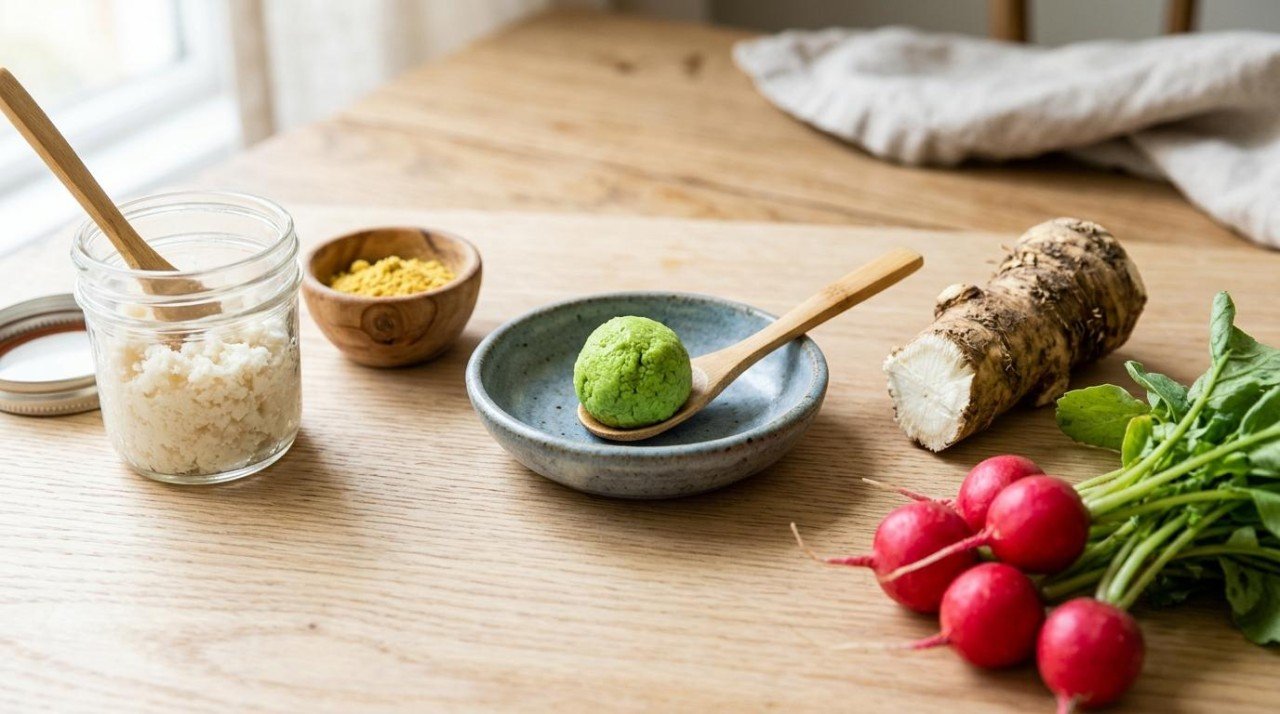
- Fresh horseradish root, grated — the hottest and freshest option; you control the heat
- Hot English mustard or Japanese karashi — the same sinus-clearing sharpness, with a mustard flavor
- Grated daikon or radish — a mild, fresh, genuinely Japanese side for sushi and tempura
- Pickled or fresh ginger — different, but it does the palate-brightening job at a sushi meal
- Chili paste in the soy sauce — heat for the dipping dish when the sharpness is not the point
- Prepared horseradish on its own — the best swap for wasabi mayo, dips, mashed potatoes and crusts
- Dijon mustard + horseradish — the right choice for vinaigrettes and salad dressings
What You Are Actually Replacing
Wasabi's heat is unlike chili heat. It does not linger on the tongue — it spikes up into your nose for a few seconds and then disappears. That comes from pungent compounds called isothiocyanates, which form when the plant's cells are broken by grating, chopping or mixing with water. Horseradish is a classic source, and mustard seed works the same way, which is why both stand in so convincingly.
Real wasabi is a different plant in the same family. Its flavor is fresher, sweeter and more fragrant, and it is actually less hot than horseradish. It is also expensive enough that high-end sushi restaurants pay up to $300 a kilo for it, and once grated it starts to deteriorate after about 15 minutes. That is why the familiar green paste is made from horseradish instead: it is cheaper, punchier and lasts for months.
So when a recipe calls for wasabi, it usually wants three things:
- Sharp, nasal heat — the quick hit that fades fast, not a slow chili burn
- A thick paste — something that sits on a piece of fish or dissolves into soy sauce without going watery
- A clean, slightly green flavor — no vinegar tang, no sweetness, no smoke
Horseradish and mustard nail the first one. The other two are where the technique below matters.
For Sushi, Sashimi and Poke
Prepared Horseradish Plus Dry Mustard
- Swap: 1 teaspoon wasabi paste to 1 teaspoon well-drained prepared horseradish + 1/4 teaspoon dry mustard powder. Mix, rest 5 minutes, then taste and add more mustard for more bite
- Best for: Sushi, sashimi, hand rolls, poke, a dab in soy sauce for dipping
- Skip it for: Nothing, really — this is the all-purpose answer
- Health notes: Prepared horseradish has about 2 calories and 21 mg of sodium per teaspoon
This is the home version of the tube. Prepared horseradish is grated root packed in vinegar, which gives it a tang that real wasabi does not have, so press it in a fine strainer or a paper towel to get rid of as much liquid as you can. The mustard powder does two jobs: it adds back sharpness that horseradish loses sitting in a jar, and it soaks up moisture so the paste stiffens enough to sit on top of a piece of fish.
Use the hottest mustard powder you have. Colman's or another English-style powder is ideal. If you want the color, a tiny pinch of matcha turns it pale green and adds a faint grassy note — purely optional, and nobody will taste the difference in a soy dish.
Wasabi Powder
- Swap: Mix equal parts powder and cold water into a stiff paste, cover or flip the bowl upside down, and rest about 10 minutes. Use 1:1 for wasabi paste
- Best for: Everything tube wasabi does, plus any time you want to keep a backup in the pantry
- Skip it for: Dishes where you need it in under five minutes — it needs the rest
Wasabi powder is the same horseradish-and-mustard mix in dry form, with real wasabi only in some premium brands. It keeps far longer than an open tube, which makes it the smart thing to buy if you make sushi or poke only occasionally. Brands differ on the exact ratio, so start with a little less water than powder and add drops until it forms a thick, smooth paste — it should hold a peak, not slump.
The rest is not optional. The heat develops after the water goes in, and the paste tastes flat and dusty if you use it right away. Flipping the bowl upside down is a traditional trick that keeps the volatile heat from escaping while it develops. Make only what you will use in the next half hour, because it fades after that.
Fresh Horseradish Root, Grated
- Swap: Start with 1/2 teaspoon finely grated fresh horseradish per 1 teaspoon wasabi paste, and work up
- Best for: Sashimi, nigiri, steak, roast beef — anywhere the condiment is the star
- Skip it for: Kids, sensitive eaters, or anyone who has never had fresh horseradish
- Health notes: A fresh root counts as one more plant for the week
If you can find the knobbly root in the produce section, this is the version that outclasses the tube. Peel a small section and grate it on the finest side of a microplane, ideally outdoors or near an open window, because the fumes are real. Freshly grated horseradish is significantly hotter than anything in a jar, which is why the ratio starts at half.
You can set the heat level with vinegar. Acid stops the reaction that creates the heat, so according to this guide from WYPR's Radio Kitchen, adding a few drops of rice vinegar right after grating gives a mild result, waiting 1 to 2 minutes gives medium, and waiting 3 minutes gives maximum heat. Do not wait much longer than that, as the flavor starts to break down and turn unpleasant. For sushi, a short wait and very little vinegar keeps it closest to wasabi; a splash of rice vinegar is gentler than white vinegar here.
Hot English Mustard or Japanese Karashi
- Swap: 1 teaspoon wasabi paste to 1/2 teaspoon prepared hot English mustard or karashi. From powder: mix equal parts mustard powder and cold water, rest 10 minutes, then use the same 1/2 teaspoon
- Best for: Dipping sauces, hand rolls, gyoza, tonkatsu, cold noodle dishes
- Skip it for: Delicate white fish sashimi, where the mustard flavor is obvious
Hot mustard delivers the same quick sinus hit as wasabi, just with a distinctly mustardy flavor behind it. Karashi is the Japanese version, served with oden, natto and pork cutlets, so it is right at home on a Japanese table. Use about half as much as you would wasabi, because it reads stronger in the mouth.
Making it from powder works the same way as wasabi: cold water, then 10 to 30 minutes of standing time for the flavor to develop. Use only cold water — hot water dulls the reaction — and do not expect it to hold more than a few hours. Regular yellow mustard is not a substitute here; see the list of what to avoid below.
Grated Daikon or Red Radish
- Swap: 1 tablespoon finely grated daikon, lightly squeezed, per 1 teaspoon wasabi paste. For more bite, stir in 1/8 teaspoon mustard powder or a pinch of chili flakes
- Best for: Sashimi, tempura, grilled fish, ponzu dipping sauce
- Skip it for: Anyone who wants real heat — on its own it is mild and peppery
- Health notes: Almost no calories or sodium, and a bit of fiber and water-rich crunch
Daikon is in the same plant family as horseradish and wasabi, and grated daikon (daikon oroshi) is a traditional Japanese condiment in its own right, served with tempura and grilled fish. It is much milder than wasabi, with a clean, slightly peppery bite, and it brings a fresh, juicy texture that is excellent with rich fish like salmon or tuna. Mix in a little red chili and you have momiji oroshi, the pink-tinted version served with ponzu.
No daikon? Red radishes grated on a microplane work the same way and are usually a little sharper. Squeeze out the liquid before serving, or it will pool on the plate.
Pickled or Fresh Ginger
- Swap: A few slices of pickled ginger (gari) per serving, or 1/2 teaspoon finely grated fresh ginger per 1 teaspoon wasabi
- Best for: Sushi dinners, poke bowls, cold noodles, soy-based dipping sauces
- Skip it for: Any recipe where wasabi is a measured ingredient, like a dressing or a crust
Ginger is not a heat match — it is warm and zingy rather than nasal and sharp. But at a sushi meal, it does the same job: it cuts through rich fish and refreshes your palate between pieces. Pickled ginger is the traditional choice and already sits on the plate; freshly grated ginger stirred into soy sauce adds more punch and works especially well with salmon and tuna.
Grate it fresh, on a microplane, so you get juice and pulp rather than stringy fibers. Our fresh ginger guide covers what to do if you are out of that, too.
Chili Paste in the Soy Sauce
- Swap: 1/4 teaspoon sambal oelek or sriracha per 1 tablespoon soy sauce, instead of the dab of wasabi you would usually stir in
- Best for: Dipping sauce for sushi, dumplings and spring rolls; spicy poke dressing
- Skip it for: Nigiri purists, and any recipe that wants the nose-clearing hit specifically
If you are the kind of sushi eater who stirs wasabi into the soy dish until it turns cloudy, what you really want is heat in the dipping sauce — and chili paste supplies that easily. The heat is a different kind: it builds slowly and stays on the tongue, rather than flashing through your sinuses and vanishing. Sambal oelek is the cleanest choice because it is just chili, salt and vinegar; sriracha adds garlic and a little sweetness.
Start small. A quarter teaspoon is enough to wake up a tablespoon of soy sauce, and it is easier to add more than to rescue a dipping dish that is too hot to use.
For Dressings, Wasabi Mayo, Dips and Crusts
When wasabi is a measured ingredient in a recipe rather than a condiment on the side, the goal changes. You want the heat to blend smoothly, you do not care about color, and a little extra tang is often welcome. That makes jarred horseradish and mustard even better fits here than they are for sushi.
Prepared Horseradish On Its Own
- Swap: 1 teaspoon wasabi paste to 1 to 1 1/2 teaspoons prepared horseradish. Drain it for mayo and thick dips; leave it undrained in dressings and cut back the recipe's vinegar or citrus slightly
- Best for: Wasabi mayo, sour cream and yogurt dips, mashed potatoes, salmon or tuna crusts, deviled eggs, Bloody Marys
- Skip it for: Recipes where the green color is part of the appeal
Jarred horseradish loses some of its heat in the vinegar, which is why it takes a little more than wasabi paste to get the same punch. In creamy recipes that is no problem — it is one of the classic flavors with mayo and sour cream already. For a quick wasabi-style mayo, stir 1 to 2 teaspoons of drained prepared horseradish and 1/4 teaspoon of dry mustard into 1/4 cup of mayonnaise with a squeeze of lime. For a lighter dip, use plain Greek yogurt instead and add a pinch of salt.
For wasabi mashed potatoes, fold it in at the end, off the heat. Heat drives off the pungent compounds quickly, so anything stirred in during cooking will taste much milder by the time it reaches the table. The same applies to crusts on fish: mix the horseradish into the coating, but expect it to bake down to a gentle warmth rather than a sharp hit.
One thing to watch: "horseradish sauce" is not the same as prepared horseradish. The sauce is already blended with mayonnaise or cream and is much milder, so you will need several times as much and it will add fat to the recipe.
Dijon Mustard Plus Horseradish
- Swap: 1 teaspoon wasabi paste to 1 1/2 teaspoons Dijon mustard + 1/2 teaspoon prepared horseradish
- Best for: Vinaigrettes, sesame-soy salad dressings, slaws, grain bowls, glazes
- Skip it for: Sushi and sashimi, where the mustard flavor is too strong
Wasabi does two jobs in a vinaigrette: it adds heat, and it helps the oil and vinegar stay emulsified. Dijon mustard is better at the second job than wasabi is, and a little horseradish adds back the sharp edge Dijon lacks on its own. The result is a dressing that holds together well and has a clean bite — great on a cabbage slaw, a soba noodle salad or a salmon grain bowl.
If you have only Dijon, use 2 teaspoons per teaspoon of wasabi and accept a milder, more mustard-forward dressing. Our Dijon mustard guide has the reverse swaps if your jar is empty as well.
Which Swap for Which Job
- Nigiri and sashimi: fresh horseradish if you can get it, otherwise horseradish plus dry mustard; grated daikon for a mild option
- Soy sauce dipping dish: horseradish plus mustard, hot mustard, or a little chili paste
- Poke bowls: horseradish plus mustard stirred into the dressing, or fresh ginger
- Wasabi mayo and creamy dips: prepared horseradish plus a pinch of dry mustard
- Vinaigrettes and slaws: Dijon plus horseradish
- Mashed potatoes and crusts: prepared horseradish, added at the end where possible
- Backup for next time: a tin of wasabi powder, which keeps much longer than an open tube
The Healthier Angle: Mostly the Same, With One Real Upgrade
Wasabi is not a nutritional concern. A teaspoon of the usual horseradish base has about 2 calories and 21 mg of sodium, so no swap on this list will make or break anyone's diet. If sodium is what you are watching at a sushi meal, the soy sauce dish is where almost all of it is — our soy sauce substitutes guide covers the lower-sodium options. Tube and powdered wasabi often add starch, sweeteners, oil and green coloring to the horseradish, so making your own from horseradish and mustard does give you a shorter, simpler ingredient list — but the nutritional difference is small.
The real upgrade is grating fresh roots. Horseradish is a cruciferous vegetable, in the same family as broccoli and cabbage, and contains compounds called glucosinolates. When the root is grated, an enzyme turns them into isothiocyanates, the very compounds responsible for the heat. A tablespoon of horseradish provides about 24 mg of glucosinolates, according to the Linus Pauling Institute. Those compounds are widely studied, but the same source is clear that there is currently insufficient evidence that they reduce cancer risk in people, so treat this as a nice bonus of eating more vegetables rather than a reason to eat horseradish by the spoonful.
The more practical win is variety. Fresh horseradish, daikon, radish and ginger are all plants, and a sushi night that includes a grated root, a side of pickled ginger, cucumber, avocado and seaweed adds a surprising number of different plants in one meal. Eat Well Planner's Plant Points tracker counts each one toward the 30-different-plants-a-week target from gut microbiome research — a small, satisfying nudge to reach for the fresh root next time.
Take the Guesswork Out of Eating Well
Eat Well Planner helps you organize your favorite recipes, plan balanced meals, and automatically generate shopping lists — all in one place. Whether you're tracking macros, managing dietary restrictions, or just trying to stop asking "what's for dinner?", we've got you covered.
Our AI-powered tools can adapt any recipe to your dietary needs, help you discover new meals you'll love, and even log your nutrition effortlessly. It's meal planning made simple.
Start Organizing Your Meals — FreeWhat Not to Use
- Yellow ballpark mustard. It gets its color from turmeric and its flavor from vinegar, and it has almost none of the sharp heat. On sushi, it tastes like a hot dog.
- Horseradish sauce in place of prepared horseradish. It is already cut with mayo or cream, so it is mild and rich. Fine for a dip, wrong for sushi, and you will need far more.
- Straight chili flakes or cayenne on fish. The heat is gritty, slow and lingering — the opposite of wasabi's quick flash — and it overwhelms raw fish.
- Wasabi or horseradish cooked for a long time. The heat is volatile and disappears with long cooking. Add it at the end of a sauce or dish, not at the start.
- Old prepared horseradish. An opened jar slowly loses its heat and can turn bitter or darken. If it smells weak or tastes flat, it will not do the job.
- Green food coloring in anything. It adds nothing but the look. If color matters, a pinch of matcha does it better.
When You Are Not Sure Which One Fits
A guide like this can tell you how each substitute behaves in general. It cannot tell you whether the Dijon in your fridge will taste right in the specific sesame dressing you are halfway through making, or how much horseradish your crusted salmon really needs — that depends on the rest of the recipe.
Eat Well Planner is a free app for saving recipes, planning meals and tracking what you eat. Import a recipe from any website, Instagram reel or YouTube video, and its AI recipe chat can answer substitution questions with the full recipe in context — ask what to use instead of wasabi in that exact poke bowl, and it weighs the other ingredients before answering. For bigger changes, like making a recipe milder for kids or swapping the mayo out of a dressing, Recipe Variations rewrites the whole thing with the changes already worked in. And if you are curious how a swap like Greek yogurt for mayo in a wasabi dip changes the nutrition, the Recipe Playground shows the score shift in real time before you commit.