The chicken is cooked, the rice is measured, and the can of cream of chicken soup you were sure was in the pantry isn't. Don't drive to the store. Condensed cream of chicken soup is a thick, savory white sauce made with chicken stock and seasoned heavily. Flour, butter, broth, and milk get you most of the way to rebuilding it in about 10 minutes, and the rest of the swaps below get you there with no cooking at all.
In a recipe, the can does three jobs. It binds the casserole so it holds together when you scoop it, it makes the dish creamy, and it seasons it. The seasoning is a bigger deal than it looks. Campbell's condensed cream of chicken lists 870 mg of sodium per 1/2 cup, with about 2.5 servings in a 10.5-ounce can, so one can carries roughly 2,175 mg. That's nearly the entire 2,300 mg Daily Value before the cheese, the crackers on top, or any salt you add. Making your own lets you decide how much salt goes in.
Which substitute you pick depends on the dish. A baked casserole will take almost anything thick and creamy. A slow cooker running all day is hard on dairy, and a pot pie filling needs to be thick enough to hold its shape. Every swap below gives an exact amount to replace one 10.5-ounce can (about 1 1/4 cups of condensed soup), and there's a guide after the list for matching swaps to dishes.
The Quick List
- 10-minute homemade cream of chicken — the closest match for every recipe, with about a third of the sodium
- Low-sodium canned cream of chicken — a can-for-can swap with half the sodium
- Cream of mushroom or cream of celery — the zero-effort swap if one of those is in the cupboard
- DIY dry cream soup mix — a shelf-stable jar that turns into "a can" with water
- Plain Greek yogurt + broth — tangy, high-protein, and best in the oven
- Sour cream + broth — rich and forgiving in baked casseroles
- Cream cheese + broth — the most heat-stable dairy pick for slow cookers
- Evaporated milk + flour — a pantry staple that holds up to long cooking
- Dairy-free olive oil and oat milk sauce — the homemade version without butter or milk
- Blended cauliflower cream — the lighter option that adds a vegetable
10-Minute Homemade Cream of Chicken
- Swap: 1 can condensed soup → 3 tablespoons butter + 3 tablespoons all-purpose flour + 1/2 cup chicken broth + 1/2 cup milk + 1/4 teaspoon poultry seasoning + 1/4 teaspoon onion powder + 1/8 teaspoon garlic powder + 1/4 teaspoon salt
- Best for: Everything — chicken and rice bakes, pot pie, enchiladas, funeral potatoes, slow cooker chicken, biscuits and gravy-style dishes
- Skip it for: Nothing; it just takes 10 minutes the can doesn't
- Health notes: With low-sodium broth it lands around 700 mg of sodium for the whole batch, about a third of the canned soup, with no modified starch or MSG
Melt the butter in a small saucepan over medium heat, whisk in the flour, and cook for about a minute, stirring, until it smells toasty but hasn't browned. Pour in the broth slowly while whisking so it doesn't lump, then whisk in the milk and seasonings. Let it simmer, stirring often, for 2 to 3 minutes until it's thick enough that a spoon dragged through it leaves a trail. That's about 1 1/4 cups, the same as a can, and it goes into the recipe undiluted, exactly where the soup would. Equal parts butter and flour to equal parts broth and milk is the ratio most homemade versions settle on, because it reproduces the can's thickness.
The difference between this and a generic white sauce is the chicken flavor, so lean into it. Use a full-flavored chicken broth or stock, not water. The poultry seasoning (sage, thyme, and marjoram) is what makes it taste like the can; if you don't have it, a pinch each of dried thyme and sage does the same thing, and our poultry seasoning guide has more options. If you're starting from a rotisserie chicken, skim a spoonful of the fat from the container and use it for part of the butter, and stir 1/4 cup of finely chopped chicken into the finished sauce if you'd like the little chicken bits the canned soup has. Using regular salted broth instead of low-sodium? Leave out the 1/4 teaspoon of salt and taste at the end.
Gluten-free: skip the flour. Melt the butter, add the broth, and bring it to a simmer. Whisk 1 1/2 tablespoons of cornstarch into the cold milk, pour that in, and simmer for a minute or two until it thickens. Cornstarch thickens about twice as well as flour, which is why you need half as much (see our cornstarch guide). The sauce will be a little glossier, but no one will notice once it's baked in.
Low-Sodium Canned Cream of Chicken
- Swap: One-to-one, can for can
- Best for: Any recipe written for the regular can, when you want to change nothing about the method
- Skip it for: Nothing; it cooks the same as the original
- Health notes: Campbell's Healthy Request (now labeled Heart Healthy) lists 410 mg of sodium, 70 calories, and 2.5 g of fat per 1/2 cup, against 870 mg, 120 calories, and 8 g of fat for the regular can
It's not homemade, but it's the easiest way to cut the salt in a recipe you already know works. A full can still brings about 1,025 mg of sodium, so think of it as half the salt rather than low-salt. Since most casseroles that call for cream of chicken also add cheese, a seasoning packet, or a buttery cracker topping, cut back on the added salt and taste before you serve.
Reading the label matters here. Campbell's also sells a "98% fat free" cream of chicken, and that one is about fat, not sodium. Look for "Heart Healthy," "Healthy Request," or "reduced sodium" on the front of the can.
Cream of Mushroom or Cream of Celery
- Swap: One-to-one, can for can
- Best for: Casseroles, slow cooker chicken, pork chops, rice bakes
- Skip it for: Nothing, unless you strongly dislike mushrooms or celery
- Health notes: About the same sodium as cream of chicken; check the label
All the condensed cream soups are built the same way: a thick starch-and-dairy base with a flavor on top. That makes them interchangeable in almost any recipe. Cream of mushroom is earthier and works especially well with chicken thighs and rice. Cream of celery is the lightest, and once it's baked into a casserole with chicken it tastes a lot like cream of chicken. Cream of potato works too, though it's thicker and a little blander.
If you'd like the chicken flavor back, stir 1/4 teaspoon of poultry seasoning or a teaspoon of low-sodium chicken bouillon into the can before you add it. If you're out of every kind of canned cream soup, our cream of mushroom soup guide covers a 10-minute mushroom version and a few more swaps.
DIY Dry Cream Soup Mix
- Swap: 1 can condensed soup → 1/3 cup dry mix + 1 1/4 cups cold water, whisked and cooked until thick
- Best for: Casseroles, baked dishes, and anyone who wants a can-free pantry backup
- Skip it for: Dairy-free cooking (the base is dry milk)
- Health notes: Fat-free, with 6 g of protein and 20% of the Daily Value for calcium per portion; low in sodium if you use a low-sodium bouillon
Extension services have handed out versions of this recipe for decades as a cheap stand-in for canned soup, and because it's seasoned with chicken bouillon, it's essentially a dry cream of chicken. The Michigan State University version mixes 2 cups nonfat dry milk, 3/4 cup cornstarch, 2 to 3 tablespoons instant chicken bouillon, 1 tablespoon dried onion, and 1/4 teaspoon pepper. It makes 9 portions of 1/3 cup, each with 100 calories and 0 g of fat. To use one, whisk 1/3 cup of the mix into 1 1/4 cups of cold water in a saucepan and stir over medium heat until it thickens. Start with cold water every time, since cornstarch clumps if it hits hot liquid.
The sodium comes almost entirely from the bouillon, so use a low-sodium bouillon or the low end of the range. Stirring a teaspoon of poultry seasoning into the whole jar pushes the flavor closer to the canned soup. Keep it in an airtight container somewhere cool and dark, and you'll have a can's worth of sauce whenever you need it.
Plain Greek Yogurt + Broth
- Swap: 1 can condensed soup → 3/4 cup plain Greek yogurt + 1/2 cup chicken broth + 1 1/2 tablespoons flour, whisked smooth
- Best for: Baked chicken casseroles, chicken enchiladas, chicken and broccoli bakes
- Skip it for: Slow cookers and anything that boils hard; yogurt curdles faster than other dairy
- Health notes: About 15 g of protein in 3/4 cup of plain Greek yogurt, with less saturated fat than sour cream or butter-based sauces
Greek yogurt brings the creaminess and body of the can plus a fresh tang that works well with chicken, especially in dishes with lemon, dill, green chiles, or salsa. The flour isn't optional. Starch helps keep dairy proteins from tightening up and separating in the heat, and that's what keeps the sauce smooth instead of grainy. Whisk the flour into the broth first, then whisk in the yogurt.
Let the yogurt come to room temperature, and bake at a moderate temperature (350°F is fine) rather than letting the casserole bubble hard for a long time. Whole-milk or 2% Greek yogurt holds up better than nonfat. More tips are in our Greek yogurt substitution guide.
Sour Cream + Broth
- Swap: 1 can condensed soup → 3/4 cup sour cream + 1/2 cup chicken broth + 1 tablespoon flour, whisked smooth
- Best for: Baked casseroles, chicken enchiladas, chicken noodle bakes, poppy seed chicken
- Skip it for: All-day slow cooking; stir it in during the last 30 minutes instead
Many cream of chicken casseroles already include sour cream, so this swap can feel like you just doubled an ingredient you already had. It gives a rich, slightly tangy sauce that's a bit looser than the can. Use full-fat sour cream, which handles oven heat much better than light or fat-free, and whisk the flour into the broth before adding the sour cream so there are no lumps.
Season it the way the can would be: a pinch each of onion powder, garlic powder, and poultry seasoning, plus black pepper. If you're also out of sour cream, our sour cream guide covers the alternatives.
Cream Cheese + Broth
- Swap: 1 can condensed soup → 4 ounces cream cheese, softened and cubed + 2/3 cup chicken broth, whisked over low heat until smooth
- Best for: Slow cooker creamy chicken, chicken pasta bakes, dips, chicken and rice
- Skip it for: Dishes where you want a lighter sauce; this one is rich
Cream cheese is the most heat-stable of the common dairy swaps, which makes it the best choice when the recipe goes in a slow cooker. It melts into a thick, smooth sauce and doesn't break during long cooking. Whisk it into warm broth over low heat before adding it to the dish, or put the cubes straight into the slow cooker for the last 30 to 60 minutes and stir them in once they've melted.
It's richer and a little tangier than the can, so the dish will come out creamier. A pinch of poultry seasoning and garlic powder makes it taste like a chicken sauce instead of a cheese sauce. Neufchâtel or a "1/3 less fat" cream cheese works the same way and is a bit lighter. Out of cream cheese too? See our cream cheese guide.
Evaporated Milk + Flour
- Swap: 1 can condensed soup → 1 cup evaporated milk + 1/4 cup chicken broth + 2 tablespoons flour (or 1 tablespoon cornstarch), simmered until thick
- Best for: Slow cookers, scalloped potatoes, funeral potatoes, chicken and noodles
- Skip it for: Delicate dishes where a faintly sweet, cooked-milk flavor would stand out
- Health notes: No added butter or oil, and it brings protein and calcium; fat-free evaporated milk lightens it further
Evaporated milk has had about 60 percent of its water cooked off, and that concentration makes it more stable under long heat than regular milk. It's a good shelf-stable pick for recipes that simmer or bake for a long time. Whisk the flour into the broth until smooth, add the evaporated milk, and simmer for 3 to 4 minutes, stirring, until it coats a spoon.
Its slightly caramelized flavor disappears in cheesy and potato dishes but can come through in a plain chicken sauce. A little sautéed onion and some poultry seasoning cover it. Our evaporated milk guide has more ways to use the can.
Dairy-Free Olive Oil and Oat Milk Sauce
- Swap: 1 can condensed soup → 3 tablespoons olive oil + 3 tablespoons flour + 1/2 cup chicken broth + 1/2 cup unsweetened plain oat or soy milk, plus the same seasonings as the homemade version
- Best for: Dairy-free casseroles, pot pie filling, slow cooker chicken
- Skip it for: Nothing in particular; just avoid sweetened or vanilla plant milks
- Health notes: Swaps butter's saturated fat for olive oil's mostly unsaturated fat
This is the homemade cream of chicken with the dairy swapped out, and it's made exactly the same way: oil and flour cooked together for a minute, then the broth, then the plant milk, simmered until thick. Unsweetened oat milk and soy milk are the best choices because they're creamy and neutral and they handle heat without separating. Almond milk works but makes a thinner, slightly nutty sauce. A light-tasting olive oil keeps the flavor in the background, though a peppery extra-virgin olive oil is nice in heartier dishes.
For a vegan casserole, use vegetable broth and add a teaspoon of nutritional yeast for a savory, almost chicken-like note. If you want it richer, blend 1/2 cup of raw cashews (soaked in hot water for 30 minutes) with 3/4 cup broth until completely smooth and use that instead. The cashew cream in our cream of mushroom guide works the same way here.
Which Substitute for Which Dish
Most of these work in most recipes, but a few dishes are pickier than others.
Baked casseroles (chicken and rice, chicken and broccoli, poppy seed chicken)
This is the easy one. Oven heat is moderate and the bake is fairly short, so any of the substitutes works. The homemade cream of chicken is the closest match. Greek yogurt or sour cream make it tangier, and the cauliflower cream below makes it lighter. For a worked example, our healthier chicken, broccoli, and rice casserole replaces the can with a quick flour, stock, and milk sauce and scores every swap. Our funeral potatoes makeover does the same for a recipe that uses two cans.
Slow cooker chicken
Hours of unattended heat are hard on most dairy. Milk, sour cream, and yogurt can curdle in a slow cooker, which is a big part of why so many slow cooker recipes rely on the can: its starches and stabilizers keep it smooth. Use the homemade sauce (the cooked flour protects it), cream cheese, evaporated milk, or the dairy-free version. If the recipe calls for sour cream or yogurt as well, add it in the last 15 to 30 minutes, after stirring a few spoonfuls of the hot liquid into it first.
Chicken pot pie and creamy fillings
A pot pie filling needs to set up enough to cut. Make the homemade sauce and use 4 tablespoons of flour instead of 3, or go with the evaporated milk version. Let the filling cool for 10 minutes before you add the crust, and let the finished pie rest for 10 minutes before slicing, so the sauce has time to thicken.
Chicken enchiladas
Sour cream with broth or Greek yogurt with broth are the best fits, because the tang tastes right with salsa and green chiles. Stir in a pinch of cumin. If you want to go further, our chicken enchiladas makeover replaces the can and the canned red sauce with a homemade chile sauce.
Gravy and smothered chicken
Here you want something that pours. Make the homemade sauce in the pan you browned the chicken in, so the drippings flavor it, and thin it with another 1/2 to 3/4 cup of broth. For a darker, nuttier gravy, cook the flour in the fat until it turns light tan before adding any liquid.
Healthier Upgrade: Blended Cauliflower Cream
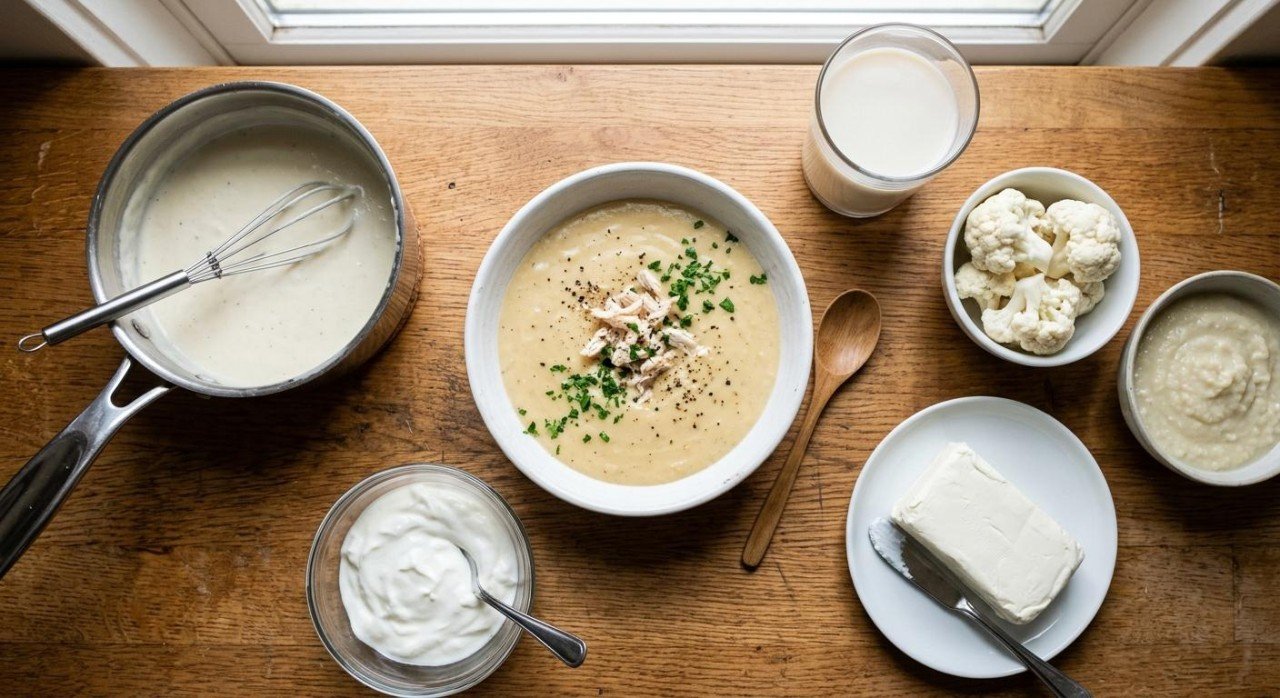
- Swap: 1 can condensed soup → 2 cups cauliflower florets, simmered in 1 cup chicken broth until very tender (about 10 minutes), then blended with 1/3 cup of the cooking broth + 1 tablespoon olive oil or butter + 2 teaspoons cornstarch + 1/4 teaspoon poultry seasoning + a pinch of garlic powder; simmer 1 minute to thicken
- Best for: Baked chicken casseroles, chicken and rice, creamy chicken soups
- Skip it for: Recipes where the sauce is the star, like a chicken gravy or creamy pasta; it reads as a lighter sauce
- Health notes: A fraction of the calories, fat, and sodium of the can, plus a full serving of vegetables in each batch
This is the swap for when you want the casserole to do a little more for you. Cauliflower blends into a surprisingly silky, mild purée, and once it's seasoned and baked with chicken, rice, and cheese, it reads as creamy rather than vegetable. It also adds a plant to a dish that often has only one or two, which helps if you're aiming for more variety in your week. The small amount of cornstarch gives it the binding power cauliflower lacks on its own, so the casserole still holds together when you scoop it.
Be realistic about the result. It's lighter and a little less rich than the canned soup, and in a recipe with very little cheese, you may notice a faint cauliflower flavor. A spoonful of Parmesan or a little extra poultry seasoning fixes that. Frozen cauliflower works fine and saves the chopping. If you're curious what a swap like this does to your recipe's numbers, the Eat Well Planner Recipe Playground shows you: swap the can for cauliflower and watch the nutrition score, sodium, and fiber change live before you commit to anything.
Take the Guesswork Out of Eating Well
Eat Well Planner helps you organize your favorite recipes, plan balanced meals, and automatically generate shopping lists — all in one place. Whether you're tracking macros, managing dietary restrictions, or just trying to stop asking "what's for dinner?", we've got you covered.
Our AI-powered tools can adapt any recipe to your dietary needs, help you discover new meals you'll love, and even log your nutrition effortlessly. It's meal planning made simple.
Start Organizing Your Meals — FreeWhat Not to Use
- Ready-to-serve cream of chicken soup. It's already diluted with water or milk, so it's far too thin to bind a casserole. If that's what you have, simmer about 2 cups down to 1 1/4 cups, or thicken it with 1 tablespoon cornstarch whisked into 2 tablespoons cold water.
- Chicken noodle soup or plain broth on its own. No creaminess and nothing to thicken it, so the casserole comes out soupy.
- Bouillon cubes or powder alone. They're useful for seasoning a homemade sauce, but they add only salt and flavor, not body. A teaspoon of most regular bouillon powder carries several hundred milligrams of sodium, so measure it.
- Plain milk with no thickener. It won't set. Always add flour or cornstarch.
- Jarred Alfredo sauce. It's thick enough, but the strong Parmesan and garlic flavor changes the dish, and many jars carry as much sodium as the soup you're replacing.
- Light or fat-free yogurt or sour cream without a starch. Low-fat dairy separates fastest in the heat. If it's all you have, add the flour and keep the oven at a moderate temperature.
Make Any of These Fit Your Recipe
Condensed cream of chicken soup is easy to replace because its jobs are simple: thicken, enrich, and season. The 10-minute homemade version handles nearly every recipe and cuts the sodium by about two-thirds. Cream cheese and evaporated milk get you through the slow cooker. The olive oil and oat milk sauce covers dairy-free cooking, and blended cauliflower makes a lighter casserole with an extra vegetable in it.
Not sure which one fits the dish you're making? The Eat Well Planner AI recipe chat can tell you. Open or import the recipe, ask "I don't have cream of chicken soup, what should I use?", and it'll recommend the substitute that fits that specific dish, with the full recipe in front of it, including how much to cut the salt elsewhere. If you'd like the swap worked into the whole recipe, Recipe Variations rewrites it for you. And Make It Healthier will suggest changes like the homemade sauce or cauliflower cream on its own, checking the actual nutritional gain before it shows you anything.