You are halfway through a recipe and the sour cream tub is empty, or you are staring at a taco night with nothing to spoon on top. Good news: sour cream is one of the easiest dairy ingredients to stand in for, and you almost certainly have a workable swap in the fridge right now.
The catch is that the best substitute depends entirely on what you are doing with it. A swap that is perfect dolloped on a cold baked potato can curdle into grainy little clumps the moment it hits a simmering sauce. So the sections below are ordered by how versatile each option is, and every one tells you plainly what it is good for and where it falls apart.
Let's get you back to cooking.
The quick list
- Plain Greek yogurt — the closest all-purpose 1:1 swap, with more protein and less fat
- Creme fraiche — the one to reach for in hot sauces and soups; it will not split
- Cream cheese (thinned) — for extra-rich dips and anything you do not want to break over heat
- Blended cottage cheese — high-protein, neutral, works cold or baked
- Buttermilk — thin and tangy, ideal for baking and dressings (not for dolloping)
- Kefir — drinkable and probiotic, great in marinades and dressings
- Mascarpone — rich, mild, and heat-stable for finishing sauces
- Mayonnaise — the surprise swap for dips and for keeping baked goods moist
- Coconut cream + lemon — the go-to dairy-free option
First, the one thing that trips people up: heat
Sour cream splits when you add it to something hot because it is relatively low in fat (around 20 percent) and higher in protein. Heat makes those proteins seize and clump, and the acidity speeds it along. That is why a stroganoff or a pan sauce can turn grainy the second the sour cream goes in and boils.
Two rules fix almost every heat problem. First, stir any cultured dairy swap in at the very end, off the heat or on the lowest simmer, never at a rolling boil. Second, when a recipe genuinely needs to cook with it, reach for a higher-fat substitute like creme fraiche, mascarpone, or cream cheese — the extra butterfat coats the proteins and keeps them from breaking.
Plain Greek yogurt
- Swap: 1:1, full-fat for the closest match
- Best for: Dips, dolloping, tacos, baked potatoes, baking, and dressings
- Skip it for: Boiling sauces, unless you stir it in at the end off the heat
- Health notes: More protein and far less fat and saturated fat than sour cream
Greek yogurt is the default answer for a reason: it is thick, tangy, and spoons and bakes almost exactly like sour cream. Use plain, unsweetened, and preferably full-fat, since nonfat can taste sharper and behaves a little thinner. In cold uses it is a straight one-for-one swap that most people cannot tell apart.
In hot dishes it can still curdle, so treat it like sour cream: stir it in at the end and keep it below a boil. If you want the full breakdown of why Greek yogurt is so much richer in protein, our guide on how to pick a Greek yogurt walks through it.
Creme fraiche
- Swap: 1:1, straight from the tub
- Best for: Hot sauces, soups, and pan sauces where sour cream would split
- Skip it for: Nothing, really — it is milder and richer, but it works everywhere
If you only remember one heat-proof swap, make it creme fraiche. It is essentially a higher-fat, less-tangy cousin of sour cream, and that extra butterfat (around 30 percent versus sour cream's 20) is exactly what lets it simmer and even boil without breaking. Stir it into a stroganoff, a mushroom sauce, or a soup with zero anxiety.
The trade-off is a softer, less sour flavor and more richness, so it is not the pick if you specifically want that sharp tang on a taco. A squeeze of lemon juice brings it closer.
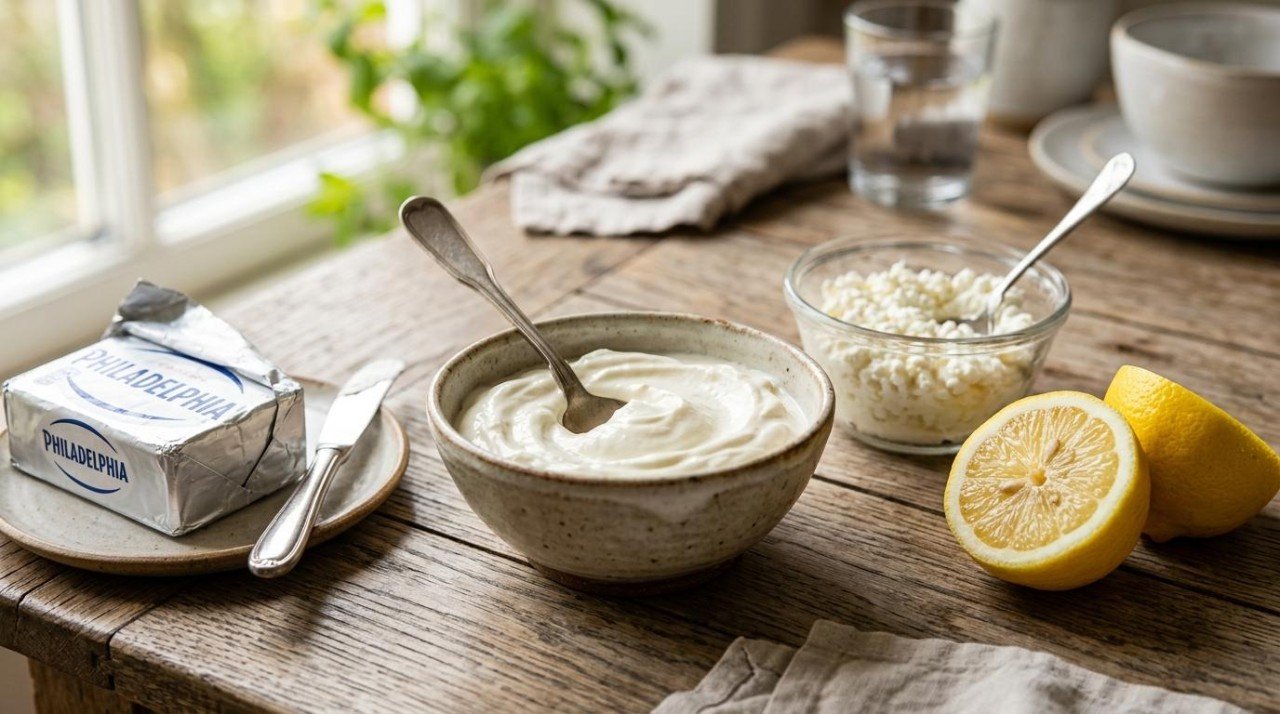
Cream cheese (thinned)
- Swap: Soften and thin with about 1 tablespoon of milk or a squeeze of lemon per 1/4 cup, then use 1:1
- Best for: Rich dips, cheesecakes, and hot dishes where you want body without splitting
- Skip it for: A light dollop — it is denser and heavier than sour cream
Cream cheese shares sour cream's tang but brings a lot more richness and structure, which makes it a natural for dips that need to hold their shape and for baked goods that want a dense, moist crumb. Because it is high in fat, it also behaves well in warm dishes rather than curdling.
Straight from the block it is too stiff, so let it come to room temperature and whisk in a little milk, buttermilk, or lemon juice until it loosens to a spoonable, sour-cream-like consistency.
Blended cottage cheese
- Swap: 1 cup cottage cheese + up to 4 tablespoons milk + 2 teaspoons lemon juice, blended completely smooth
- Best for: Dips, baking, and stirred into dishes off the heat
- Skip it for: Anything where you cannot blend out the curds
- Health notes: One of the highest-protein, lowest-fat swaps here
Cottage cheese is having a moment, and for good reason. Blended until perfectly smooth with a little milk and lemon, it turns into a creamy, mild, faintly tangy base that stands in for sour cream at a fraction of the fat and with a big protein boost. The blending step is not optional — the whole point is to erase the curds.
It is a little milder and less sour than the real thing, so lean on the lemon juice if you want more tang. Like all cultured dairy, add it late to hot dishes rather than boiling it.
Buttermilk
- Swap: 1:1 in batters, reducing the other liquid by a couple of tablespoons since buttermilk is thinner
- Best for: Pancakes, muffins, quick breads, and creamy dressings
- Skip it for: Dolloping or dips — it is pourable, not scoopable
Buttermilk brings the same lactic tang and the same tenderizing acidity that makes sour cream so good in baking, but it is a liquid, so its uses are limited to things that are already wet. In a batter it is an easy swap that keeps cakes and biscuits soft; in a dressing it thins things beautifully.
What it cannot do is sit on top of a bowl of chili. If you happen to be out of buttermilk too, our buttermilk substitutes guide has the quick fixes (and yes, sour cream thinned with a little milk is one of them, so the swap runs both ways).
Kefir
- Swap: 1:1 wherever a pourable, tangy dairy works
- Best for: Marinades, dressings, and baking
- Skip it for: Toppings and dips — it is too thin to hold a shape
Kefir is a drinkable fermented milk that is even tangier than sour cream and loaded with live cultures. Its thin consistency rules it out for anything you want to spoon, but that same pourability is an asset in a buttermilk-style dressing or a marinade, where its acidity tenderizes meat.
It is also a genuine gut-health upgrade thanks to its diverse cultures — if that angle interests you, we compared it head to head with other ferments in kimchi vs kefir vs kombucha.
Mascarpone
- Swap: 1:1, with a squeeze of lemon to add tang
- Best for: Finishing sauces, luxurious dips, and desserts
- Skip it for: A lighter, tangier result — it is sweet-leaning and very rich
Mascarpone is an Italian cream cheese with a high fat content and a mild, almost sweet flavor. That richness makes it heat-stable, so it stirs into a hot sauce or risotto without breaking, and it is an easy, decadent finish for a pan sauce.
The one thing it lacks is sour cream's signature tang, so add a teaspoon or two of lemon juice if the dish is counting on that sharpness. In desserts, its natural sweetness is a feature rather than a flaw.
Mayonnaise
- Swap: 1:1
- Best for: Creamy dips, dressings, and keeping cakes moist
- Skip it for: Toppings where you want clean dairy tang, like tacos or baked potatoes
Mayonnaise is the swap people forget, but it is a workhorse. It has a similar thick, creamy body and a mild acidity, and it shines in ranch-style dips, coleslaw, and dressings where other flavors carry the dish. In baking, it is a well-known trick for an ultra-moist chocolate cake, since it is essentially oil and egg.
Where it falls short is flavor: it tastes of oil and egg rather than cultured dairy, so it is wrong for anything where you want that bright, sour finish on top. Use it where it can hide.
Coconut cream + lemon (dairy-free)
- Swap: Chilled thick coconut cream + 1 to 2 teaspoons lemon juice per 1/2 cup, whisked smooth; use 1:1
- Best for: Vegan dips, toppings, and baking
- Skip it for: Savory dishes where a faint coconut note would clash
For a dairy-free table, the thick cream scooped from the top of a chilled can of full-fat coconut milk, brightened with lemon juice, gives you a rich, spoonable, tangy stand-in. It is the closest plant-based match in texture, and it works both cold and in baking.
The obvious caveat is a mild coconut flavor, which disappears in a sweet or spiced context but can feel out of place in, say, a savory Eastern European dish. Store-bought vegan sour cream (often soy- or cashew-based) is the neutral-flavored alternative if that matters.
The healthier swaps, and what you actually gain
Sour cream is not something to feel bad about, but if you use it often, two of these swaps are genuine nutritional upgrades. Both plain Greek yogurt and blended cottage cheese give you noticeably more protein and a fraction of the saturated fat, while behaving almost identically once they are in the dish. Trading a couple of grams of saturated fat per dollop for a few grams of protein, meal after meal, adds up.
The honest trade-off is a slightly tangier, sometimes thinner result, and a little more care needed around heat. In most recipes that difference is invisible, but in a delicate dessert or a showcase dip, the full-fat original still has an edge.
Not sure whether a swap will hold up in the specific thing you are making? That is exactly what Eat Well Planner is built for. Its AI recipe chat can look at your actual recipe and tell you which substitute fits — and its Make It Healthier feature proposes swaps like Greek yogurt for sour cream automatically, then uses a calculator to verify the real nutritional gain before it suggests them, so you can see exactly what changes before you commit.
Take the Guesswork Out of Eating Well
Eat Well Planner helps you organize your favorite recipes, plan balanced meals, and automatically generate shopping lists — all in one place. Whether you're tracking macros, managing dietary restrictions, or just trying to stop asking "what's for dinner?", we've got you covered.
Our AI-powered tools can adapt any recipe to your dietary needs, help you discover new meals you'll love, and even log your nutrition effortlessly. It's meal planning made simple.
Start Organizing Your Meals — FreeWhat to skip
- Fat-free sour cream in hot dishes — with even less fat to protect the proteins, it splits faster than the regular kind. Save it for cold uses.
- Whipped topping (Cool Whip and similar) — it is sweet and has no tang, so it will not read as sour cream anywhere savory.
- Plain milk or cream — no tang and far too thin. If that is all you have, culture it with a tablespoon of lemon juice or vinegar per cup and let it sit 10 minutes.
- Ricotta straight from the tub — it is grainy and bland. Blend it smooth with lemon and a splash of milk first, or it will feel wrong.
The bottom line
For most cold uses, grab Greek yogurt and move on. If the dish is going to get hot, switch to creme fraiche, mascarpone, or thinned cream cheese so it does not split. And for a dairy-free table, chilled coconut cream with a little lemon does the job. Match the swap to the job and no one will notice the tub was empty.
Once you land on a version you like, save the recipe to Eat Well Planner so the swap is baked in for next time — and let it build your shopping list so you are never caught mid-recipe without the sour cream again.