The recipe says to finish the sauce with a few spoonfuls of creme fraiche, and you either never bought it or the little tub in the back of the fridge has quietly turned into a science project. It happens constantly, because creme fraiche is one of those ingredients a recipe calls for once and then forgets about.
The good news is that you have options, and at least one of them is probably in your fridge right now. The bad news is that the most obvious swap, sour cream, is exactly the one that fails in the place creme fraiche is most often used: a hot pan. So this guide is organized by what you are actually doing with it, and it starts with the one property that decides whether a substitute works or turns your sauce grainy.
Find your use case below, grab the matching swap, and get back to the stove.
The quick list
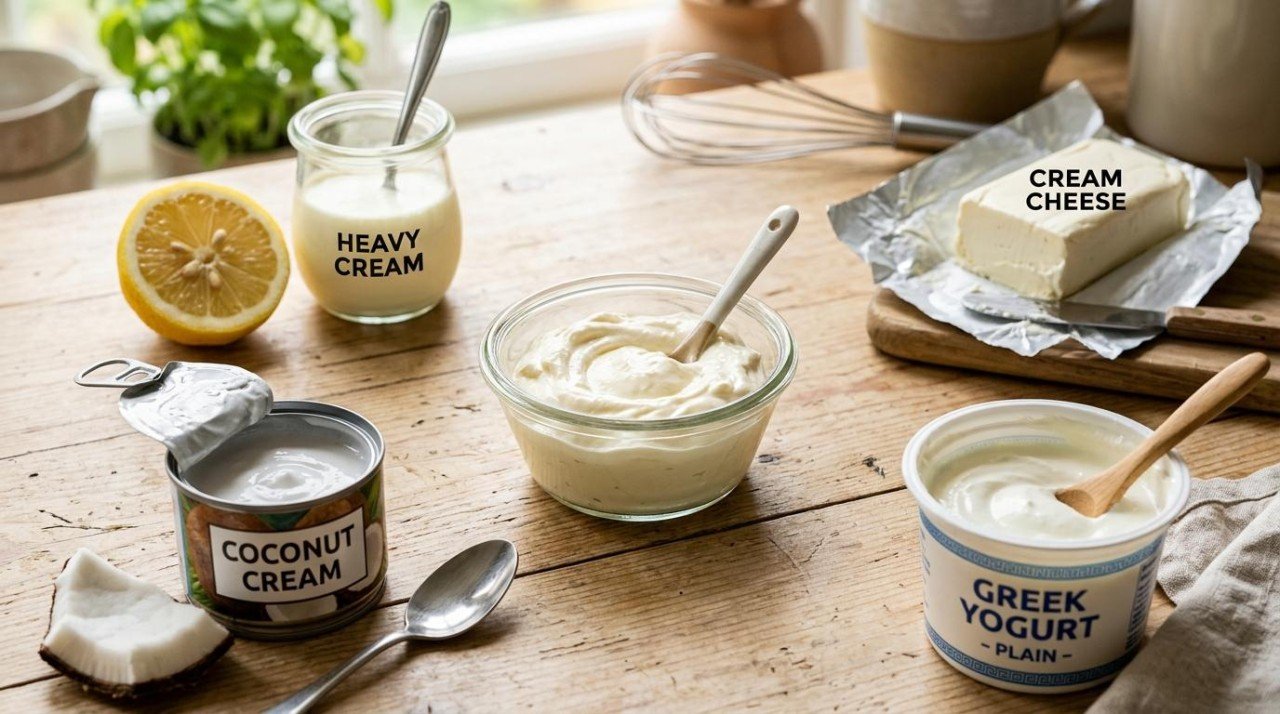
- Sour cream + heavy cream (equal parts) — the best all-around stand-in, and the one to use in warm sauces
- Heavy cream + a squeeze of lemon — for pan sauces and soups that need to simmer
- Mascarpone — rich, mild, and heat-proof; ideal for pasta, risotto, and desserts
- Mexican crema — the closest ready-made match, a little thinner and great for drizzling
- Cream cheese (thinned) — sturdy in hot dishes, best where it melts into a sauce
- Sour cream — fine cold and in baking, but it splits if it boils
- Full-fat Greek yogurt (with a splash of cream) — the lighter, higher-protein option for dolloping and baking
- Coconut cream + lemon — dairy-free, and stable in curries and soups
- Cashew cream — dairy-free and neutral, for dolloping and stirring in off the heat
- Homemade creme fraiche — the real thing, if you have 12 to 24 hours
First: why creme fraiche does not split (and most swaps do)
Creme fraiche is cultured heavy cream: cream that has been thickened and soured by the same kind of friendly bacteria that make buttermilk and yogurt. The important part is the fat. Creme fraiche is made from cream with as much as 45 percent butterfat, while sour cream starts from dairy with just 15 to 20 percent. That gap is the whole story.
When cultured dairy gets hot, its proteins tighten up and clump together, and the acid in it speeds that along. In sour cream and yogurt there is relatively little fat to get in the way, so the proteins seize into those tiny curds you see floating in a broken sauce. In creme fraiche there is so much fat surrounding the proteins that they cannot find each other, which is why it stays smooth when it is stirred into hot dishes. You can simmer it, reduce it, and even let it bubble without it breaking.
That gives you a simple sorting rule for every substitute below. High-fat swaps (heavy cream, mascarpone, cream cheese, Mexican crema, coconut cream) can go into a hot pan. Lower-fat swaps (sour cream, yogurt, cashew cream) are great cold or in baking, but in a hot dish they need to go in at the very end, off the heat.
For pan sauces, soups, and pasta (anything that gets hot)
This is where creme fraiche earns its place in a recipe, and where you need to be pickiest about the swap.
Sour cream + heavy cream (equal parts)
- Swap: 1 cup creme fraiche → 1/2 cup sour cream + 1/2 cup heavy cream, whisked together
- Best for: Almost everything: warm sauces, soups, dolloping, dips, and baking
- Skip it for: A hard, rolling boil; keep it at a gentle simmer
If you have both of these in the fridge, this is your answer. Mixing equal parts sour cream and heavy cream gives you something with the tang of the former and much of the richness of the latter, and you can use it immediately. The cream does two jobs: it thins sour cream's stiff texture toward creme fraiche's softer, spoonable body, and it raises the fat level so the mixture is far more forgiving in a warm pan than sour cream alone.
It is not quite as bulletproof as the real thing, since the blend lands somewhere around the high-20s percent fat rather than creme fraiche's 30-plus. In practice that means you can stir it into a pan sauce and let it simmer, but avoid cranking the heat to a hard boil. If you have time, letting the mixture sit covered on the counter for a few hours thickens it further and makes it taste more like true creme fraiche.
Heavy cream + a squeeze of lemon
- Swap: 1 cup creme fraiche → 1 cup heavy cream, plus 1 to 2 teaspoons lemon juice stirred in at the end
- Best for: Pan sauces, cream soups, braises, and pasta sauces that simmer or reduce
- Skip it for: Dolloping or anything cold; it is pourable, not spoonable
Plain heavy cream has about as much fat as creme fraiche (roughly 36 percent), so it will not split no matter how long you simmer it. In fact, America's Test Kitchen points out that creme fraiche substitutes 1:1 for heavy cream in almost any application, and the swap works just as well in reverse for cooked dishes. What heavy cream lacks is tang and thickness. Let it reduce for a couple of extra minutes to build body, then add the lemon juice off the heat at the end to bring back that gentle sourness.
Add the acid last and in small amounts. Lemon juice whisked into a pan of simmering cream is fine; dumping a large splash into cold cream and letting it sit will make it curdle on purpose, which is a different recipe entirely. Out of heavy cream too? Our heavy cream substitutes guide covers the stand-ins for that.
Mascarpone
- Swap: 1:1, loosened with 1 to 2 tablespoons of milk or cream per 1/2 cup if you want it softer, plus a squeeze of lemon for tang
- Best for: Pasta sauces, risotto, mashed potatoes, and desserts
- Skip it for: Anything where you want noticeable sourness; it is mild and slightly sweet
Mascarpone is an Italian cream cheese made from cream, and it is one of the richest dairy products you can buy. All that fat makes it completely heat-proof, so it melts into a hot sauce or a pot of risotto in seconds without any risk of breaking. It is thicker than creme fraiche straight from the tub, which is why a splash of milk or cream helps if you are using it for a looser sauce.
Where it falls short is flavor. Creme fraiche has a gentle, nutty tang and mascarpone has almost none, so in savory dishes add a little lemon juice to make up the difference. In desserts, its sweetness is an advantage: mascarpone in place of creme fraiche alongside a tart or a bowl of berries is arguably an upgrade.
Mexican crema
- Swap: 1:1
- Best for: Drizzling over soups, tacos, enchiladas, and roasted vegetables; stirring into warm sauces
- Skip it for: Dolloping a thick spoonful on dessert; it runs
Mexican crema is the closest relative creme fraiche has on most American grocery shelves. It runs about 30 percent fat versus around 20 percent in sour cream, and that extra fat keeps it from curdling in hot or acidic dishes. The flavor is similar too: tangy with a slight sweetness, often with a touch of salt or lime.
The main difference is texture. Crema is pourable, while creme fraiche is thick enough to hold a soft peak on a spoon. That makes crema perfect anywhere you would swirl creme fraiche into a bowl of soup, and slightly less ideal as a dessert topping. Look for it in the refrigerated section near the Mexican cheeses.
Cream cheese (thinned)
- Swap: 1/2 cup softened cream cheese + 2 to 3 tablespoons milk or cream, whisked smooth, to replace 1/2 cup creme fraiche
- Best for: Creamy pasta sauces, mashed potatoes, casseroles, and dips
- Skip it for: A delicate dollop; it is denser and tangier in a cheesy way
Cream cheese is high enough in fat to stay smooth in a hot dish, and it brings plenty of body. The catch is that it comes in a firm block, so it needs to soften to room temperature and be thinned before it behaves like creme fraiche. Whisking it with a little milk or cream first prevents lumps; if you drop cold cubes straight into a sauce, you will spend five minutes chasing them around the pan.
The flavor is a little more "cheesy" and less buttery than creme fraiche, which suits savory dishes far better than desserts. For more ideas built around it, see our cream cheese substitutes guide, which runs the swaps in the other direction.
For dolloping, desserts, and cold dishes
Cold uses are where creme fraiche is easiest to replace, because heat stability no longer matters. What matters now is texture and how tangy you want it.
Sour cream
- Swap: 1:1
- Best for: Topping soups and potatoes, dips, dressings, and baking
- Skip it for: Simmering sauces and soups; it will curdle
Sour cream is the substitute everyone reaches for first, and in cold dishes it is a perfectly good one. It is a little thicker and noticeably sharper than creme fraiche, which tastes milder and more buttery. In a dip or as a topping for chili, few people would notice the difference.
The problem is heat. With its lower fat content, sour cream is likely to curdle in a hot dish, though adding it after cooking is fine. If a recipe tells you to simmer creme fraiche into a sauce, take the pan off the heat, let it stop bubbling, and then stir in the sour cream, or upgrade to the sour cream plus heavy cream blend above. For desserts, the sharper tang can taste out of place next to fruit; a teaspoon of sugar or a spoonful of heavy cream softens it.
Full-fat Greek yogurt (with a splash of cream)
- Swap: 1:1 on its own, or about 3/4 cup full-fat Greek yogurt + 1/4 cup heavy cream for 1 cup creme fraiche
- Best for: Dolloping on soups, fruit, and savory bowls; dips; baking
- Skip it for: Anything that will boil, unless you stir it in at the end off the heat
- Health notes: Far more protein and a fraction of the saturated fat (see the numbers below)
Greek yogurt has the thick, spoonable body of creme fraiche and a similar tang, and it is the lightest swap here. Use full-fat: nonfat Greek yogurt tastes sharper, feels chalky by comparison, and is even more likely to split. Whisking in a little heavy cream rounds off the sourness and makes the texture silkier, getting you noticeably closer to the real thing.
Like sour cream, yogurt does not like heat. Stir it into a warm dish off the burner and do not let it boil afterward. In baking, it is an easy one-for-one swap that keeps cakes and quick breads moist. For more on how it stands in across recipes, see our Greek yogurt substitutes guide and the full sour cream substitutes guide, since the two ingredients cover a lot of the same ground.
For baking
Creme fraiche shows up in pound cakes, scones, tart fillings, and quiche, where it adds moisture, richness, and a soft tang. Heat stability matters less here because it is mixed into a batter or custard, so most of the swaps above work:
- Sour cream is the easiest 1:1 swap in cakes, muffins, and scones. Expect a slightly tangier, marginally less rich result.
- Full-fat Greek yogurt also works 1:1 and keeps the crumb moist. It is a little drier than creme fraiche, so in a very rich cake you can add a tablespoon of melted butter per cup.
- The sour cream + heavy cream blend is the closest match for custards and quiche fillings, where creme fraiche's richness sets the texture.
- Mascarpone is lovely in cheesecakes and tart fillings, but its lack of tang changes the flavor; add a teaspoon of lemon juice per cup.
One swap to avoid in baking: buttermilk. It is the starter for homemade creme fraiche, but on its own it is far too thin to replace it in a batter without throwing off the liquid balance. If buttermilk is what you are short on, our buttermilk substitutes guide has you covered.
Dairy-free substitutes
Coconut cream + lemon
- Swap: 1 cup thick coconut cream (scooped from the top of a chilled can of full-fat coconut milk) + 1 to 2 teaspoons lemon juice
- Best for: Curries, soups, and pan sauces; dolloping on desserts and fruit
- Skip it for: Savory dishes where a coconut flavor would clash
Coconut cream is very high in fat, so like dairy cream it holds up beautifully in a simmering sauce or soup without separating. Chill the can overnight and scoop off the thick, solid layer on top; save the watery part for a smoothie. A little lemon juice adds the tang, and whisking it gives you a soft, spoonable texture remarkably close to creme fraiche.
The obvious trade-off is coconut flavor. It disappears into a Thai curry or a spiced soup and works well with tropical fruit, but it can taste odd in a French pan sauce. Our coconut milk substitutes guide covers the full-fat versus light distinction if you are shopping for it.
Cashew cream
- Swap: Soak 1 cup raw cashews, then blend with 1/2 cup water, 1 tablespoon lemon juice, 1 teaspoon apple cider vinegar, and a pinch of salt; use 1:1
- Best for: Dolloping, dips, and stirring into soups at the end
- Skip it for: Long simmering; it thickens and can catch on the bottom of the pan
- Health notes: Mostly unsaturated fat, plus some fiber and magnesium from the nuts
Blended cashews make a neutral-tasting, creamy base that takes on whatever acid you add to it. This cashew sour cream recipe soaks the nuts at room temperature for 4 to 6 hours, or in hot water for 30 minutes if you are in a hurry, and keeps for 5 to 7 days in the fridge. A high-speed blender gives the smoothest result; in a regular blender, add an extra tablespoon or two of water and blend longer.
It is the better choice than coconut cream when you want no competing flavor, though it is not as heat-stable. Swirl it into a soup bowl rather than simmering it in the pot.
Make your own creme fraiche (if you can wait)
- Recipe: 1 cup pasteurized heavy cream (not ultra-pasteurized) + 2 tablespoons cultured buttermilk
- Time: 12 to 24 hours at about 75°F, until thickened but still pourable
- Best for: Everything creme fraiche does, at a fraction of the price
If the recipe is for tomorrow, you can make the real thing. America's Test Kitchen's method is simply to stir 1 cup pasteurized heavy cream with 2 tablespoons buttermilk, cover the jar, and leave it somewhere warm, ideally 75 to 80 degrees, until it thickens, which takes 12 to 24 hours. Then refrigerate it, where it firms up further.
Two details make or break it. Use cultured buttermilk with live cultures, since the "milk plus lemon juice" buttermilk shortcut has no bacteria to do the work. And skip ultra-pasteurized cream if you can find regular pasteurized, because the high-heat process makes it slower and less reliable to culture. A cool kitchen just means it takes longer; check it after 12 hours and give it more time if it is still thin.
The healthier swaps, and what you actually gain
Creme fraiche is a lovely ingredient, and a few spoonfuls to finish a sauce for four people is not something to worry about. But if you use it often, it is worth knowing what it is made of. Because it is cultured heavy cream, its nutrition sits close to heavy cream's: per 100 grams, heavy cream has about 340 calories and 23 grams of saturated fat, with under 3 grams of protein.
Compare that with the two lighter swaps:
- Full-fat Greek yogurt: about 97 calories, 2.4 grams of saturated fat, and 9 grams of protein per 100 grams
- Sour cream: about 198 calories, 10 grams of saturated fat, and 2.4 grams of protein per 100 grams
Greek yogurt is the standout. Swapping it in for a dollop on soup, a topping on fruit, or a spoonful in a cake batter roughly triples the protein and cuts the saturated fat by about 90 percent, while keeping the creamy tang. Even the 3-to-1 yogurt and cream blend keeps most of that advantage. The honest trade-off is that yogurt cannot simmer, so for sauces that need to cook, the heat-stable options above are still the right call, and you can simply use a little less.
Not sure which of these fits the specific dish you are making? That is exactly the kind of question Eat Well Planner is built for. Its AI recipe chat can look at your actual recipe, see whether the creme fraiche is being simmered, dolloped, or baked, and tell you which swap will hold up. And if you are swapping for health reasons, the Recipe Playground lets you trade creme fraiche for Greek yogurt and watch the recipe's nutrition score change live before you commit.
Take the Guesswork Out of Eating Well
Eat Well Planner helps you organize your favorite recipes, plan balanced meals, and automatically generate shopping lists — all in one place. Whether you're tracking macros, managing dietary restrictions, or just trying to stop asking "what's for dinner?", we've got you covered.
Our AI-powered tools can adapt any recipe to your dietary needs, help you discover new meals you'll love, and even log your nutrition effortlessly. It's meal planning made simple.
Start Organizing Your Meals — FreeWhat to skip
- Sour cream, yogurt, or light sour cream in a boiling sauce — they will split into grainy curds. Add them off the heat or use a high-fat swap instead.
- Nonfat Greek yogurt — chalky, very sharp, and the quickest of all to curdle. Full-fat only.
- Half-and-half — at around 11 percent fat it is too thin to dollop and too low in fat to stay smooth when reduced with acid. If that is all you have, our half-and-half guide explains what it can and cannot do.
- Whipped topping — sweet, airy, and with none of the tang. It reads as dessert, not cream.
- "Buttermilk" made from milk and lemon juice, for homemade creme fraiche — it sours the cream but has no live cultures, so it will not thicken it properly.
The bottom line
If the creme fraiche is going into a hot pan, use something high in fat: equal parts sour cream and heavy cream, heavy cream with a squeeze of lemon, mascarpone, Mexican crema, or thinned cream cheese. If it is being dolloped, spread, or baked, sour cream or full-fat Greek yogurt does the job, with Greek yogurt as the lighter, higher-protein pick. For a dairy-free table, coconut cream handles heat and cashew cream handles everything cold. And if you have a day to spare, a jar of cream and a splash of buttermilk gives you the real thing.
Once you find the swap that works for a recipe you love, save it to Eat Well Planner with the substitution built in, or ask it to create a variation (dairy-free, lighter, or just "whatever is in my fridge") so you never have to work it out mid-recipe again.