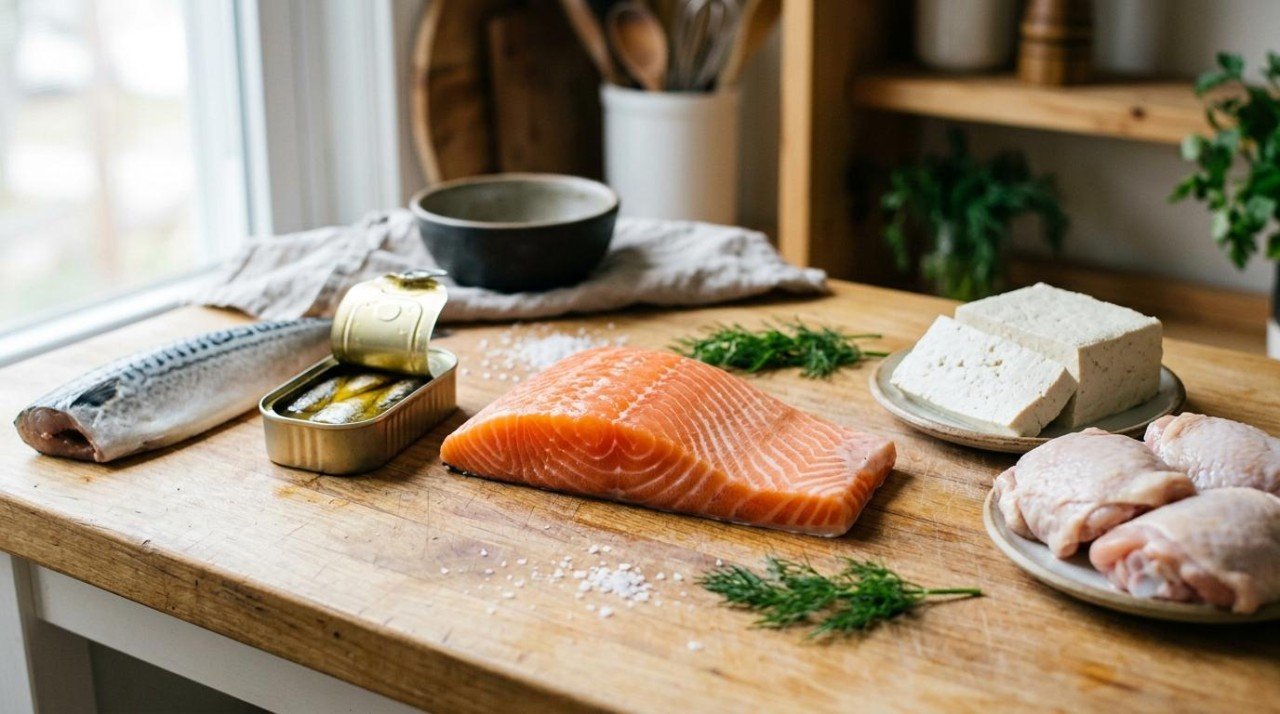
The recipe wants salmon. The fish counter had trout and a wall of frozen white fillets, or the price per pound made you put it back down, or someone at the table just does not like salmon.
Salmon is easier to replace than most people expect, because what it actually brings to a dish is fat. It is rich, it stays moist, it flakes into big soft pieces, and it forgives a couple of extra minutes in the oven. Any swap that matches that fat slots straight in. Any swap that does not needs two small adjustments, and the whole post below is really about those two adjustments.
The other thing that decides the swap is what job the salmon is doing. A seared fillet, a can folded into patties, and a few silky slices on a bagel are three completely different problems, so this guide is grouped that way.
The Quick List
- Rainbow trout or steelhead — the closest everyday 1:1 swap, just leaner and thinner
- Arctic char — looks and cooks almost exactly like salmon, tastes milder
- Sablefish (black cod) — even richer than salmon; the luxury swap
- Atlantic mackerel — cheap, very oily, big flavor; best with acid and high heat
- Canned salmon — the pantry answer for cakes, salads, pasta, and casseroles
- Canned sardines — strongest flavor, best nutrition per dollar on this page
- Tuna, fresh or canned — steaks for the grill, cans for the mixing bowl
- Cod, halibut, or other white fish — works everywhere if you add fat and cut the time
- Smoked trout or smoked mackerel — for dips, eggs, pasta, and bagels
- Carrot lox — the plant-based stand-in for cold-smoked slices
- Chicken thighs or breast — the no-seafood answer for bowls, sheet pans, and curries
- Extra-firm tofu or tempeh — plant-based, for anything roasted or glazed
First: How Fat, How Thick, and How Hot
Farmed Atlantic salmon runs about 175 calories, 19 grams of protein, and 10 grams of fat per 3 ounces cooked. That fat is your safety margin. Swap in something leaner and you lose it, so do two things: add a tablespoon or two of oil, butter, or a glaze per pound, and take the fish out of the oven earlier than the recipe says.
For timing, the old ten-minute rule still works: bake at 450F for 10 minutes per inch of thickness at the thickest point, turning halfway, adding 5 minutes if it is wrapped in foil or sitting in sauce, and doubling to 20 minutes per inch straight from frozen. Thickness matters more than the label on the package — a thin trout fillet in a recipe written for a 1.25-inch salmon portion will be done in half the time.
On doneness, the FDA number is 145F internal. Most cooks pull fatty fish well before that: America's Test Kitchen lands on 125F for farmed salmon and 120F for wild, because wild salmon has more collagen and about half the fat and dries out faster. That gap is the whole lesson of this page in miniature. The leaner your substitute, the earlier it needs to come off the heat.
The Closest Swaps: Another Rich, Pink Fish
Rainbow Trout or Steelhead
- Swap: 1 lb salmon → 1 lb trout fillets. Fillets usually run thinner, so cut 3 to 5 minutes off the cook time and check early
- Best for: Roasted and baked fillets, pan-searing, grilling in foil or a basket, glazed and sheet-pan dinners
- Skip it for: Long, hard grilling on bare grates, and any recipe leaning on salmon's fat to survive a long bake
- Health notes: About 142 calories, 20 grams of protein, and 0.74 grams of EPA and DHA per 3 ounces cooked — leaner than salmon, with roughly 40% of its omega-3s, and on the EPA and FDA Best Choices list
If you take one swap from this page, take this one. Trout is in the same family as salmon, the flesh is the same pink-orange, and it behaves the same way in a pan — it just cooks faster and tastes gentler. Steelhead is sea-run rainbow trout, sold in salmon-sized fillets, and is the single most convincing lookalike on the fish counter.
The only real trap is dryness. Trout carries less fat than farmed salmon, so brush it with oil or a glaze, keep the skin on if you have it, and pull it at around 125F.
Arctic Char
- Swap: 1 lb → 1 lb, same cook time if the fillets are the same thickness
- Best for: Absolutely everything salmon does — roasting, searing, grilling, poaching, curing, smoking
- Skip it for: Nothing, really. The only catch is finding it and paying for it
- Health notes: About 19 grams of protein, 464 IU of vitamin D, and more than 1,000 mg of EPA and DHA per serving, and one of the few farmed fish with green Seafood Watch ratings and no red flags
Arctic char sits between salmon and trout, and it is close enough to salmon that a lot of people cannot tell them apart on the plate. The flesh is the same pink, the fat content is similar, and the texture is a touch firmer with a lighter, flakier bite and a milder flavor than salmon.
That mildness is the reason to reach for it deliberately, not just when the salmon runs out. If someone in your house finds salmon too fishy, char is usually the fish that changes their mind.
Sablefish (Black Cod)
- Swap: 1 lb → 1 lb. Similar timing to salmon, and much harder to overcook
- Best for: Miso-glazed and broiled fillets, roasting, poaching, smoking, anything with a sweet-salty glaze
- Skip it for: Salads and grain bowls where you want firm chunks — it flakes into very soft, silky pieces
- Health notes: Higher in fat than salmon at about 15 grams per 100 grams raw, and, per NOAA, very high in EPA and DHA
Despite the name, black cod is not a cod. It is the richest, most forgiving fish most people can buy, with a soft, velvety texture and large white flakes — which is exactly why it is the fish behind every miso-glazed black cod on a restaurant menu.
Cook it the way you would cook salmon and it will be better than the salmon. The trade-offs are price and structure: it costs more than most salmon, and it is too delicate for skewers, tacos, or anything stirred.
Atlantic Mackerel
- Swap: 1 lb → 1 lb fillets, but they run about half an inch thick — figure 6 to 8 minutes under a broiler or in a hot pan, not the 12 to 15 a salmon portion takes
- Best for: Broiling, grilling, pan-searing skin-side down, escabeche, anything served with lemon, vinegar, or mustard
- Skip it for: Delicate cream sauces, mild family dinners, and cold salads where you want the fish to stay in the background
- Health notes: About 222 calories, 20 grams of protein, and 1.06 grams of EPA and DHA per 3 ounces cooked, and it is on the EPA and FDA Best Choices list
Mackerel is the cheapest way to get salmon-level richness, and the most divisive fish here. It is oilier than salmon and far more assertive, with a flavor that fades fast as it ages — buy it as fresh as you can find it, or buy it tinned.
Treat the strength as a feature and give it something sharp. Lemon, vinegar, capers, mustard, and charred edges all work. Under a broiler with salt and lemon it is genuinely one of the best cheap dinners going.
One important caution: Atlantic mackerel is the one on the Best Choices list. King mackerel is a different, much larger fish and sits on the high-mercury list to avoid, along with shark, swordfish, tilefish, and orange roughy.
Pantry and Budget Swaps
Canned Salmon
- Swap: 1 lb raw salmon → about 14 oz drained canned salmon (RecipeTin Eats treats 1 lb fresh salmon and 14 oz canned as interchangeable in patties). One 14.75 oz can, drained, gets you close
- Best for: Salmon cakes and patties, salads, pasta, chowders, casseroles, dips, sandwich fillings
- Skip it for: Anything where the salmon is a seared or roasted fillet — it is already cooked and already flaked
- Health notes: About 117 calories, 20 grams of protein, 241 mg of calcium, and 0.92 grams of EPA and DHA per 3 ounces drained — the calcium comes from the softened bones, and it holds roughly half the omega-3s of a fresh fillet at a fraction of the price
This is the swap most worth building a habit around. Canned salmon is one of the cheapest sources of long-chain omega-3s in the store, keeps for years, and needs no cooking. Buy it with the skin and bones in if you can — the bones are soft, you will not notice them once the mix is combined, and they are where that calcium number comes from.
Two practical notes. Canned salmon is drier than fresh, so hold back 1 to 2 tablespoons of the canning liquid and fold it into the mix, or add an extra spoonful of mayonnaise or Greek yogurt. And fold it in at the end rather than stirring it hard, so it stays in flakes instead of turning to paste.
Canned Sardines
- Swap: 4 oz cooked salmon → two standard 3.75 oz tins, drained (about 6 oz of fish, since sardines punch harder per ounce)
- Best for: Pasta with garlic and chili, toast, grain bowls, salads, fish cakes, anything tomato- or lemon-forward
- Skip it for: Anyone salmon-shy, and any dish where the fish should be mild or sit in a cream sauce
- Health notes: About 177 calories, 21 grams of protein, 324 mg of calcium, and 0.83 grams of EPA and DHA per 3 ounces drained, plus 555% of the Daily Value for B12 and 143% for selenium
Nutritionally this is the best-value swap on the page, and the hardest sell. Sardines are strong, salty, and unmistakably fishy — but that is manageable when they are broken into a garlicky pasta or mashed onto toast with lemon and parsley rather than served as a fillet.
Start with sardines packed in olive oil rather than water, drain them well, and let acid do the balancing. If you want the full case for the tin, we made it in our guide to sardines.
Tuna, Fresh or Canned
- Swap: Fresh: 1 lb salmon → 1 lb tuna steaks, seared hot and fast, 1 to 2 minutes a side, pulled rare. Canned: 1 lb salmon → about 14 oz drained canned tuna
- Best for: Fresh steaks on the grill or in a pan; canned tuna in cakes, salads, melts, and pasta
- Skip it for: Any recipe that cooks the fish through — tuna is very lean and goes gray and chalky at salmon temperatures
- Health notes: Canned light tuna carries far less omega-3 than salmon at about 0.20 grams of EPA and DHA per 3 ounces. Canned white tuna is better at about 0.73 grams, but sits in the Good Choices mercury tier rather than Best Choices
Fresh tuna is a good visual and structural match for a salmon steak and a poor thermal one. It has almost none of salmon's fat, so the window between rare and ruined is about 60 seconds. Sear the outside, leave the middle red, slice it against the grain.
Canned tuna is the more common real-world swap and it works fine in the mixing bowl. Just know you are trading most of the omega-3s away — canned salmon costs a little more and delivers roughly four times as much.
If All You Have Is Lean White Fish
Cod, Halibut, and Other White Fish
- Swap: 1 lb salmon → 1 lb cod, halibut, haddock, or pollock, plus 1 to 2 extra tablespoons of oil or butter. Match the thickness and use the ten-minute rule; thin fillets like tilapia need roughly half the time
- Best for: Baked fillets with sauce, chowders, curries, tacos, breaded and pan-fried, sheet pans
- Skip it for: Bare grill grates (halibut excepted), cold salads where the fish's richness carries the dish, and anything with a long unattended bake
- Health notes: Leaner and lower in calories, but the omega-3 gap is real — cod carries about 0.13 grams of EPA and DHA per 3 ounces, under a tenth of what farmed salmon does
White fish will do the job of salmon in most cooked recipes as long as you compensate for the missing fat. Add oil or butter, use a sauce or a glaze rather than dry heat alone, and check for doneness several minutes before the recipe tells you to.
Where it falls down is any dish built on salmon's richness: a simple roasted fillet with lemon, a warm salad, a cold flaked salmon lunch. Those need the fat back, from the fish or from the dressing. For picking between white fish, our guide to white fish substitutes covers firmness and thickness in detail. Shrimp and scallops also work in curries, chowders, and pasta, added in the last 2 to 3 minutes.
For Smoked Salmon and Lox
Smoked Trout or Smoked Mackerel
- Swap: 4 oz smoked salmon → 4 oz smoked trout or mackerel. Cold-smoked trout slices are a true 1:1; hot-smoked fillets need to be flaked rather than draped
- Best for: Dips and spreads, scrambled eggs, potato salads, pasta, canapes, bagels if you are happy with flakes
- Skip it for: Anywhere the look matters and you need silky, drapeable slices — hot-smoked fish will not do that
- Health notes: Both are oily fish with a similar omega-3 profile, and both are salty. Smoked fish is a cured product, so it is worth treating as an occasional ingredient rather than a daily protein
The distinction that matters is cold-smoked versus hot-smoked, not the species. Cold-smoked fish stays raw in texture and slices thin, which is what a bagel with cream cheese, red onion, and capers actually needs. Hot-smoked fish is cooked through and flakes, which is better in eggs, dips, and pasta.
Smoked mackerel is the cheapest of the three and by far the strongest; smoked trout is the closest in flavor to smoked salmon. Gravlax, which is cured with salt, sugar, and dill rather than smoked, is also a straight swap when you can find or make it.
Carrot Lox
- Swap: A few ounces of lox → 3 large carrots (about 8 oz), salt-baked, peeled into ribbons, and marinated. One reliable version bakes salt-coated carrots at 350F for 30 minutes, then marinates the ribbons in soy sauce, olive oil, lemon juice, smoked paprika, garlic powder, and a little maple syrup — 30 minutes minimum, overnight is better
- Best for: Bagels with cream cheese, canapes, breakfast boards, anywhere lox is a garnish
- Skip it for: Any dish where the fish is the protein — carrot lox is about 43 calories a serving and essentially no protein
Nobody is fooled by the first bite, and that is fine. What carrot lox genuinely delivers is the silky, salty, smoky, faintly sweet quality of cured salmon against cream cheese, plus the right color and drape. Marinate it a full day if you can, slice it as thin as your peeler allows, and serve it the way you would serve lox — with capers, red onion, dill, and lemon doing half the work.
When You Are Not Using Fish at All
Chicken Thighs or Breast
- Swap: 1 lb salmon → 1 lb boneless chicken in 3/4-inch pieces or thin cutlets, cooked to 165F. It goes into the recipe much earlier than the fish would have
- Best for: Grain bowls, sheet-pan dinners, curries, glazed and teriyaki-style dishes, salads
- Skip it for: Anything where the point is flaky fish, and any dish you were making for the omega-3s
Usually this swap is not about the store at all — it is about one person at the table who does not eat fish. Thighs are the better match because they carry more fat and stay closer to salmon's forgiving texture. Push back toward the original flavor with soy and honey, miso, lemon and dill, or a mustard glaze. Cut-specific detail lives in the chicken thigh and chicken breast guides.
Extra-Firm Tofu or Tempeh
- Swap: 1 lb salmon → one 14 to 16 oz block of extra-firm tofu, pressed and cut into thick planks, or 8 oz of tempeh. Marinate at least 30 minutes, then roast at 400F for 25 to 30 minutes or air-fry until the edges crisp
- Best for: Glazed and teriyaki dishes, grain bowls, sheet pans, tacos, salads
- Skip it for: Any dish where you need the flake, and any nutrition parity on omega-3s
Pressing and a real marinade are non-negotiable — plain tofu in a salmon recipe is the reason people think they dislike tofu. Soy sauce, maple syrup, smoked paprika, and rice vinegar get you most of the way, and a small piece of nori or a splash of caper brine adds the sea note. Our guide to cooking tofu and tempeh has the technique.
Which Swap for Which Dish
- Roasted or baked fillets: Trout, arctic char, sablefish. White fish with extra oil
- Pan-seared with crispy skin: Trout, arctic char, mackerel
- Grilled on bare grates: Arctic char, mackerel, tuna steaks, halibut. Trout needs a basket or foil
- Glazed, miso, or teriyaki: Sablefish, trout, arctic char, chicken thighs, tofu
- Salmon cakes and patties: Canned salmon, canned tuna, sardines, cooked white fish
- Salads and grain bowls: Canned salmon, smoked trout, canned tuna, chicken, tofu
- Pasta and chowders: Smoked mackerel, sardines, canned salmon, white fish, shrimp
- Bagels and lox boards: Cold-smoked trout, gravlax, smoked mackerel, carrot lox
- Curries and coconut braises: White fish, shrimp, chicken thighs, extra-firm tofu
About Those Omega-3s
Salmon is not an ingredient anyone needs to improve on. It is one of the best sources of long-chain omega-3s in the food supply, which is the honest reason to care which swap you pick — some of these substitutes match it and some quietly cost you most of the benefit.
Cleveland Clinic's comparison, all per 3-ounce serving, sets the scale: farmed Atlantic salmon at 1.83 grams, Atlantic herring at 1.71, wild Atlantic salmon at 1.57, Atlantic mackerel at 1.02, canned pink salmon at 0.91, wild rainbow trout at 0.84, canned sardines at 0.83, and canned white tuna at 0.73. Canned light tuna, further down, is around 0.20 grams. Lean white fish is lower still.
So the swaps that keep the nutrition intact are arctic char, sablefish, mackerel, herring, trout, and anything from a can with bones in it. The swaps that do not — white fish, light tuna, chicken, tofu — are perfectly good food, they just are not doing the same job. If omega-3s are why you were making salmon, pick from the first group.
Two more things worth knowing. Salmon, trout, sardines, anchovies, and Atlantic mackerel all sit on the EPA and FDA Best Choices list, where the advice is 2 to 3 servings a week, so rotating between them is genuinely encouraged rather than a compromise. And if you are swapping to plants, walnuts, flax, and chia give you ALA rather than EPA and DHA — Harvard notes the conversion from ALA to EPA and DHA may not be sufficiently efficient, which is why algae oil exists.
Take the Guesswork Out of Eating Well
Eat Well Planner helps you organize your favorite recipes, plan balanced meals, and automatically generate shopping lists — all in one place. Whether you're tracking macros, managing dietary restrictions, or just trying to stop asking "what's for dinner?", we've got you covered.
Our AI-powered tools can adapt any recipe to your dietary needs, help you discover new meals you'll love, and even log your nutrition effortlessly. It's meal planning made simple.
Start Organizing Your Meals — FreeWhat Not to Use
- King mackerel. Easy to confuse with Atlantic mackerel and completely different — it is on the high-mercury avoid list with shark, swordfish, tilefish, and orange roughy. Check the label, not just the word "mackerel."
- Tilapia or basa in a roasted fillet recipe. Not because they are bad fish, but because they are thin and nearly fat-free. In a recipe written for a thick salmon portion they overcook before you have opened the oven twice.
- Canned fish where a fillet is called for. It is cooked and flaked already. Brilliant in cakes and salads, useless under a broiler.
- Fresh tuna cooked to salmon doneness. Tuna has almost no fat to hide behind. Cooked through, it is dry and gray; the swap only works rare.
- Imitation or flavored "salmon" products. Formed, seasoned, ready-to-eat products are their own thing, not a substitute for a raw fillet.
- Any substitute at the original cook time. This is the most common way the swap fails. Thinner and leaner both mean less time — measure the fillet, or use a thermometer.
Which One Should You Actually Use?
Most of the time the answer is short. Trout or arctic char for a roasted or seared fillet. Canned salmon for anything that gets mixed in a bowl. Smoked trout for the bagel. White fish plus a tablespoon of butter when that is what the store had.
The tenth time depends on your specific recipe — how long it bakes, how thick your fillet is, whether there is a glaze or a sauce doing the work. That is where a blog post runs out of road and Eat Well Planner picks up. Its AI recipe chat can see your actual recipe, so "I have steelhead instead of salmon, what do I change?" gets an answer about your fillet and your oven rather than a general one. If you are swapping for dietary reasons, Recipe Variations will rewrite the whole recipe with the substitution built in.
And if the omega-3 question above is the one you care about, the Recipe Playground lets you swap the fish and watch the nutrition move before you commit — so you can see for yourself what trading salmon for cod, or cod for sardines, actually costs or gains.
Now go check how thick that fillet is. It is probably not what the recipe assumed.