The recipe says quinoa. The container in the pantry has about two tablespoons in it, and the vegetables are already roasted.
Quinoa is usually doing one of three jobs: it is the fluffy base of a grain bowl or cold salad, it is a plain side soaking up something saucy, or it is a warm breakfast porridge. It is also the grain a lot of people buy on purpose, because it is gluten-free and unusually high in protein - about 8 grams of protein and 5 grams of fiber per cooked cup, with all nine essential amino acids.
So the right swap depends on which of those jobs you need covered. Here is what actually works, with exact ratios.
The Quick List
- Bulgur - the best all-around swap for salads and bowls, and it beats quinoa on fiber
- Couscous - the fastest option, ready in 10 minutes off the heat
- Farro - chewy and substantial for warm bowls and soups
- Pearled barley - soups and hearty sides, with a big dose of beta-glucan fiber
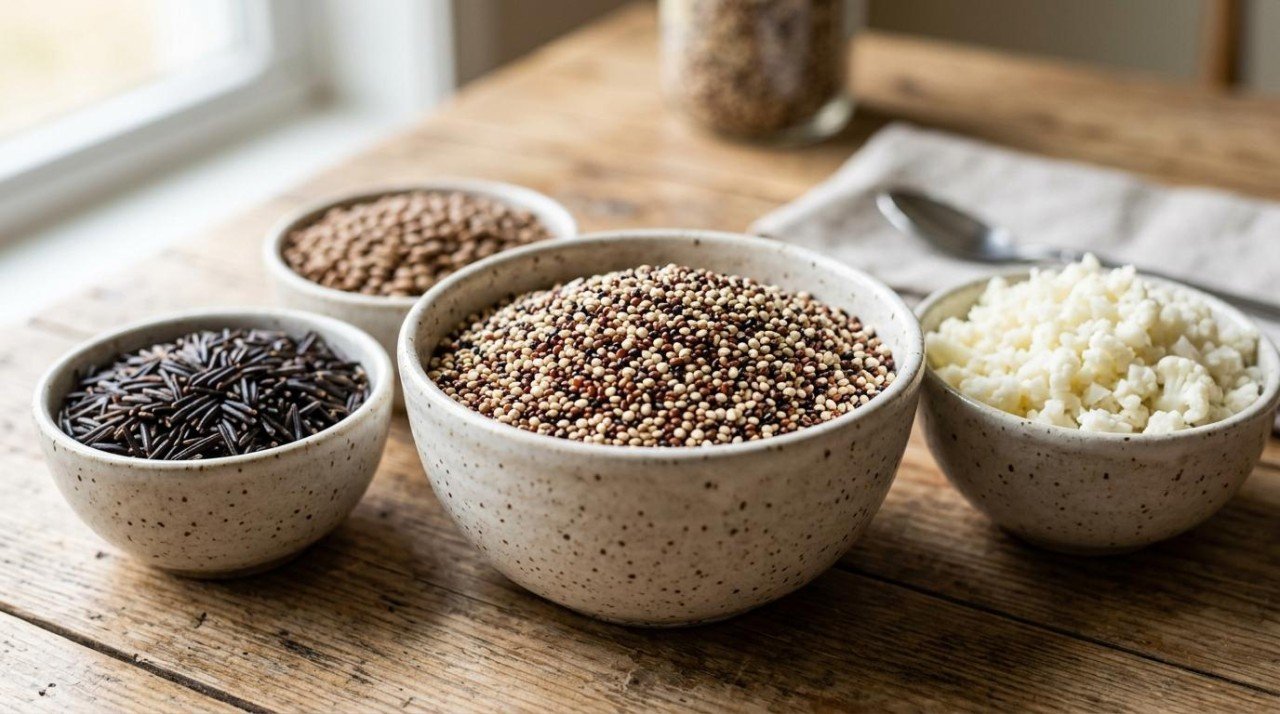
- Wild rice - gluten-free and nutty, great in salads with dried fruit and nuts
- Brown rice - the everyday side under curries and stir-fries
- Millet - the closest gluten-free match for quinoa's fluffy texture
- Buckwheat groats - gluten-free, earthy, done in about 20 minutes
- Amaranth - the protein swap, and the best porridge grain here
- Teff - the porridge grain with the most protein and fiber here
- Steel-cut oats - breakfast only, but everyone already has them
- Riced cauliflower - the low-carb route, at a fraction of the calories
- Lentils - if quinoa was there for the protein, this is the real upgrade
How to Swap Without Ruining Dinner
Nearly every grain here swaps 1:1 by dry volume - 1 cup of dry quinoa becomes 1 cup of the dry substitute. What changes is the liquid and the timer, both listed under each grain below. The one trap is measuring the wrong state: 1 cup of dry quinoa yields about 3 cups cooked, so if the recipe calls for 2 cups cooked quinoa, measure the substitute after cooking, not before.
If It Has to Be Gluten-Free
This matters more for quinoa than for most ingredients, because plenty of people are cooking with it specifically to avoid wheat. Four of the most popular substitutes are not safe.
- Naturally gluten-free: millet, brown rice, buckwheat (despite the name, it is not wheat), amaranth, teff, wild rice, sorghum, riced cauliflower, lentils
- Contains gluten: couscous, bulgur, farro, barley, freekeh, orzo
- Depends: oats are gluten-free by nature but routinely cross-contaminated, so buy certified gluten-free oats if celiac disease is in play
For Grain Bowls and Cold Salads
Bulgur
- Swap: 1 cup dry quinoa to 1 cup medium bulgur, cooked in 2 cups liquid, simmered 10 to 12 minutes, then fluffed. Fine bulgur (#1) only needs to soak in an equal volume of boiling water for about 20 minutes.
- Best for: Tabbouleh, cold grain salads, pilafs, stuffed vegetables
- Skip it for: Gluten-free cooking
- Health notes: 8.2 grams of fiber per cooked cup versus quinoa's 5.2, for about 150 calories - the only common swap here that beats quinoa on fiber (USDA FoodData Central)
Bulgur is parboiled cracked wheat, which is why it cooks so fast for a whole grain. Its texture is the closest thing to quinoa in a cold salad - small, separate, slightly chewy - and it holds a vinaigrette for days without going soft. The flavor is nuttier and more wheat-forward, which is usually an improvement in anything with lemon, parsley, and olive oil.
Couscous
- Swap: 1 cup dry quinoa to 1 cup dry couscous. Stir into 1 cup of boiling water or broth, cover, take it off the heat, and let it sit undisturbed 5 to 10 minutes before fluffing.
- Best for: Fast weeknight bowls, anything served under a saucy stew or braise
- Skip it for: Gluten-free cooking, and salads you dress hours ahead - fine couscous turns pasty
- Health notes: About 5.9 grams of protein and 2.2 grams of fiber per cooked cup. Whole wheat couscous closes most of the fiber gap.
Couscous is not really a grain at all - it is tiny semolina pasta, which is why it needs no simmering. Toasting it in a little olive oil first keeps the grains separate and buys a lot of flavor for thirty seconds of work. For something closer to quinoa's bead-like bite, use pearl (Israeli) couscous instead: boil it like pasta in salted water for 8 to 10 minutes, then drain.
Farro
- Swap: 1 cup dry quinoa to 1 cup farro cooked in 2½ cups liquid, 25 to 40 minutes depending on the milling - pearled at the fast end, whole farro at the slow end
- Best for: Warm bowls, brothy soups, robust salads that need to sit
- Skip it for: Gluten-free cooking, and dishes where you wanted small delicate grains
Farro is the swap for when you want the bowl to feel more substantial, not less. The grains are big and genuinely chewy, so they read as the main event rather than a bed, and they are nearly impossible to overcook into mush. It is also one of the most underused whole grains in the average pantry.
Pearled Barley
- Swap: 1 cup dry quinoa to 1 cup pearled barley cooked in 3 cups liquid for 25 to 30 minutes, draining any excess. Yields about 3 cups, the same as quinoa.
- Best for: Soups, mushroom sides, warm bowls with roasted vegetables
- Skip it for: Gluten-free cooking, and any 20-minute dinner
- Health notes: 6 grams of fiber per cooked cup, much of it the beta-glucan type. Protein is low for this list at about 3.5 grams.
Barley releases starch as it cooks, so it makes soups silkier in a way quinoa never does. That same starch is why it clumps when cold - rinse it briefly under cool water if it is headed into a salad.
Wild Rice
- Swap: 1 cup dry quinoa to 1 cup wild rice cooked in 3 cups liquid for 45 to 55 minutes, until the grains split open
- Best for: Holiday sides, stuffings, salads with dried cranberries, pecans, and a sharp dressing
- Skip it for: Weeknights - it is the slowest option here
- Health notes: About 6.5 grams of protein per cooked cup, the most of any salad or side grain here, and naturally gluten-free
Wild rice is neither rice nor wheat - it is the seed of an aquatic grass, which is why it is safe for celiac cooking. The flavor is strongly nutty and a little tea-like, so it dominates rather than disappears. Where you wanted a neutral base, a wild rice blend is the easier sell.
For a Plain Side Under Something Saucy
Brown Rice
- Swap: 1 cup dry quinoa to 1 cup long-grain brown rice cooked in 2½ cups liquid for 25 to 45 minutes, then rested off the heat for 10 minutes
- Best for: Curries, stir-fries, chili, anything with enough sauce to carry the dish
- Skip it for: Dinner in 20 minutes
- Health notes: About 5.5 grams of protein and 3.2 grams of fiber per cooked cup - less of both than quinoa, but well ahead of white rice
This is the swap almost everyone already has, and under enough sauce nobody will notice. The trade is time - brown rice takes two to three times as long as quinoa, so start it before you do anything else.
Millet
- Swap: 1 cup dry quinoa to 1 cup millet cooked in 2 cups liquid, simmered 17 to 20 minutes, then left covered off the heat for 10 minutes and fluffed with a fork
- Best for: A fluffy gluten-free side, pilafs, anywhere quinoa's light texture mattered
- Skip it for: Salads you dress well ahead - millet keeps drinking liquid and softens
- Health notes: About 6.1 grams of protein per cooked cup, but only 2.3 grams of fiber
Millet is the best gluten-free stand-in for quinoa's actual mouthfeel: small round grains that stay separate. Two things make or break it - toast the dry millet in a dry pan until it smells nutty, and do not stir it while it simmers, since that breaks the grains and releases the starch that turns millet gluey. Gluey is a feature if you want it, though. Add an extra cup of liquid, stir often, and the same grain becomes a creamy porridge.
Buckwheat Groats (Kasha)
- Swap: 1 cup dry quinoa to 1 cup buckwheat groats cooked in 2 cups liquid for about 20 minutes. Pre-toasted kasha runs faster - start checking at 10 minutes.
- Best for: Savory sides, kasha varnishkes, bowls with assertive flavors like mushrooms, dill, or braised cabbage
- Skip it for: Delicate dishes, or anyone who dislikes a strong earthy flavor - buckwheat is not a background grain
- Health notes: About 5.7 grams of protein and 4.5 grams of fiber per cooked cup, gluten-free, and unusually rich in lysine, the amino acid most grains fall short on. Per gram of protein it carries nearly as much lysine as quinoa and around 40 percent more than brown rice (USDA FoodData Central).
Cook it in broth rather than water and use a wide pan so it steams rather than stews. Buckwheat goes from perfect to porridge fast at the end, so check it early.
For Breakfast Porridge
Amaranth
- Swap: 1 cup dry quinoa to 1 cup amaranth in 2 cups liquid, simmered 15 to 20 minutes for a thick pilaf. Add another cup of liquid and stir often for a true porridge.
- Best for: Breakfast porridge, thickening soups and stews
- Skip it for: Anything that needs to be fluffy - amaranth is tiny and sticky and will never separate into distinct grains
- Health notes: About 9.3 grams of protein per cooked cup, more than quinoa, and like quinoa it is a complete protein containing all nine essential amino acids
If you bought quinoa for the nutrition, amaranth is the closest true replacement on that count - it just cannot be used the same way. Treat it as porridge or a thickener, not as a bed for roasted vegetables.
Teff
- Swap: 1 cup dry quinoa to 1 cup teff in 3 cups liquid, simmered about 20 minutes
- Best for: Breakfast porridge, injera, and stirring into stews for body
- Skip it for: Grain salads and pilafs - the grains are poppy-seed small and behave like polenta
- Health notes: Among the most nutrient-dense grains here - roughly 9.8 grams of protein, 7.1 grams of fiber, and 5 milligrams of iron per cooked cup, against quinoa's 8.1 grams, 5.2 grams, and 2.8 milligrams (USDA FoodData Central)
Teff has a malty, almost cocoa-like flavor that works beautifully with maple syrup and cinnamon. Its iron content is genuinely high for a plant food, though iron from grains is absorbed less readily than iron from meat - a squeeze of citrus alongside it helps.
Steel-Cut Oats
- Swap: 1 cup dry quinoa to 1 cup steel-cut oats in 4 cups liquid, simmered about 30 minutes
- Best for: Breakfast, and only breakfast
- Skip it for: Savory sides and salads - oats will not hold their shape as a grain base
- Health notes: Buy certified gluten-free oats if you are cooking for celiac disease, since ordinary oats are usually cross-contaminated with wheat
Not glamorous, but if quinoa was your breakfast porridge, this one is already in the cupboard. Rolled oats work too and cook in five minutes - they are just softer and less distinct.
For a Low-Carb Bowl
Riced Cauliflower
- Swap: 1 cup cooked quinoa to 1 to 1½ cups riced cauliflower, sautéed in a little oil over medium-high heat for 5 to 8 minutes, spread out so the moisture steams off rather than pooling
- Best for: Low-carb bowls, cauliflower fried rice, a bed under a saucy braise
- Skip it for: Cold make-ahead salads (it weeps water overnight), soups (it disintegrates), and anything that needed a grain to soak up dressing
- Health notes: About 5 grams of carbohydrate and under 30 calories per cup, versus roughly 39 grams and 222 calories for cooked quinoa - but protein drops from 8 grams to under 2
Be honest about what you are replacing. Riced cauliflower is a great vegetable and a poor grain: it does not hold structure and gives back almost none of quinoa's protein. In a bowl where the grain was mostly a vehicle for sauce it works; in a tabbouleh that has to sit in the fridge it does not.
If You Chose Quinoa for the Protein
Quinoa's reputation rests on being a complete protein - all nine essential amino acids in one grain. That is true, and it is also a smaller deal than it sounds. You do not need complete protein at every meal; the body pools amino acids across the day, so a varied diet covers the gaps without any careful combining at dinner.
The more useful number is how much protein actually lands in the bowl. Quinoa gives you about 8 grams per cooked cup. Amaranth and teff give slightly more. Legumes leave all of them behind.
Lentils
- Swap: 1 cup cooked quinoa to 1 cup cooked lentils. Brown or green lentils hold their shape best - simmer 20 to 25 minutes in plenty of water, then drain. Red lentils collapse into puree, so save those for soup.
- Best for: Grain bowls, warm salads, anywhere quinoa was carrying the protein
- Skip it for: Breakfast porridge and light pilafs
- Health notes: About 18 grams of protein and 15 grams of fiber per cooked cup - roughly double quinoa's protein and three times its fiber (USDA FoodData Central)
Cooked chickpeas do a similar job with a firmer, rounder bite. Either one also counts as a different plant in your week, which matters if you are working toward 30 different plants a week for gut health.
Take the Guesswork Out of Eating Well
Eat Well Planner helps you organize your favorite recipes, plan balanced meals, and automatically generate shopping lists — all in one place. Whether you're tracking macros, managing dietary restrictions, or just trying to stop asking "what's for dinner?", we've got you covered.
Our AI-powered tools can adapt any recipe to your dietary needs, help you discover new meals you'll love, and even log your nutrition effortlessly. It's meal planning made simple.
Start Organizing Your Meals — FreeWhat Not to Use
- Instant or minute rice - it collapses under dressing and gives back almost none of quinoa's fiber or protein. Regular white rice is a better emergency swap.
- Rolled or instant oats as a savory base - fine as porridge, but they turn to paste under a vinaigrette.
- Chia, hemp, or flax seeds - people reach for these because they sound nutritionally similar, but by volume they are seasonings, not a grain base. Chia in particular turns any dish gelatinous.
- Fine couscous in a make-ahead salad - great on day one, gummy by day two. Use bulgur or pearl couscous if the salad has to keep.
- Riced cauliflower in soup - it dissolves into the broth and thickens it in a way you probably did not want.
The Real Answer Depends on Your Recipe
A list like this can only tell you how each grain behaves in general. Whether bulgur or millet is right for the thing on your stove right now depends on what else is in it, how long it has to sit, and who is eating it.
That is what Eat Well Planner's recipe chat is for: import the recipe, tell it you are out of quinoa, and it answers with your actual ingredient list in front of it, including how the liquid and cook time should shift. If the swap is becoming permanent, the Recipe Playground shows what it does to the nutrition before you commit, and Make It Healthier suggests the changes that measurably improve the dish rather than just change it.