The bread machine is loaded, the yeast is measured, and the recipe wants two tablespoons of powdered milk — a thing you are fairly sure you have never owned. Or you are mixing up homemade hot cocoa, or a granola bar recipe, and the same white powder shows up in the ingredient list.
Good news: powdered milk is nothing more than milk with the water taken out, which makes it one of the easier ingredients to replace. The catch is that the recipe was written around a dry ingredient, so the right fix depends on whether there is liquid in the recipe you can trade against.
If the recipe also calls for water — as most bread recipes do — the swap is simple and you can stop reading after the first section. If it does not, you need another powder. Both are below.
The Quick List
- Liquid milk instead of the water — the best swap whenever the recipe has water to trade
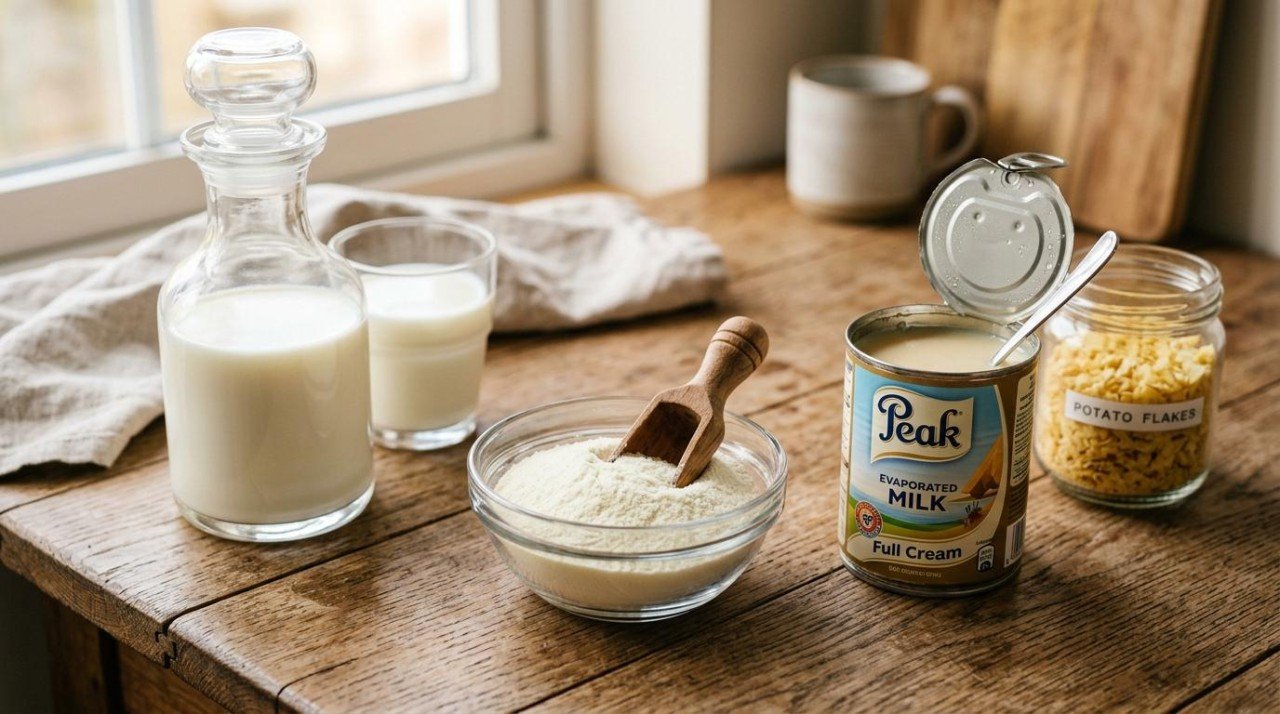
- Evaporated milk + water — the shelf-stable version of the same trick, diluted 50/50
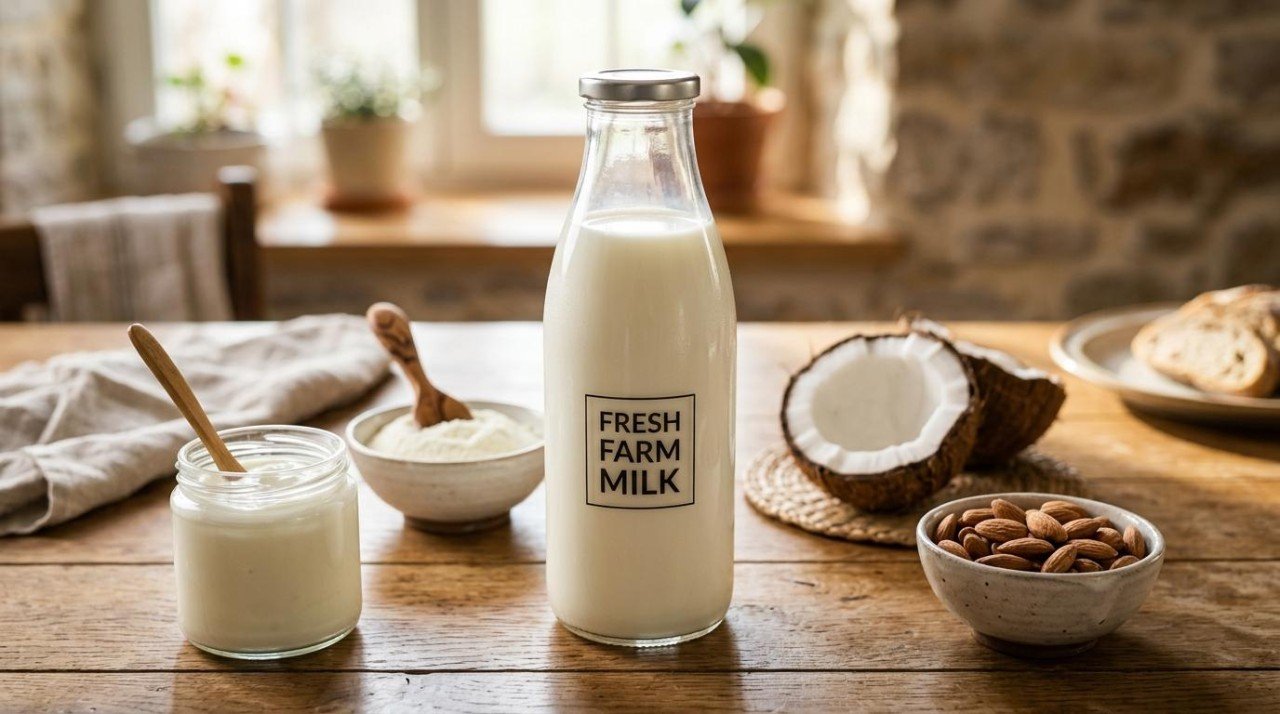
- Unsweetened plant milk — same swap, dairy-free
- Just leave it out — works in bread; expect a paler, slightly less tender loaf
- Instant potato flakes — brings back the softness, but not the browning
- Coconut milk powder — richest dry swap, best in curries, soups, and cocoa mixes
- Soy milk powder — the closest dry match on protein, 1:1 almost anywhere
- Buttermilk powder — 1:1 with a tang; mind your baking soda
- Malted milk powder — flavor-forward, sweet and toasty, not neutral
- Cashew or rice powder — dry, dairy-free, and useful in mixes and smoothies
First, Why Bakers Put It in There
Powdered milk turns up in bread recipes more than anywhere else, and it is not filler. Milk brings three things to a loaf — creamy flavor, a tender crumb, and better browning — and dry milk delivers all of that without adding water, which is the entire point in a dough whose hydration is already dialed in. The lactose is what browns, reacting with the proteins in the crust so the loaf comes out golden rather than pale, while the milk proteins soften the crumb and help the bread stay fresh an extra day.
In dry mixes — cocoa, pancake mix, ranch seasoning — it does something simpler: making the mix creamy once water hits it, with no refrigeration in the meantime. Knowing which job matters in your recipe tells you which substitute to grab. Browning and tenderness in bread? Use real milk. Creaminess in a dry mix? Use another powder.
Swaps for Bread and Baking (Where There Is Liquid to Trade)
1. Liquid Milk in Place of the Water
- Swap: Replace the recipe's water with an equal amount of milk and leave the powder out. As a guide, 1/4 cup of milk powder is roughly 1 cup of milk
- Best for: Bread, rolls, pancakes, muffins, soups — anything with water in the ingredient list
- Skip it for: Dry mixes and anything that has to stay shelf-stable
- Health notes: Identical nutrition to the milk you pour in, and you choose the fat level
This is the swap, and it is almost embarrassingly simple: use milk wherever the recipe calls for water, and skip the powder. Most bread recipes that use dry milk want about a cup of water and two to four tablespoons of powder, so a straight cup of milk lands close enough. Brands vary in concentration — Bob's Red Mill reconstitutes at 3 tablespoons per cup of water, while instant granules can run up to 1/3 cup — so follow your recipe's own ratio rather than agonizing over the math.
One technique note for enriched dough: consider scalding the milk first. Milk contains protease enzymes and whey proteins that can weaken gluten strands, and pasteurization does not fully deactivate them. Heat the milk to about 180°F (just steaming, with tiny bubbles at the edge of the pan), then cool it to 105 to 110°F before it meets the yeast. For a rustic loaf it hardly matters; for brioche or a soft sandwich loaf it is worth the five minutes. Our guide to milk substitutes covers which milks hold up to heat.
2. Evaporated Milk + Water
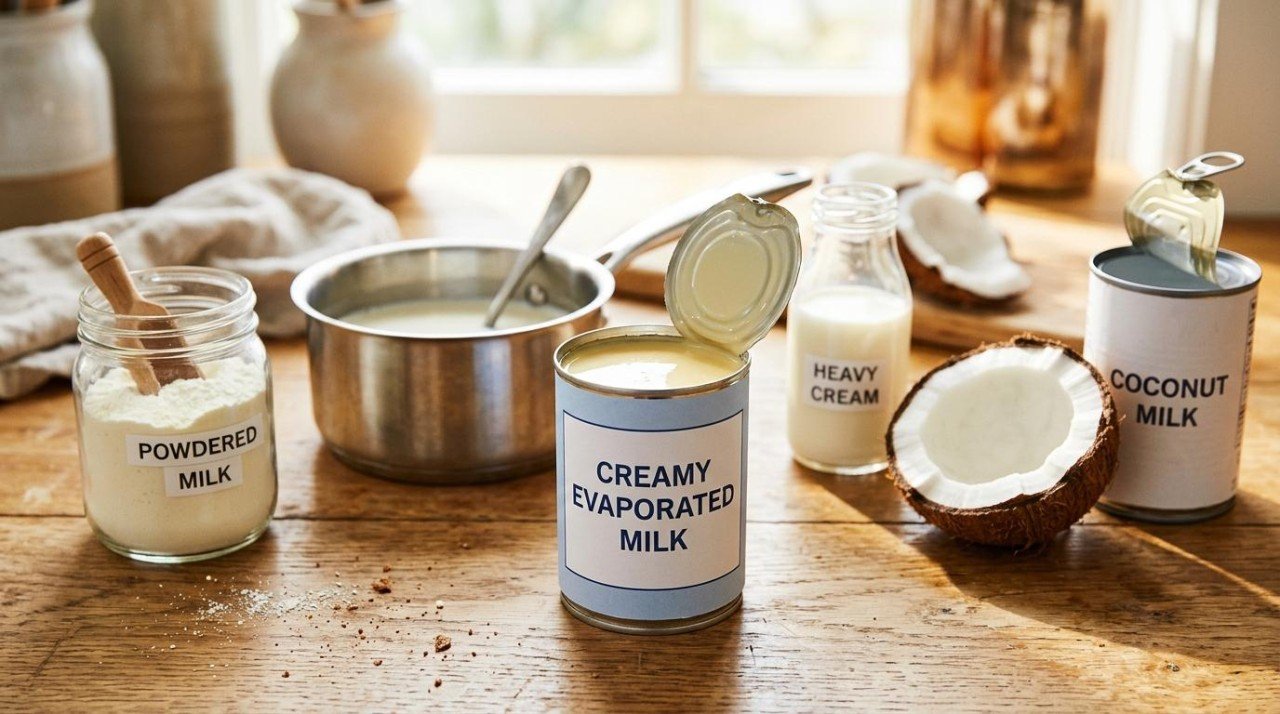
- Swap: 50/50 — 1/2 cup evaporated milk + 1/2 cup water for every cup of milk you need, then omit the powder and cut the recipe's water to match
- Best for: Bread, pancakes, cakes, puddings, and cream sauces — the pantry answer when there is no fresh milk
- Skip it for: Pouring straight from the can as a 1:1 for milk
- Health notes: Nutritionally close to the milk it was made from, just concentrated
If you keep powdered milk for its shelf life, evaporated milk does the same job from a can. America's Test Kitchen tested three dilution ratios in pudding, sponge cake, and bechamel, and only the 50/50 mix came out close to the fresh-milk versions — at 75% evaporated milk the pudding was gluey and the cake was dense. Once diluted, treat it exactly like fresh milk. It carries a faintly cooked, caramel note that is a small bonus in sweet bakes and unnoticeable in bread. Our evaporated milk guide has the full picture on that can.
3. Unsweetened Plant Milk
- Swap: Replace the water and the dry milk with non-dairy milk in equal amounts — 1 cup water + 2 tablespoons powder becomes 1 cup plant milk
- Best for: Dairy-free bread, rolls, pancakes, and muffins
- Skip it for: Vanilla or sweetened cartons in savory dough — buy plain and unsweetened
- Health notes: Unsweetened soy or pea milk keeps the protein close to dairy; almond and rice milk bring far less
King Arthur's advice for dairy-free bread is exactly this: swap both the water and the powder for plain, unsweetened non-dairy milk at 1:1. Soy holds up best because it actually has protein to contribute, and browning in a milk-enriched loaf depends on protein and sugar — almond milk offers almost none of either. Oat milk is a close second and browns nicely thanks to its own sugars. Check the label for added sugar and vanilla, which sneak into a lot of cartons. Coconut milk works where the flavor suits the bake; our coconut milk guide covers when that is an asset.
4. Just Leave It Out
- Swap: Omit the powder, keep the water as written, and bake about 5 minutes longer
- Best for: Any yeasted bread, when you have nothing else and do not want to stop
- Skip it for: Recipes calling for more than about 1/4 cup of powder, or where creaminess is the point
- Health notes: Removes a little protein and calcium from the loaf; nothing dramatic
This belongs on the list because it is the honest answer for a lot of bread recipes. Two tablespoons of dry milk in a loaf is a supporting player, not a structural ingredient. Leave it out and the bread still works — King Arthur says it comes out slightly less tender and a bit more pale, and needs roughly five extra minutes in the oven since there is less sugar driving the browning. Want some of that color back without dairy? Brush the loaf with a light wash of maple syrup or plant milk before baking.
5. Instant Potato Flakes (for Softness Only)
- Swap: Not a direct swap — replace 1/4 cup of the recipe's flour with 1/2 cup potato flakes in a recipe using 3 to 4 cups of flour
- Best for: Soft sandwich bread and dinner rolls, when you want the tender crumb back
- Skip it for: Browning, flavor, or protein — it does none of those jobs
- Health notes: Adds starch, not protein or calcium; a texture fix rather than a nutrition one
A workaround rather than a true substitute, and it is the trick behind a lot of very soft supermarket-style loaves. Potato starch absorbs and holds onto liquid, which is why potato bread stays tender for days. If you left the dry milk out and missed the soft crumb more than the color, flakes get most of it back — add them with the dry ingredients, since they hydrate and break down during kneading. Just do not expect a golden crust from them.
Swaps When You Need an Actual Powder
Dry mixes, no-bake bars, homemade cocoa, ice cream bases, and smoothies use powdered milk precisely because it is dry. Pouring liquid in defeats the purpose, so these swaps are all other powders.
6. Coconut Milk Powder
- Swap: 1:1 unless the package says otherwise
- Best for: Curry and soup mixes, hot cocoa mixes, instant coffee blends, and anything already leaning tropical or spiced
- Skip it for: Delicate, neutral bakes — the coconut flavor comes along, and the fat makes baked goods heavier
- Health notes: Rich — about 240 calories and 20 grams of fat per 1/4 cup, against roughly 4 grams of protein
Coconut milk powder stands in for whole milk powder rather than nonfat, because it is genuinely rich. That makes it lovely in a cocoa mix or curry base and heavy-handed in a delicate cake, and it is the most reliably available dairy-free powder on a normal supermarket shelf. Two things to watch: swapping large amounts will make baked goods denser, and some brands add sodium caseinate, which is milk-derived — read the label if you are avoiding dairy for allergy reasons.
7. Soy Milk Powder
- Swap: 1:1 in nearly any recipe
- Best for: Baked goods, granola bars, smoothies, dry mixes — the most versatile dairy-free powder
- Skip it for: Recipes where a faint beany note would stand out; baking mellows it
- Health notes: About 8 grams of protein and 90 calories per 1/4 cup — the closest dry match to nonfat milk powder
If you want one dairy-free powder that behaves like the real thing, this is it. Soy protein is the reason: it contributes to structure and browning in a way starchy powders simply cannot, so bread and bars come out closer to the original. It is less common in supermarkets than coconut milk powder, but health food stores and online retailers carry it and it keeps for months. If you are building a dairy-free baking kit, stock this one.
8. Buttermilk Powder
- Swap: 1:1, then taste and adjust — it is tangier and slightly saltier
- Best for: Pancake and biscuit mixes, ranch seasoning, scones, soda bread
- Skip it for: Delicate cakes leavened only with baking powder, where the extra acid shifts the balance
- Health notes: Similar protein and calcium profile to nonfat dry milk
Buttermilk powder is dried cultured buttermilk — essentially milk powder with a tang built in. In anything savory or breakfast-shaped that tang is an upgrade rather than a compromise, which is why it lives in so many homemade pancake and biscuit mixes. Keep an eye on the acidity: if your recipe relies on baking soda, you will get a bit more lift than expected, which is usually welcome. For the liquid version, see our buttermilk substitutes guide.
9. Malted Milk Powder
- Swap: 1:1, treating it as a flavor ingredient rather than a neutral one
- Best for: Milkshakes, waffles, pancakes, cookies, ice cream bases — anywhere toasty malt flavor belongs
- Skip it for: Savory dishes, gluten-free baking, and anything that does not want added sweetness
- Health notes: Sweeter than plain milk powder; dial back the recipe's sugar slightly if you use a lot
Malted milk powder is barley malt, wheat, milk, and a touch of salt — so there is real milk powder in there, but it arrives with a strong personality. Nobody will mistake the result for the original recipe, and in a pancake or a chocolate cookie that is a happy accident. Two hard limits: it contains wheat, so it is out for gluten-free baking, and it is noticeably sweet, so it does not belong in savory bread or a spice mix.
10. Cashew Powder or Rice Powder
- Swap: 1:1 for either, unless the package says otherwise
- Best for: Smoothies, granola bars, desserts, and homemade non-dairy coffee creamer
- Skip it for: Anything relying on milk protein for structure or browning
- Health notes: Cashew powder runs about 140 calories, 6 grams of fat, and 3 grams of protein per 1/4 cup; rice powder about 140 calories and 31 grams of carbs with 3 grams of protein
Both are dairy-free, both blend into mixes, and both are considerably weaker than milk powder nutritionally — you are getting starch or fat rather than protein and calcium. Rice powder is also noticeably sweeter, which is fine in a dessert and odd in a savory mix. Cashew powder tends to clump, so blend it with a little liquid before it goes into a soup or sauce. Neither will rescue a bread recipe, but for smoothies, bars, and creamers they do the job.
The Nutrition Angle (What You Gain or Lose)
Nonfat dry milk is one of the more nutrient-dense things in a pantry — a concentrate of milk protein and calcium with the water and fat stripped out, which is why a quarter cup carries roughly what a cup of milk does. Soy milk powder is the only swap here that genuinely matches it, at around 8 grams of protein per quarter cup. Coconut milk powder trades that protein for fat; rice and cashew powders trade it for carbohydrate. So if your reason for using milk powder was to boost the protein in bars or smoothies, soy powder is the swap to make.
On the liquid side, reaching for unsweetened soy or pea milk adds plant diversity to your week without changing how the dough behaves, and a fortified carton keeps the calcium in play. If you would rather see what a swap does to a recipe's numbers than guess, Eat Well Planner's Recipe Playground lets you change one ingredient and watch the nutrition score move, with a per-edit delta showing the impact of that single change.
Take the Guesswork Out of Eating Well
Eat Well Planner helps you organize your favorite recipes, plan balanced meals, and automatically generate shopping lists — all in one place. Whether you're tracking macros, managing dietary restrictions, or just trying to stop asking "what's for dinner?", we've got you covered.
Our AI-powered tools can adapt any recipe to your dietary needs, help you discover new meals you'll love, and even log your nutrition effortlessly. It's meal planning made simple.
Start Organizing Your Meals — FreeWhat Not to Use
- Powdered coffee creamer. It looks the part and behaves nothing like milk. Most non-dairy creamers are built from corn syrup solids and vegetable oil with a whitening agent — almost no protein, a lot of sugar, and no browning power. It will sweeten your bread and leave it pale.
- Sweetened condensed milk. It is milk, but so much of its weight is sugar that it throws off any recipe not built around it. If it is truly all you have, our condensed milk guide covers what it can and cannot do.
- Instant hot chocolate mix. Same sugar problem, plus cocoa and flavorings. Fine in a pinch for a chocolate bake, never in bread.
- Flavored protein powder. Whey protein is not milk powder — it lacks the lactose that drives browning, and the sweeteners and flavorings come along for the ride.
The Short Version
If your recipe has water in it, pour milk in instead and forget the powder — that covers nearly every bread recipe you will hit. If it does not, reach for another powder and match the job: soy milk powder for protein, coconut milk powder for richness, buttermilk powder for tang. And if you only kept powdered milk for pantry insurance, a couple of cans of evaporated milk do the same thing, diluted 50/50 when the moment comes.
Where a blog post runs out of road is your specific recipe — a general ratio cannot tell you whether the hydration in your dough can absorb an extra half cup of liquid. That is what Eat Well Planner's AI recipe chat is for: import the recipe, ask what to use instead of the milk powder, and get an answer built around the actual ingredient list in front of you. If the swap is for dietary reasons, Recipe Variations will rewrite the whole thing dairy-free with the changes already worked in, rather than leaving you to adapt line by line at the counter. Both are free to use — as is a well-stocked pantry list that means fewer of these emergencies in the first place.