The lemon chicken is browning, the broth is warm, and the box of orzo you were sure was in the pantry is nowhere to be found. Or you have it, but someone at the table is gluten-free, or you want a little more fiber in the bowl than a refined pasta brings. Either way, you need to know what will actually work in its place.
Orzo is easy to replace once you know what job it is doing. Despite the rice-like shape, it is just a small pasta made from wheat, and it shows up in three very different kinds of dishes: brothy soups where it floats in small spoonfuls, cold salads where every piece needs to stay separate, and creamy one-pan dishes and "orzotto" where its starch thickens the sauce. The best substitute for each of those is different, so the quick list below is split by dish, followed by every substitute with its exact swap, what it is good for, what it is not, and whether it is gluten-free.
The Quick List (By Dish)
For soups (Italian wedding, lemon chicken orzo, minestrone):
- Acini di pepe or stelline — tiny soup pastas that behave almost exactly like orzo
- Ditalini — the classic minestrone pasta; a little chunkier
- Broken spaghetti or angel hair — the pantry fallback that always works
- Long-grain white rice — gluten-free and the closest look-alike
- Pearl barley — chewier and heartier, with more fiber (contains gluten)
For salads (Greek orzo salad, pesto orzo, roasted vegetable orzo):
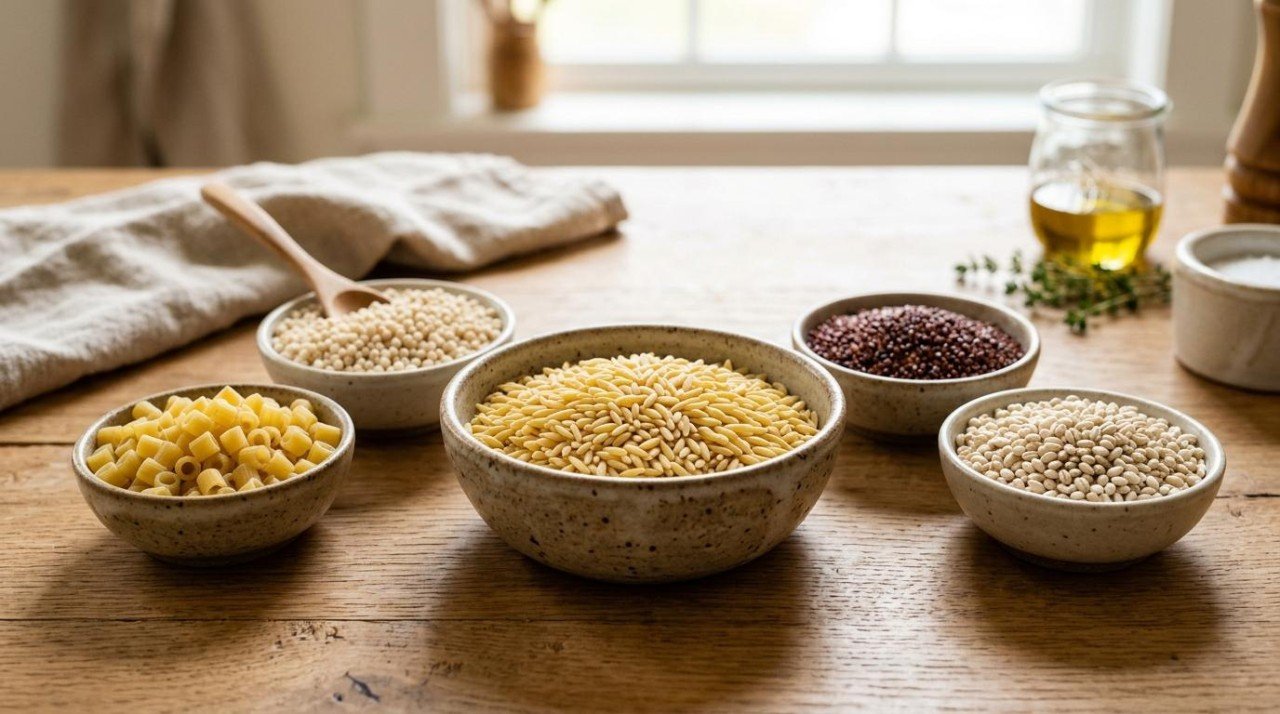
- Pearl couscous — the closest match in size and chew
- Small shells or ditalini — sturdy and great at catching dressing
- Quinoa — gluten-free, lighter, and a complete protein
- Farro — nutty and chewy; holds up for days in the fridge
- Fregola — toasty Sardinian pasta pearls, excellent with lemon and herbs
For creamy one-pan dishes, baked orzo, and orzotto:
- Arborio rice — the original risotto rice; creamier, but needs more time and liquid
- Pearl couscous — cooks in about the same time, so it fits one-pan recipes
- Acini di pepe or ditalini — a straight pasta-for-pasta swap
- Quick-cooking barley — for a heartier "barley-otto" with more fiber
First, a Note on Amounts
Orzo is dense for a pasta. About 2 ounces dry is a typical serving, which is roughly 1/3 cup uncooked and close to 1 cup cooked. The swaps below use that as the reference point, and the most reliable way to swap one small pasta for another is by weight. Hollow and curved shapes like ditalini and small shells take up more room in a measuring cup than the same weight of orzo, so if you are measuring by volume, use a little more of them.
Timing is the other thing to watch. Orzo cooks in about 8 to 10 minutes, and one-pan recipes are written around that. A substitute that needs 20 or 40 minutes will either sit underdone in the sauce or force you to add liquid and time, so each section below says how its cook time compares.
Acini di Pepe or Stelline
- Swap: 1:1 by weight or volume
- Best for: Soups, especially Italian wedding soup and brothy chicken soups; creamy one-pan dishes
- Skip it for: Big-bowl salads, where the tiny pieces can clump and get lost
- Gluten-free: No
These are the closest substitutes in the pasta aisle. Acini di pepe ("peppercorns") are tiny beads of pasta, and stelline are tiny stars; both are made from the same durum wheat semolina as orzo and do the same job in a spoonful of soup. Acini di pepe is in fact the pasta many Italian wedding soup recipes call for, so in that dish you are arguably upgrading to the traditional choice.
They are smaller than orzo, so they usually cook a minute or two faster — check the box and start tasting early. In a creamy skillet dish or orzotto they release starch just like orzo does and give you a similar silky sauce. In a salad they work in a pinch, but toss them with the dressing while warm and keep the mix-ins small, or the result tastes more like a grain bowl than a pasta salad.
Ditalini or Small Shells
- Swap: 1:1 by weight; by volume, use about 1/2 cup ditalini or small shells for every 1/3 cup orzo
- Best for: Minestrone and bean soups, pasta salads, baked pasta dishes
- Skip it for: Delicate brothy soups where you want a fine, rice-like texture
- Gluten-free: No
Ditalini ("little thimbles") are short tubes, and small shells are, well, small shells. Both are larger and chunkier than orzo, which changes the look of a dish but not much else. They are the traditional pasta for minestrone and pasta e fagioli, and in a cold salad they are sturdier than orzo: the hollows catch vinaigrette, olives, and crumbled feta, and they stay pleasantly firm the next day.
Cook them to the package time, which is usually close to orzo's. For a soup you plan to eat over several days, cook the pasta separately and add it to each bowl. Small pastas left sitting in broth keep drinking it up, and by day two you have a stew with bloated pasta instead of a soup. That tip applies to orzo itself too.
Broken Spaghetti or Angel Hair
- Swap: 1:1 by weight; break into 1/2-inch pieces
- Best for: Soups and rice-pilaf-style side dishes
- Skip it for: Salads and orzotto, where the jagged pieces look and feel messy
- Gluten-free: No
Almost everyone has a box of spaghetti, and broken into small pieces it is a very serviceable orzo stand-in for soup. Wrap a small bundle in a clean kitchen towel, snap it over the edge of the counter a few times, and pour out the pieces. Angel hair or thin spaghetti give the most orzo-like result, and they cook in just a few minutes, so add them at the very end.
Broken thin pasta is also the base of Mexican sopa de fideo and many rice pilafs, where it is toasted in oil until golden before the liquid goes in. Doing the same in an orzo pilaf or soup adds a nutty flavor that more than makes up for the less elegant shape.
Pearl Couscous (Israeli Couscous)
- Swap: 1:1 by volume dry; cook 1 cup pearl couscous in 1 1/2 cups water or broth
- Best for: Salads, side dishes, one-pan and baked orzo recipes
- Skip it for: Very brothy soups, where the larger pearls feel heavy
- Gluten-free: No
Pearl couscous is not a grain — it is a toasted pasta made from durum wheat semolina, rolled into small balls, which is why it behaves so much like orzo. The RiceSelect package directions call for 1 cup pearl couscous in 1 1/2 cups boiling water, covered and simmered for about 8 to 10 minutes, yielding about 2 cups. That timing lines up almost exactly with orzo, which is what makes it the best swap for sheet-pan and one-pot recipes that were written for orzo.
It is a touch chewier and bouncier than orzo, and the pearls stay separate, so it really shines in a Greek-style salad with cucumber, tomatoes, and feta. Toasting it in a little olive oil for a few minutes before adding the liquid deepens the flavor. Regular (Moroccan) couscous works for salads too and is even faster: pour 1 cup boiling water or broth over 1 cup couscous, cover for 5 minutes, and fluff. It is much finer than orzo, though, so it reads more like tabbouleh than pasta salad.
Fregola
- Swap: 1:1 by weight; boil like pasta according to the package, usually around 10 minutes
- Best for: Salads, seafood dishes, brothy stews
- Skip it for: Kids' soups and dishes where you want a neutral flavor
- Gluten-free: No
Fregola (or fregula) is a Sardinian semolina pasta rolled into small, irregular pearls and toasted, so the pieces come out of the bag in a mix of golden and darker brown. It sits somewhere between orzo and pearl couscous in size and has a nutty, toasty flavor that plain orzo does not. In a salad with lemon, herbs, and roasted vegetables, or in a tomato broth with clams or shrimp, it is arguably better than the original.
It is a specialty item, so you are more likely to find it at an Italian market or well-stocked grocery store than in an average pantry. If you have it, use it anywhere you would use pearl couscous.
Whole-Wheat Orzo
- Swap: 1:1 by weight or volume
- Best for: Everything regular orzo does
- Skip it for: Very delicate dishes where you want a pale, neutral pasta
- Gluten-free: No
- Health notes: Whole-wheat pasta has more than twice the fiber of refined pasta
If you are swapping because you want the dish to do more for you rather than because you ran out, this is the easiest upgrade on the list. It is the same shape, cooks in about the same time (sometimes a minute longer), and slips into soups, salads, and one-pan dishes without changes to the recipe. The flavor is a little nuttier and the color darker, which you will barely notice once there is a sauce, broth, or dressing involved.
The fiber difference is real. A cup of cooked whole-wheat spaghetti has about 6 grams of fiber and 174 calories, compared with 2.5 grams and 220 calories for refined spaghetti, according to Healthline's comparison — and the same applies to whole-wheat versions of small shapes like orzo. If your store does not carry whole-wheat orzo, whole-wheat ditalini, small shells, or elbows are the next best thing. Our pasta substitutes guide covers more options.
Arborio Rice
- Swap: 1:1 by volume dry, but plan on roughly 18 to 20 minutes of cooking and about 4 cups of hot broth per cup of rice
- Best for: Orzotto and creamy, risotto-style skillet dishes
- Skip it for: Salads (it turns sticky and hard when cold) and baked one-pan orzo recipes (it will not cook through in time)
- Gluten-free: Yes
A lot of creamy orzo recipes are a shortcut version of risotto, so swapping arborio back in simply turns the dish into risotto. Arborio is a short-grain, high-starch rice that releases its starch as you stir, giving you the same creamy, spoon-coating sauce, and many people prefer it. It is also gluten-free, which plain orzo is not.
The catch is time and liquid. Orzo cooks in about 10 minutes, while arborio needs around 18 to 20, and it absorbs more broth along the way, so have extra hot broth ready and add it a ladle at a time, stirring often. Do not expect it to work in a sheet-pan or baked orzo recipe as written: the rice will still be crunchy when everything else is done. For that, use pearl couscous instead. Shorter-grain rices like carnaroli or even sushi rice behave similarly if arborio is not on hand.
Long-Grain White or Brown Rice
- Swap: 1:1 by volume dry; in soup, add white rice about 15 to 20 minutes before serving
- Best for: Soups, pilafs, stuffed vegetables
- Skip it for: Creamy one-pan dishes (long-grain rice will not get creamy) and quick-cooking recipes
- Gluten-free: Yes
Orzo is named for its resemblance to a grain ("orzo" means barley in Italian), and in a soup, long-grain rice is its closest gluten-free look-alike. It is the obvious swap for lemon chicken orzo soup, which is a close cousin of Greek avgolemono, traditionally made with rice. White rice needs longer in the pot than orzo, so add it earlier, and expect it to thicken the broth a little as it releases starch.
Brown rice works too and adds fiber, but it can take 40 minutes or more, so it is better to cook it separately and stir it into the soup or pilaf at the end. Our white rice substitutes guide has more ideas if you want to go beyond rice entirely.
Pearl Barley
- Swap: 1:1 by volume dry; quick-cooking barley takes about 10 to 12 minutes, regular pearl barley 30 to 40
- Best for: Hearty soups, "barley-otto," grain salads
- Skip it for: Delicate brothy soups and anyone avoiding gluten
- Gluten-free: No — barley contains gluten
- Health notes: About 6 grams of fiber per cooked cup, more than twice that of orzo
Barley is the grain orzo was named after, and pearl barley makes a sturdier, chewier version of almost any orzo dish. In a soup it gives a hearty, old-fashioned beef-barley feel. Cooked risotto-style with broth, mushrooms, and Parmesan, it makes a satisfying "barley-otto" with a pleasant bite. And it stays firm in a cold salad for days, which orzo does not.
Regular pearl barley takes a lot longer than orzo, so for a recipe on a tight timeline, look for quick-cooking barley, which is partially precooked. The nutrition is a genuine upgrade: per USDA data, a cup of cooked pearl barley has about 193 calories and 6 grams of fiber, compared with about 220 calories and 2.5 grams of fiber for a cup of cooked enriched pasta. Barley is also rich in beta-glucan, a soluble fiber that has been shown to help lower LDL cholesterol. One caveat: barley has gluten, so it is not a swap for anyone with celiac disease.
Farro
- Swap: 1:1 by volume dry; pearled farro takes about 15 to 20 minutes boiled like pasta, whole farro much longer
- Best for: Grain salads, Mediterranean bowls, hearty soups
- Skip it for: Creamy one-pan dishes on a short timeline, and gluten-free diets
- Gluten-free: No — farro is a type of wheat
Farro is an ancient wheat with large, chewy grains and a nutty flavor, and it is one of the best swaps for orzo in a salad. A Greek orzo salad made with farro instead holds its texture for several days in the fridge, which makes it great for meal prep, and the grains do not clump together the way cold pasta can. The easiest way to cook it is like pasta: boil it in plenty of salted water until tender, then drain.
Check the bag to see whether it is pearled, semi-pearled, or whole, because the cooking time varies a lot between them. Pearled farro is the fastest and most orzo-friendly. For more on farro and other overlooked whole grains, see our guide to the whole grains you are missing.
Quinoa
- Swap: 1 cup cooked quinoa for 1 cup cooked orzo; cook 1 cup rinsed quinoa in 2 cups water for about 15 minutes
- Best for: Salads, grain bowls, stuffed peppers
- Skip it for: Creamy orzotto-style dishes (it will not release the same starch)
- Gluten-free: Yes
- Health notes: About twice the fiber of orzo per cooked cup, plus all nine essential amino acids
Quinoa is the easiest gluten-free swap for orzo salads. It is smaller and lighter than orzo, with a slight pop, and it takes dressings well. In a lemony Mediterranean salad with chickpeas, cucumber, and herbs, most people will not miss the pasta at all. Rinse it before cooking to remove any bitter coating, then fluff it and let it cool before tossing with the dressing so the salad does not turn soggy.
A cup of cooked quinoa has about 222 calories, 8 grams of protein, and 5 grams of fiber, per USDA data, so it matches orzo on protein and calories and roughly doubles the fiber. Healthline notes it is also a complete protein, which is useful in a vegetarian salad. In soup, add rinsed quinoa for the last 15 minutes. Our quinoa substitutes guide covers what to use if you are out of that too.
Gluten-Free Orzo
- Swap: 1:1 by weight or volume
- Best for: Any orzo recipe that needs to be gluten-free
- Skip it for: Make-ahead soups (it softens quickly in broth)
- Gluten-free: Yes (check the label)
Several brands now make gluten-free orzo, usually from a blend of rice and corn flour. It looks the same and works in the same dishes, so it is the simplest option if you are cooking for someone with celiac disease or gluten sensitivity. The main difference is texture: gluten-free pasta can go from al dente to mushy faster, so start tasting a couple of minutes before the package time, and for soups, cook it separately and add it to each bowl.
If you cannot find it, any gluten-free pasta in a small shape (elbows or small shells) works the same way, as do rice and quinoa. For more on whether you need to avoid gluten in the first place, see is gluten bad for you without celiac disease?
Chickpea or Lentil Pasta
- Swap: 1:1 by weight in a small shape like small shells, elbows, or ditalini
- Best for: Pasta salads and baked dishes
- Skip it for: Brothy soups (it releases a lot of starch and softens fast)
- Gluten-free: Usually (check the label)
- Health notes: Much more protein and fiber than wheat pasta, though amounts vary by brand
Pasta made from chickpea or lentil flour is the protein-and-fiber upgrade. Many brands come in small shapes that stand in nicely for orzo, and they turn a side-dish salad into something closer to a full meal. Expect a slightly earthier flavor and a softer bite. Check the box for exact nutrition, but popular chickpea pastas list about 11 grams of protein per 2-ounce serving, versus roughly 7 grams for regular pasta, and several times the fiber.
Legume pastas foam a lot when boiling and turn mushy if overcooked, so use a big pot, stir a few times, and taste early. Rinse briefly before using in a cold salad. In soup, add them cooked at the end rather than simmering them in the broth.
Riced Cauliflower
- Swap: 1 to 1 1/2 cups riced cauliflower for every 1 cup cooked orzo
- Best for: Lighter soups, side dishes, lower-carb bowls
- Skip it for: Creamy orzotto (it will not thicken the sauce) and make-ahead salads
- Gluten-free: Yes
- Health notes: About 25 calories and 2 grams of fiber per cup
Treat riced cauliflower as a vegetable that looks like orzo rather than a pasta substitute, and you will like it more. A cup has just 25 calories, 5 grams of carbs, and 2 grams of fiber, according to Healthline. To cook it, sauté it in a little oil, covered, for 5 to 8 minutes. Squeeze freshly riced cauliflower in a towel first to avoid sogginess.
In soup, stir it in for the last few minutes. In a warm side dish with lemon, garlic, herbs, and Parmesan, it does a convincing impression of a light orzo pilaf. The middle path is often the best one: replace half the orzo with riced cauliflower, and you keep the pasta texture while adding a serving of vegetables.
Healthier Upgrades Worth Trying
Orzo is not a bad food. It is a quick-cooking pasta that is a good vehicle for broth, vegetables, and herbs. But it is a refined grain, and a cup of cooked enriched pasta has about 220 calories, 8 grams of protein, and only 2.5 grams of fiber, according to USDA data. If you want the dish to keep you full longer, here is how the main swaps compare per cooked cup:
- Whole-wheat pasta: about 174 calories, 7.5 grams of protein, 6 grams of fiber — the easiest swap, with no change in cooking
- Pearl barley: about 193 calories, 3.5 grams of protein, 6 grams of fiber — plus cholesterol-friendly beta-glucan
- Quinoa: about 222 calories, 8 grams of protein, 5 grams of fiber — and gluten-free
- Riced cauliflower: about 25 calories and 2 grams of fiber — the light option
- Chickpea or lentil pasta: the most protein and fiber of any option, depending on the brand
Swapping in a whole grain also adds a different plant to your week, which matters if you are working toward the "30 plants a week" goal for gut health — barley, farro, and quinoa each count. And often the bigger win is around the pasta, not in it: more vegetables, a generous portion of beans, chicken, or fish, and plenty of herbs and lemon. We did exactly that in our healthier chicken noodle soup makeover.
If you are not sure which swap fits the recipe in front of you, Eat Well Planner's AI recipe chat can help. Import the recipe, then ask something like "I don't have orzo and I need this gluten-free — what should I use, and do I need to change the liquid?" It answers with your actual dish in context. And if you want to see what a swap like barley or chickpea pasta does to the dish's nutrition before you commit, the Recipe Playground updates the nutrition score live as you change an ingredient.
Take the Guesswork Out of Eating Well
Eat Well Planner helps you organize your favorite recipes, plan balanced meals, and automatically generate shopping lists — all in one place. Whether you're tracking macros, managing dietary restrictions, or just trying to stop asking "what's for dinner?", we've got you covered.
Our AI-powered tools can adapt any recipe to your dietary needs, help you discover new meals you'll love, and even log your nutrition effortlessly. It's meal planning made simple.
Start Organizing Your Meals — FreeWhat Not to Use (and Common Mistakes)
- Assuming orzo is gluten-free. It looks like rice, but it is wheat pasta. So are pearl couscous, fregola, and farro, and barley contains gluten too. For a gluten-free dish, use rice, quinoa, gluten-free orzo, or riced cauliflower.
- Putting arborio or brown rice in a baked orzo recipe without adjusting. Both need more time and liquid than orzo, and they will still be crunchy when the rest of the dish is done.
- Long pasta shapes and big tubes. Unbroken spaghetti, penne, and rigatoni do not fit on a soup spoon and overpower an orzo salad.
- Leaving any small pasta in the soup pot overnight. It keeps absorbing broth and turns bloated. Store the pasta and soup separately.
- Long-grain rice in orzotto. It will not release enough starch to make a creamy sauce. Use arborio or another short-grain rice.
- Riced cauliflower in make-ahead salads. It releases water in the fridge and dilutes the dressing. Make it fresh.
The Bottom Line
For soup, acini di pepe, ditalini, broken spaghetti, or rice will all do the job. For salad, pearl couscous is the closest match, with quinoa or farro if you want a whole grain. For creamy one-pan dishes, use arborio if you have time for a true risotto, or pearl couscous if you need to keep the original timing. And if you want the dish to work harder for you, whole-wheat orzo, barley, or chickpea pasta add real fiber without giving up the comfort of the original.
When you are standing over the stove and still not sure, ask Eat Well Planner's recipe chat with your recipe open — it will pick the substitute that fits the dish you are actually making.