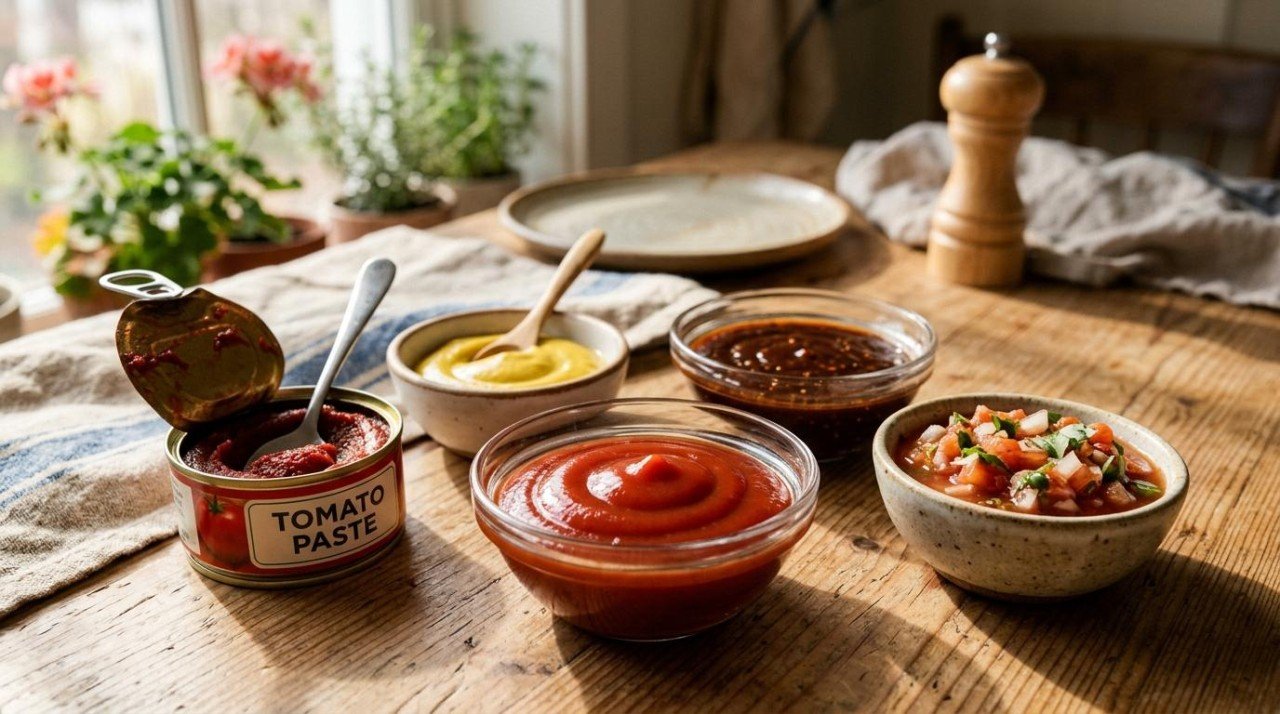
The burgers are plated, the fries are coming out of the oven, or the meatloaf is half assembled in the bowl — and the squeeze bottle is empty. Ketchup is such a default that running out feels like a bigger problem than it actually is.
It is not. Ketchup is concentrated tomato, vinegar, sugar and salt, with a quiet background of onion, garlic and warm spice. Almost all of that is already in your pantry, and the closest substitute takes about five minutes and a can of tomato paste.
What matters is which job the ketchup was doing. A dipping sauce needs the thick, glossy body and the sweet-tangy hit. A meatloaf or a pan of meatballs mostly needs concentrated tomato, a little sugar and some moisture. A glaze needs sugar that will caramelize under the broiler. Below are the substitutes that genuinely work, ordered from closest match to most specialized, each with an exact ratio and an honest note on what changes.
The Quick List
- Tomato paste + vinegar + a little sweetener — the five-minute rebuild, and the closest thing to real ketchup
- Tomato sauce, reduced and sweetened — the same idea with the can most people already have open
- Chili sauce — built from almost identical parts; the easiest near-1:1 swap
- BBQ sauce — 1:1 in cooked dishes and glazes, sweeter and smokier
- Cocktail sauce — ketchup with horseradish already stirred in; excellent for dipping
- Salsa — the best swap on a burger or eggs, and a real nutrition upgrade
- Marinara or thick pasta sauce — reduce it, sweeten it, and it works in meatloaf
- Sweet chili sauce or sriracha — for fries and nuggets, when you want a good dip more than an accurate one
- Yellow mustard — burgers and hot dogs only, but it is the no-sugar answer
- Tomato jam, chutney, or ajvar — a genuine upgrade on a burger or a grilled cheese
- Steak sauce — for meatloaf, marinades and anything savory-tangy
What Ketchup Is Actually Doing
Ketchup does five things at once, and knowing which ones your dish needs is what separates a good swap from a bad one:
- Concentrated tomato — cooked-down, savory tomato depth, not fresh tomato flavor
- Sweetness — about 3.6 grams of sugar per tablespoon, per USDA FoodData Central
- Tang — vinegar acidity that cuts through fat, which is why it works so well on fried food
- Salt — roughly 154 mg of sodium per tablespoon
- Thick, clingy body — it sits on a fry and does not run off a meatloaf
Most failed ketchup swaps are a concentration problem rather than a flavor problem. Reach for something watery and your glaze slides off, your meatloaf goes soft, and your fries get soggy. Every section below flags which way the swap pushes.
Tomato Paste, Vinegar and a Little Sweetener
- Swap: 1/2 cup tomato paste + 3 to 4 tablespoons water + 2 tablespoons apple cider vinegar + 1 tablespoon honey or brown sugar + 1/2 teaspoon salt + 1/4 teaspoon each onion powder and garlic powder + a pinch of ground allspice. Makes a scant cup.
- Small batch: 2 tablespoons tomato paste + 2 teaspoons water + 2 teaspoons vinegar + 1 teaspoon honey + a pinch of salt, for about 1/4 cup
- Best for: Everything — dipping, burgers, meatloaf, glazes, baked beans, marinades
- Skip it for: Nothing, though it will not taste identical to the bottle the second you whisk it
- Health notes: Roughly 2 g sugar and about 75 mg sodium per tablespoon, against 3.6 g and 154 mg in bottled ketchup
This is the answer, and it is barely a recipe. Tomato paste is tomato cooked down to a fraction of its volume, which is exactly the concentration ketchup needs — everything else you add is the vinegar, sugar and salt that turn concentrated tomato into a condiment. Whisk it cold in a bowl and it is done. Apple cider vinegar is closest to the fruity edge of commercial ketchup, though plain white vinegar works fine, and our apple cider vinegar guide covers what to use if that bottle is empty too.
Two things make it taste less homemade. If you have three extra minutes, cook the paste in a little oil first until it darkens from bright red toward a deeper burnt orange — that is the step scratch ketchup recipes use, and it removes the slightly raw, metallic edge paste has straight out of the can. Then let it sit: the flavor rounds out noticeably after an hour in the fridge, and it keeps for a couple of weeks. The pinch of allspice is optional, but it is the flavor most people cannot name in ketchup, so use it if you have it.
Tomato Sauce or Passata, Reduced
- Swap: Simmer 2 cups plain tomato sauce or passata down to 1 cup, then stir in 2 tablespoons vinegar, 2 to 4 tablespoons sugar, and salt to taste
- For cooking only, no reducing: The classic extension-service conversion is 1 cup tomato sauce plus sugar and 2 tablespoons vinegar per cup of ketchup
- Best for: Meatloaf, meatballs, sloppy joes, baked beans, braises — anything that simmers
- Skip it for: Dipping, unless you actually reduce it; unreduced it runs straight off a fry
Tomato sauce is a fraction of the concentration of tomato paste, so the reduction is not optional if you want ketchup texture. Twenty minutes at a bare simmer gets you most of the way there, and the flavor deepens as it goes. In a cooked dish where the extra liquid has somewhere to evaporate, you can skip the reduction entirely and just add the vinegar and sugar to the pot.
One honest note on the shortcut. Nebraska Extension's tomato conversion chart gives the cooking substitution as 1 cup tomato sauce plus 1/2 cup sugar and 2 tablespoons vinegar. That is roughly double the sugar real ketchup contains — USDA puts a cup of ketchup at about 50 grams of sugar, which is a quarter cup, not a half. Start at 2 tablespoons, taste, and add more only if the dish actually needs it.
Chili Sauce
- Swap: Start with 3/4 the amount, taste, then add more; a squeeze of lemon balances it in cold applications
- Best for: Meatloaf, cocktail meatballs, sloppy joes, marinades, shrimp cocktail, dipping
- Skip it for: Kids who will notice the spice, and delicate dishes where onion and chili would intrude
American-style chili sauce — the Heinz-style bottle in the condiment aisle, not the Asian chili sauces — is built from nearly the same parts as ketchup. The same Nebraska Extension chart makes chili sauce out of tomato sauce, brown sugar, vinegar, cinnamon, cloves and allspice, which is a ketchup formula with the spice rack opened wider. It is chunkier, more onion-forward, and carries a mild chili warmth.
Because it is more assertive, three-quarters volume is a safer start than a straight 1:1, particularly anywhere the sauce is not diluted by other ingredients. Stirred into a meatloaf or a pan of cocktail meatballs the difference all but disappears, and a lot of people quietly prefer it.
BBQ Sauce
- Swap: 1:1, ideally with 1 teaspoon of vinegar added per 1/4 cup to pull the sweetness back
- Best for: Meatloaf and meatball glazes, burgers, sloppy joes, baked beans, dipping
- Skip it for: Anywhere smoke and molasses are wrong — shrimp cocktail, eggs, Italian or Greek dishes
- Health notes: Noticeably sweeter and saltier, at about 5.7 g sugar and 175 mg sodium per tablespoon (USDA), versus ketchup's 3.6 g and 154 mg
Most BBQ sauce is essentially ketchup's own recipe with molasses, smoke and extra spice layered on top, so it drops straight into anything where ketchup was doing a savory-sweet job. On a meatloaf it is arguably an improvement: the extra sugar caramelizes harder under a broiler and gives you a better crust.
The trade-off is real, though. USDA figures put BBQ sauce at roughly 60 percent more sugar per tablespoon than ketchup, and brands vary enormously — plenty land well above that. If the dish already carries sugar of its own, like baked beans or a sweet glaze, pull some of that back to compensate.
Cocktail Sauce
- Swap: 1:1
- Best for: Fries, burgers, fish, crab cakes, anywhere a little horseradish is welcome
- Skip it for: Kids' plates, and dishes where the horseradish would fight the seasoning
Cocktail sauce is the least altered substitute on this list, because it is literally ketchup with horseradish, lemon and often a shot of Worcestershire stirred in. The tomato base is the same one you were reaching for. On fries it is not really a compromise so much as an upgrade.
The one thing to check is heat. Prepared horseradish varies wildly in strength, and some jarred cocktail sauces are sharp enough to make a five-year-old push the plate away. Taste it first. In anything cooked the horseradish bite mostly fades, so it disappears neatly into a meatloaf.
Salsa
- Swap: 1:1 on the plate; drain the loose liquid off, or blend it smooth if you want it to behave like ketchup
- Best for: Burgers, eggs, hash browns, roasted potatoes, sandwiches — anything served rather than baked
- Skip it for: Mixing into meatloaf or glazing, where the water content works against you
- Health notes: About 0.7 g sugar and 128 mg sodium per tablespoon (USDA), versus ketchup's 3.6 g and 154 mg, plus a little fiber
Salsa is not a flavor match — it is fresh, herby and often citrusy where ketchup is sweet and cooked-down — but as a red, tangy thing you put on a burger it works well, and it is the swap most likely to make you stop restocking ketchup entirely. USDA numbers put it at roughly a fifth of ketchup's sugar per tablespoon.
It is also the most interesting swap nutritionally, because a jar of salsa is four or five different plants (tomato, onion, chili, garlic, cilantro) where ketchup is essentially one. If you are working toward the thirty-plants-a-week idea from gut microbiome research, salsa quietly counts and ketchup does not. Its one failure mode is inside a dish: salsa is mostly water, so half a cup stirred into a meatloaf mix will loosen it noticeably.
Marinara or Thick Pasta Sauce
- Swap: Simmer 1 1/2 cups down to 1 cup, then add 1 tablespoon vinegar and 1 to 2 tablespoons brown sugar per cup
- Best for: Meatloaf, meatballs, casseroles, sloppy joes — anything already Italian-adjacent
- Skip it for: Fries, hot dogs, and any dish where basil and oregano would be out of place
The problem with marinara is not the tomato, it is everything else in the jar: basil, oregano, olive oil, often a lot of garlic. In a meatball that reads as seasoning. On a hot dog it reads as a mistake. Match it to dishes that would have welcomed those flavors anyway and it works well.
Reduce it, because jarred sauce is far thinner than ketchup, and do not skip the vinegar. Marinara has almost none of ketchup's tang, and without it the finished dish tastes flat and vaguely sweet in a way that is genuinely hard to diagnose after the fact.
Sweet Chili Sauce or Sriracha
- Swap: 1:1 for dipping. For sriracha, whisk 1 part into 3 parts mayo if you want fry-sauce texture
- Best for: Fries, nuggets, onion rings, fish sticks, burgers, eggs
- Skip it for: Meatloaf, baked beans, and anything where chili and garlic would clash
This is the give-up-on-matching option, and for dipping it is a good trade. Sweet chili sauce is the closer of the two: it has ketchup's sweet, tangy, glossy shape with chili and garlic where the tomato was, and it clings to a fry just as well.
Sriracha brings the tang and the heat but none of the sweetness or body, which is why it is so much better whisked into mayonnaise than squeezed on straight — the mayo restores the thickness ketchup was providing. If that bottle turns out to be empty too, our sriracha substitutes guide has the rebuild.
Yellow Mustard
- Swap: Use about half as much — mustard is far more assertive than ketchup
- Best for: Burgers, hot dogs, sandwiches, potato salad, marinades, dressings
- Skip it for: Meatloaf glazes, baked beans, dipping fries, or anywhere the dish actually needs tomato
- Health notes: No sugar to speak of — yellow mustard is vinegar, mustard seed, salt and turmeric
This is not a tomato substitute and there is no point pretending otherwise. But for the narrow job of putting something tangy on a burger or a hot dog, it works, and it has the best nutrition math on this list purely because there is nothing sweet in it.
The technique note is quantity. Mustard's sharpness hits immediately and does not mellow, so the same squeeze you would give ketchup will take over the sandwich. Use half. If you want to bridge the gap, whisk mustard with a spoonful of tomato paste and a little honey — that is roughly what a diner special sauce is doing anyway.
Tomato Jam, Chutney, or Ajvar
- Swap: Use about 2/3 as much — these are more concentrated and much more strongly seasoned
- Best for: Burgers, grilled cheese, sandwiches, cheese boards, roasted vegetables
- Skip it for: Kids expecting ketchup, and cooked dishes where the spicing would take charge
Tomato jam and tomato chutney are structurally ketchup with the volume turned up: cooked-down tomato, sugar, vinegar and spice, just bolder in every direction. Ajvar, the Balkan roasted red pepper and eggplant spread, is not tomato at all but plays the same role on a burger — thick, sweet-smoky, and with real vegetable substance behind it.
Expect to use less. These are seasoned for spreading rather than squeezing, and a ketchup-sized dollop of a good chutney will flatten a plain beef patty. Start at two-thirds and adjust from there.
Steak Sauce
- Swap: 1:1 in cooked dishes; about half as much as a table condiment
- Best for: Meatloaf, marinades, burgers, sloppy joes, pan sauces
- Skip it for: Dipping fries, eggs, and anything mild — it is intensely tangy
Steak sauce is built on tomato puree, vinegar and fruit purees, which puts it in the same family as ketchup but pushes it far more sour and savory, with a raisin-like depth underneath. Stirred into a meatloaf mix or a marinade it is genuinely good, and plenty of meatloaf recipes call for both anyway.
Straight from the bottle it is too sharp for most people; it is designed to cut through a steak, not to sit on a fry. If you are using it cold, cut it with a spoonful of honey or mayo to round it off.
Which Swap for Which Job
- Dipping fries and nuggets: Tomato paste rebuild, chili sauce, cocktail sauce, sweet chili sauce
- On a burger or hot dog: Salsa, mustard, tomato jam or chutney, cocktail sauce
- Mixed into meatloaf, meatballs or sloppy joes: Tomato paste rebuild, reduced tomato sauce, chili sauce, BBQ sauce, steak sauce
- As a glaze under the broiler: BBQ sauce, tomato paste rebuild with an extra teaspoon of sugar, chili sauce
- Baked beans, braises and marinades: Tomato sauce, BBQ sauce, steak sauce
- With eggs or hash browns: Salsa, chili sauce, sriracha
The Healthier Angle Is Sugar and Sodium, Not Calories
At about 17 calories a tablespoon, ketchup is not a calorie problem. The lever is sugar and sodium in the amounts people actually use. Three tablespoons alongside a plate of fries — a normal amount, not a heroic one — works out to roughly 11 grams of sugar and about 460 mg of sodium. That is a fifth of the FDA's 2,300 mg Daily Value for sodium and a meaningful bite out of the 50-gram Daily Value for added sugars, from something most people do not think of as food at all. It is a good illustration of how much sugar sits in savory bottles rather than sweet ones.
The tomato paste rebuild is where this gets interesting, because you set both dials yourself. The version above lands around 2 grams of sugar and about 75 mg of sodium per tablespoon — under half the sodium of the bottle — and you can push either lower without the result tasting like a compromise. You also get more actual tomato out of it: USDA lists unsalted tomato paste at roughly 28,800 mcg of lycopene per 100 grams, along with about 4 grams of fiber and 1,000 mg of potassium. Concentrated, cooked tomato also happens to be the form the body absorbs lycopene from best. In a small crossover study of five people, an identical 23 mg dose of lycopene delivered as tomato paste produced about 2.5 times the blood levels it did as fresh tomatoes. Five subjects is not much to hang a claim on, but it fits the broader pattern in the lycopene research.
Salsa is the other honest upgrade — roughly a fifth of the sugar per spoonful and several extra plants along with it. If neither appeals, the smallest useful change is simply using less ketchup rather than reaching for a worse substitute for it.
What no general guide can tell you is what a specific swap does to your specific dish. That is the gap Eat Well Planner fills: the AI recipe chat has your actual recipe in front of it, so "I am making this meatloaf and I am out of ketchup, what should I use?" gets an answer built around your ingredients and quantities rather than a general rule. And if you would rather see the nutritional consequences than guess at them, the Recipe Playground lets you swap ketchup for any of these and watch the nutrition score move with each edit, before you commit to anything.
Take the Guesswork Out of Eating Well
Eat Well Planner helps you organize your favorite recipes, plan balanced meals, and automatically generate shopping lists — all in one place. Whether you're tracking macros, managing dietary restrictions, or just trying to stop asking "what's for dinner?", we've got you covered.
Our AI-powered tools can adapt any recipe to your dietary needs, help you discover new meals you'll love, and even log your nutrition effortlessly. It's meal planning made simple.
Start Organizing Your Meals — FreeWhat Not to Use
- Tomato paste straight from the can — no acid, no sweetness, and a raw metallic edge. It needs the vinegar and the sugar. Our tomato paste guide covers the swap in the other direction.
- Tomato juice or V8 — over 90 percent water. It slides off a fry and turns a meatloaf into a casserole.
- Condensed tomato soup — thin, usually starch-thickened, sometimes dairy-based, and seasoned for a bowl. Passable in a retro casserole, wrong everywhere else.
- Chopped fresh tomatoes — ketchup's entire character comes from concentration, and fresh tomato is the opposite of concentrated.
- Hot sauce on its own — Tabasco or Frank's is thin vinegar and heat with none of the body or sweetness. Fine mixed into something thick, useless alone.
- Thousand Island, fry sauce, or Russian dressing — all of them are built on ketchup, so they only help if you already have a bottle. Great as a dip, no use rebuilding a recipe.
The Bottom Line
If there is a can of tomato paste in the cupboard, you have ketchup — five minutes, a whisk, vinegar and a little sweetener. If there is not, chili sauce and BBQ sauce cover almost everything cooked, cocktail sauce covers dipping, and salsa quietly outperforms ketchup on a burger.
Once you find the swap you like, it is worth keeping rather than rediscovering it next time you run out. Eat Well Planner's Recipe Variations can rewrite a whole recipe with the substitution already worked in, so the meatloaf in your recipe book says what you actually use — and the nutrition and the shopping list update to match.