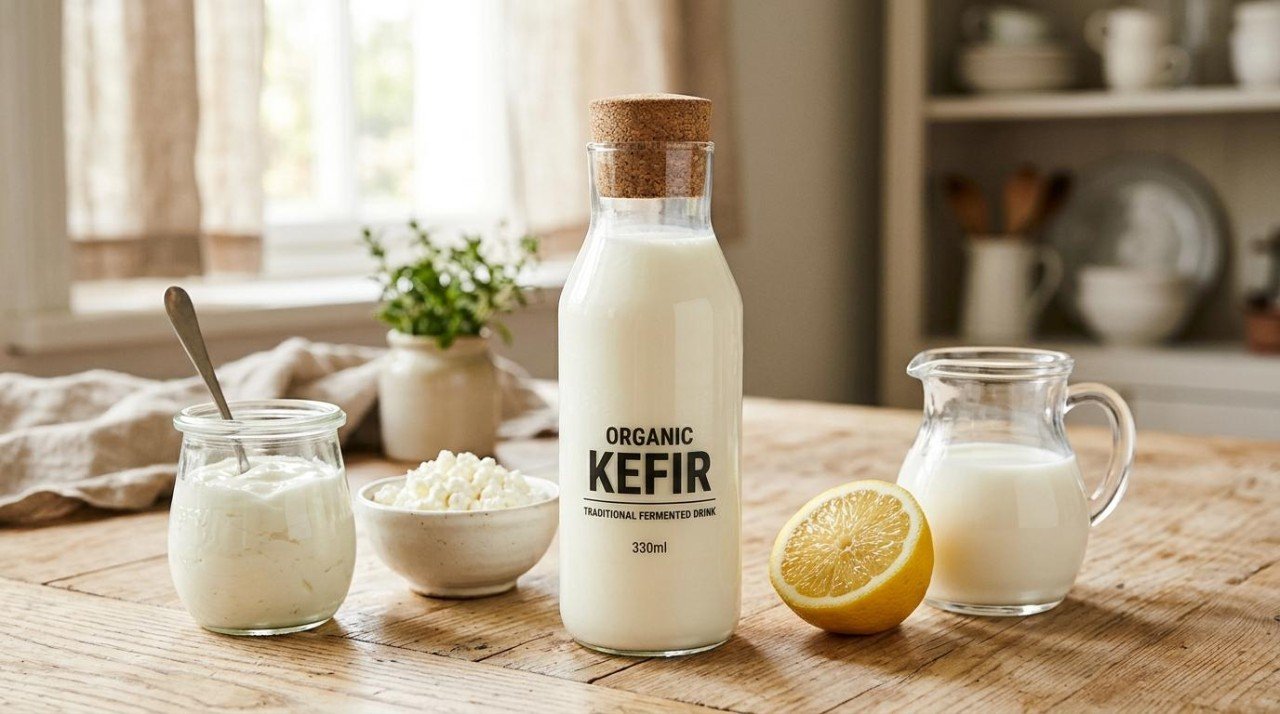
The recipe calls for a cup of kefir, and you are holding an empty bottle. Maybe it is a smoothie, a batch of muffins, or a chicken marinade. Kefir is easy to replace, but the right swap depends on what the recipe needs from it.
Kefir does three things in a recipe. It brings tang, it brings acid (which matters a lot if the recipe uses baking soda), and it brings a pourable, creamy body, thicker than milk and thinner than yogurt. In some recipes it is there for its fourth quality, the live cultures, and that one is the hardest to replace. Below are the substitutes that actually work, with exact ratios. For each one you will see what it is good for, what it is not, and whether it keeps any of the probiotics.
The Quick List
- Plain yogurt thinned with milk — the closest all-around match, cultures included
- Cultured buttermilk — a straight 1:1 pour for baking, marinades, and dressings
- Greek yogurt or skyr, thinned — the high-protein upgrade, great in smoothies
- Plain drinkable yogurt — the easiest 1:1 swap for smoothies and overnight oats
- Sour cream, thinned — the richest stand-in, best in tender cakes and dressings
- Milk + lemon juice or vinegar — the pantry fix for baking, no cultures
- Blended cottage cheese + milk — a protein-packed smoothie base
- Dairy-free yogurt or coconut kefir — the closest dairy-free match
- Soy milk + lemon juice — dairy-free baking when you have no plant yogurt
- Water kefir — keeps the probiotics in a smoothie, but none of the creaminess
First, What Is Kefir Doing in Your Recipe?
Kefir is milk fermented with kefir "grains," which are small clusters of bacteria and yeasts. That fermentation makes it tart, slightly fizzy, and acidic. It also sets kefir apart from most other cultured dairy: a review in Frontiers in Microbiology notes that kefir carries "a large population of yeasts" alongside its lactic acid bacteria, and sequencing studies have found dozens of distinct bacterial types in a single batch. Yogurt is usually made with a few specific bacterial strains and no yeasts.
Before you pick a swap, figure out which job kefir is doing:
- Baking with baking soda (muffins, pancakes, soda bread, quick breads): the acid matters most. Soda needs an acid to react with, or the bake comes out flat and soapy-tasting. Any swap here must be acidic.
- Smoothies and overnight oats: body and tang matter most, and this is where kefir's cultures actually survive to reach you.
- Marinades: acid and tang, which gently tenderize meat the way buttermilk does.
- Dressings, cold soups, and dips: tang and pourable creaminess, with the cultures still intact because nothing gets cooked.
Every substitute below says which of these it covers. If you are baking, almost any acidic dairy will do. For a smoothie, focus on texture. And if you were drinking kefir for gut health, read the section on probiotics further down before you pick.
Plain Yogurt Thinned with Milk
- Swap: 1 cup kefir → 3/4 cup plain yogurt + 1/4 cup milk, whisked smooth
- Best for: Everything — baking, smoothies, marinades, dressings, overnight oats
- Skip it for: Nothing major, as long as the yogurt is plain and unsweetened
- Probiotics: Yes, if the label says "live and active cultures," though fewer strains than kefir and no yeasts
This is the swap to reach for first. Yogurt and kefir are both cultured, tangy, and acidic, so yogurt does everything kefir does once you loosen it up. Whisk 3/4 cup yogurt with 1/4 cup milk and you get something close to kefir's thick-but-pourable texture. For a thinner batter or a recipe that really wants a liquid, go to equal parts. America's Test Kitchen uses 1/2 cup yogurt to 1/2 cup water when replacing the similarly thin buttermilk, and treats kefir and buttermilk as 1:1 equivalents.
Nutritionally the two are close. Plain whole-milk yogurt has about 3.5 grams of protein per 100 grams, almost the same as lowfat plain kefir at 3.8 grams. Use whole-milk yogurt if you want kefir's richness, or low-fat if your kefir was low-fat. Avoid vanilla or fruit yogurts, which add sugar and flavor the recipe did not ask for.
Cultured Buttermilk
- Swap: 1:1 — 1 cup kefir → 1 cup cultured buttermilk
- Best for: Pancakes, biscuits, muffins, soda bread, fried-chicken marinades, ranch-style dressings
- Skip it for: Drinking straight or smoothies, where it tastes thinner, saltier, and more sour
- Health notes: Similar calories and protein to lowfat kefir, but more sodium
Buttermilk is kefir's closest cousin in the baking aisle. It is a cultured, acidic, pourable dairy that bakers have used with baking soda for generations, and America's Test Kitchen lists kefir and buttermilk as a straight 1:1 swap. Pour it in cup for cup. Buttermilk is a little thinner and milder, so a thick batter may come out slightly looser. Any recipe written for buttermilk will work with it, which covers most kefir baking recipes too.
Buttermilk is weaker in smoothies and anything you drink. It is saltier than you might expect: cultured lowfat buttermilk has about 148 milligrams of sodium per 100 grams, roughly 360 milligrams a cup, compared with about 100 milligrams a cup for plain kefir. Calories and protein are nearly identical. Many commercial buttermilks contain live cultures, but they are fewer and less varied than kefir's, and brands vary, so check the label if that matters to you. (Out of both? Our buttermilk substitutes guide covers the pantry fixes.)
Greek Yogurt or Skyr, Thinned
- Swap: 1 cup kefir → 1/2 cup plain Greek yogurt or skyr + 1/2 cup milk (or water), whisked smooth
- Best for: Smoothies, overnight oats, dressings, marinades, and most baking
- Skip it for: Recipes where a lighter, thinner tang is the whole point, like a drinkable cold soup
- Health notes: Close to double the protein of kefir per cup when thinned with milk
Greek yogurt and Icelandic skyr are strained, so they are much thicker than kefir and need more thinning. Half yogurt, half milk gets you close to kefir's body. For something as thin as buttermilk, America's Test Kitchen uses 1/3 cup Greek yogurt with 2/3 cup water. Whisk well, or blend if it stays lumpy, because strained yogurt resists thinning at first.
The payoff is protein. Plain nonfat Greek yogurt has about 10 grams of protein per 100 grams, nearly three times kefir's. Half a cup of it plus half a cup of milk comes to about 16 grams of protein, compared with about 9 grams in a cup of lowfat kefir. That makes this the best swap for a smoothie or overnight oats meant to carry you to lunch. Its tang is a little sharper and less fizzy than kefir's, and skyr is the sharpest of all. A ripe banana or a few dates in the smoothie balances it out. More ways to use it are in our Greek yogurt guide.
Plain Drinkable Yogurt
- Swap: 1:1 — 1 cup kefir → 1 cup plain, unsweetened drinkable yogurt (or unsalted lassi)
- Best for: Smoothies, overnight oats, and drinking straight
- Skip it for: Sweetened versions in baking or savory dishes
- Probiotics: Usually yes, check for "live and active cultures"
Drinkable yogurt is the no-mixing option. It is already thinned to a pourable texture, so it goes into a blender or an oats jar exactly like kefir. Plain lassi works the same way. Ayran and doogh, the salted yogurt drinks from Turkey and Iran, work well in savory marinades and cold soups, but their salt makes them a poor fit for sweet smoothies.
The catch is sugar. Many drinkable yogurts are sweetened or flavored, so look for "plain" or "unsweetened" and check the added sugars line on the label. If the only version on the shelf is sweetened, use thinned plain yogurt instead and sweeten it yourself to taste. Our guide to building a balanced smoothie explains why that matters.
Sour Cream, Thinned
- Swap: 1 cup kefir → 1/2 cup sour cream + 1/2 cup milk, whisked smooth
- Best for: Tender cakes, coffee cake, quick breads, creamy dressings and dips
- Skip it for: Smoothies and lean, light bakes
- Health notes: Much richer — full sour cream has about 10 grams of saturated fat per 100 grams
Sour cream is cultured, tangy, and acidic, so it handles baking soda without trouble. Its extra fat makes cakes and muffins especially soft and moist. It is far thicker than kefir, though, so thin it with an equal amount of milk before measuring. Undiluted, it would leave the batter too stiff.
It is a rich swap. Full-fat sour cream has about 198 calories and 10 grams of saturated fat per 100 grams, while lowfat kefir has 43 calories and under 1 gram. Thinned half and half with milk, it lands somewhere between the two. That is fine in a cake but heavy in a smoothie. Light sour cream works too and stays closer to kefir. For the reverse problem, see our sour cream substitutes guide.
Milk + Lemon Juice or Vinegar
- Swap: 1 cup kefir → 1 cup milk + 1 tablespoon lemon juice or white or apple cider vinegar; stir and rest 10 to 15 minutes
- Best for: Baking with baking soda — muffins, pancakes, quick breads, soda bread
- Skip it for: Smoothies, drinking, overnight oats, and dressings
- Probiotics: None — this is soured milk, not a fermented one
When the fridge has nothing cultured in it, this pantry trick solves the baking problem. Stir a tablespoon of lemon juice or vinegar into a cup of milk and let it stand for 10 to 15 minutes, until it thickens very slightly and curdles. The acid gives baking soda what it needs to react, and the bake rises normally. Whole milk gives the richest result.
Keep it to baking, though. The milk curdles into small lumps rather than thickening smoothly, it tastes like sour milk instead of tangy kefir, and it contains no live cultures. It works for leavening and nothing else, so leave it out of smoothies, oats, and dressings.
Blended Cottage Cheese + Milk
- Swap: 1 cup kefir → 1/2 cup lowfat cottage cheese + 1/2 cup milk, blended until completely smooth
- Best for: Smoothies and protein-heavy overnight oats
- Skip it for: Baking with soda (it is only mildly acidic) and anywhere you cannot blend
- Health notes: About 16 grams of protein per cup of mix, but noticeably more sodium
This one is for smoothie drinkers. Blended with milk, cottage cheese turns into a smooth, creamy, mildly tangy base with a lot of protein: 2% cottage cheese has about 10 grams per 100 grams, so half a cup plus half a cup of milk lands around 16 grams. Run the blender a full 30 seconds or so, or the curds will leave a grainy texture.
Two trade-offs. Cottage cheese is much milder than kefir, so the smoothie tastes less tangy. A squeeze of lemon helps. It is also salted: that same 2% cottage cheese carries about 308 milligrams of sodium per 100 grams, so half a cup adds roughly 350 milligrams. That is fine once in a while, but worth knowing if you watch sodium. Some brands add live cultures and say so on the label, but most cottage cheese does not contain them.
Dairy-Free Yogurt or Coconut Kefir
- Swap: 1 cup kefir → 1 cup coconut kefir, or 3/4 cup plain unsweetened soy or coconut yogurt + 1/4 cup unsweetened plant milk
- Best for: Smoothies, overnight oats, dressings, and most baking
- Skip it for: Sweetened or vanilla versions in savory recipes
- Probiotics: Usually yes — most are cultured, so check for live cultures on the label
If you avoid dairy, cultured plant-based products are the closest match. Coconut kefir, sold as a refrigerated drink, can be used cup for cup. Plain cultured soy or coconut yogurt, thinned like dairy yogurt, works in nearly everything. Cultured plant yogurts are tangy and acidic enough to react with baking soda.
Not all plant bases are equal. Soy yogurt has the most protein of the group, close to dairy yogurt. Coconut versions are creamier and richer but contain very little protein and a lot of saturated fat. Almond and oat yogurts are usually thinner and lower in protein too. Read the label for added sugar, since "plain" plant yogurts are sometimes lightly sweetened. For other dairy-free swaps, see our coconut milk guide.
Soy Milk + Lemon Juice
- Swap: 1 cup kefir → 1 cup unsweetened soy milk + 1 tablespoon lemon juice or vinegar; rest 10 minutes
- Best for: Dairy-free muffins, pancakes, and quick breads
- Skip it for: Smoothies, drinking, and dressings
- Probiotics: None
This is the dairy-free version of the milk-and-lemon trick, for when there is no plant yogurt in the house. Soy milk works best because its protein curdles and thickens with acid much like dairy milk does. Oat and almond milk barely respond, so they add acid but none of the body. Like its dairy counterpart, it covers leavening only. It does nothing for a smoothie that a plain glass of soy milk would not.
Water Kefir
- Swap: 1 cup milk kefir → 1 cup water kefir in smoothies only, plus a frozen banana or 1/4 cup yogurt for body
- Best for: Dairy-free smoothies where the probiotics are the point
- Skip it for: Baking, marinades, dressings, and anything that needs creaminess
- Probiotics: Yes, though its microbes differ from milk kefir's
Water kefir shares a name with milk kefir, but in the kitchen it is a different thing. It is sugar water (or juice) fermented with its own type of grains, and it comes out as a light, fizzy, faintly sweet drink with no fat, almost no protein, and none of milk kefir's thickness. It can keep a smoothie probiotic and dairy-free, but you will need a frozen banana, some yogurt, or a spoonful of nut butter to replace the body. It is too thin and too low in fat and protein to stand in for kefir in baking or a marinade.
Which Swaps Keep the Probiotics?
For a lot of people, kefir is not just a recipe ingredient. It is part of a gut-health routine. Here is how the swaps compare on that front:
- Live cultures, often good variety: plain yogurt, Greek yogurt and skyr, drinkable yogurt, cultured plant yogurt, coconut kefir, water kefir (look for "live and active cultures" on the label)
- Sometimes live cultures: cultured buttermilk, sour cream, cottage cheese — depends on the brand, so check the label
- No live cultures: milk or soy milk soured with lemon juice or vinegar
Two points put this in perspective. First, heat kills live cultures, so in muffins, pancakes, and anything else you bake, it does not matter which swap you use. None of the probiotics survive the oven. The difference only counts in recipes that stay cold, like smoothies, overnight oats, dressings, and cold soups.
Second, kefir really does stand out. Its yeasts and its wider range of bacteria make it more varied than a typical yogurt, so even the best swap here is a narrower set of microbes. Still, yogurt holds up well. In a 2021 Stanford trial published in Cell, adults who ate more fermented foods, including yogurt, kefir, and fermented vegetables, saw their gut microbiome diversity rise and a range of inflammatory markers fall. It was a small study, but the benefit came from eating fermented foods regularly, not from any one product. If you are comparing your options, our breakdown of kimchi, kefir, and kombucha looks at which fermented foods have the strongest evidence.
One more consideration if you chose kefir because milk bothers you: in a small study of adults with lactose maldigestion, both plain kefir and plain yogurt were digested far more easily than milk and reduced gas symptoms by more than half. So plain yogurt is a reasonable swap on that count too. Soured milk is not, since it has all of milk's lactose and no live cultures to help break it down.
Healthier Upgrades Worth Knowing
Kefir is already a good ingredient, so the goal here is not to "fix" it. Still, a couple of swaps give you something kefir does not:
- More protein: thinned Greek yogurt or skyr, or blended cottage cheese, nearly doubles the protein of a cup of kefir, which helps a breakfast smoothie keep you full.
- Less sodium: plain kefir and plain yogurt have about a third of buttermilk's sodium or less, so in a marinade or dressing they are the lower-sodium pick.
- More plants: if you go dairy-free, a cultured soy yogurt adds a legume to your week's plant count. Building a smoothie around it with berries, greens, and seeds adds even more.
How much a swap changes the nutrition depends on the whole recipe, not one ingredient. That is the part a general guide cannot answer for you. Eat Well Planner can. Ask its AI recipe chat "I'm out of kefir, what should I use?" with your actual recipe open, and it will tell you whether the kefir is doing leavening, texture, or tang in that dish, and which swap fits. To see what a swap does to the numbers, the Recipe Playground lets you trade kefir for Greek yogurt or buttermilk and watch the recipe's nutrition score change live before you commit.
Take the Guesswork Out of Eating Well
Eat Well Planner helps you organize your favorite recipes, plan balanced meals, and automatically generate shopping lists — all in one place. Whether you're tracking macros, managing dietary restrictions, or just trying to stop asking "what's for dinner?", we've got you covered.
Our AI-powered tools can adapt any recipe to your dietary needs, help you discover new meals you'll love, and even log your nutrition effortlessly. It's meal planning made simple.
Start Organizing Your Meals — FreeWhat Not to Use
- Plain milk in a recipe with baking soda — no acid means no rise, and leftover soda leaves a soapy, metallic taste. If milk is all you have, sour it with lemon juice or vinegar first.
- Sweetened or flavored yogurt in baking or savory dishes — vanilla yogurt in a chicken marinade is a mistake you only make once. Use plain, unsweetened products everywhere except a smoothie you would sweeten anyway.
- Unthinned Greek yogurt or sour cream, cup for cup — they are two to three times thicker than kefir, so batters turn stiff and bakes come out dense. Always thin them first.
- Soured milk in a smoothie or dressing — it curdles into lumps and tastes like milk that has gone off, not like kefir.
- Kombucha — another fermented drink, but it is tea-based, sweet, and dairy-free with no creaminess. It is a different drink, not a kefir substitute.
The Bottom Line
For most recipes, plain yogurt thinned with milk is the answer: 3/4 cup yogurt plus 1/4 cup milk for every cup of kefir. It covers baking, smoothies, marinades, and dressings, and it keeps live cultures. If you are baking, cultured buttermilk swaps in cup for cup, and milk with a tablespoon of lemon juice handles the leavening when nothing else is around. For a high-protein smoothie, thin Greek yogurt or skyr. For a dairy-free one, use coconut kefir or cultured soy yogurt. And if the probiotics were the point, keep the swap cold. Any cultured option is a good stand-in, and none of them survive baking.
Once you find the swap that works in a recipe you make often, save it to Eat Well Planner with the substitution built in. Or ask it to create a variation, whether dairy-free, higher-protein, or "whatever is in my fridge," and you will not have to work it out mid-recipe next time.