You opened the bag of spinach for tonight's pasta and found a slimy green puddle. Or the store was out, or the recipe calls for a pound and you have a handful. Spinach is one of the most-replaced ingredients in the kitchen for exactly that reason: it goes bad fast. The good news is that it is also one of the easiest to replace, because there is a whole aisle of leafy greens that do the same job.
The catch is that spinach does two very different jobs. Cooked, it is a mild green that wilts in about a minute and melts into sautés, soups, pasta, lasagna, quiche, and dips. Raw, it is a soft, tender salad leaf that also disappears into smoothies. A green that is perfect for one job can be wrong for the other (try a raw salad of mature collards), so this guide is split by use, with exact amounts for each.
Two numbers worth knowing first. By USDA weights, one cup of raw spinach is only about 1 ounce (30 g), and a standard 10-ounce bag is about 9 to 10 loosely packed cups. And spinach shrinks dramatically: one pound of fresh spinach cooks down to about 1 1/4 cups. Most swaps below replace spinach 1:1 by weight or by cups of chopped leaves, so if your recipe says "5 ounces baby spinach," you are looking for about 5 ounces of the substitute.
The Quick List
- Frozen spinach — the best swap for any cooked dish, especially dips, lasagna, quiche, and soups
- Swiss chard — the closest fresh stand-in for sautés, pasta, soups, and gratins
- Beet greens — spinach's close cousin, tender and quick-cooking, a little earthier
- Kale — sturdier and heartier; great in soups, stews, sautés, and pasta with a few extra minutes
- Bok choy — the go-to for stir-fries, noodle soups, and dumplings
- Collard greens — for long braises, beans, and stews, or sliced thin for a sauté
- Mustard greens — a peppery cooked swap for curries, beans, and soups
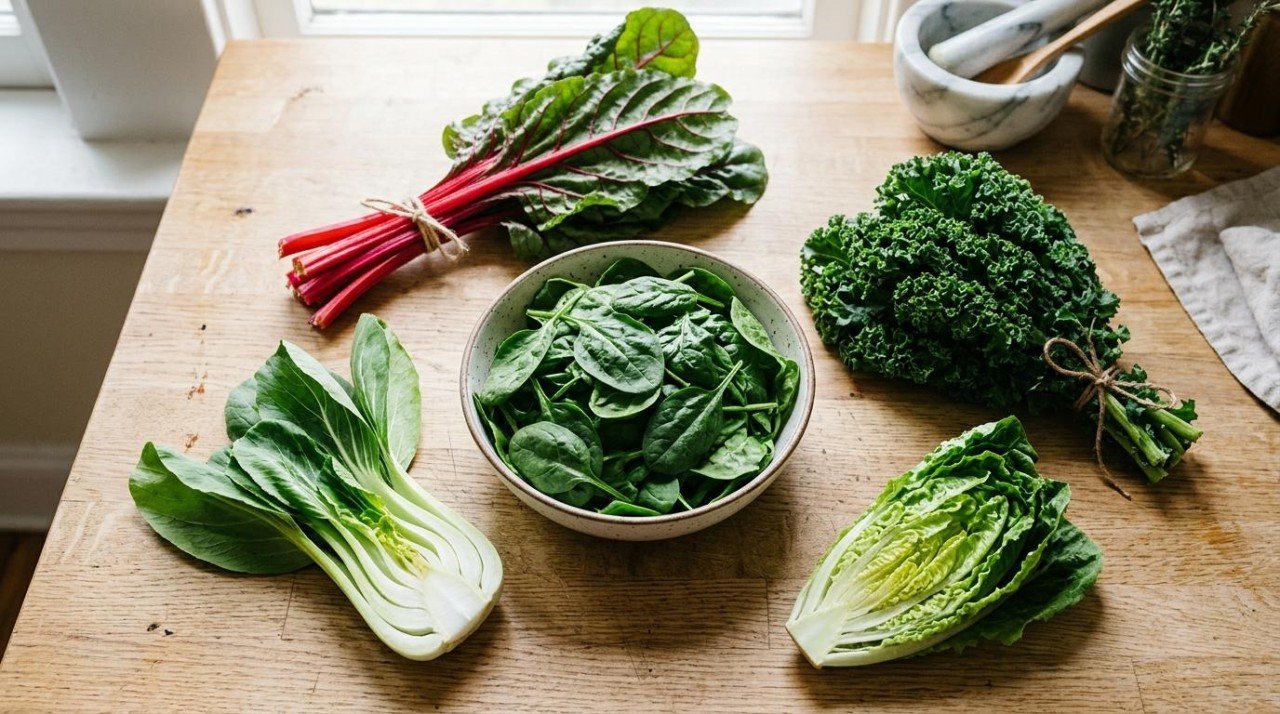
- Baby kale — the best raw swap for salads, wraps, and smoothies
- Arugula — a peppery raw salad swap that also wilts nicely into warm pasta
- Romaine or leaf lettuce — a mild raw swap for salads, sandwiches, and smoothies
- Watercress — a crisp, peppery raw swap for salads and sandwiches, and great in soup
For Cooked Dishes: Sautés, Soups, Pasta, Lasagna, and Dips
This is where most spinach goes, and where you have the most options. The rule of thumb: tender greens (chard, beet greens, bok choy leaves) cook in about the same time as spinach, while sturdier greens (kale, collards, mustard greens) need to be chopped smaller and cooked longer. If the recipe depends on spinach being soft and dry, like a dip, a lasagna layer, or a quiche, frozen spinach is your best friend.
Frozen Spinach
- Swap: One 10-ounce package frozen → about 1 pound fresh spinach, cooked. For smaller amounts, use about 1/2 cup frozen for every 4 cups of fresh baby spinach
- Best for: Spinach dip, lasagna, stuffed shells, quiche, frittatas, spanakopita, soups, curries like saag, smoothies
- Skip it for: Raw salads, sandwiches, and any recipe where you want whole, glossy leaves
- Health notes: Frozen spinach is still spinach, frozen soon after harvest. Because it is so compact, a serving packs in more of it: per USDA, a cup of cooked frozen spinach has about 7 g of fiber
Frozen spinach is already blanched, so it behaves like spinach that has been cooked and drained. That is exactly what dips, lasagna, and quiche want. Per USDA, a 10-ounce package yields about 220 g (about 1 1/4 cups) once cooked and drained, which lines up with the 1 1/4 cups that a pound of fresh spinach cooks down to. That is why one box replaces one pound of fresh in nearly every cooked recipe.
The one step you cannot skip: thaw it and squeeze it dry. Thaw it in the fridge or microwave, then wring it out in a clean kitchen towel or a fistful at a time over the sink until almost nothing drips. Skip this and your dip goes watery, your lasagna slides apart, and your quiche never quite sets. For soups, stews, and curries, you can add it frozen straight to the pot, since the extra water just becomes part of the broth. In smoothies, about 3 tablespoons of frozen spinach stands in for each cup of fresh, and it chills the drink too.
Swiss Chard
- Swap: 1:1 by weight or by cups of chopped leaves. Chop the stems and cook them 3 to 4 minutes before adding the leaves
- Best for: Sautés, pasta, soups, beans, gratins, frittatas, stuffed pasta fillings
- Skip it for: Raw salads (mature chard leaves are chewy; baby chard is fine), and recipes where you want a perfectly mild green
- Health notes: 19 calories and 1.6 g fiber per 100 g, with about 70% more vitamin K than spinach, but far less folate
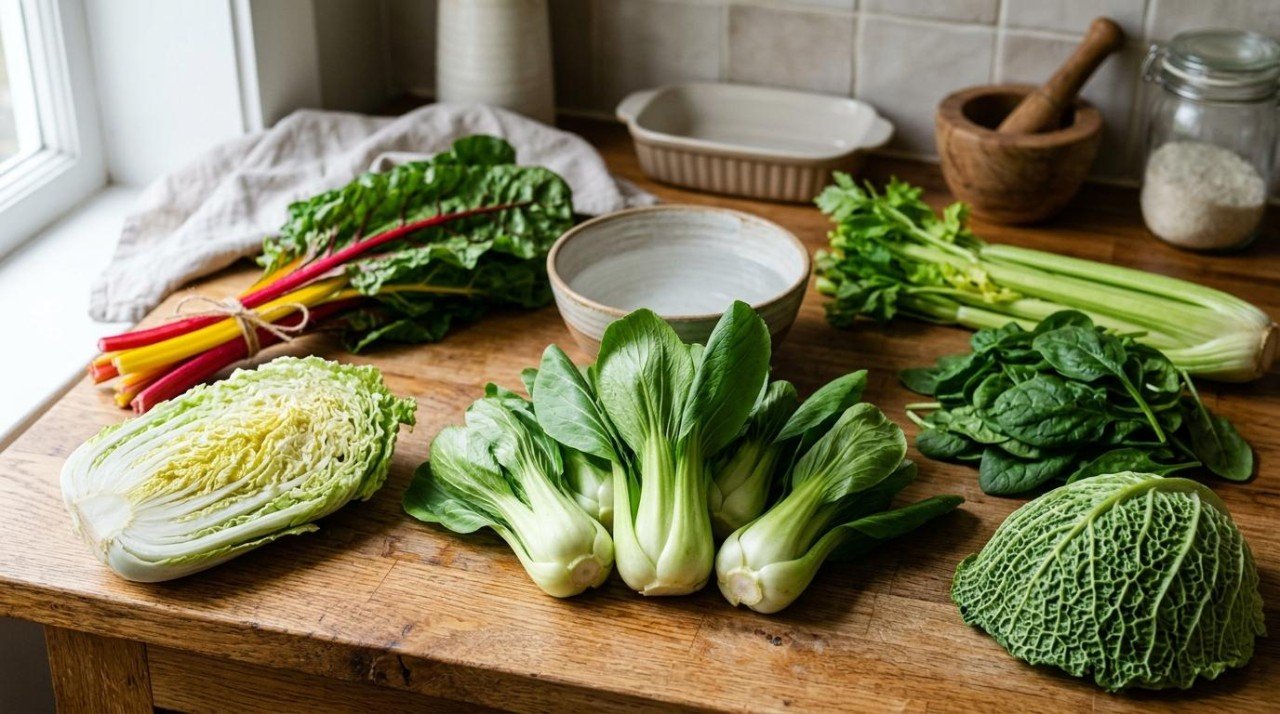
Swiss chard is the closest fresh swap for cooked spinach. The two are botanical relatives (along with beets, they are in the same plant family), and chard leaves wilt in 2 to 4 minutes into a soft, silky green with a slightly earthier, mineral flavor. Rainbow and red chard work the same way as green; the colorful stems just bleed a little pink into creamy sauces.
Do not throw out the stems. They are crunchy, like celery, and need a head start: slice them thin, sauté them with your onion or garlic for a few minutes, then add the chopped leaves. If your recipe is a dip or a lasagna filling, cook the leaves until fully wilted and squeeze them dry the same way you would spinach.
Beet Greens
- Swap: 1:1 by weight or by cups of chopped leaves
- Best for: Sautés, pasta, soups, grain bowls, frittatas, and anywhere you would wilt spinach with garlic and olive oil
- Skip it for: Dishes where a deep red tint would look odd (the red stems and veins can color the dish)
- Health notes: 3.7 g fiber and 2.6 mg iron per 100 g, against spinach's 2.2 g fiber and 2.7 mg iron
If you bought beets with their tops on, you already have a spinach substitute in your fridge. Beet greens are in the same family as spinach and chard, and young ones are almost as tender as spinach, wilting in 2 to 3 minutes with a slightly sweeter, earthier taste. Larger leaves have thicker stems; slice those thin and give them a minute or two before the leaves, as with chard.
Beet greens are also one of the few swaps that roughly match spinach on iron, and they bring more fiber. They do not keep long once cut from the beets, so use them within a few days.
Kale
- Swap: 1:1 by weight, stems removed, leaves chopped smaller than you would cut spinach. Add 3 to 5 minutes of cooking time
- Best for: Soups, stews, beans, pasta, grain bowls, frittatas, smoothies, and sautés
- Skip it for: Quick one-minute wilts, delicate cream sauces, and smooth dips unless you chop it very fine
- Health notes: Per 100 g raw, 4.1 g fiber, 254 mg calcium, and 93 mg vitamin C, against spinach's 2.2 g, 99 mg, and 28 mg
Kale is the substitute most people already have, and it works in nearly any cooked spinach dish as long as you give it more time. Strip the leaves off the tough center ribs, chop them, and sauté for 5 to 7 minutes instead of 1 or 2, or add them to soup about 10 minutes before the end instead of the last minute. Lacinato (also called Tuscan or dinosaur) kale is more tender than curly kale and is the better pick for pasta and sautés.
Expect a heartier, chewier result with a deeper cabbage-family flavor. That is a plus in minestrone, white bean soup, or sausage pasta, and less welcome in a spinach-artichoke dip, where kale stays noticeably chewy unless it is finely chopped and well cooked. Kale is also sold frozen, and frozen kale swaps for frozen spinach at the same amount in soups and casseroles.
Bok Choy
- Swap: 1:1 by cups of chopped bok choy. Cook the white stems 2 to 3 minutes before adding the leaves
- Best for: Stir-fries, noodle soups, ramen, fried rice, dumpling fillings, steamed sides
- Skip it for: Dips, lasagna, and quiche, where it is too watery and crunchy
- Health notes: Very light at 13 calories per 100 g, with 105 mg calcium and 45 mg vitamin C
For Asian-style dishes, bok choy is often a better fit than spinach. The leaves wilt just like spinach, while the white stems stay juicy and crisp-tender. Baby bok choy can be halved or quartered and cooked whole; full-size bok choy should be separated, washed well (grit hides at the base), and sliced.
Bok choy is about 95% water, so it is a poor swap for anything that needs dry cooked greens. In a stir-fry or soup that does not matter.
Collard Greens
- Swap: 1:1 by weight, center ribs removed. Braise 20 to 30 minutes, or slice into very thin ribbons and sauté 5 to 8 minutes
- Best for: Bean dishes, stews, soups, braised greens, and sturdy sautés
- Skip it for: Raw salads, quick wilts, and smoothies
- Health notes: Per 100 g raw, 4 g fiber and 232 mg calcium, more than twice spinach's calcium
Collards are the toughest green on this list, so they work best where the recipe gives them time: a pot of beans, a soup that simmers for half an hour, or Southern-style braised greens. For a faster dish, stack a few leaves, roll them up like a cigar, and slice crosswise into thin ribbons. Ribbons cook in a skillet in about 5 to 8 minutes.
Mustard Greens
- Swap: 1:1 by weight, tough stems removed. Cook 5 to 10 minutes. For a milder result, use half mustard greens and half a milder green
- Best for: Indian curries and saag, bean soups, braised greens, stir-fries
- Skip it for: Mild, creamy dishes and anywhere a spicy bite would clash
- Health notes: 3.2 g fiber and 70 mg vitamin C per 100 g
Mustard greens taste like their name: peppery, with a horseradish kick that mellows a lot as they cook. They are traditional in Punjabi sarson ka saag and in Southern pots of greens, so they are a natural swap in spinach curries like saag paneer. In mild dishes, start with half mustard greens and half chard, kale, or frozen spinach.
For Raw Salads, Sandwiches, and Smoothies
Raw spinach is valued for being soft and mild, so the best raw substitutes are tender leaves. Mature chard, kale, and collards are too tough here (unless you massage kale, more on that below). If you only have one raw substitute that is too peppery, mixing it half and half with something mild works well.
Baby Kale
- Swap: 1:1 by cups
- Best for: Salads, grain bowls, wraps, sandwiches, smoothies, and quick wilting into pasta or eggs
- Skip it for: Very delicate salads where you want a buttery-soft leaf
- Health notes: Same nutrition story as mature kale: more fiber, calcium, and vitamin C than spinach
Baby kale is picked young, so the leaves are tender enough to eat raw without any prep. It is a little firmer and more robust than baby spinach, and it holds up better in a dressed salad that sits for a while, which makes it a good choice for packed lunches. In smoothies it is a 1:1 swap, though it tastes a little greener than spinach.
Only have mature kale? Strip the ribs, chop the leaves, add a pinch of salt and a little lemon juice or olive oil, and massage it with your hands for 1 to 2 minutes until it darkens and softens. It will never be spinach-soft, but it makes a sturdy salad that lasts days in the fridge.
Arugula
- Swap: 1:1 by cups. For a milder salad, use half arugula and half lettuce
- Best for: Salads, sandwiches, pizza topping, and stirring into hot pasta or grains at the end
- Skip it for: Smoothies, mild creamy dips, and kid-friendly dishes where pepperiness will be noticed
- Health notes: 160 mg calcium and 97 mcg folate per 100 g
Arugula is as tender as baby spinach, so the texture swap is perfect. The flavor is not: arugula is peppery and a little bitter. That is great with a lemony vinaigrette, shaved Parmesan, or fruit like pears or strawberries, and less great in a sweet smoothie. It is also an excellent stand-in for spinach wilted into hot pasta; toss it in off the heat and it softens in seconds. It also works in pesto, and our fresh basil substitutes guide covers how to use it there.
Romaine or Leaf Lettuce
- Swap: 1:1 by cups
- Best for: Salads, sandwiches, wraps, burgers, and smoothies
- Skip it for: Nearly all cooked dishes; lettuce turns limp and watery
- Health notes: Romaine is lighter at 17 calories per 100 g, with 136 mcg folate, close to spinach's 194 mcg
Romaine and green or red leaf lettuce are the mildest raw swap, which makes them the safest choice for picky eaters and smoothies. Romaine is crunchier and watery-crisp rather than soft, while leaf lettuce and butter lettuce are closer to spinach's tenderness. Romaine is also a better nutrition swap than its reputation suggests, with more folate and vitamin A than people expect. In a smoothie, use a packed cup of chopped romaine for each cup of spinach; the flavor almost disappears.
Watercress
- Swap: 1:1 by cups, thick stems trimmed
- Best for: Salads, sandwiches, and stirring into soups and broths at the end
- Skip it for: Smoothies and long-cooked dishes
- Health notes: Only 11 calories per 100 g, with 120 mg calcium and 43 mg vitamin C
Watercress is tender and peppery, like a crisper, juicier arugula. It is excellent in salads with citrus or apples, in a sandwich in place of spinach leaves, and in brothy soups, where it wilts in about 30 seconds. Like arugula, mix it with lettuce if you want a milder salad.
What You Gain (and Lose) Nutritionally
Spinach has a reputation as a nutrition all-star, and for some nutrients it earns it. But several substitutes beat it on the nutrients people actually think spinach is giving them. Here is how the main swaps compare per 100 g raw, using USDA data:
- Folate: Spinach leads at 194 mcg, almost half the daily value. Romaine (136 mcg), collards (129 mcg), and arugula (97 mcg) come closest. Chard and beet greens have very little (14 to 15 mcg). If folate matters to you, as it does in pregnancy, romaine or collards are the better swaps.
- Iron: Spinach has 2.7 mg and beet greens 2.6 mg, while chard (1.8 mg) and kale (1.6 mg) have less. But spinach's iron number is misleading, because very little of it is absorbed. Our post on why you absorb almost none of the iron in spinach explains why, and how to pair plant iron with vitamin C to absorb more.
- Calcium: This is where kale, collards, and bok choy win, and not just on paper. Spinach is high in oxalate, which binds its calcium. In one study, adults absorbed only 5.1% of the calcium from spinach, against 27.6% from milk. Kale is a low-oxalate green, and in a similar study its calcium was absorbed even better than milk's (about 41% vs 32%). Kale also has more than 2.5 times spinach's calcium per 100 g to begin with.
- Fiber: Kale (4.1 g), collards (4 g), beet greens (3.7 g), and mustard greens (3.2 g) all beat spinach's 2.2 g.
- Vitamin C: Kale (93 mg), mustard greens (70 mg), and bok choy (45 mg) all outrank spinach (28 mg).
Two groups of readers should pay special attention to these swaps:
- If you have had calcium oxalate kidney stones, the NIDDK lists spinach among the high-oxalate foods to limit or avoid. Kale, bok choy, and collards are much lower in oxalate, which makes them more than just backup options. Swiss chard and beet greens are close relatives of spinach and are also high in oxalate, so they are not the swap to pick here. For the full picture, see our post on oxalates and other "antinutrients".
- If you take warfarin, the issue is vitamin K, and swapping one leafy green for another can change your intake a lot. Chard has about 830 mcg per 100 g raw, against spinach's 483 and arugula's 109. MedlinePlus advises people on warfarin not to change how much of these greens they eat day to day or week to week, and to check with their provider before big diet changes. Our guide to food-drug interactions goes into more detail.
One more bonus: trying a green you do not usually buy, like beet greens, mustard greens, or watercress, adds a new plant to your week. A wider variety of plants is linked to a more diverse gut microbiome, as we explain in 30 plants a week: what actually happens inside your body.
Not sure which green fits the recipe in front of you? A guide like this can only speak in general terms. In Eat Well Planner, you can ask the AI recipe chat right from your saved recipe ("I'm making this lasagna and I only have kale — how should I prep it?") and get an answer that accounts for everything else in the dish. Or open the recipe in the Recipe Playground, swap spinach for kale or collards, and watch the nutrition score update before you commit.
Take the Guesswork Out of Eating Well
Eat Well Planner helps you organize your favorite recipes, plan balanced meals, and automatically generate shopping lists — all in one place. Whether you're tracking macros, managing dietary restrictions, or just trying to stop asking "what's for dinner?", we've got you covered.
Our AI-powered tools can adapt any recipe to your dietary needs, help you discover new meals you'll love, and even log your nutrition effortlessly. It's meal planning made simple.
Start Organizing Your Meals — FreeWhat Not to Use
- Undrained frozen spinach in dips, lasagna, or quiche. It releases a lot of water as it bakes. Squeeze it dry first, every time.
- Iceberg or romaine in cooked dishes. Lettuce collapses into a watery, limp mess in a sauté. Keep it raw.
- Mature kale or collards in a raw salad without prep. They are tough and fibrous raw. Use baby kale, or massage mature kale first.
- Collards in a one-minute wilt. Stirred into pasta at the end like spinach, collards stay chewy. Slice them into thin ribbons and cook them first.
- Arugula or mustard greens in a sweet smoothie. The peppery bite does not hide behind banana and berries the way spinach does.
- Fresh herbs as a spinach replacement. A big handful of parsley or basil brings a lot of flavor, not a mild green. Use a little alongside a mild green, not instead of one.
The Bottom Line
For cooked dishes, frozen spinach is the easiest swap, at one 10-ounce package per pound of fresh, squeezed dry for dips, lasagna, and quiche. For fresh greens in the pan, Swiss chard and beet greens behave most like spinach, while kale, collards, and mustard greens work if you chop them smaller and cook them longer. Bok choy takes over in stir-fries and noodle soups. For raw salads and smoothies, baby kale is the most versatile swap, romaine is the mildest, and arugula and watercress add a peppery kick. Many of these swaps also bring more fiber, vitamin C, or better-absorbed calcium than spinach would have. If you are making a spinach dip, our healthier spinach artichoke dip works with frozen spinach or chopped chard.
And when you are looking at a specific recipe and still are not sure, you do not have to adapt it line by line. Eat Well Planner can create a recipe variation with the swap already worked in, from the prep to the cooking times, so dinner still happens with whatever greens are in your fridge.