The pumpkin pie filling is half-whisked, the oven is preheating, and the can of evaporated milk you were sure you had is nowhere in the pantry. Or the mac and cheese recipe wants a cup of it and you have exactly none. It is one of those cans that lives in the back of the cupboard until the one night you actually need it.
Here is the reassuring part: evaporated milk is nothing more than regular milk with about 60% of its water simmered off — no sugar, no additives, just concentrated milk. That single fact is why it is one of the easiest ingredients in the kitchen to replace. Anything rich and unsweetened that you can cook down, or that is already concentrated, will stand in for it.
The best swap depends on what you are making. Pumpkin pie and custards want smooth body and a neutral flavor; mac and cheese and cream soups want richness; fudge wants concentration. All of them want an unsweetened dairy taste — which is the one trap to avoid (more on that below). Below are the substitutes that actually deliver, starting with the one you can make from milk that is probably already in your fridge.
The Quick List
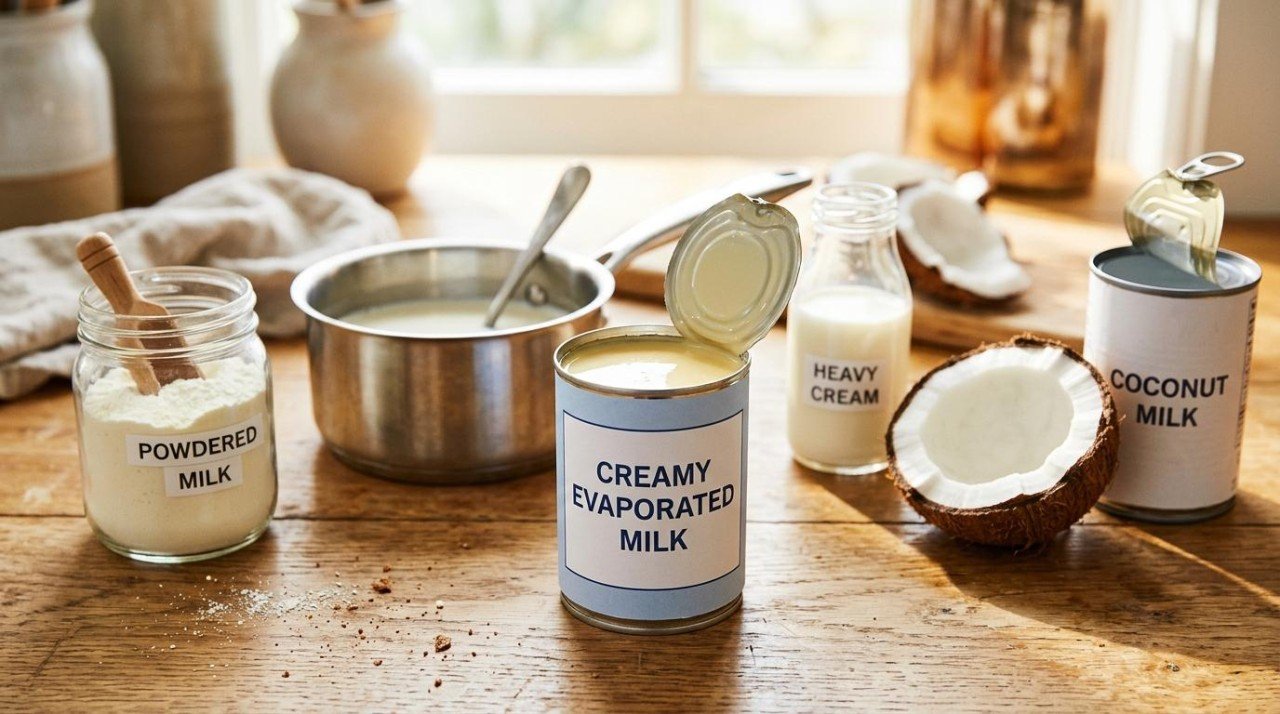
- Homemade (simmer milk down) — the closest match, made from regular milk in about 30 minutes
- Half-and-half — the easiest 1:1 swap, poured straight from the carton
- Whole milk + heavy cream — build the richness from two things you likely already have
- Powdered milk, double-strength — the shelf-stable pantry fix, mixed thicker than usual
- Canned lite coconut milk — the dairy-free stand-in that needs no cooking at all
Make Your Own (The Closest Match)
- Swap: 2 cups whole milk → 1 cup homemade evaporated milk (for a full 12-ounce can, start with about 3 cups)
- Best for: Everything evaporated milk does — pie, custards, mac and cheese, fudge, and cream soups
- Skip it for: The moment you are in a genuine rush; it takes about half an hour
- Health notes: Identical to the milk you start with, just concentrated — you control the fat by choosing whole, 2%, or skim
Because evaporated milk is literally milk with the water cooked out, you can recreate it exactly. Pour milk into a saucepan, bring it to a gentle simmer, then drop the heat to low and let it reduce by about half, stirring now and then so the milk solids do not scorch on the bottom. Expect roughly 25 to 30 minutes. Whole milk gives the richest, truest result, but 2% works too — it will just be a little thinner.
This is the swap to reach for when accuracy matters, like a pie or custard where texture is the whole point. Let it cool before adding it to a recipe, and if you want to get even closer to the canned version, simmer it a few minutes past the halfway mark, since the real thing has slightly more than half its water removed.
Half-and-Half
- Swap: 1:1 — 1 cup evaporated milk becomes 1 cup half-and-half
- Best for: Cream sauces, mac and cheese, creamy soups, mashed potatoes, and coffee-based bakes
- Skip it for: Recipes where you are watching saturated fat closely — it runs a touch richer
- Health notes: Slightly higher in fat than evaporated milk, so a little more indulgent cup for cup
If you keep half-and-half for your coffee, you already have the easiest substitute there is. Just pour it in at a straight 1:1 — no cooking, no math. At roughly 10 to 18% fat it is a shade richer than whole evaporated milk (which sits closer to 8%), so dishes come out a little more luxurious, which is rarely a complaint in mac and cheese or a cream soup. It is neutral and unsweetened, so it slots into savory and sweet recipes alike.
Whole Milk + Heavy Cream
- Swap: 1 cup evaporated milk → 3/4 cup whole milk + 1/4 cup heavy cream, stirred together
- Best for: Rich, cooked dishes — fudge, cream sauces, soups, and casseroles
- Skip it for: A lighter dish, unless you dial back the cream
- Health notes: Comparable richness to evaporated milk, with more of it coming from cream
When you do not have half-and-half but you do have milk and a carton of cream, you can build the same effect yourself — this combination is, after all, roughly what half-and-half is. Three parts milk to one part heavy cream lands close to evaporated milk's body and works cleanly at a 1:1 swap. If plain heavy cream is all you have, it will also stand in, but it is far richer, so cut it with a little water or milk first. For a lighter dish, tilt the ratio toward more milk and less cream.
Powdered Milk (Double-Strength)
- Swap: Reconstitute dry milk with about 60% of the water the package calls for, then use 1:1
- Best for: Anything cooked or baked — this is the pantry-insurance option
- Skip it for: Not much, though it shines in cooked dishes more than raw applications
- Health notes: Same nutrition as the milk it is made from, and shelf-stable for months
This is the clever one. Powdered milk turns into ordinary milk when you mix it with the full amount of water, but mix it with less water — about 60% of what the label says — and you get a thick, concentrated milk that behaves almost exactly like the canned stuff. Whisk it well to break up any lumps, and reach for it 1:1. If you keep a box of dry milk in the cupboard, you are never truly out of evaporated milk. It is the quiet hero of a well-stocked pantry.
Canned Lite Coconut Milk (Dairy-Free)
- Swap: 1:1 — one can of lite coconut milk holds about 1 3/4 cups, close to a 12-ounce can of evaporated
- Best for: Dairy-free pumpkin pie, curries, spiced bakes, and soups where a hint of coconut fits
- Skip it for: Delicate white sauces or anywhere the coconut flavor would feel out of place
- Health notes: No lactose; lite coconut milk keeps the richness lighter than the full-fat can
Canned lite coconut milk is, as the folks at Go Dairy Free put it, nature's version of evaporated milk — already concentrated, pourable, and ready with no cooking required. Use the lite can, since full-fat coconut milk is closer to heavy cream and can overwhelm a recipe. The one caveat is flavor: a mild coconut note comes along for the ride. That is a non-issue in a spiced pumpkin pie, a curry, or a coconut-friendly soup, but worth avoiding in a plain savory cream sauce.
Prefer a different dairy-free milk? Any unsweetened plant milk — soy, oat, cashew — can be simmered down by half the same way you would reduce cow's milk, giving you a neutral, evaporated-style base. Soy and oat hold up best to the heat; watch that thinner milks do not separate, and blend them smooth again if they do.
Take the Guesswork Out of Eating Well
Eat Well Planner helps you organize your favorite recipes, plan balanced meals, and automatically generate shopping lists — all in one place. Whether you're tracking macros, managing dietary restrictions, or just trying to stop asking "what's for dinner?", we've got you covered.
Our AI-powered tools can adapt any recipe to your dietary needs, help you discover new meals you'll love, and even log your nutrition effortlessly. It's meal planning made simple.
Start Organizing Your Meals — FreeThe Sweetened Condensed Milk Trap
This is the mix-up that ruins dinners, so it is worth being clear: sweetened condensed milk is not a substitute for evaporated milk. The two cans look almost identical on the shelf and sit side by side, which is exactly why people grab the wrong one.
Both start as milk with most of the water removed. The difference is sugar — and a lot of it. Sweetened condensed milk is roughly 40 to 45% sugar by weight; a single ounce carries about 20 grams of it, nearly as much sugar as a whole cup of evaporated milk contains naturally. Swap it into a savory mac and cheese or a cream soup and you will get a cloying, syrupy mess. Evaporated milk, by contrast, has no added sugar at all — it is just concentrated milk, which is the whole reason it is so easy to recreate at home. If a recipe calls for evaporated milk, reach for the unsweetened can (or one of the swaps above), and save the condensed milk for fudge, pie, and Vietnamese coffee where the sugar belongs.
A Note on the Nutrition
Evaporated milk is essentially milk with the volume turned up: a cup of the whole version has about 338 calories, 17 grams of protein, and over half a day's calcium — roughly double regular milk across the board, since it is twice as concentrated. That makes it a genuinely nutrient-dense way to add creaminess, but it also means the calories add up fast.
If you want the body without as much richness, two easy moves help: make your homemade version with 2% or skim milk, or buy fat-free or low-fat evaporated milk, which delivers the same concentrated texture with far less fat. Either way, the protein and calcium come along for the ride. It is a good reminder that a smart swap is not always about a healthier ingredient — sometimes it is just about matching the job while nudging the numbers in your favor.
Not sure which of these fits the exact recipe in front of you? That is what Eat Well Planner's AI recipe chat is built for. Pull up your recipe, tell it you are out of evaporated milk, and it will point you to the swap that suits that dish — the right dilution, the right richness, and whether a coconut note will work with the other flavors. And if you are cooking dairy-free for good, the recipe variations feature can rewrite the whole recipe with the substitutions already worked in. Match the job, make the swap, and get back to the oven.