The pie is assembled, the oven is hot, and the recipe says "brush with egg wash." Except you used your last egg in the filling. Or you are baking for someone who is vegan or allergic to eggs. Either way, you do not want a pale, matte crust that looks like it skipped the final step.
Good news: egg wash is one of the easiest things to replace, because you are not asking the substitute to hold anything together inside the dough. You are just asking it to paint the surface. The catch is that egg wash does three jobs at once — golden browning, glossy shine, and glue for seeds and sealed edges — and most substitutes are good at one or two of those, not all three.
So below, the swaps are sorted by which job they do best, each with exactly how to mix and apply it. If you only need a quick answer: brush on heavy cream or whole milk for a dairy-friendly bake, or a store-bought liquid vegan egg for an egg-free one.
The Quick List
- Heavy cream (or half-and-half) — the best all-around stand-in: golden color plus a soft sheen
- Whole milk — reliable browning on pie crust, scones, and rolls, with a light gloss
- Liquid vegan egg — the closest egg-free match for both browning and shine
- Unsweetened soy or oat milk — even, golden browning for vegan bakes, but little shine
- Aquafaba — egg-free browning that also glues on seeds and sugar
- Plant milk + maple + melted vegan butter — a vegan glaze that adds the shine plant milk alone lacks
- Maple syrup or honey wash — deep color and gloss for sweet bakes, brushed on late
- Warm apricot jam — a glossy, fruity finish for tarts, galettes, and pie crust
- Cornstarch glaze — high gloss with almost no extra color, classic on rye and lean breads
- Water — the simplest glue for sealing edges and sticking seeds to bread
- Melted butter or olive oil — flavor and a tender crust, but not much color or shine
First, What Is Your Egg Wash Doing?
An egg wash is a beaten egg, usually thinned with a splash of water, milk, or cream. Its proteins brown in the oven, its fat gives a sheen, and its stickiness holds toppings in place and seals pastry edges shut. Different recipes lean on different parts of that:
- Browning — the golden, finished look on pie crust, scones, and dinner rolls. Proteins and sugars are what brown, so substitutes that have some of either (milk, cream, plant milks, aquafaba, syrup) do this best.
- Shine — the lacquered look on challah, brioche, and bakery-style pastries. Fat and sugar drive gloss, so cream, syrup, jam, and cornstarch glazes win here.
- Glue — making sesame seeds stick to a bun, coarse sugar stick to a pie, or the edges of a hand pie or empanada stay sealed. Water, milk, and aquafaba handle this; fats are too slippery.
Pick the job that matters most for what you are making, then pick from that section. For a pie, color usually matters most. For challah, shine. For a seeded bagel, glue. And no matter which substitute you use, brush a thin, even coat and keep it from pooling or dripping down the cut sides of puff pastry and biscuits — any wash that glues those layers together will stop them from rising as tall.
Best Overall: Browning With Some Shine
These are the swaps to reach for when you just want the bake to look the way the recipe intended, without thinking too hard about it.
Heavy Cream (or Half-and-Half)
- Swap: Brush on straight from the carton, about 1 to 2 tablespoons for the top of a 9-inch double-crust pie
- Best for: Pie crusts, scones, biscuits, galettes, hand pies
- Skip it for: Vegan or dairy-free bakes, and when you want a high, lacquered shine
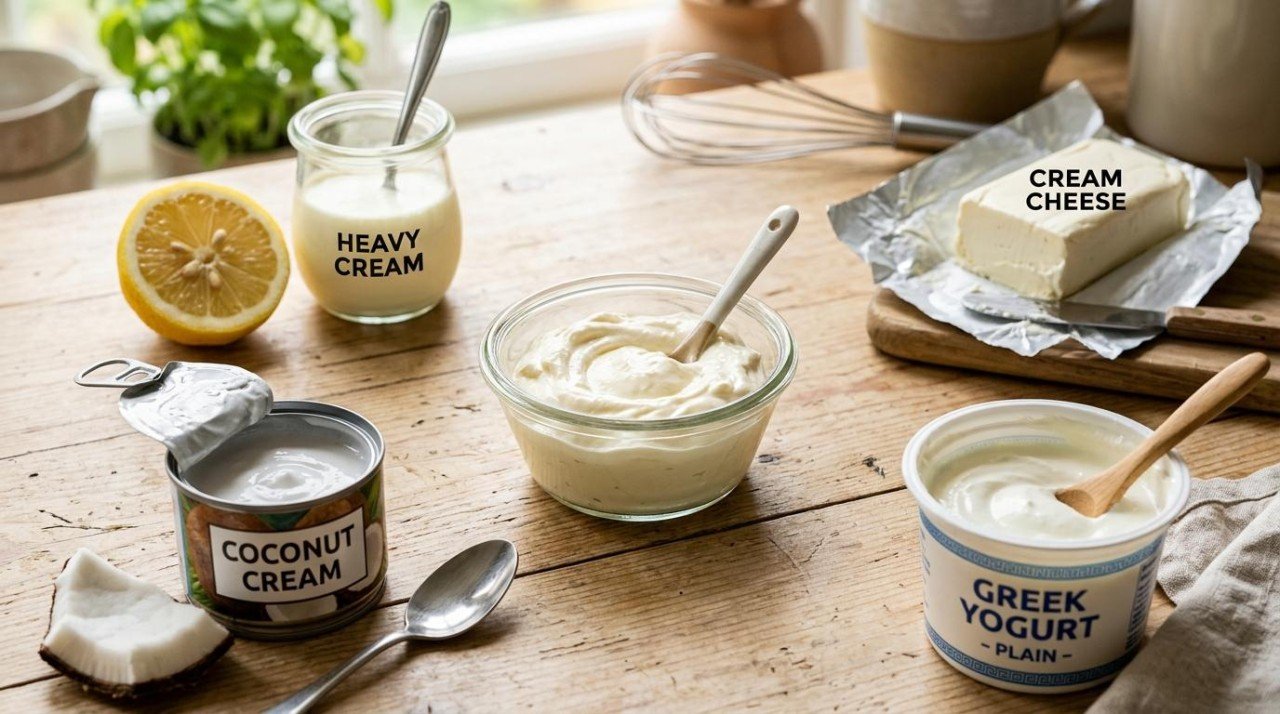
Cream is the swap many professional bakers use on purpose, not just in a pinch. King Arthur Baking editor Jessica Battilana told PureWow that she brushes milk or cream on crusts and scones instead of egg wash. Because of its fat, cream gives a light golden color that shines well. It browns a little more gently than a whole-egg wash, so you get a warm gold rather than a deep mahogany.
For a sweet bake, scatter coarse or turbinado sugar right over the cream; it sticks well and adds sparkle plus extra browning. Half-and-half works the same way with a touch less color and shine. And if you have neither, the heavy cream substitutes guide covers what to keep on hand next time.
Whole Milk
- Swap: Brush on straight, a thin coat; for sweet bakes, add a sprinkle of sugar on top for more color
- Best for: Pie crusts, scones, dinner rolls, sandwich bread, cobbler toppings
- Skip it for: Challah or brioche where a glossy finish is the whole point
Milk is the most common egg-free wash, and it does a respectable job: a lightly glossy, mid-brown finish on pie crust. Its proteins and milk sugar (lactose) are what brown, so whole milk beats skim; less fat means less sheen. It also tends to give a slightly softer crust than egg, which is welcome on rolls and scones.
If you are already out of eggs, it is worth checking whether you are low on milk too — the milk substitutes guide has the backups, several of which also work as washes.
Liquid Vegan Egg
- Swap: Shake well and brush on exactly as you would beaten egg
- Best for: Vegan or egg-free pie crust, scones, rolls, and any bake where you want it to look identical to the original
- Skip it for: Nothing in particular — just the cost and availability if you do not already keep it
When America's Test Kitchen brushed eight egg-free options onto scones, rolls, and pie dough, only one delivered both browning and shine: a mung-bean-based liquid vegan egg, which "produced results identical to regular egg wash." Their caveat is fair: different brands of egg substitutes are formulated differently, so another brand may not perform the same way.
If you bake egg-free regularly, this is the one product worth buying for the job. If you do not keep it on hand, the next two sections get you most of the way there with pantry staples.
For Golden Color Without Eggs or Dairy
These are the vegan workhorses. In the America's Test Kitchen test, plant milks and aquafaba all "created rich, even browning," but none of them produced much shine. Use them when color matters most, or pair them with a little sweetener for gloss (next section).
Unsweetened Soy or Oat Milk
- Swap: Brush on straight, a thin coat
- Best for: Vegan pie crust, scones, rolls, and savory pastries
- Skip it for: Anything that needs a glossy finish; sweetened or flavored versions on savory bakes
Soy milk is the strongest choice here, with the most protein of the common plant milks, and oat milk is close behind. Both brown evenly. Almond milk is the weak link: it is low in fat and protein, so expect only a slight, sometimes uneven browning. Use unsweetened, unflavored milk unless you are making something sweet — vanilla soy milk on an empanada is a surprise nobody wants.
Aquafaba
- Swap: 1 to 2 tablespoons liquid from a can of chickpeas, whisked for a few seconds until loose and frothy, then brushed on
- Best for: Vegan pie crust, bagels and buns with seeds, sealing vegan hand pies
- Skip it for: Shine on its own — add a little fat or syrup if you want gloss
Aquafaba is the thick, starchy liquid in a can of chickpeas, and it is the best pantry stand-in for the "glue" part of egg wash: it is just sticky enough to hold seeds and seal edges. It also browns surprisingly well. The Daily Meal's rundown of pie washes notes that it "provides a surprising amount of brownness," with limited gloss unless you add fat. For a bit more sheen, whisk in about 1/2 teaspoon of maple syrup or neutral oil per tablespoon of aquafaba.
Use the liquid from unsalted or low-sodium chickpeas if you have them, especially on sweet bakes. And keep the chickpeas: the chickpeas guide has ideas for what to do with them.
For Shine
When the gloss is the point — challah, sweet buns, fruit tarts, holiday pies — sugar and fat are what deliver it. The trade-off is that sugar browns fast, so timing matters more with this group.
Plant Milk + Maple + Melted Vegan Butter
- Swap: 1 tablespoon melted vegan butter + 1 teaspoon soy milk + 1/2 teaspoon maple syrup, stirred briskly and cooled slightly; for savory bakes, skip the maple and use 1 tablespoon melted vegan butter + 2 tablespoons plant milk
- Best for: Vegan pie crust, pastries, sweet rolls, and cinnamon buns
- Skip it for: Sticking seeds — the fat makes it slippery
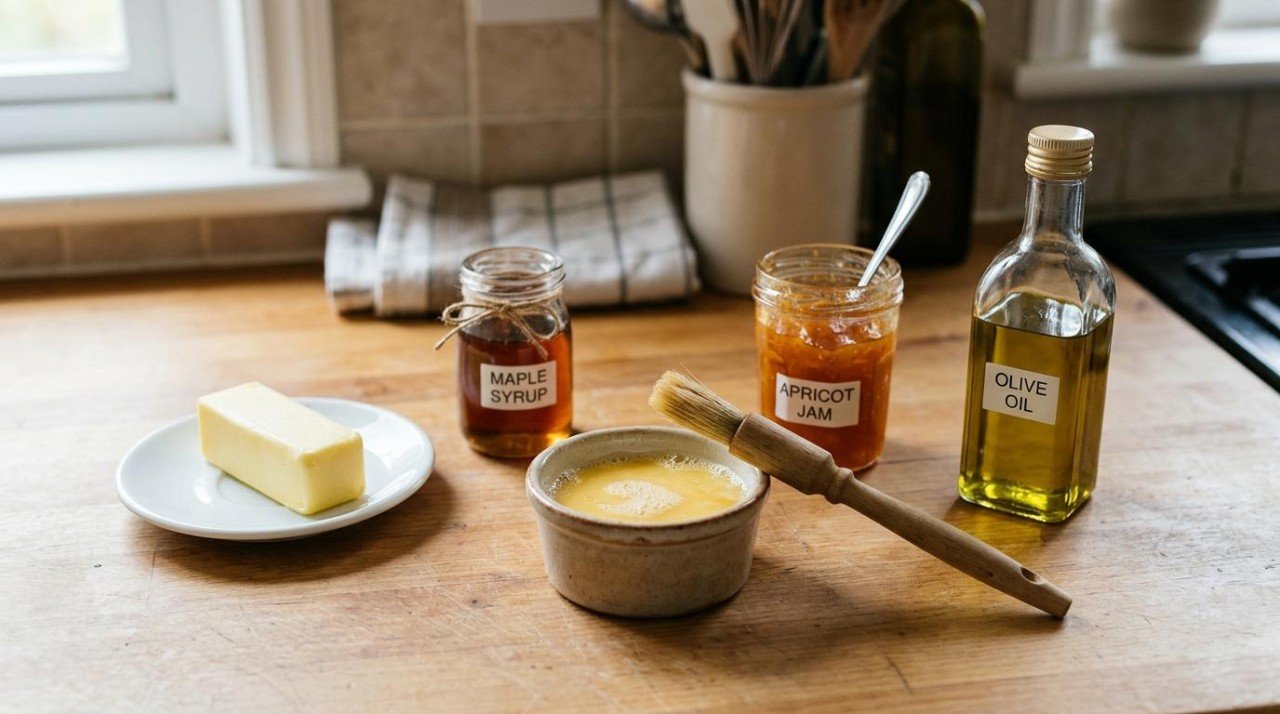
This mix covers both bases: the plant milk and maple handle browning, and the touch of sugar adds the gloss plant milk alone cannot. Stir it right before brushing, since the fat separates as it sits. One honest note: in the America's Test Kitchen test, vegan butter brushed on by itself left rolls looking "dry and matte," so do not skip the milk and syrup — they are what make this work. Refined coconut oil can stand in for the vegan butter.
Maple Syrup or Honey Wash
- Swap: 1 tablespoon maple syrup or honey + 1 tablespoon water or milk, brushed on during the last 5 to 10 minutes of baking
- Best for: Sweet rolls, challah, sweet breads, fruit pastries, granola-topped loaves
- Skip it for: Savory bakes, and brushing on at the start of a long bake
Thinned syrup gives a deep brown color and a glossy, slightly crackly finish. The catch is speed: the American Society of Baking warns that honey and maple syrup "may burn very quickly in a hot oven," and suggests using them on quick bakes or applying them near the end. Brushing it on in the final few minutes gives you all of the shine with none of the scorching. If you are low on either, see the maple syrup and honey substitute guides.
Honey is not vegan, so use maple or agave for a plant-based bake.
Warm Apricot Jam
- Swap: 2 tablespoons apricot jam + 1 to 2 teaspoons water, warmed for a few seconds until fluid (strain out fruit pieces for a smooth glaze)
- Best for: Fruit tarts and galettes (brushed on after baking), pie crust, and sealing the bottom crust of a pie
- Skip it for: Savory pastries
A warm apricot glaze is the classic finish on French fruit tarts, brushed over the fruit and crust after baking for a jewel-like shine. It also works before baking: Giada De Laurentiis uses apricot jam in place of egg wash on pie crust, because "the sugar in the spread browns just like beaten eggs" and its light color will not stain a golden crust. Brushed onto the bottom crust, its stickiness also helps the crust and filling bind.
Because jam is much higher in sugar than an egg wash, it burns more easily. If you brush it on before baking and the top darkens too fast, tent the pie loosely with foil.
Cornstarch Glaze
- Swap: 1 teaspoon cornstarch stirred into a little cold water, then mixed with water to make 1/2 cup and heated until it turns clear and slightly thick; brush on just before and again right after baking
- Best for: Rye bread, lean loaves, pretzel-style rolls, and vegan breads where you want shine
- Skip it for: Pie crust and pastries where you want golden color
This is the old deli-rye trick: a thin cornstarch paste gives bread a glassy, high-gloss crust with almost no change in color. Cornstarch glazes add a slightly crisp exterior and "super glossy" finish. Brush it on while it is warm; it thickens as it cools, so rewarm it if it turns jelly-like. It also helps caraway or sesame seeds stay put on a loaf.
For Sticking Seeds and Sealing Edges
Sometimes you do not care about color at all — you just need the sesame seeds to stay on the bagel or the hand pie to stay shut. Aquafaba (above) and plain milk both work here. So does the simplest option of all.
Water
- Swap: Brush or mist a light coat of water, then add seeds or press edges together right away
- Best for: Sealing hand pies, empanadas, turnovers, and dumplings; sticking seeds, oats, or coarse salt to lean breads and bagels
- Skip it for: Color or shine — it adds neither
A dab of water along the edge of pastry is the standard way to seal a turnover or empanada, egg or no egg. On lean bread, a light mist helps seeds cling and encourages a crisp, crackly crust. Press seeds in gently with your palm so they bed into the dough, and do it right after wetting; water dries fast. If you also want color on a sealed hand pie, seal with water, then brush the top with milk, cream, or plant milk.
One thing that does not work as glue: fats. The American Society of Baking notes that oil and melted butter are too slippery to hold seeds or nuts. Toppings slide right off.
Melted Butter or Olive Oil: Flavor, Not Color
- Swap: Brush a thin coat of melted butter or olive oil before baking, or right after for a soft crust
- Best for: Dinner rolls (after baking), phyllo, focaccia and flatbreads, savory crackers
- Skip it for: Pie crust where you want deep golden color, and anything that needs seeds to stick
Butter is the most common thing people reach for, and it is a fine choice — just for a different result. Instead of color or crispness, it offers a more luxurious flavor and softness, and it melts and runs off instead of setting. Bakes brushed only with butter tend to look paler than egg-washed ones. Where butter really shines is after baking: brushed on warm dinner rolls, it gives that soft, tender, bakery-style top.
Olive oil is the savory version, and it is the traditional finish on focaccia and many flatbreads rather than a substitute at all. For phyllo, melted butter or oil between the layers and on top is the standard method anyway. If you are out of butter too, the butter substitutes guide covers the rest.
Which Substitute for Which Bake
- Double-crust fruit pie: Heavy cream plus coarse sugar; for vegan, liquid vegan egg or the plant milk + maple mix
- Savory pot pie or quiche crust: Heavy cream or whole milk; for vegan, unsweetened soy milk or aquafaba
- Scones and biscuits: Heavy cream or whole milk, brushed on top only so the sides can still rise
- Challah and brioche: A thinned maple or honey wash in the last 5 to 10 minutes, or cream for a softer sheen
- Sesame buns and seeded bagels: Water or aquafaba for glue, milk if you want some color too
- Hand pies and empanadas: Water to seal the edges, milk, cream, or soy milk on top for color
- Fruit tarts and galettes: Cream on the crust before baking, warm apricot jam over the fruit after
- Rye and lean breads: Cornstarch glaze for shine, water mist for a crackly crust
- Dinner rolls: Milk before baking for color, melted butter after for softness
A Note on Allergies and Health
Nutritionally, an egg wash is a small thing either way. A single egg glazes more than a whole pie, and most of the substitutes above use a tablespoon or two over an entire bake, so none of these swaps will meaningfully change a recipe's nutrition. The syrup and jam glazes add a little sugar, but it is spread across the whole bake — the filling, flour, and butter in the recipe matter far more.
Where this choice really matters is allergies. The American College of Allergy, Asthma and Immunology estimates that as many as 2 percent of children are allergic to eggs. Some people with egg allergy can tolerate egg that has been baked at high heat for a long time, but there is no way to predict that, and a thin wash on the surface of a crust is easy to forget about when you are listing a dish's ingredients. If you are baking for someone with an egg allergy, remember the wash, not just the filling, and use one of the egg-free options here.
Of course, the wash is rarely the only egg in the recipe. If the dough or filling has eggs too, the guide to substitutes for eggs in baking walks through replacing them by what the egg is doing. Or skip the line-by-line adapting: Eat Well Planner can create an egg-free variation of any recipe in your recipe book, with every swap worked in, and its AI recipe chat can tell you which wash fits the exact pie or pastry you are making.
Take the Guesswork Out of Eating Well
Eat Well Planner helps you organize your favorite recipes, plan balanced meals, and automatically generate shopping lists — all in one place. Whether you're tracking macros, managing dietary restrictions, or just trying to stop asking "what's for dinner?", we've got you covered.
Our AI-powered tools can adapt any recipe to your dietary needs, help you discover new meals you'll love, and even log your nutrition effortlessly. It's meal planning made simple.
Start Organizing Your Meals — FreeWhat Not to Use
- Mayonnaise (regular or vegan) on sweet bakes: It gets suggested a lot, but in the America's Test Kitchen test vegan mayo left rolls "dry and matte" and added an unwanted flavor.
- Coconut oil on its own: Same test, same result — a matte look and a slightly greasy residue. It does help browning, but gives no shine.
- Butter or oil to hold seeds: Too slippery; use water, milk, or aquafaba.
- Syrup, honey, or sugar water at the start of a long bake: They brown fast and can burn before the inside is done. Brush them on late, or tent with foil.
- Almond milk or skim milk when color matters: Too little protein and fat to brown well. Fine in a pinch, but expect a pale crust.
- A heavy, dripping coat of anything: Pooled wash burns in spots, and wash that runs down the cut edges of puff pastry or biscuits glues the layers and stops them from rising.
The Bottom Line
For most bakes, heavy cream or whole milk is all you need, and it is the swap plenty of bakers prefer anyway. For egg-free baking, a liquid vegan egg comes closest to the real thing, soy milk or aquafaba gets you golden color from the pantry, and a little maple brings back the shine. Match the substitute to the job — color, gloss, or glue — and nobody will know the egg was missing.
And if you are staring at a specific recipe wondering which of these fits, that is exactly the kind of question the recipe chat in Eat Well Planner is built for: it reads your actual recipe and tells you what to brush on.