The vinaigrette is half whisked, the pan sauce is waiting, or the ham sandwich is open on the cutting board — and the Dijon jar in the door turns out to be a crust of dried mustard around the rim. It is one of those ingredients nobody thinks about until the moment it is missing.
Dijon does three separate jobs, which is why it is worth understanding before you swap it. It brings sharp tang, from the white wine, vinegar, water, and salt blended with brown mustard seeds to imitate the verjuice the original was made with. It brings a clean heat that climbs into your nose rather than sitting on your tongue. And it is an emulsifier — the reason a spoonful of it keeps oil and vinegar from separating in the bottom of a jar.
Which substitute is right depends entirely on which of those three jobs your recipe is hiring Dijon to do. On a sandwich, almost any mustard works. In a vinaigrette, the emulsifying matters more than the flavor. Below are the swaps that genuinely hold up, with exact ratios and the job each one is best at.
The Quick List
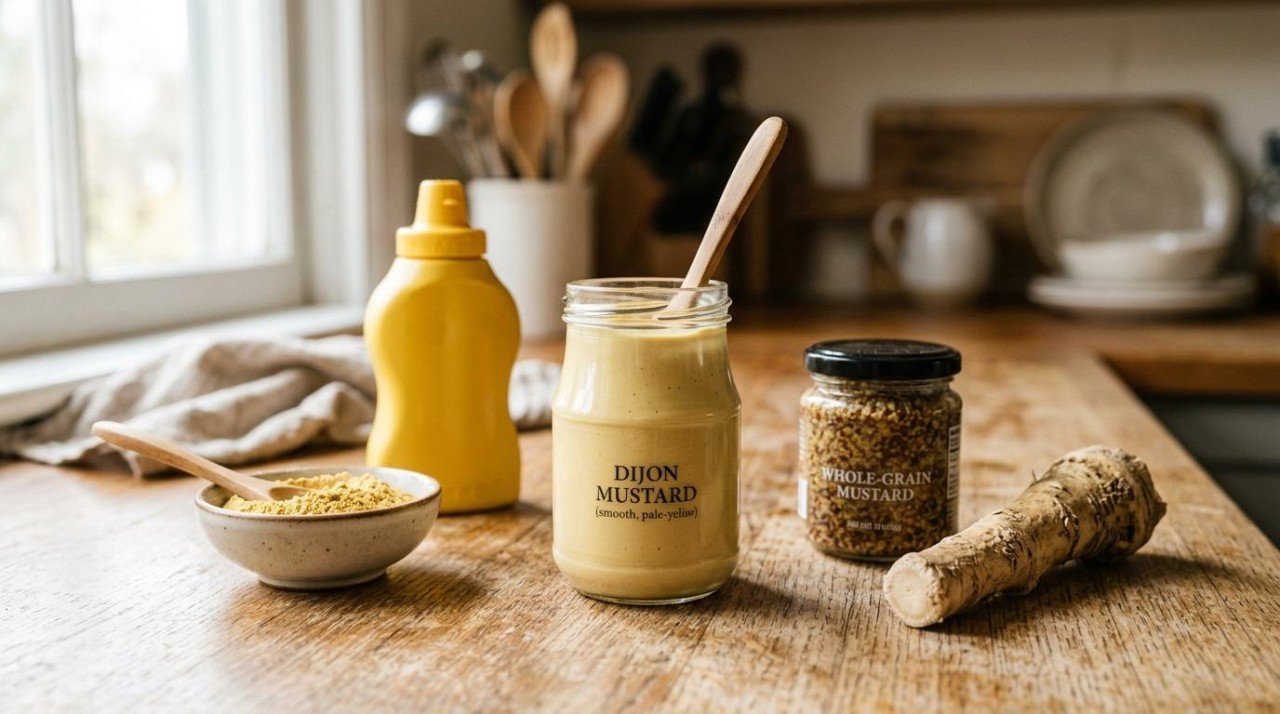
- Stone-ground (whole-grain) mustard — the closest match overall; swap it 1:1 and barely notice
- Spicy brown mustard — nails Dijon's heat; best for pan sauces, marinades, and deli sandwiches
- Yellow mustard plus a splash of vinegar — the swap most kitchens can actually make right now
- The 3-ingredient homemade version — mustard powder, mayo, and white wine vinegar; rebuilds all three jobs
- Dry mustard powder — excellent in rubs, marinades, and cooked sauces
- Mayonnaise — when the job is holding a dressing together, not flavor
- Prepared horseradish — the same nasal heat, none of the tang; use half
- Wasabi paste — heat only, in a much smaller dose
- Honey mustard — fine 1:1 if you pull back the sweetener elsewhere
Stone-Ground (Whole-Grain) Mustard
- Swap: 1:1
- Best for: Vinaigrettes, pan sauces, marinades, glazes, sandwiches — essentially everything
- Skip it for: Smooth, glossy sauces where visible seeds look out of place
This is the first jar to reach for, because it is built from the same brown mustard seeds Dijon is. The difference is the grind: many of the seeds are left whole, so the heat is gentler and arrives with a pleasant pop of texture. Everything else — the vinegar tang, the wine-adjacent depth, the seed hulls that do the emulsifying — is still there.
In a vinaigrette it still does the structural job, so your dressing comes together and holds. If the seeds bother you visually in a smooth sauce, mash the spoonful against the side of a bowl with the back of a spoon first, or buzz the finished dressing with an immersion blender.
Spicy Brown Mustard
- Swap: 1:1, tasting before you add more
- Best for: Pan sauces, marinades, meat glazes, deli sandwiches, potato salad
- Skip it for: Delicate cream sauces, or anyone at the table who is sensitive to heat
Deli-style brown mustard is also made from coarsely ground brown seeds, which gives it a speckled look and a spicier flavor than yellow mustard — and some versions have horseradish stirred in, pushing them a step past Dijon. On the heat axis it is the closest thing on the shelf.
What it has slightly less of is the wine-driven acidity that makes Dijon taste bright rather than just hot. A few drops of white wine vinegar per tablespoon closes most of that gap, which matters in a dressing and matters not at all on a pastrami sandwich.
Yellow Mustard (Plus a Splash of Vinegar)
- Swap: 1:1, plus about 1/4 teaspoon white wine vinegar and a grind of black pepper per tablespoon
- Best for: Sandwiches, deviled eggs, potato salad, coleslaw, barbecue glazes, marinades
- Skip it for: Vinaigrettes that need to hold, and pale cream sauces it would tint yellow
- Health notes: About 57 mg of sodium per teaspoon, against roughly 120 mg in a teaspoon of Grey Poupon
Yellow mustard is made from milder yellow mustard seeds, cut with a high proportion of vinegar and colored with turmeric. Next to Dijon it reads sharper but flatter — more sour, less complex, and noticeably less hot. The vinegar and pepper are not strictly necessary, but they nudge it toward Dijon's brighter, spicier register.
The one place to think twice is a dressing. Tasting Table notes that recipes often call for Dijon specifically to emulsify the oil and vinegar, and that yellow mustard carries less of the seed material that does that work, so the dressing may not emulsify properly. If that is your recipe, add a teaspoon of mayonnaise alongside it, or make the homemade version below instead.
The 3-Ingredient Homemade Dijon
- Swap: Whisk 1 tablespoon dry mustard powder, 1 1/2 tablespoons mayonnaise, and 3/4 tablespoon white wine vinegar with a pinch each of salt and sugar. Makes about 3 tablespoons; use it 1:1.
- Best for: Vinaigrettes above all, plus anywhere the mustard flavor is front and center
- Skip it for: Dry rubs and spice blends, which cannot take the extra moisture
This is the one to make when Dijon is doing all three jobs at once. The powder supplies the heat, the vinegar supplies the tang, and the mayonnaise supplies both creamy body and emulsifying muscle — and A Couple Cooks rates the result as remarkably similar to Dijon in taste tests. Use a vegan mayonnaise and the whole thing is vegan.
One technique note worth the extra ten minutes: hydrate the powder in a teaspoon of cold water first and let it sit before adding anything else. Mustard's pungency comes from an enzyme reaction that starts when ground seed meets water, and hotter liquids and stronger acids denature the enzymes responsible for it. Cold water, then a rest, then the vinegar gives you a sharper result than mixing everything at once.
Dry Mustard Powder
- Swap: 1 tablespoon Dijon → 1 teaspoon dry mustard powder plus about 2 teaspoons cold water or white wine, rested 10 minutes
- Best for: Marinades, spice rubs, cheese and cream sauces, mac and cheese, braises
- Skip it for: Sandwich spread duty — there is no body or acidity to it
Mustard powder is nothing but ground seed, which makes it the most concentrated option here and the only one that works in a dry application. Stirred into a rub or a flour dredge, it contributes a savory, faintly sinus-tickling background that most people cannot name but would miss.
Two things to remember. First, powder brings no acid at all, so in a dressing or sauce you need to add the vinegar or lemon juice the Dijon would have contributed, or the balance goes soft — our vinegar guide covers what to reach for if the white wine vinegar is missing too. Second, its heat is fragile: stirred into a simmering pan sauce it lands as gentle savory depth rather than pungency, which is often exactly what you want in a cream sauce.
Mayonnaise
- Swap: 1:1 by volume, plus 1/4 teaspoon mustard powder and 1/2 teaspoon vinegar per tablespoon if you want the flavor back
- Best for: Vinaigrettes and creamy dressings, potato and egg salad, sandwich spread
- Skip it for: Sauces that will simmer, where it can split, and any dish where the mustard flavor is the point
- Health notes: The one swap that meaningfully changes the numbers — mayonnaise runs around 90 to 100 calories a tablespoon, against roughly 5 for Dijon
Mayonnaise is the answer when Dijon was hired as an emulsifier rather than as a flavor. Egg yolks contain phospholipids that interact with both the oil layer and the water, which is what makes mayonnaise itself such a stable emulsion — and that stability transfers straight into your dressing. Most jarred mayonnaise already contains mustard, so you are borrowing a little of the flavor too.
Because it is the calorie-dense option, use it as a lever rather than a pour: a single teaspoon is usually enough to hold a quarter cup of vinaigrette together. If you are out of that as well, our guide to mayonnaise substitutes covers what else can stand in.
Prepared Horseradish
- Swap: Start with half — 1 tablespoon Dijon becomes 1 1/2 teaspoons — and taste from there
- Best for: Beef of any kind, roast beef sandwiches, steak pan sauces, potato salad, cocktail-style dressings
- Skip it for: Vinaigrettes that need structure, and delicate fish or chicken dishes
Horseradish is not a stylistic cousin of mustard so much as a chemical one. Both release allyl isothiocyanate when the plant tissue is damaged and the enzyme myrosinase acts on the compound sinigrin — the same reaction in mustard seed and horseradish root alike, and the reason both burn upward through your nose rather than across your tongue.
What horseradish does not bring is Dijon's rounded acidity or its emulsifying ability, and jarred prepared horseradish is considerably more assertive by the spoonful. Reach for the plain kind packed in vinegar rather than creamy horseradish sauce, which is mostly mayonnaise and will dilute the effect. Its heat also fades quickly with cooking, so add it late.
Wasabi Paste
- Swap: Roughly one quarter the amount, tasting as you go
- Best for: Mayo-based sauces, salmon marinades, dressings with an Asian lean
- Skip it for: Classic French dressings, and anything that should not turn green
Most tube wasabi is horseradish, mustard powder, and coloring, which is precisely why it works here — it is the same pungent chemistry in a more intense package. Mashed recommends using substantially less than the recipe calls for, since the burn is fierce but brief.
Treat it as a deliberate flavor turn rather than a stealth swap. In a soy-and-sesame dressing it is genuinely better than Dijon would be; in a French potato salad it is a different dish.
Honey Mustard
- Swap: 1:1, then cut the honey, sugar, or maple in the recipe by about the same volume
- Best for: Glazes for chicken, salmon, or pork; sandwiches; slaws
- Skip it for: Savory pan sauces and sharp vinaigrettes, where the sugar throws off the balance
- Health notes: Adds a few grams of added sugar per tablespoon
Honey mustard is usually yellow or Dijon mustard with a sweetener already stirred in, so the swap is mostly an accounting exercise: subtract elsewhere what it adds. If your recipe has no sweetener to subtract, a splash of vinegar restores some of the sharpness that gets lost.
Watch it under a broiler or in a hot pan, where the extra sugar browns faster than plain mustard would. Our honey substitutes guide is useful if you would rather build your own version with a different sweetener.
When Dijon Is Only There to Hold the Dressing Together
Plenty of vinaigrette recipes call for a teaspoon of Dijon you can barely taste. That teaspoon is structural: mustard contains mucilage, a mix of carbohydrates that acts as an emulsifier, keeping oil suspended in vinegar instead of pooling on top.
If flavor is not what you need back, you have three easy levers. A teaspoon of mayonnaise per quarter cup of dressing does the job invisibly. A teaspoon of honey adds both body and a little emulsifying help, at the cost of some sweetness. And a raw egg yolk will emulsify far more oil than a vinaigrette contains — the Caesar dressing approach — though it is worth using a pasteurized egg if raw yolk is a concern. Failing all of that, shake the dressing in a sealed jar right before it hits the salad and accept that it will separate again.
The Healthier Angle
Mustard is one of the rare ingredients where there is not much to upgrade. At around 5 calories a teaspoon with no fat and no sugar, Dijon is already one of the most efficient flavor tools in the fridge — and the honest health story here is that a mustard vinaigrette you whisk yourself is a real step up from most bottled creamy dressings, whichever mustard you build it from.
The one number worth watching is sodium, since every prepared mustard is salted. Yellow mustard runs roughly half the sodium of a typical Dijon per teaspoon, and the homemade powder-based version lets you set the salt yourself. If you are cooking with an eye on sodium, that is a swap that actually moves something — though for most recipes the bigger contributors are elsewhere, which is what our guides to soy sauce and Worcestershire sauce get into.
Take the Guesswork Out of Eating Well
Eat Well Planner helps you organize your favorite recipes, plan balanced meals, and automatically generate shopping lists — all in one place. Whether you're tracking macros, managing dietary restrictions, or just trying to stop asking "what's for dinner?", we've got you covered.
Our AI-powered tools can adapt any recipe to your dietary needs, help you discover new meals you'll love, and even log your nutrition effortlessly. It's meal planning made simple.
Start Organizing Your Meals — FreeWhat Not to Use
- Whole mustard seeds. They need long soaking to soften and grind, and dropped into a dressing they contribute neither tang nor heat — just crunch.
- Egg white as an emulsifier. The phospholipids live in the yolk. The white will foam, thin your dressing, and in a hot sauce cook into strands.
- Turmeric. It supplies the color of yellow mustard and none of its function. Prepared mustards are tinted with it, which is not the same as being made of it.
- Squeeze-bottle yellow mustard in a pale cream sauce. The flavor is workable; the color is not. It will turn a white wine sauce a distinctly ballpark shade.
- Nothing at all, in a vinaigrette. Leaving the mustard out is the one choice guaranteed to fail. A teaspoon of mayonnaise costs you almost nothing and saves the dressing.
One last thing worth knowing about the jar you do have: prepared mustard loses its pungency over time, and it holds on to it longer when kept sealed, cool, and out of the light. A Dijon that has been open in the door for a year is already a milder mustard than the label promises, which may explain why a dressing that used to have bite suddenly does not.
Not Sure Which One Fits Your Recipe?
A guide like this can tell you what each substitute does in general. What it cannot know is whether the Dijon in your recipe is there for flavor, for heat, or to keep the dressing from splitting — and that is the whole question.
That is where Eat Well Planner helps. Import the recipe you are cooking from any website, Instagram reel, or YouTube video, and its AI recipe chat can answer with your actual ingredient list in front of it: which swap fits this dish, how much of it, and what it will change. The Recipe Playground shows what a swap does to a recipe's nutrition score live, before you commit — useful when the choice is between a teaspoon of mustard and a tablespoon of mayonnaise. And if you are adapting a recipe for a dietary need rather than an empty jar, Recipe Variations will rewrite the whole thing with the substitutions already worked in.