You are mid-recipe with an empty cottage cheese tub, or you are staring at a high-protein snack you meant to make and wondering what else will do the job. Either way, cottage cheese has quietly become one of the most reached-for ingredients in the fridge again — mostly because of its protein. A single cup delivers around 24 to 28 grams of protein for only about 215 calories, which is a lot of staying power for very little.
That protein is exactly why cottage cheese is harder to swap than it looks. Plenty of things can mimic its soft, mild, slightly tangy curds — but most of them do not bring the same lean protein hit, so the best substitute depends heavily on why you are using it in the first place.
Cottage cheese really does three different jobs: it bakes into lasagna and stuffed shells, it gets eaten straight as a high-protein snack, and it blends into dips, sauces, and pancake batters. Here are the substitutes that actually work for each, with exact swaps.
The Quick List
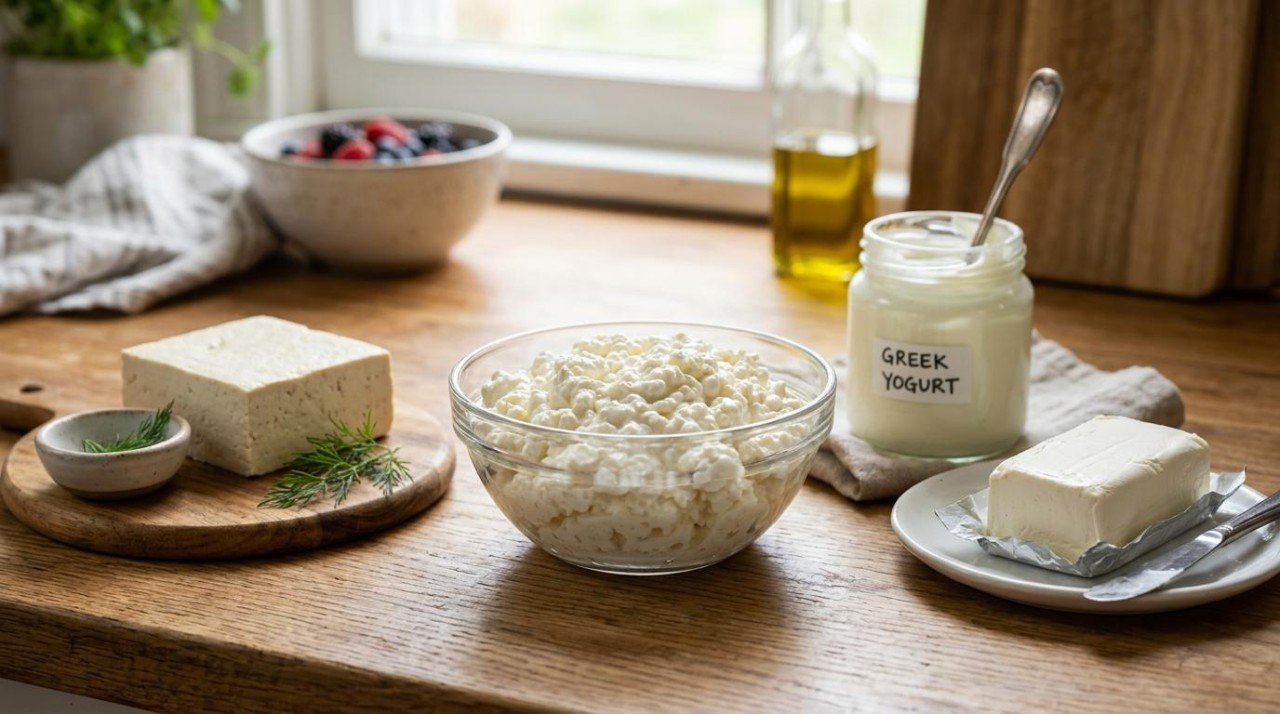
- Ricotta — the closest texture for baked dishes; richer and creamier, though higher in fat
- Plain Greek yogurt — the best everyday swap for snacking and blending, and it keeps the protein
- Skyr — the highest-protein pick when you are chasing that macro specifically
- Farmer's cheese or quark — the closest fresh-curd texture for fillings
- Crumbled firm tofu — the dairy-free stand-in for lasagna and baked pasta
- Blended silken tofu — dairy-free, glass-smooth, for dips and sauces
- Cream cheese — richer and denser, for dips and cheesecake-style fillings
- Sour cream — for dips and dressings where protein is not the point
For Lasagna, Stuffed Shells, and Baked Fillings
Here you need something with body — soft curds or a fresh-cheese texture that holds up in the oven instead of weeping into a puddle. Match the fat level too: full-fat swaps behave far better in a bake than nonfat ones.
Ricotta (The Closest Texture)
- Swap: 1 cup cottage cheese to 1 cup ricotta
- Best for: Lasagna, baked ziti, stuffed shells, manicotti
- Skip it for: A lean, high-protein snack — it is much richer
- Health notes: Whole-milk ricotta runs about double the calories and fat of cottage cheese
Ricotta and cottage cheese are near-interchangeable in baked pasta — in fact, many lasagna recipes call for a blend of the two, since ricotta brings the rich creaminess while cottage cheese lightens things up. Use it one-to-one. The trade-off is nutritional: per cup, whole-milk ricotta carries roughly 174 calories and 15 grams of fat per 100 grams versus about 98 calories and 4 grams of fat for cottage cheese. The protein is close (ricotta is actually a touch higher), so this is a richness upgrade, not a leaner one. One bonus: ricotta is much lower in sodium, so you may want to salt the dish a little more than you would with cottage cheese. If you keep a tub of cottage cheese around instead, our guide to ricotta substitutes runs this same swap in the other direction.
Farmer's Cheese or Quark
- Swap: 1 cup cottage cheese to 1 cup farmer's cheese or quark
- Best for: Fillings and pierogi, blintzes, and savory bakes
- Skip it for: Nothing much — the main hurdle is finding it
These fresh, pressed cheeses are the closest textural cousins to drained cottage cheese: mild, soft, and lightly tangy, but drier and more cohesive, which makes them excellent in fillings that you do not want to turn watery. Swap one-to-one. Quark is a bit thicker and creamier, farmer's cheese a bit firmer and crumblier, so mash in a spoonful of milk or yogurt if you want a looser, curd-like texture. The catch is availability — you will usually find them at larger or European grocers rather than every corner store.
Crumbled Firm Tofu (Dairy-Free)
- Swap: 14 oz firm or extra-firm tofu, pressed and crumbled, replaces about 1.5 cups cottage cheese
- Best for: Vegan lasagna, stuffed shells, baked pasta
- Skip it for: Snacking straight from the tub
- Health notes: Dairy-free plant protein and a point toward your weekly plant variety
Pressed and crumbled firm tofu makes a genuinely convincing ricotta- or cottage-cheese-style filling in a baked dish. Reach for firm or extra-firm tofu, not silken — silken is too thin and creamy to hold the curd. Press out the water, crumble it with a fork for a rustic curd, then season with a tablespoon of lemon juice, a couple of tablespoons of nutritional yeast, a clove of garlic, and salt. The lemon brings the tang, the nutritional yeast adds savory depth, and it bakes up beautifully inside a lasagna. If tofu tends to come out bland for you, our guide on how to cook tofu and tempeh so it actually tastes good covers the pressing and seasoning that make the difference.
For a High-Protein Snack Bowl
This is the reason cottage cheese is having a moment: a bowl of it, savory with cracked pepper and tomato or sweet with berries and honey, is a fast 20-plus grams of protein. To replace that, you want a swap that keeps the protein rather than just the creaminess — which rules out most of the richer cheeses.
Plain Greek Yogurt (The Everyday Swap)
- Swap: 1 cup cottage cheese to 1 cup plain Greek yogurt
- Best for: Snack bowls sweet or savory, breakfast, anywhere you eat cottage cheese by the spoon
- Skip it for: People who want visible curds rather than a smooth spoonful
- Health notes: Comparable protein, usually less sodium, plus gut-friendly live cultures
Plain Greek yogurt is the most natural everyday replacement: similar tang, similar protein-per-calorie, and it takes the same sweet or savory toppings. The texture is smooth rather than curdy, which most people find is an upgrade in a snack bowl. It also brings live cultures and typically less sodium than cottage cheese, which is surprisingly salty. Use whole-milk or 2% for the closest richness, and reach for a thick, strained variety — if you are unsure which tub to grab, our breakdown of Greek yogurt versus regular sorts it out.
Skyr (The Highest-Protein Pick)
- Swap: 1 cup cottage cheese to 1 cup skyr
- Best for: Maximizing protein per calorie in a snack or breakfast
- Skip it for: Hot dishes — like yogurt, it can split when boiled
- Health notes: Among the highest protein-per-calorie of any dairy
Skyr, the traditional strained Icelandic yogurt, is thicker than most Greek yogurt and exceptionally lean: a 3/4-cup serving of plain nonfat skyr delivers 19 grams of protein for just 100 calories. If cottage cheese is in your rotation specifically for the macro, skyr matches or beats it while going down smoother. It is mild and only lightly tart, so it works in both a savory bowl and a fruit-and-honey one. Swap it one-to-one anywhere you would eat cottage cheese cold.
Take the Guesswork Out of Eating Well
Eat Well Planner helps you organize your favorite recipes, plan balanced meals, and automatically generate shopping lists — all in one place. Whether you're tracking macros, managing dietary restrictions, or just trying to stop asking "what's for dinner?", we've got you covered.
Our AI-powered tools can adapt any recipe to your dietary needs, help you discover new meals you'll love, and even log your nutrition effortlessly. It's meal planning made simple.
Start Organizing Your Meals — FreeFor Dips, Sauces, and Pancake or Baked Batters
Blended cottage cheese has become a go-to base for high-protein dips, pasta sauces, and pancake and baked-goods batters, precisely because it disappears into a smooth, tangy, protein-rich cream once you run it through a blender. To replace it, you want something that blends glass-smooth — the curds are irrelevant here.
Blended Greek Yogurt
- Swap: 1 cup cottage cheese to 1 cup Greek yogurt
- Best for: Dips, dressings, pancake and muffin batters, no-cook sauces
- Skip it for: A hard simmer — it can curdle over high heat
- Health notes: Keeps the protein; adds tang
Greek yogurt is already smooth, so it skips the blending step entirely and drops straight into dips, dressings, and batters at a one-to-one ratio. It reads a little tangier than blended cottage cheese, which is usually a plus in a dip and easy to balance in a batter. The one rule: if it is going into a hot sauce, stir it in off the heat or over the lowest flame and do not let it boil, or it will split — the same behavior it shares with sour cream.
Blended Silken Tofu (Dairy-Free)
- Swap: 1 cup cottage cheese to 1 cup silken tofu, blended
- Best for: Dairy-free dips, creamy sauces, smoothies, baked batters
- Skip it for: Anything that needs curds or structure
- Health notes: Plant-based; lower protein than the dairy options but adds plant variety
Here is where silken tofu shines, exactly the opposite of the baked-filling section. Its soft, custardy body blends into a completely smooth cream with no dairy at all, making it a great base for a dairy-free dip, pasta sauce, or protein-boosted smoothie. Blend it with a squeeze of lemon and a pinch of salt to wake it up. It brings less protein than cottage cheese or yogurt, so it is a texture-and-plant swap rather than a protein one — but it is the cleanest dairy-free route to that same smooth, creamy base.
Cream Cheese
- Swap: Replace up to half the cottage cheese with softened cream cheese
- Best for: Richer dips and cheesecake-style fillings
- Skip it for: When you are after the protein or a lighter dish
- Health notes: Much higher in fat, much lower in protein
Cream cheese is denser and far richer than cottage cheese, so it is best as a partial swap that adds body to a dip or sets a no-bake cheesecake filling. Soften it to room temperature and beat in a spoonful of milk or yogurt to loosen it toward a blended-cottage-cheese consistency. Just know you are trading up on fat and down on protein — this is a richness move, not a healthier one.
What to Skip
- Silken tofu in a baked filling. It is too wet and structureless to stand in for curds in a lasagna — save it for blending. Use pressed firm tofu for bakes.
- Nonfat cheeses in a long bake. Without some fat, cottage cheese swaps weep water and turn grainy in the oven. Go full- or reduced-fat for baked dishes.
- Mozzarella or other melting cheeses as a one-to-one swap. They melt into stretchy strings rather than a soft, curd-like layer — a completely different job.
- Regular yogurt in place of the protein. Unstrained yogurt is thinner and much lower in protein than cottage cheese, Greek yogurt, or skyr; it will water down a filling and miss the macro.
Which One Fits Your Recipe?
A guide like this gives you the general rules, but the honest answer to "what should I use instead?" always depends on the exact dish in front of you — which is what Eat Well Planner's AI recipe chat is built for. Pull up your recipe, ask what to swap the cottage cheese for, and it answers for that dish specifically, not in the abstract. Cooking it dairy-free? The app can rewrite the whole recipe as a variation with the tofu or plant-based swaps already worked in.
And since most people reach for cottage cheese for the protein, it helps to see what a swap actually does to a recipe before you commit. Eat Well Planner's nutrition score and Make It Healthier tools verify the real nutritional change — whether a swap keeps the protein, cuts the calories, or trades one for the other — so you are never guessing whether the healthier-sounding choice is actually the better one. Sometimes running out of an ingredient is how you find a better version of the dish.