The sauce is simmering, the stir-fry is nearly done, and you reach for the cornstarch — empty box. Do not panic and do not let the pan overcook. Cornstarch is one of the easiest pantry staples to work around, because almost every kitchen has something else that thickens.
The catch is that cornstarch does three pretty different jobs. It thickens savory sauces and gravies, it sets fruit pie fillings, and it crisps up fried coatings. A swap that is perfect for one of those can be mediocre at another — arrowroot makes a gorgeous clear fruit glaze but turns slimy in a dairy sauce, and flour thickens a gravy just fine but would make a soggy coating. So the best pick depends on what you are making.
Below are the substitutes that genuinely work, ordered from most versatile to most specialized, each with an exact ratio and honest notes on where it shines and where it falls apart. One technique note up front, since it applies to nearly all of them: whisk the starch into a little cold water first to make a smooth slurry, stir it into the hot liquid near the end of cooking, and bring it to a gentle simmer to activate — never dump dry starch straight into a hot pot, or it clumps.
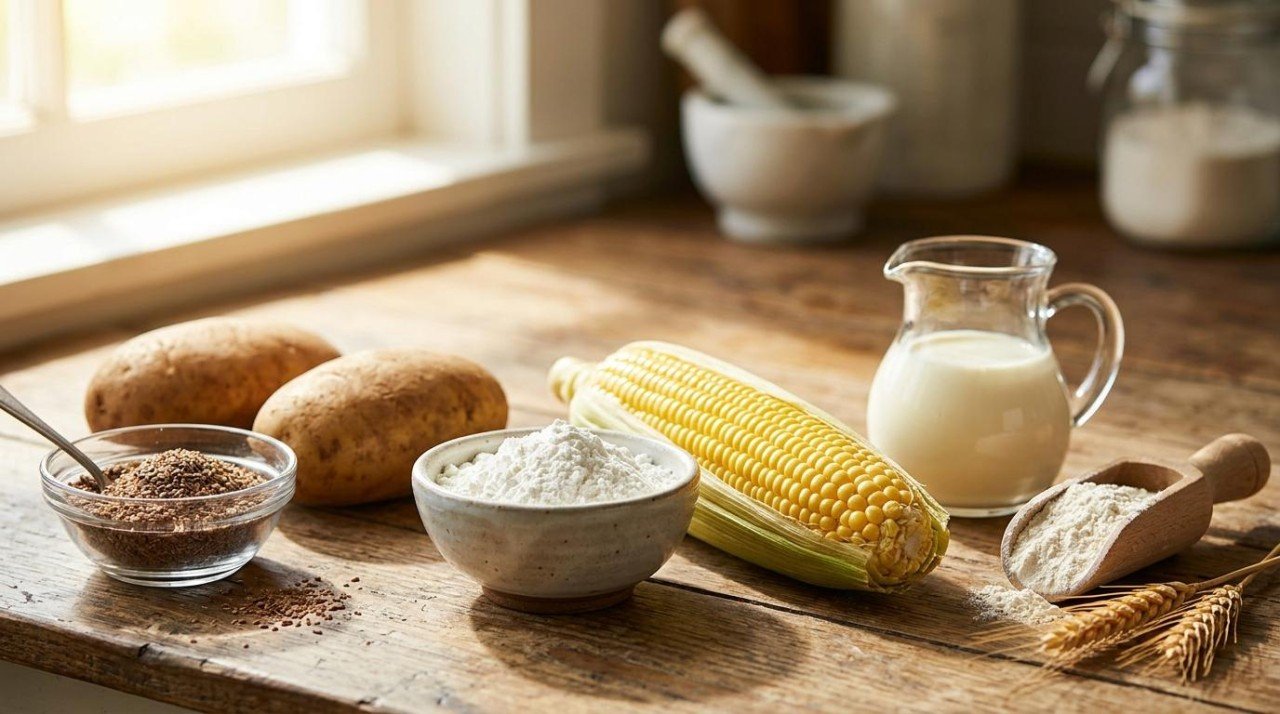
The Quick List
- Arrowroot powder — clear, glossy sauces; the best pick for acidic and freezer-bound dishes
- Tapioca starch — glossy fruit pie fillings that freeze well
- Potato starch — a clean 1:1 swap for gravies and soups; add it late
- Rice flour — the secret to extra-crispy fried coatings; also thickens clear liquids
- All-purpose flour — the almost-always-on-hand backup for hearty, opaque sauces
- Xanthan or guar gum — a tiny pinch thickens; great for low-carb and no-cook sauces
- Ground flaxseed — a rustic, fiber-rich thickener for smoothies and hearty dishes
- Glucomannan or psyllium — near-zero-carb pure-fiber thickeners; use sparingly
Which One for Which Job
If you just need the answer and are standing over a hot pan, here is the fast lookup:
- Savory gravy or stew: potato starch (1:1), or flour if that is all you have
- Clear, glossy stir-fry sauce or glaze: arrowroot or tapioca
- Acidic sauce (citrus, tomato, wine, fruit): arrowroot — it holds up where cornstarch weakens
- Dairy sauce, custard, or pudding: flour or potato starch — keep arrowroot and tapioca out, they turn slick with milk
- Fruit pie filling: quick-cooking tapioca or arrowroot
- Anything headed for the freezer: tapioca or arrowroot — cornstarch weeps and turns spongy after freezing
- Crispy fried coating: rice flour or potato starch
- Low-carb or keto: xanthan gum or glucomannan, a pinch at a time
Arrowroot Powder
- Swap: Start with 2 teaspoons arrowroot for every 1 tablespoon of cornstarch, and add a little more if the sauce stays thin (juicy fruit fillings can take up to an equal tablespoon)
- Best for: Clear, glossy sauces and glazes, acidic sauces, and anything you plan to freeze
- Skip it for: Dairy sauces, custards, and puddings (it turns slimy with milk), and dishes held at a hard, long boil
- Health notes: Gluten-free, with a little more fiber than cornstarch
Arrowroot is the closest all-around stand-in for cornstarch and is better than it in two specific ways. It stays perfectly clear and glossy, and it keeps its grip in acidic mixtures like citrus curds and fruit glazes, where cornstarch tends to thin out. It also survives the freezer far more gracefully — a cornstarch-thickened sauce often separates or weeps once thawed, while arrowroot holds together. The two things to remember: do not pair it with milk or cream, where it can go stringy and slick, and stir it in at the very end, because prolonged high heat breaks it back down to a thin liquid.
Tapioca Starch
- Swap: About 2 tablespoons tapioca starch (also sold as tapioca flour) for every 1 tablespoon of cornstarch
- Best for: Glossy fruit pie fillings and fillings destined for the freezer
- Skip it for: Sauces you want opaque and matte, and dairy custards, where it can turn gummy or stringy if overused
- Health notes: Gluten-free; nutritionally very close to cornstarch
Tapioca comes from the cassava root and gives a bright, glossy, almost jewel-like finish, which is exactly why it is a favorite for fruit pies. Like arrowroot, it holds up to freezing better than cornstarch does, so it is the smart choice for a pie you will bake later. For pie fillings, reach for quick-cooking (also called instant) tapioca and let the filling rest 15 to 30 minutes before baking so the granules soften — skip that step and you can end up with hard little beads in the filling. A light hand is key: too much tapioca turns a sauce stretchy and gummy.
Potato Starch
- Swap: 1:1 — use the same amount as the cornstarch called for
- Best for: Gravies, soups, and clear Asian-style sauces; its flavor is completely neutral
- Skip it for: Long, hard boiling — it thickens fast but breaks down if cooked too long
- Health notes: Gluten-free; a refined starch much like cornstarch
Potato starch is the easiest swap to eyeball because it goes in one-for-one. It has strong thickening power and a clean, neutral taste, which makes it a natural in gravies and soups. The one rule: add it toward the end and pull the pot off the heat as soon as it thickens. Potato starch does not like a prolonged boil — hold it there too long and the sauce can thin back out. Do not confuse it with potato flour, which is a heavier, cooked product and is not a straight substitute.
Rice Flour
- Swap: About 2 tablespoons rice flour for every 1 tablespoon of cornstarch
- Best for: Extra-crispy fried coatings (tempura, fried chicken) and thickening clear liquids
- Skip it for: Silky-smooth sauces if you only have brown rice flour, which can taste gritty in quantity
- Health notes: Naturally gluten-free
Rice flour is the substitute that steps in for cornstarch's crunchier job: dredging and battering fried foods. Cornstarch and rice flour both fry up lighter and crispier than wheat flour, and rice flour holds that crunch well even after the food cools. As a thickener it stays colorless in liquid and works in both hot and cold applications. Use white or sweet (glutinous) rice flour for the smoothest result — brown rice flour brings more nutrition but a slightly sandy texture if you lean on it heavily.
All-Purpose Flour
- Swap: About 2 tablespoons flour for every 1 tablespoon of cornstarch (roughly double, since flour has less pure starch)
- Best for: Hearty, opaque sauces — gravies, stews, and anything built on a roux
- Skip it for: Clear or glossy results (it turns cloudy), gluten-free cooking, and quick fixes
- Health notes: Contains gluten; brings a little protein and fiber along with the starch
All-purpose flour is the one almost everyone already has, which makes it the reliable backup even though it is not the most elegant. Because it is only part starch, you need about twice as much as cornstarch, and you have to cook it longer — a couple of minutes at a simmer at least — to lose the raw, pasty flour taste. It leaves sauces opaque rather than clear, which is a downside for a stir-fry glaze but a non-issue for a country gravy. For the full breakdown of flour swaps in the other direction, see our guide to substitutes for all-purpose flour.
Lower-Carb and Higher-Fiber Options
Here is the honest part: cornstarch and its closest cousins — arrowroot, tapioca, potato starch, rice flour — are all refined starches with nearly identical nutrition (roughly 30 calories and next to no fiber per tablespoon). Swapping one for another does not change the nutrition of your dish in any meaningful way. If you actually want a thickener that adds something, these are the ones that do, whether you are eating low-carb or just want more fiber on the plate.
Xanthan Gum and Guar Gum
- Swap: Tiny amounts — start with a scant 1/4 to 1/2 teaspoon per 1 tablespoon of cornstarch and add more only if needed
- Best for: Low-carb and gluten-free cooking, salad dressings, and no-cook sauces (they thicken without heat)
- Skip it for: Anywhere you might overshoot — too much turns a sauce slimy fast, and it is hard to undo
- Health notes: Soluble fiber, negligible digestible carbs; large amounts can upset some stomachs
Xanthan and guar gum are wildly more powerful than starch — a pinch does the work of a spoonful of cornstarch, and they thicken cold liquids without any cooking, which is why they are staples in dressings and keto sauces. That potency is also the trap: add a hair too much and the texture turns slick and snotty, with no easy fix. Sprinkle it in gradually, whisking hard, and stop the moment it looks right.
Ground Flaxseed
- Swap: About 1 tablespoon ground flaxseed whisked with 4 tablespoons water to replace roughly 2 tablespoons of cornstarch
- Best for: Smoothies, oatmeal, and rustic, hearty dishes where a little texture and nutty flavor is welcome
- Skip it for: Clear, smooth sauces — it adds color, speckles, and a slightly gritty body
- Health notes: A genuine upgrade: soluble fiber plus plant-based omega-3 (ALA)
Ground flaxseed will never pass for cornstarch in a delicate sauce, but in the right dish it thickens while actually contributing something — soluble fiber and omega-3 fats you would not get otherwise. Whisk it with water, let it sit a minute to gel, and stir it into soups, smoothies, or a pot of chili. Expect a rustic result rather than a glossy one, and lean on it where a little nutty, wholesome texture belongs. For why that soluble fiber matters, see our look at the two kinds of fiber most people underuse.
Glucomannan and Psyllium Husk
- Swap: Very little — about 1/4 teaspoon glucomannan (konjac) to replace 2 teaspoons of cornstarch; start psyllium at 1/2 teaspoon and adjust
- Best for: Very low-carb and keto cooking; glucomannan makes a clear, odorless gel
- Skip it for: Any recipe where a light hand is hard — both clump and over-thicken easily
- Health notes: Essentially pure soluble fiber with near-zero net carbs; glucomannan is a prebiotic
These are the specialist picks for keto and very low-carb kitchens. Glucomannan, milled from the konjac root, is almost pure fiber and thickens into a clear, flavorless gel using a fraction of a teaspoon — mix it with cold liquid first, because it seizes on contact with hot water. Psyllium husk works similarly and is another soluble-fiber powerhouse. Both are potent enough that a heavy hand ruins the dish, so measure in small pinches.
Take the Guesswork Out of Eating Well
Eat Well Planner helps you organize your favorite recipes, plan balanced meals, and automatically generate shopping lists — all in one place. Whether you're tracking macros, managing dietary restrictions, or just trying to stop asking "what's for dinner?", we've got you covered.
Our AI-powered tools can adapt any recipe to your dietary needs, help you discover new meals you'll love, and even log your nutrition effortlessly. It's meal planning made simple.
Start Organizing Your Meals — FreeNo-Starch Ways to Thicken
Sometimes the best swap is no thickener at all. A few whole-food methods add body and nutrition at the same time:
- Simmer and reduce. Just letting a sauce or soup bubble uncovered evaporates water and concentrates it — no starch required. It takes longer, but the flavor deepens too.
- Puree in vegetables or beans. Blending a ladle of the soup with some of its vegetables, or stirring in mashed white beans or a cooked potato, thickens a pot while adding fiber, protein, and plant variety. It is a great way to earn a few extra plants toward the week.
- Stir in a spoon of dairy. A little Greek yogurt or sour cream (off the heat, so it does not split) thickens and enriches a sauce while adding protein.
What Not to Use
A couple of swaps look tempting but backfire:
- Do not use arrowroot or tapioca in a dairy sauce. Both can turn milk and cream slick and stringy. For a cream sauce or pudding, reach for flour or potato starch instead.
- Do not boil starch-thickened sauces hard for a long time. Arrowroot, potato starch, and cornstarch itself all lose their grip under a prolonged, rolling boil. Thicken near the end and ease off the heat.
- Do not dump any starch dry into hot liquid. It seizes into lumps that will not whisk out. Always make a cold-water slurry first.
- Do not overdo the gums. Xanthan, guar, glucomannan, and psyllium are so strong that an extra quarter-teaspoon can turn dinner into slime. Start smaller than you think.
The through-line with cornstarch is the same as with any ingredient that quietly does several jobs: match the swap to the task, not just the name. Figure out whether you are thickening a savory sauce, setting a fruit filling, or crisping a coating — and whether dairy, acid, or the freezer is in the picture — then grab the substitute that handles that exact situation well.
Not sure which one fits the recipe in front of you? That is exactly what Eat Well Planner's AI recipe chat is for. Pull up your recipe, tell it you are out of cornstarch, and it will recommend the swap that suits that dish — accounting for whether there is milk, acid, or a trip to the freezer involved — with the ingredients and method already in view. And if you would rather thicken with real food, the nutrition tools can show you exactly what pureeing in a handful of vegetables does to the dish. Match the job, make the swap, and get back to cooking.