You are halfway through a recipe and the bacon is gone, or you are trying to eat a little less of it. Either way, the fix depends on understanding what bacon actually does for a dish. It does three jobs at once: it adds smoke, it adds salt and savory depth, and it adds crispy, fatty texture. Almost nothing nails all three, so the best substitute depends on which job your recipe leans on most.
A BLT needs the crisp. Carbonara needs the salty pork fat. A pot of beans just needs the smoky background hum. Match the substitute to the job and nobody will miss the bacon.
Here are the swaps that actually work, most versatile first, with exact amounts and what each one is (and is not) good for.
The quick list
- Smoked paprika — bacon's smoky flavor with no meat; best stirred into beans, soups, and roasts
- Pancetta or guanciale — the closest cured-pork stand-in for pasta like carbonara
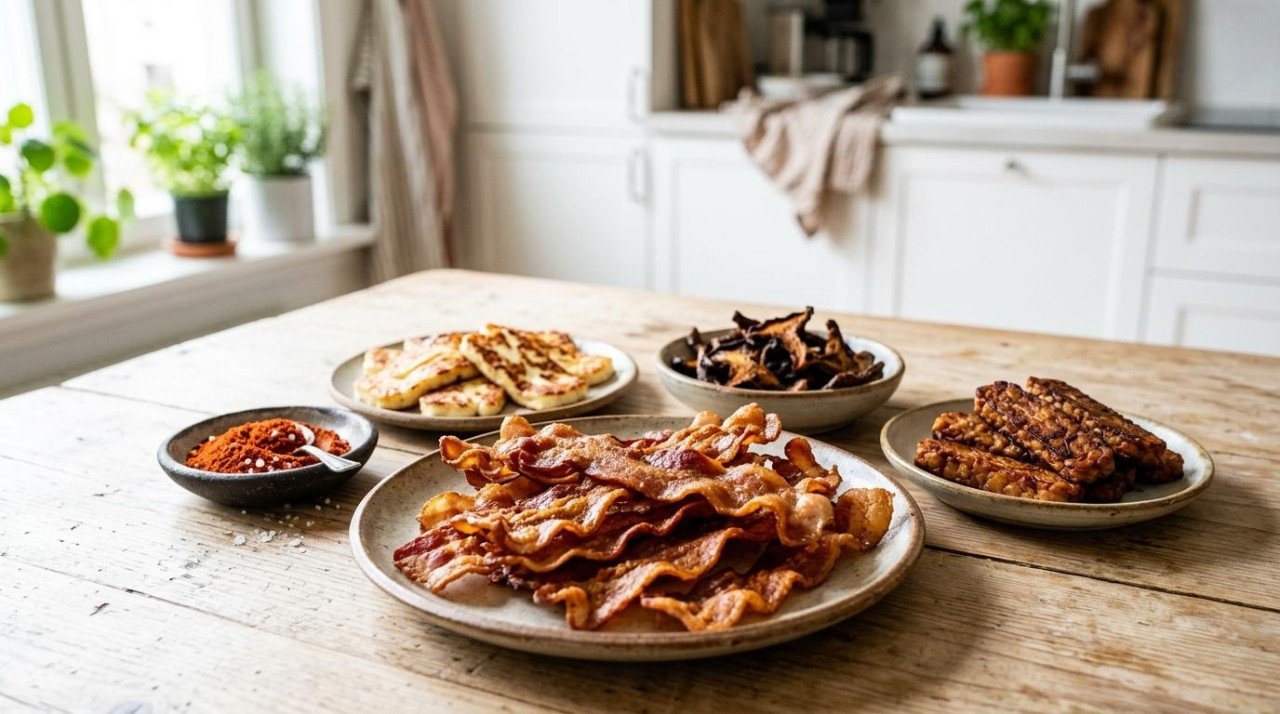
- Turkey bacon — the like-for-like strip for BLTs and breakfast, leaner but saltier
- Mushroom bacon — crispy, smoky, savory, and plant-based; a great salad and sandwich topper
- Tempeh bacon — high-protein plant strips for BLTs and breakfast plates
- Halloumi — salty, crisp-edged, holds its shape; a sandwich and salad substitute
- Coconut bacon — crunchy smoky-salty flakes for sprinkling over salads and soups
- Liquid smoke — pure smoke flavor, a few drops at a time, for marinades and braises
Smoked paprika
- Swap: 1/2 to 1 teaspoon smoked paprika per dish, plus a pinch of salt and a little oil or butter
- Best for: Beans, lentils, soups, chowders, greens, roasted vegetables, spice rubs, dips
- Skip it for: Anywhere you need crispy texture or an actual strip of something
- Health notes: Plant-based, essentially calorie-free, and adds no sodium of its own
When people say they miss bacon in a dish, what they usually miss is the smoke. Smoked paprika (pimenton) delivers exactly that, because the peppers are smoked over oak before grinding. Stir it into a pot of beans or a lentil soup with a knob of butter or a glug of olive oil and a little salt, and you get bacon's smoky, savory backbone without the meat.
It does nothing for texture, so this is a flavor swap, not a topping. If you want the salty edge too, reach for smoked salt or pair the paprika with a splash of soy sauce for umami. Start with the smaller amount and taste, since smoked paprika can turn bitter if you overdo it.
Pancetta or guanciale
- Swap: Equal weight, 1:1 for bacon; use a little less added salt in the recipe
- Best for: Carbonara, amatriciana, pasta sauces, sauteing into greens, wrapping
- Skip it for: BLTs if you want smokiness (these are cured, not smoked) and any low-sodium goal
These are bacon's Italian cousins, and for classic pasta they are arguably the correct ingredient. Guanciale (cured pork cheek) is the traditional choice for carbonara and amatriciana; pancetta (cured pork belly) is easier to find and works just as well. Both are cured but not smoked, so they bring the salty, porky richness rather than the smoke. Prosciutto crisps up beautifully too and makes a delicate, salty topper for salads and eggs.
Be honest with yourself on the health front: these are still cured, processed pork, so they carry the same salt and saturated fat that regular bacon does. Swap them in for flavor and authenticity, not as a lighter choice.
Turkey bacon
- Swap: 1:1, strip for strip; cook in a touch of oil since it has less fat to render
- Best for: BLTs, breakfast plates, sandwiches, anywhere you want a familiar strip
- Skip it for: Rendering fat into a sauce, and cutting back on sodium
- Health notes: Fewer calories and less than half the saturated fat, but more sodium
Turkey bacon is the honest like-for-like, and it is genuinely leaner: per 2-ounce serving it runs about 218 calories and 14 grams of fat versus pork bacon's 268 calories and 22 grams, with roughly half the saturated fat (4 grams versus 8). Where the marketing gets ahead of the facts is sodium: that same serving of turkey bacon carries more than 1,900 milligrams of sodium, compared with around 1,300 for pork. It is also still a processed meat, so it is a leaner swap, not a health food.
Because it has less fat, turkey bacon does not crisp the way pork does. Cook it in a lightly oiled pan over medium heat and give it a minute longer than you think to get those crisp edges.
Mushroom bacon
- Swap: Thin-slice shiitake or king oyster mushrooms; toss with 1 tablespoon olive oil, 1 tablespoon soy sauce, 1/2 teaspoon smoked paprika, and 1 teaspoon maple syrup, then roast at 375 degrees F for 15 to 20 minutes until crisp
- Best for: BLTs, salads, grain bowls, pasta toppers, anywhere you want a crispy savory bite
- Skip it for: Situations where you need chewy, fatty pork richness
- Health notes: Low calorie, adds fiber, and counts toward your weekly plant variety
This is the plant-based swap that surprises people. Thinly sliced mushrooms crisp up in the oven into salty, smoky, deeply savory shards, and the marinade does the work: soy sauce for salt and umami, smoked paprika for the smoke, olive oil to crisp, and a little maple syrup for the touch of sweetness bacon has. Shiitake and king oyster hold up best; watch them closely near the end, as they go from crisp to burnt fast.
It will not fool anyone into thinking it is pork, but on a BLT or scattered over a salad it hits the same crispy-salty-smoky notes for a fraction of the saturated fat, and it adds fiber and a point toward eating a wider range of plants each week.
Tempeh bacon
- Swap: Thin-slice tempeh; marinate 15 minutes in 1 tablespoon soy sauce, 1 teaspoon maple syrup, 1/2 teaspoon smoked paprika, and a few drops of liquid smoke, then pan-fry until browned and crisp at the edges
- Best for: BLTs, breakfast plates, sandwiches, wraps
- Skip it for: Anyone avoiding soy, and dishes that need melting fat
- Health notes: High in protein and fiber, made from fermented whole soybeans
Tempeh is the substitute to reach for when you want plant-based strips with real substance on the plate. It is firm, nutty, and high in protein, and because it is made from fermented whole soybeans it brings fiber and gut-friendly benefits that no bacon can. The marinade is the same idea as mushroom bacon: salt, smoke, and a hint of sweet.
It is firmer and drier than pork, so slice it thin and do not skip the oil in the pan. A quick steam before marinating mellows any bitterness if you are sensitive to it.
Halloumi
- Swap: Slice 1/4 inch thick and pan-fry 2 to 3 minutes per side until golden; add smoked paprika for smokiness
- Best for: Sandwiches, burgers, salad toppers, breakfast plates
- Skip it for: Smoky flavor on its own, and low-sodium cooking
Halloumi has an unusually high melting point, so instead of oozing it develops a crisp, golden crust while staying firm inside, giving you that salty, crisp-edged bite bacon brings to a sandwich or salad. It is naturally very salty, which is exactly why it works here, but it brings no smoke, so a dusting of smoked paprika in the pan closes the gap.
Nutritionally it is a trade rather than a clear win: halloumi adds protein and calcium but is high in saturated fat and sodium, so treat it like the salty accent it is rather than piling it on.
Coconut bacon
- Swap: Toss 1 1/2 cups flaked (not shredded) coconut with 1 tablespoon soy sauce, 1 teaspoon maple syrup, 1/2 teaspoon smoked paprika, and 1/4 teaspoon liquid smoke; bake at 325 degrees F for 12 to 15 minutes, stirring often
- Best for: A crunchy topping on salads, soups, baked potatoes, and avocado toast
- Skip it for: Strips, sandwiches, or anything you need to hold together
Coconut bacon is purely a garnish, but as a garnish it is fantastic: crispy, smoky, salty, and a little sweet, perfect scattered over a salad or a bowl of soup for crunch. Use large coconut flakes rather than fine shredded coconut so they crisp instead of burn, and stir often near the end since the sugars scorch quickly.
Coconut is high in saturated fat, so this is a sprinkle-it-on topping, not a pile-it-high one. A little goes a long way, which is fine, because a little is all you need.
Liquid smoke
- Swap: 1/4 teaspoon (or just a few drops) stirred into a whole dish; add more only after tasting
- Best for: Beans, chili, braises, barbecue sauces, and boosting the plant-based bacons above
- Skip it for: Salt, texture, or crunch; this is smoke flavor and nothing else
Liquid smoke is real smoke condensed into water, so a tiny amount delivers the campfire depth bacon lends to a pot of beans or a chili. It is potent to the point of being easy to ruin a dish with, so measure by the drop and build up slowly. Pair it with a little salt and fat and you have replicated bacon's flavor contribution to a braise without any meat at all.
Take the Guesswork Out of Eating Well
Eat Well Planner helps you organize your favorite recipes, plan balanced meals, and automatically generate shopping lists — all in one place. Whether you're tracking macros, managing dietary restrictions, or just trying to stop asking "what's for dinner?", we've got you covered.
Our AI-powered tools can adapt any recipe to your dietary needs, help you discover new meals you'll love, and even log your nutrition effortlessly. It's meal planning made simple.
Start Organizing Your Meals — FreeWhich substitute for which dish
Because bacon does different jobs in different recipes, here is the fast answer by dish:
- BLT or breakfast strips: turkey bacon, halloumi, tempeh bacon, or mushroom bacon
- Carbonara and pasta: pancetta or guanciale; for meat-free, crisped mushrooms plus a little Parmesan for the salty, savory hit
- Salad or soup topper (for crunch): mushroom bacon, coconut bacon, or crisped chickpeas
- Beans, greens, chili, and stews (for depth): smoked paprika plus a little fat and salt, a few drops of liquid smoke, or a Parmesan rind simmered in the pot
What not to use
Plain deli ham or Canadian bacon can stand in for pork flavor in a pinch, but they bring no smoke and no crisp, so they will not save a BLT. Artificial bacon bits (the shelf-stable kind) are fine as an occasional sprinkle and are usually meat-free, but they are ultra-processed and very salty, so they are a topping, not a cooking ingredient. And do not expect any single swap to do all three of bacon's jobs at once, which is why smoky plus salty plus crispy often means combining two of these, like mushrooms crisped with smoked paprika.
Let the app match the swap to your recipe
A guide like this gives you the general rules, but the right substitute really does depend on the specific dish in front of you. In Eat Well Planner, you can pull up any recipe and ask the AI recipe chat something like "I am making this and I am out of bacon, what should I use?" and it will suggest a swap that fits that exact dish, with the amounts adjusted for your servings.
If you are leaning toward the plant-based options to eat a little less processed meat, the app's Make It Healthier tool proposes swaps like these and verifies the actual nutritional change before you commit, and mushrooms, tempeh, and other plants count toward your weekly Plant Points for gut health. Keep the smoky, salty, crispy payoff you love, and let the app handle which version fits what you are cooking tonight.