You are elbow-deep in a recipe, reach for the flour, and the bag is empty — or nearly. Before you abandon the whole plan, take a breath: all-purpose flour is one of the easier staples to work around, as long as you match the swap to the job.
And that is the catch. All-purpose flour is a quiet multitasker. It builds structure in cakes and bread, it thickens gravy and pan sauces, and it coats chicken and fish before they hit the pan. A flour that stands in perfectly for one of those jobs can flop at another — cornstarch thickens a sauce better than flour but makes a terrible loaf of bread, and almond flour that shines in a cookie will turn a roux into greasy sludge.
So the right pick depends entirely on what you are making. Below, the substitutes are grouped by the three jobs flour does — baking, thickening, and breading — with exact ratios and honest notes on where each one works and where it falls apart.
The Quick List
- Bread flour — the closest 1:1 swap for most baking, just a little chewier
- Cake flour — great for tender cakes and muffins, too weak for bread
- Self-rising flour — 1:1 if you cut the recipe's baking powder and salt
- Whole wheat flour — the everyday healthier swap; start with half, add a splash more liquid
- White whole wheat flour — all the fiber of whole wheat, milder flavor and lighter color
- Oat flour — blend rolled oats; gluten-free and best as a partial swap
- Gluten-free 1:1 baking blend — the reliable answer for true gluten-free baking
- Almond flour — for denser bakes only, and never a straight 1:1
- Coconut flour — extremely absorbent; use a fraction of the amount plus extra eggs
- Cornstarch — for thickening sauces and gravy (half as much as flour)
- Arrowroot, tapioca, or potato starch — other pure starches for thickening
For Baking: Other Wheat Flours
In baking, flour is doing structural work. Its protein forms gluten, the stretchy network that traps gas and gives bread its chew and cake its crumb. The trick with any baking swap is matching that protein level: too much and a cake turns tough, too little and a loaf collapses. All-purpose sits right in the middle (around 10 to 12% protein), which is exactly why it is so versatile — and why the closest swaps are simply other wheat flours nudged up or down from that midpoint.
Bread Flour
- Swap: 1:1
- Best for: Bread, pizza dough, pretzels, bagels, and most everyday baking
- Skip it for: Delicate, tender cakes where you want a soft crumb
Bread flour is the nearest stand-in for all-purpose because it is the same kind of flour with a touch more protein — King Arthur's runs about 12.7% versus 11.7% for their all-purpose. Swap it one-for-one and most things will turn out beautifully, just with a bit more chew and a slightly tighter crumb. That extra gluten is a bonus in anything you want structured and springy, and only a drawback in fragile cakes, where it can read as a little tough. Because bread flour drinks up a touch more liquid, add a teaspoon or two of water if the dough feels stiff.
Cake Flour
- Swap: Use it 1:1 only in tender bakes — do not use it where you need structure
- Best for: Cakes, cupcakes, muffins, and soft cookies you want extra tender
- Skip it for: Bread, pizza, and anything that needs to be chewy or hold its shape
Cake flour is the low-protein end of the spectrum (around 10%), milled extra-fine to make especially soft, fine-crumbed cakes. That makes it a swap that only works in one direction: it is lovely in tender bakes, but it does not have the gluten to support a chewy or structured one. King Arthur warns that dropping cake flour straight into an all-purpose recipe can leave you with a sunken cake or cookies that fall apart. So treat this as your friend for cakes and muffins, and reach elsewhere for bread.
Self-Rising Flour
- Swap: 1:1, but omit about 1 1/2 teaspoons baking powder and 1/4 teaspoon salt per cup from the recipe
- Best for: Biscuits, pancakes, muffins, and quick breads that already use baking powder
- Skip it for: Yeast breads and anything where you do not want added lift or salt
Self-rising flour is just all-purpose flour with baking powder and salt already mixed in — about 1 1/2 teaspoons of baking powder and 1/4 teaspoon of salt per cup. So you can swap it in one-for-one, as long as you subtract that leavening and salt from the rest of the recipe to avoid a bitter, over-risen result. It is a natural fit for anything chemically leavened, like biscuits or pancakes. Leave it out of yeast breads, where the extra baking powder just gets in the way.
Healthier Swaps for Baking
If you are not strictly out of flour but want a more nourishing bake, this is where the real upgrades live. Whole-grain flours keep the bran and germ that refined white flour strips away, which is where most of the fiber, along with extra minerals and B vitamins, actually lives. Whole wheat flour carries about 10.7 grams of fiber per 100 grams against roughly 2.7 grams in white flour — close to four times as much. The honest trade-off is texture and flavor, which is why the smart move is usually a partial swap rather than an all-or-nothing one.
Whole Wheat Flour
- Swap: Start by replacing half the all-purpose flour; add 2 teaspoons extra liquid per cup swapped
- Best for: Bread, muffins, pancakes, and quick breads with a hearty character
- Skip it for: Delicate white cakes and pastries where a fine, pale crumb is the point
- Health notes: Close to four times the fiber of white flour, plus more minerals and B vitamins
Whole wheat flour is the everyday fiber upgrade, but it behaves differently: the bran soaks up more moisture and cuts through gluten strands, so a straight 100% swap can bake up dense and dry. King Arthur recommends starting at 50% and adding about 2 teaspoons of extra liquid for every cup of whole wheat you sub in, then letting the batter or dough rest so the bran can hydrate. Once you like the result, you can nudge the ratio higher. For more ways to work whole grains into your cooking, see our guide to the whole grains you are probably missing.
White Whole Wheat Flour
- Swap: Same as whole wheat — start around half and add a splash more liquid, though many bakes tolerate a higher proportion
- Best for: Sneaking whole grains into lighter-colored, milder bakes for picky eaters
- Health notes: Nutritionally a whole grain, with the same fiber advantage as regular whole wheat
White whole wheat flour is not a bleached or refined product — it is milled from a lighter, naturally milder variety of wheat, so it is still 100% whole grain with all the fiber, just paler in color and gentler in flavor. That makes it the easiest way to slip whole grains past skeptics, since it disappears into muffins and sandwich bread far more quietly than the assertive, nutty taste of standard whole wheat. You can often push the substitution past half before anyone notices.
Oat Flour
- Swap: About 1 1/4 cups oat flour per 1 cup all-purpose (it is lighter); best as a partial swap of around 25%
- Best for: Cookies, pancakes, muffins, and quick breads with a soft, tender texture
- Skip it for: Yeast breads and anything that needs to stretch and rise tall
- Health notes: Adds soluble fiber (beta-glucan) linked to lower cholesterol; naturally gluten-free if certified
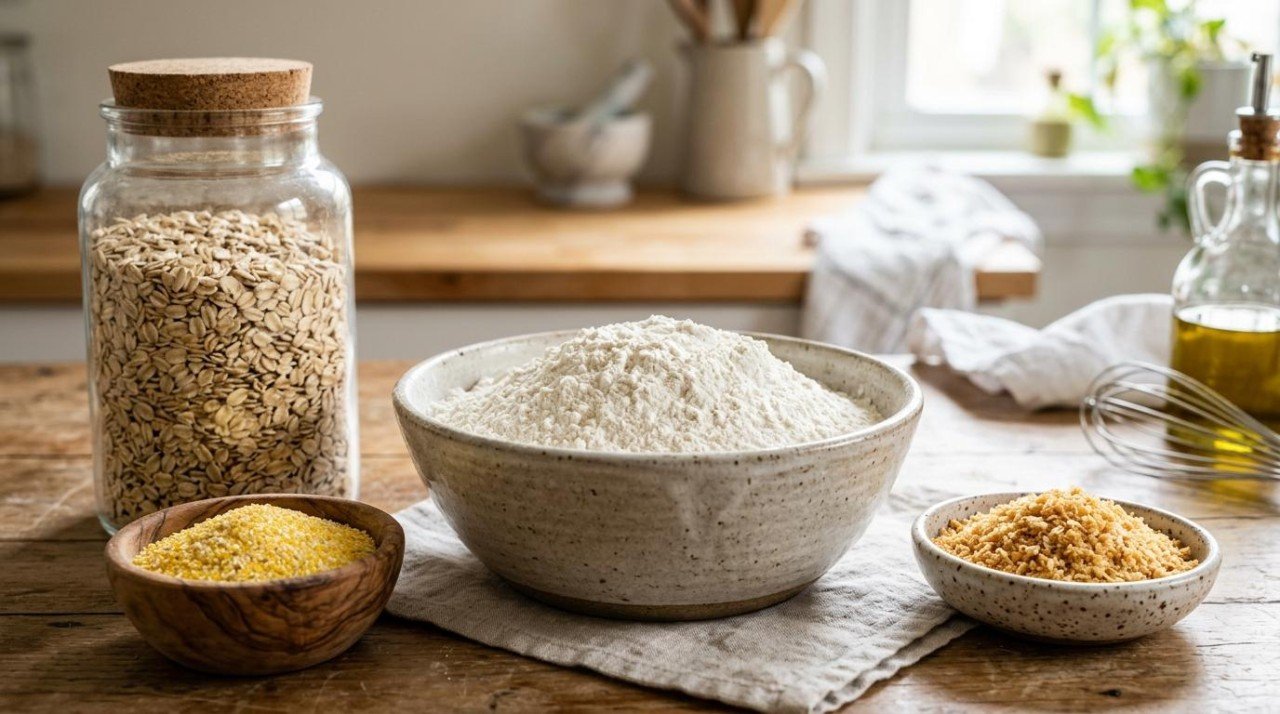
Oat flour is the swap you can make from what is already in the cupboard: blitz rolled oats in a blender or food processor for 30 seconds to a minute until they turn to a fine powder. Because oats have no gluten, a full swap tends to bake up crumbly, so it shines as a partial replacement (start around a quarter of the flour) or in forgiving recipes like cookies and pancakes. It weighs less than wheat flour cup for cup, so you need a bit more by volume — roughly 1 1/4 cups oat flour for each cup of all-purpose. Use certified gluten-free oats if that matters for your kitchen.
Take the Guesswork Out of Eating Well
Eat Well Planner helps you organize your favorite recipes, plan balanced meals, and automatically generate shopping lists — all in one place. Whether you're tracking macros, managing dietary restrictions, or just trying to stop asking "what's for dinner?", we've got you covered.
Our AI-powered tools can adapt any recipe to your dietary needs, help you discover new meals you'll love, and even log your nutrition effortlessly. It's meal planning made simple.
Start Organizing Your Meals — FreeGluten-Free Options
Going gluten-free is where flour swaps get genuinely tricky, because gluten is the very thing you are removing — and it is what held everything together. One option is built to solve that; the other two are wonderful flours that need very different handling and cannot be dropped in one-for-one.
Gluten-Free 1:1 Baking Blend
- Swap: 1:1, by design (look for blends labeled "measure for measure" or "cup for cup")
- Best for: Most recipes originally written for all-purpose flour — cookies, cakes, muffins, quick breads
- Skip it for: Artisan yeast breads that need a strong gluten network (use a dedicated gluten-free bread recipe instead)
If you actually need to bake without gluten, a pre-mixed 1:1 blend is the most reliable route by far. These combine several gluten-free flours and starches with xanthan gum (the binder that mimics gluten's stretch), and they are formulated to swap straight into standard recipes. They are not magic in every application — dedicated yeast breads still do best with a recipe built for them — but for the great majority of everyday baking they are the closest thing to a true one-for-one gluten-free flour.
Almond Flour
- Swap: Not 1:1. Best in recipes designed for it; when experimenting, add an extra egg for binding and expect a denser result
- Best for: Cookies, brownies, muffins, and pancakes with a moist, tender, cake-like crumb
- Skip it for: Bread and anything that needs to rise tall or hold a defined shape
- Health notes: Adds protein, healthy fats, vitamin E, and fiber, with fewer carbs than wheat flour
Almond flour is finely ground almonds, which means it is a nut, not a grain — no gluten, no starch, and a lot of fat and moisture. It bakes up rich and tender, but it cannot build structure on its own, so results turn out denser and more fragile. Do not treat it as a straight swap: it works best in recipes actually written for it, and when adapting a wheat recipe you will usually need an extra egg to bind and less added liquid to compensate for its natural moisture. Great in a brownie; a poor choice for a sandwich loaf.
Coconut Flour
- Swap: Never 1:1. Use only about 1/4 to 1/3 cup coconut flour per 1 cup all-purpose, and add extra eggs and liquid
- Best for: Recipes specifically developed for coconut flour
- Skip it for: Any straight substitution — it will wreck a recipe if you treat it like wheat flour
- Health notes: Very high in fiber and low in carbs, but demands a lot of eggs to work
Coconut flour deserves a clear warning, because it behaves like almost nothing else in the kitchen: it is astonishingly absorbent, soaking up roughly four times its weight in liquid. Dump in a cup where a recipe wanted a cup of wheat flour and you will get a dry, crumbly brick. It needs only a fraction of the volume — about a quarter to a third as much — plus a generous number of eggs (often around six eggs and a cup of liquid per cup of coconut flour) to hold together. Honestly, the safest approach is to find a recipe built around coconut flour rather than trying to convert one.
For Thickening Sauces and Gravy
When flour thickens a gravy, pan sauce, or fruit pie, only its starch is doing the work — the protein is irrelevant. That is good news, because pure starches thicken more efficiently than flour, do not leave a raw-flour taste, and often turn out glossier. The general rule: use about half as much pure starch as you would flour. Whisk it into a little cold water first to make a slurry (never straight into hot liquid, or it clumps), and stir it in near the end.
Cornstarch
- Swap: 1 tablespoon cornstarch for every 2 tablespoons of flour
- Best for: Gravies, pan sauces, stir-fries, fruit pies, and puddings
- Skip it for: Recipes you will boil hard for a long time, which can thin it back out
Cornstarch is the go-to flour swap for thickening, with about twice the thickening power, so you use half as much. It gives a clear, glossy finish that is perfect for stir-fry sauces and fruit pies, and it skips the pasty raw-flour flavor. Mix it with an equal splash of cold water into a smooth slurry, stir it in toward the end of cooking, and let it come to a gentle simmer to activate — then ease off the heat, since prolonged hard boiling can break down its thickening.
Arrowroot, Tapioca, or Potato Starch
- Swap: Roughly 1 tablespoon for every 2 tablespoons of flour (a hair more tapioca if your sauce stays thin)
- Best for: Arrowroot and tapioca for clear, glossy, acidic sauces and fruit fillings; potato starch for gravies
- Skip it for: Dairy-heavy sauces (arrowroot can turn slimy) and long, hard boils (potato starch loses its grip)
These pure starches all thicken at roughly double flour's strength, so the same half-as-much rule applies. Arrowroot and tapioca give a beautifully clear, glossy set and tolerate acidic ingredients better than cornstarch, which makes them favorites for fruit fillings — just keep arrowroot away from milk and cream, where it can go unpleasantly slimy. Potato starch is a great neutral thickener for gravies but wants to be added late and pulled off the heat as soon as it thickens. As with cornstarch, make a cold slurry first.
For Breading and Dredging
When flour coats chicken, fish, or vegetables before frying, it is there to give the surface something to crisp. Plenty of things do that job — some even better than flour.
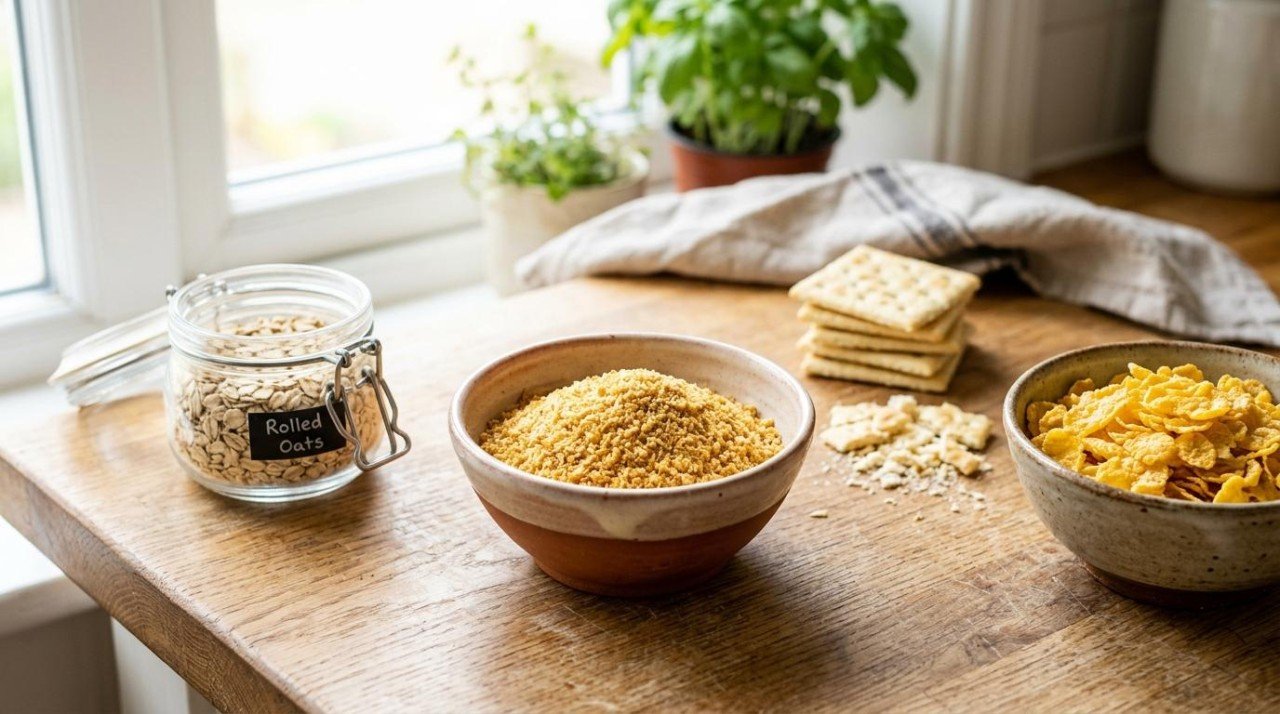
- Cornstarch or rice flour — swap in an equal amount for an extra-crisp, light coating (this is the secret behind a lot of fried chicken and tempura). Also naturally gluten-free.
- Gluten-free 1:1 blend — dredges just like regular flour, one-for-one.
- Fine cornmeal or semolina — an equal-amount swap for a coarser, crunchier crust, great on fish.
- Breadcrumbs or panko — for a thick, craggy crust, use them in place of flour (or after an egg dip) for serious crunch.
What Not to Use
A few swaps look tempting but backfire:
- Do not drop almond or coconut flour 1:1 into a wheat-flour recipe. They have no gluten and behave nothing like all-purpose — coconut flour especially will turn a batter to paste. Use them only as directed above, or in recipes written for them.
- Do not thicken a sauce with a nut or coconut flour. Thickening comes from starch, which these do not have. You will get grit and grease, not a smooth sauce.
- Do not use cake or pastry flour for bread or pizza. There is not enough protein to build the gluten those doughs need, so they bake up weak and flat.
- Do not forget to remove the leavening when using self-rising flour. Leaving the recipe's baking powder and salt in on top of what is already in the flour makes for a bitter, over-puffed result.
The through-line for flour is the same as for any ingredient that quietly does several jobs: match the task, not just the name. Figure out whether the flour is building structure, thickening a sauce, or crisping a coating, then pick the swap that does that one job well — the right protein level for the crumb, the right starch for the gravy, the right crunch for the crust.
Not sure which of these fits the exact recipe in front of you? That is precisely what Eat Well Planner's AI recipe chat is for. Pull up your recipe, tell it you are out of flour or want a whole-grain version, and it will recommend the substitute that suits that dish, with the ingredients and method already in view. If you need a full gluten-free or higher-fiber rewrite, the Recipe Variations feature can rework the whole recipe with the swaps built in — and Make It Healthier will suggest upgrades like whole wheat or oat flour and verify the real nutritional gain before you commit. Match the job, make the swap, and get back to cooking.