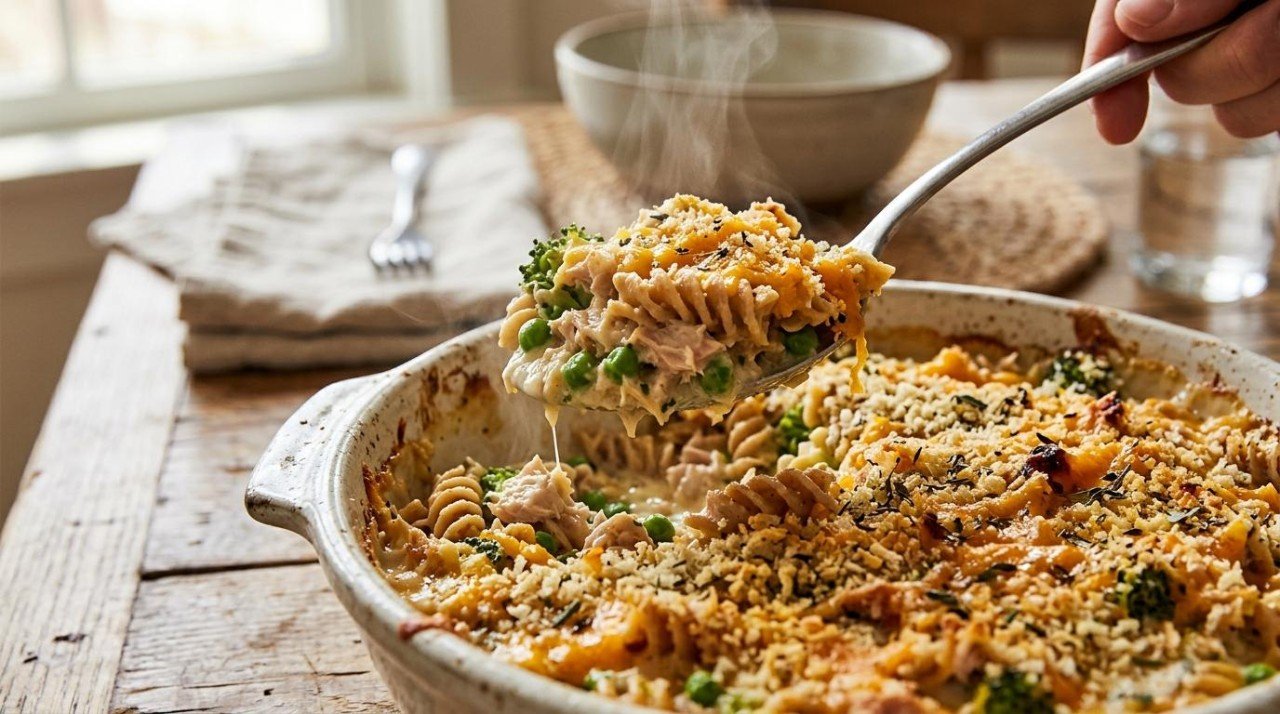
Tuna noodle casserole is one of those dinners that tastes like a warm kitchen on a weeknight. It is cheap, it comes together from the pantry, it feeds a crowd, and it reheats into next-day lunch without complaint. The classic build is almost a reflex: boil egg noodles, stir in a can of cream-of-mushroom soup, fold in canned tuna and a handful of peas, top with crushed chips, and bake until it bubbles.
So we ran that exact version through Eat Well Planner's Nutrition Score, the same at-a-glance number a visitor sees on any public recipe page. It came back 60 out of 100 — honestly, higher than a casserole built on canned soup and potato chips has any right to score. The reason is the tuna, and we will get to why that one ingredient carries so much weight.
Here is the good news: we kept it a creamy, cheesy, crunchy-topped tuna noodle casserole, and still got it to 86 out of 100. That is a 26-point jump, and every swap below carries the real, verified score change it earned. Same comfort, much better numbers.
The original: what's in it and how it scores
Here is the standard version we scored, for six people:
- 12 oz egg noodles
- 1 can (10.5 oz) condensed cream of mushroom soup
- 3/4 cup whole milk
- 10 oz canned tuna in water, drained (about three 5-oz cans)
- 1 cup frozen peas
- 1 cup shredded cheddar cheese
- 1 cup crushed potato chips
- 1 tablespoon butter
- 1/2 teaspoon salt
Nutrition Score: 60/100. Now the diagnosis, because knowing why it scores that way is what lets you fix your own recipes. Per serving, the original runs about 487 calories, 25 g protein, 6.9 g saturated fat, 800 mg sodium, and 3.9 g fiber. Three things drag it down:
- Sodium is high — about 800 mg per serving, roughly a third of a day's worth, and most of it walks in through the can of condensed soup and the chips. The American Heart Association puts the daily ceiling at 2,300 mg, ideally closer to 1,500 mg, so one bowl spends a big chunk before you salt anything yourself.
- Almost no plants. The plant-diversity score is essentially rock bottom — one plant on the whole plate (the peas), with the mushrooms hidden inside a can. This is a dish built from noodles, dairy, fish, and a salty crunch, with barely a vegetable in sight.
- Refined, low-fiber noodles. White egg noodles bring 3.9 g of fiber for the whole serving. Refined grains have had the bran and germ stripped out, which removes most of the fiber, vitamin E, and much of the B vitamins along with them.
Saturated fat also lands in the "high" zone at about 30% of a day's value, though it is not the runaway problem you might expect — it comes from a modest amount of cheese and the fat in the soup, not a stick of butter.
What is already fine, and worth keeping? A lot, and it is almost entirely the tuna. Canned tuna makes this a genuinely excellent source of vitamin B12 (nearly two days' worth per serving), niacin, and iron, and it delivers a real dose of the omega-3 fats EPA and DHA — about 43% of the daily target in one bowl. The American Heart Association recommends two servings of fish a week precisely for those fats, and a tuna casserole quietly knocks out one of them. That micronutrient payload is why the original starts at 60 instead of the 30s. We are not here to gut a dish that already does something right. We are here to fix the three things holding it back without touching what makes it dinner.
The upgrades
Three swaps do the heavy lifting, ordered from the biggest, easiest win down. If you only make one change, make the first one.
1. Ditch the canned soup for a quick homemade mushroom sauce
- Swap: 1 can condensed cream of mushroom soup → a 10-minute sauce of butter, flour, milk, broth, and real mushrooms
- Score impact: +9 points (60 → 69)
- What it changes: Cuts sodium from about 800 mg to 480 mg per serving, and takes the plant count from 1 to 3
- What it costs you: About ten minutes and one extra pan. The sauce is creamier and tastes more of actual mushrooms
The can of soup is the single biggest source of sodium in the dish, and it is doing a job you can do better in ten minutes. A quick white sauce — melt butter, soften a pile of sliced mushrooms and a little garlic, stir in flour, then whisk in milk and low-sodium broth until it thickens — gives you the same silky, creamy binder with a fraction of the salt, because you control every grain of it. You also get real mushrooms instead of the ghost of them, which is where two of those new plant points come from. If you want that classic canned-soup richness with less fat than heavy cream, evaporated milk is a great base for the sauce; our evaporated milk substitutes guide has the ratios.
One honest note: saturated fat ticks up very slightly here, because the sauce uses butter and a little more cheese-friendly body than the soup did. It is a small move, and the sodium you cut is worth far more to the score than the fraction of a gram of saturated fat you add back.
2. Switch to whole wheat noodles
- Swap: White egg noodles → whole wheat egg noodles (or any short whole wheat pasta)
- Score impact: +8 points (69 → 77)
- What it changes: Nearly doubles the fiber, from 4.1 g to 8 g per serving, and adds B vitamins and minerals
- What it costs you: A slightly nuttier, heartier noodle — buried in a creamy sauce, most people never notice
This is the quietest high-impact swap in the whole makeover. Whole wheat noodles keep the bran and germ that refined noodles throw away, which is where the fiber, the B vitamins, and a chunk of the minerals live. That fiber does real work: it slows the breakdown of starch into glucose for steadier blood sugar, helps lower cholesterol, and keeps digestion moving. In a casserole, the texture cost is close to zero — the noodles are soft, sauced, and baked, so the heartier bite disappears into the dish. If your family is chip-sensitive to whole wheat, this is the easiest place to sneak it past them.
3. Double the peas and add broccoli
- Swap: 1 cup peas → 2 cups peas plus 2 cups chopped broccoli
- Score impact: +9 points (77 → 86)
- What it changes: Pushes fiber to 10.3 g per serving, protein to about 28 g, and vitamin C from a trace to 61% of the daily value
- What it costs you: A little chopping — and the casserole is more colorful and satisfying for it
This is where the casserole stops being beige. Doubling the peas and folding in a couple of cups of broccoli is the move that erased the "low plant diversity" flag entirely and turned the dish into a genuine source of vitamin C, which a tuna casserole normally has no source for at all. Broccoli and peas both bring fiber and folate, and they bulk out the dish so each serving is more food for roughly the same calories. Cut the broccoli small so it tucks between the noodles and cooks through in the oven, and add it to the boiling pasta for the last two minutes so it starts tender rather than raw.
Take the Guesswork Out of Eating Well
Eat Well Planner helps you organize your favorite recipes, plan balanced meals, and automatically generate shopping lists — all in one place. Whether you're tracking macros, managing dietary restrictions, or just trying to stop asking "what's for dinner?", we've got you covered.
Our AI-powered tools can adapt any recipe to your dietary needs, help you discover new meals you'll love, and even log your nutrition effortlessly. It's meal planning made simple.
Start Organizing Your Meals — Free4. Toast a whole wheat panko topping instead of crushed chips
- Swap: Crushed potato chips → whole wheat panko toasted with a teaspoon of olive oil
- Score impact: +0 points (86 → 86) — a lateral move on the score, a real-food win
- What it changes: Adds the sixth plant, drops the chips' sodium, and swaps a refined fried topping for a whole grain
- What it costs you: Nothing you will miss — panko crisps up shatteringly crunchy in the oven
This one is worth being honest about, because it is a good lesson in reading a score. Swapping crushed chips for whole wheat panko did not move the number at all — a crunchy topping is a crunchy topping, and the score treats a small amount of either about the same. So why do it? Because panko is a whole grain instead of a fried refined snack, it carries less sodium, and it gives you a sixth plant on the plate. The trick is to toast it with just a teaspoon of oil (more on that below) so you get the shattering, golden crust without piling on fat. For every way to crumb a casserole topping — oats, crushed crackers, almond flour for gluten-free — our bread crumb substitutes guide breaks down which does the job.
What we kept (on purpose)
A makeover that guts the dish is a failed makeover, so a few things stayed put. We kept a full cup of real cheddar, because the melt and the sharp, savory pull are the soul of the casserole. We kept a real butter-and-flour cream sauce rather than something thin and joyless, because creamy is the entire point. And we leaned all the way into the tuna, because it is the reason this humble dish scores like it does — the B12, the iron, the omega-3s.
We also stopped at 86 on purpose. The one flag that survives to the end is saturated fat, still sitting around 30% of a day's value, and it is honestly hard to move without pulling out the cheese or the cream that make this a casserole rather than a bowl of sauced noodles. That is the real ceiling for a creamy, cheesy comfort dish. If you want to push past it, though, there are two honest ways — and we scored both.
Want to push past 86? Two verified levers
Both of these target the last remaining weakness, saturated fat, and both scored 93 in testing. We left them out of the main recipe because each trades away a little of the classic comfort — but if the number matters more to you than tradition, here is exactly what they cost.
- Go lighter on the cheese (scored 93). Cutting the cheddar from a full cup down to about 2 ounces drops saturated fat from 7.1 g to 5.2 g per serving and lifts the score seven points. You lose some of the molten, cheesy richness, so reach for a sharp or extra-sharp cheddar — it simply tastes like more, so a little goes further.
- Build the sauce on Greek yogurt (scored 93). Swapping the butter-and-flour bechamel for a Greek yogurt sauce cuts saturated fat to about 4.5 g per serving, pushes protein past 31 g, and clears every caution flag off the score. The honest catch is culinary: Greek yogurt can curdle into a grainy texture when it hits high heat, because the heat denatures its proteins. Temper it first — stir a little of the hot sauce into the yogurt to warm it gradually, whisk in a spoonful of flour or cornstarch to stabilize it, and keep the oven gentle. Done right it is creamy and tangy; rushed, it can break. It is also, unmistakably, a tangier casserole than the classic.
The healthier version: full recipe
Nutrition Score: 86/100. Serves 6.
For the casserole:
- 12 oz whole wheat egg noodles (or any short whole wheat pasta)
- 2 tablespoons butter
- 8 oz white or cremini mushrooms, sliced
- 2 cloves garlic, minced
- 3 tablespoons all-purpose flour
- 1 cup whole milk
- 1 cup low-sodium vegetable or chicken broth
- 1/4 teaspoon salt
- 1/4 teaspoon black pepper
- 10 oz canned tuna in water, drained (about three 5-oz cans)
- 2 cups frozen peas
- 2 cups broccoli florets, chopped small
- 1 cup (4 oz) sharp cheddar cheese, grated
For the topping:
- 3/4 cup whole wheat panko bread crumbs
- 1 teaspoon olive oil
- Heat the oven to 375°F and lightly grease a 9x13-inch baking dish. Bring a large pot of water to a boil.
- Cook the noodles a minute short of the package directions. Add the chopped broccoli for the final 2 minutes, then drain the noodles and broccoli together.
- Make the sauce: melt the butter in a large skillet over medium heat, add the mushrooms, and cook until softened and browned, about 5 minutes. Stir in the garlic for 30 seconds, then the flour, and cook another minute.
- Whisk in the milk and broth a little at a time, and simmer, stirring, until the sauce is smooth and thick enough to coat a spoon, 3 to 4 minutes. Season with the salt and pepper, then stir in the cheddar until melted.
- Fold the drained noodles and broccoli, the peas, and the drained tuna into the sauce until everything is coated. Spread into the baking dish.
- Toss the panko with the olive oil and a pinch of pepper, and scatter over the top.
- Bake 20 to 25 minutes, until bubbling at the edges and golden on top. Let it rest 5 minutes before serving.
Per serving, here is the before and after:
- Nutrition Score: 60 → 86
- Calories: about 487 → about 498 (essentially unchanged, for a lot more food)
- Fiber: 3.9 g → 10.7 g (from 13% to 36% of the daily value)
- Sodium: about 800 mg → about 470 mg (down roughly 41%)
- Protein: 25 g → about 29 g
- Vitamin C: about 13% → 59% of the daily value
- Plants on the plate: 1 → 6
- Saturated fat: 6.9 g → 7.1 g (held about flat — the one number we chose not to chase)
Swaps we tested and skipped
We scored a few things that sounded healthier and did not earn their place:
- A buttered or Parmesan-crusted panko topping (scored 83-84). This is the counterintuitive one. Loading the crumb topping with melted butter, olive oil, and grated Parmesan actually lowered the score by two to three points, because you are adding saturated fat for the sake of a topping. Toast the panko with nothing but a teaspoon of oil and you get the same crunch and keep the points.
- A no-noodle "cauliflower casserole." Replacing the pasta entirely with cauliflower is a popular low-carb move, and it would score well — but at that point it is a tuna-and-cauliflower bake, not tuna noodle casserole. Whole wheat noodles get you most of the nutrition win while keeping the dish the reader actually came for.
Make it fit other diets
This casserole adapts easily. Gluten-free: use a brown rice or chickpea pasta, thicken the sauce with cornstarch instead of flour, and top with gluten-free panko or crushed rice crackers. Dairy-free: build the sauce on unsweetened plant milk with an olive-oil roux, skip or swap the cheese for a plant-based melt, and add a spoonful of nutritional yeast for savory depth. In Eat Well Planner, you don't have to work these out by hand — ask the AI recipe chat to "make this gluten-free" or "make this dairy-free" and it rewrites the whole recipe with the swaps built in.
Do this to any recipe you love
None of this was guesswork. Every score and every point in this post came from running the recipe through Eat Well Planner's Make It Healthier tool, which proposes swaps like these and uses a calculator to verify the real nutritional gain before it shows you a suggestion — so you never chase a change that doesn't actually help. We tested each swap in the Recipe Playground, watching the score move in real time, which is exactly how we caught that a heavier crumb topping quietly costs points and that the humble tuna is what makes this dish score as well as it does. It is also how the casserole climbed from 1 plant to 6, the kind of variety your weekly plant count is built to reward.
You can do the same with the recipes you actually cook. Import your family's casserole from a website or a photo, score it, and let Make It Healthier show you where the easy points are hiding. Keep the dish you love. Just make the numbers better.