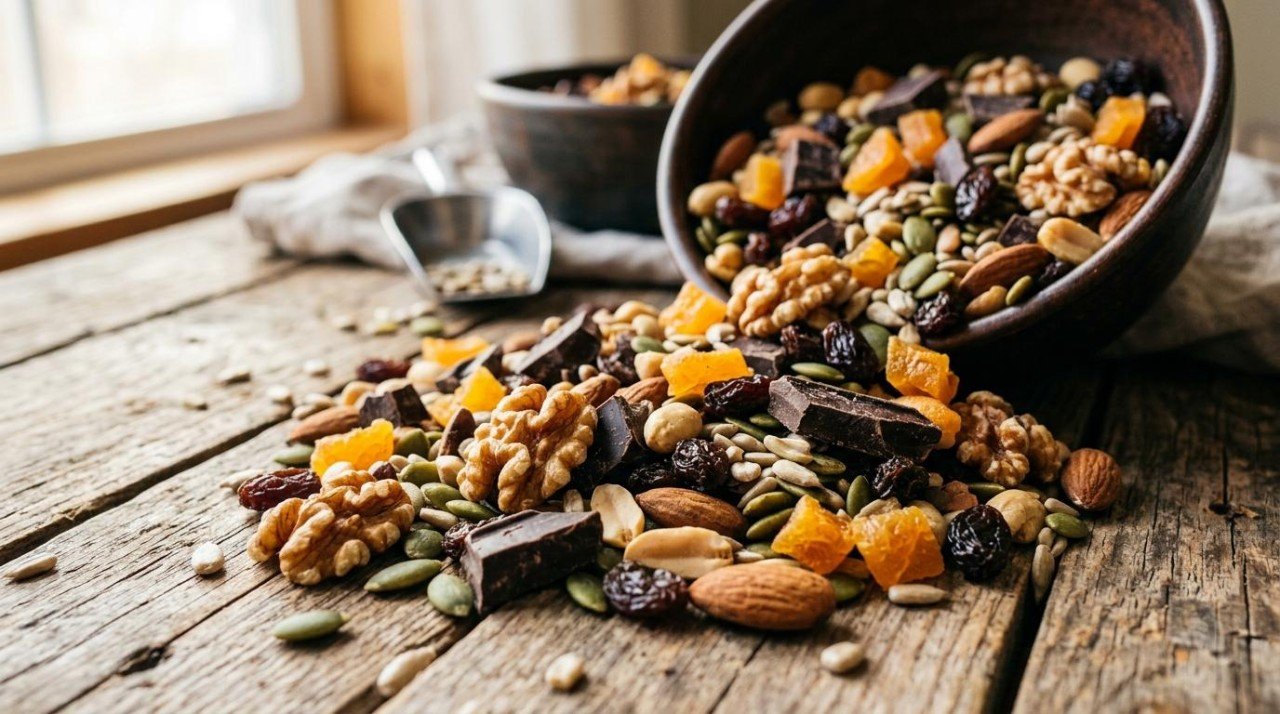
Trail mix is the snack that gets a free pass. It lives in the hiking aisle, it has nuts in it, it comes in a bag with a mountain on it, and nobody has ever felt the need to justify a handful. It is also the snack where the gap between what people think they are eating and what is actually in the bag is widest.
So we scored one. Not a boutique mix — the standard chocolate-and-nut bag: salted peanuts, candy-coated chocolate, yogurt-covered raisins, plain raisins, and a scattering of sunflower kernels. It came back at 49 out of 100, with one flag: added sugar, at 26% of a day's allowance in a 35 g handful.
We rebuilt it to 74. The chocolate is still in it. What surprised us is which change did the work — and that switching to 70% dark chocolate was worth roughly nothing on the score. Here is every swap, what each was worth, the two that were worth almost nothing apart and 22 points together, and the version that scored 80 that we did not publish.
The bag: what is in it and how it scores
The mix we scored is the supermarket standard, built as a 525 g batch (about 1 lb 2 oz) and divided into fifteen 35 g servings — a bit more than the 1 oz on the back of the bag, and much closer to what a real handful weighs:
- 150 g roasted salted peanuts
- 125 g candy-coated milk chocolate
- 100 g yogurt-covered raisins
- 90 g raisins
- 60 g sunflower seed kernels
Per 35 g serving: 172 calories, 4.0 g protein, 1.9 g fiber, 9.9 g fat, 2.6 g saturated fat, 7.0 g added sugar, and about 30 mg of sodium. The score flags exactly one thing — added sugar at 26% of a day's limit. The American Heart Association's ceiling is about 24 g a day for women and 36 g for men, so one modest handful spends nearly a third of a woman's allowance on a snack that is filed under hiking.
Start with what is already fine, because plenty is. The sodium is a non-issue: 30 mg per serving is nothing, and the "salted nuts" everyone worries about are the least of the problems here. Saturated fat is low. And the peanuts and sunflower seeds are doing real work — the original still lands as a good source of phosphorus (17% DV), biotin (15%), vitamin E (11%), and niacin (11%).
What drags it to 49 is the arithmetic of the bag. By weight, 225 g of that 525 g batch — 43% — is confectionery: candy-coated chocolate plus yogurt-covered raisins. Add the 90 g of raisins and more than half the bag is sugar-dominant by weight. The nuts and seeds, the reason anyone believes in this snack, make up 40%.
The yogurt raisins deserve a paragraph of their own, because they are the piece most people read as the healthy one. Look at a real ingredient statement. Sun-Maid's vanilla yogurt raisins list sugar first, then hydrogenated palm kernel oil, then nonfat dry milk, then dry nonfat yogurt — the raisin does not appear until after the entire coating. A 28 g box carries 18 g of sugar. It is a confection with a dairy word on it, and it is the reason "yogurt-covered" belongs in the same conversation as every other unregulated word on a front-of-package label.
One more number: the whole bag scores 3 plant points. For a snack made of nothing but plants, that is a thin showing.
The upgrades: five swaps, 25 points
Each swap is scored on top of the one before it, in the order we made them. The batch weight stays at 525 g throughout, so every version below is the same 35 g handful — only the composition changes.
1. Cut the candy-coated chocolate to a third, fill the gap with walnuts
- Swap: 125 g candy-coated chocolate → 55 g dark chocolate (70%) and 70 g walnuts
- Score impact: +7 points (49 to 56)
- What it changes: Added sugar from 7.0 g to 3.6 g per serving, clearing the flag; omega-3 ALA from essentially zero to 28% DV
- What it costs you: Less chocolate. There is no way around that, and no substitute pretends otherwise.
Walnuts are the reason to make this the first move rather than just pulling candy out. They are the most ALA-dense thing you can put in a trail mix: a single ounce provides over 2,500 mg of alpha-linolenic acid, and 70 g of them takes this mix from a rounding error to an excellent source in one step. They are also soft and slightly bitter, which is exactly what a bag full of sweet things needs.
Now the honest part, which we did not expect. We assumed most of these 7 points came from switching milk-chocolate candy to 70% dark. They did not. We ran the identical swap keeping the candy-coated chocolate at the same 55 g, and it scored 51 instead of 56 — so at this point in the build, "dark" was worth 5 of the 7. Later in the build, that advantage evaporates entirely (see below). The lever is the amount, not the label.
2. Yogurt-covered raisins become almonds
- Swap: 100 g yogurt-covered raisins → 100 g raw almonds
- Score impact: +15 points (56 to 71)
- What it changes: Added sugar from 3.6 g to 0.9 g per serving, protein from 4.3 g to 5.7 g, fiber from 2.1 g to 2.8 g, and vitamin E to an excellent 21% DV
- What it costs you: The one component in the bag that was pure candy. If you liked those, this is the swap you will feel.
Here is the receipt that makes this post worth reading. We also tested this swap first, applied to the untouched original, and it scored 48 — one point worse than doing nothing. Pulling the yogurt raisins out on their own moves the sugar around without meaningfully lowering it, and swaps a low-calorie candy for a calorie-dense nut. Only when both confections leave does the score move: apart they are worth −1 and +7, together they are worth +22.
That is the real lesson of the makeover, and it applies well beyond trail mix. Removing one of two sugar sources from a recipe often buys nothing. The score responds to what is left in the bowl, not to how virtuous the individual decision felt.
3. Half the peanuts become pumpkin seeds
- Swap: 150 g roasted salted peanuts → 75 g dry-roasted unsalted peanuts and 75 g pumpkin seeds
- Score impact: +1 point (71 to 72)
- What it changes: Magnesium from 60 mg to 70 mg per serving, zinc onto the highlights list at 11% DV, iron to 19%, and plant points from 5 to 6
- What it costs you: Nothing, unless you specifically want peanut-forward mix. Pepitas are chewier and greener-tasting.
One point looks like a waste of effort, and on the score alone it nearly is. It earns its place on the micronutrient side. The RDA for magnesium is 400-420 mg a day for men and 310-320 mg for women, and national surveys show most Americans of all ages eat less than that — pumpkin seeds are among the densest food sources there is. A snack that quietly delivers 20% of a day's magnesium is doing something a multivitamin gets credit for.
The unsalted part is barely worth mentioning, and we can prove it: swapping salted peanuts for unsalted on the original scored 51, up 2 points from 49. Trail mix is not a sodium problem. If you like salted peanuts, keep them.
4. Measure the dried fruit, and give it a second color
- Swap: 90 g raisins → 25 g raisins and 25 g chopped dried apricots, with the almonds up to 140 g
- Score impact: +0 points (72 to 72)
- What it changes: Nothing the score rewards; plant points from 6 to 7, and vitamin A stops being flagged as a weakness
- What it costs you: Fewer sweet bites per handful. This is the swap that changes the eating experience most for the least measurable gain.
We are including a swap worth zero on purpose, because the honest version of this series has to show them. Once the added-sugar flag has cleared, cutting more sugar out earns nothing further — the score has already given you the points. What the change does buy is diversity, and diversity is tracked separately: the apricots take the mix to 7 of the 30 different plants a week that gut-microbiome research points at. A snack you eat five days a week that carries seven distinct plants is a genuinely efficient way to move that number.
5. Take the chocolate down one more notch
- Swap: 55 g dark chocolate → 40 g, with the almonds up to 155 g
- Score impact: +2 points (72 to 74)
- What it changes: Saturated fat from 2.45 g to 2.27 g per serving, vitamin E from 25% to 27% DV
- What it costs you: This is the edge. Below about 40 g in a 525 g batch, you stop getting chocolate in every handful, and the mix becomes a nut mix with a surprise in it.
Forty grams across fifteen servings is roughly 2.7 g of chocolate per handful — one small shard. That is deliberately close to the amount the research on cocoa actually describes: Harvard's Nutrition Source points to studies at around 6 g daily and recommends 70% cacao or higher for the flavanols, while capping intake at about an ounce a day for heavy-metal reasons. Chop a bar rather than using chips — chips are formulated to hold their shape, and shards distribute better through a mix.
Take the Guesswork Out of Eating Well
Eat Well Planner helps you organize your favorite recipes, plan balanced meals, and automatically generate shopping lists — all in one place. Whether you're tracking macros, managing dietary restrictions, or just trying to stop asking "what's for dinner?", we've got you covered.
Our AI-powered tools can adapt any recipe to your dietary needs, help you discover new meals you'll love, and even log your nutrition effortlessly. It's meal planning made simple.
Start Organizing Your Meals — FreeWhat we kept, and exactly what it cost
Two things stayed in this mix that a stricter makeover would have removed, and both have a price we can name.
The chocolate costs 6 points. Pull the 40 g out entirely, replace it with almonds, and the mix scores 80. We did not publish that version, because a trail mix with no chocolate in it is a bowl of nuts, and the bowl of nuts is not the thing anyone searched for.
Dark chocolate is worth nothing at this dose. This is the finding we least expected, so we tested it three ways. In the finished mix, putting candy-coated chocolate back at the same 40 g scored 75 — one point higher than the dark chocolate version. Mid-build, at 55 g without the yogurt raisins, candy scored 73 against dark's 71. Only in the first swap, with the yogurt raisins still present, did dark chocolate win, by 5. Averaged across the build, the type of chocolate is noise; the quantity is the signal. We kept the 70% because it tastes better in a mix full of nuts and carries flavanols the score does not measure — but we are not going to tell you it bought points, because it did not.
The portion is half the recipe
Here is the part the card in the hiking aisle will never tell you: the improved mix has more calories per handful than the original, not fewer. 198 against 172. Nuts are denser than candy, and trading cheap calories for expensive ones is exactly what happened here.
So we scored the same finished mix at a 75 g portion — a loose half cup, which is what a bag on the passenger seat actually delivers. It still scores 74; the composition is good and stays good. But it is now 424 calories and it picks up a saturated fat flag at 21% DV. The original at that same 75 g portion drops to 46, with 15 g of added sugar — 57% of a day, marked very high.
That is the honest summary of trail mix: a good mix survives a big portion and a bad one gets worse, but neither is a free snack. Portioning is the technique. Fifteen small jars or bags, made once, is the entire trick — and it is why the recipe below ends with a step about containers instead of a step about cooking. There is good evidence for about an ounce of nuts five or more times a week, associated with a 14% lower risk of cardiovascular disease in a study of 210,000 health professionals. That is a handful, most days — not a bag, once.
A small comfort on the calorie math: those numbers are probably overstated. USDA researchers measuring what the body actually absorbs found walnuts deliver 146 calories per ounce against the 185 on the label, about 21% less, and whole raw almonds are overestimated by roughly 25%, because not all of the fat in an intact nut is digested. Nut calories on a label are the ceiling, not the count.
The healthier version: full recipe
Nutrition Score: 74/100. No caution flags. Makes 525 g, or fifteen 35 g servings.
- 155 g raw almonds (a generous 1 cup)
- 75 g dry-roasted unsalted peanuts (about 1/2 cup)
- 75 g pumpkin seeds / pepitas (a generous 1/2 cup)
- 70 g walnut halves, broken up (about 3/4 cup)
- 60 g sunflower seed kernels (a scant 1/2 cup)
- 40 g dark chocolate, 70% or higher, chopped into shards (about 1 1/2 oz)
- 25 g raisins (about 3 tablespoons)
- 25 g dried apricots, chopped small (about 5 apricots)
- Optional but worth it: spread the almonds, peanuts, pumpkin seeds, walnuts, and sunflower seeds on a sheet pan and toast at 325 degrees F for 8 to 10 minutes, until they smell nutty. Do not walk away — walnuts and pumpkin seeds go from toasted to burnt fast.
- Cool the nuts and seeds completely, spread out, for at least 30 minutes. This is not optional if you want the chocolate to survive. Warm nuts will melt it into a smear.
- Chop the dried apricots to raisin size. Whole dried fruit reads as a jackpot and gets picked out; small pieces distribute the sweetness across every handful, which is the entire point of measuring it down.
- Chop the dark chocolate into rough shards roughly the size of an almond.
- Combine everything in a large bowl and toss thoroughly with your hands, lifting from the bottom, until the chocolate and fruit are evenly spread through the nuts.
- Portion immediately into fifteen small jars, containers, or zip bags at about 35 g each (a scant 1/4 cup). Do not store it in one large container. Stored loose, this mix is 3,000 calories in a jar with a spoon next to it.
- Keep sealed at room temperature for up to 3 weeks, or in the freezer for 3 months. Nuts have a lot of unsaturated fat, and unsaturated fat goes rancid.
Per 35 g serving, original vs. improved:
- Nutrition Score: 49 → 74
- Calories: 172 → 198 (yes, up)
- Protein: 4.0 g → 6.7 g
- Fiber: 1.9 g → 2.9 g
- Added sugar: 7.0 g → 0.7 g (26% of a day's limit → nothing worth flagging)
- Saturated fat: 2.6 g → 2.3 g
- Magnesium: 30 mg → 80 mg (20% DV)
- Plant points: 3 → 7
- Caution flags: 1 → 0
The finished mix is an excellent source of omega-3 ALA (32% DV), phosphorus (28%), vitamin E (27%), biotin (24%), and magnesium (20%), and a good source of iron, riboflavin, zinc, fiber, niacin, and pantothenic acid. On the sub-scores, gut health goes from 52 to 84 and weight management from 47 to 86.
Swaps we tested and skipped
- Sweetened dried cranberries instead of the raisins and apricots: 65, a 9-point drop, with added sugar back up to 3.0 g per serving. Craisins are the most common "fruit" in commercial trail mix and they are candy with a fruit shape.
- Dropping the sunflower seeds and loading up on walnuts and almonds: 69 against the 72 it replaced. We assumed sunflower kernels were filler. They are carrying vitamin E and holding the mix's balance, and taking them out made it worse.
- Going chocolate-free: 80, and rejected on purpose. See above.
- Unsalted peanuts as a standalone fix: 51, up 2 from the original. Worth doing, not worth writing home about.
Make it fit other diets
Nut-free (school-safe): drop the almonds, peanuts, and walnuts, and rebuild on pumpkin seeds, sunflower seeds, and roasted chickpeas — our peanut butter substitutes guide covers which seed options are genuinely nut-free and which only look it. Vegan: the recipe already is, as long as the chocolate is dairy-free — most 70%+ bars are, but check, because many list milk fat. Lower sugar still: replace the dried fruit with freeze-dried strawberries or raspberries, which bring the fruit flavor and color at a fraction of the sugar density. In Eat Well Planner, Recipe Variations will rewrite the whole thing for any of these in one step, with the amounts already worked out.
Do this to your own snacks
None of the numbers in this post are estimates. We built the original in Eat Well Planner, scored it, and then ran each swap through the Recipe Playground one at a time to watch the score move — which is how we caught that the yogurt raisins were worth −1 alone and how we found out that dark chocolate was not buying what we assumed it was.
You can do the same thing to anything you eat regularly. Import a recipe from a URL, a video, or a photo, look at what the score flags, and let Make It Healthier propose the swaps — every suggestion is verified by a calculator before it is shown to you, so you see the real gain, not a guess. Then decide which trade-offs you are actually willing to make. Our healthier granola makeover is the other half of this story: the other snack everyone assumes is healthy, and the other one where the sweetener turned out to be the whole argument.