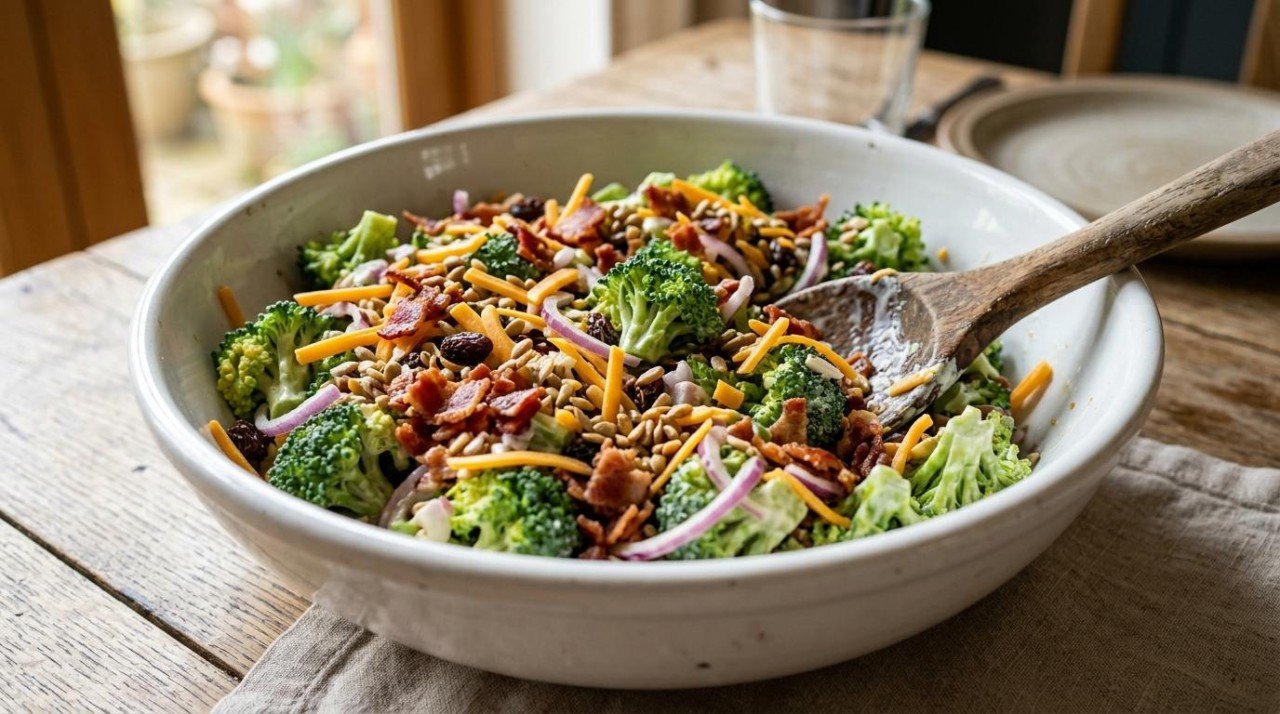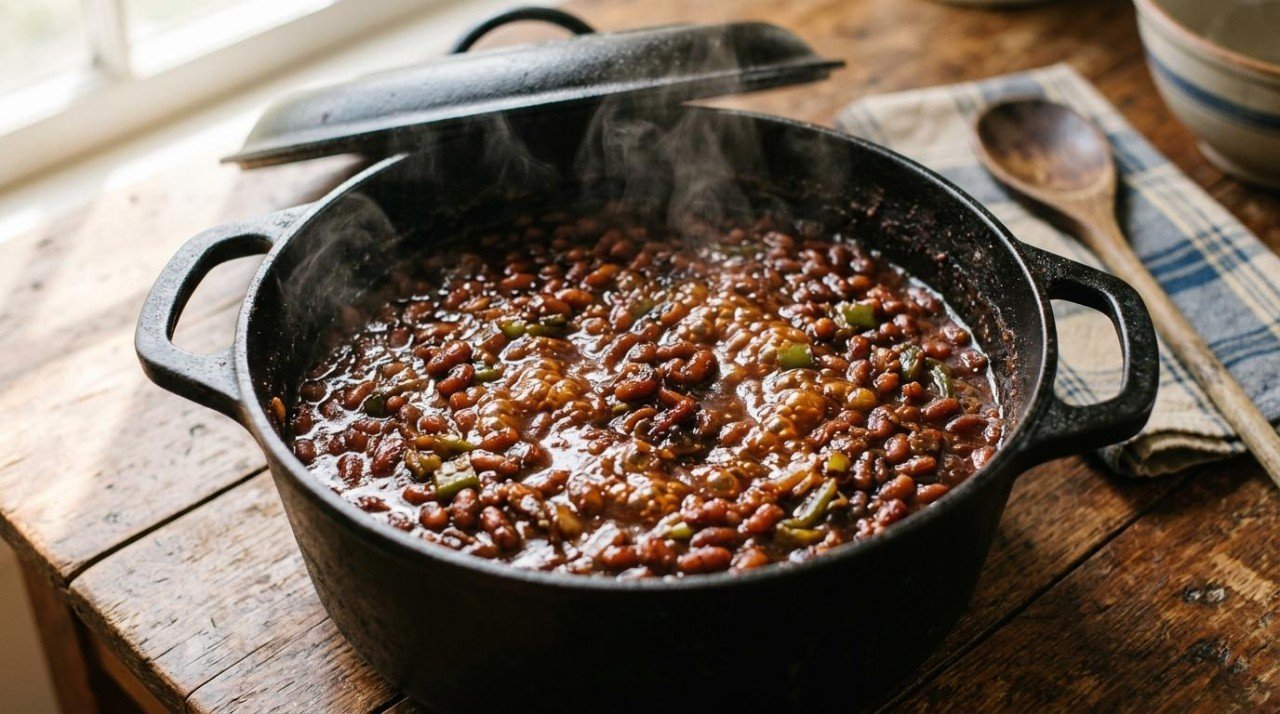
Baked beans are one of the few cookout dishes nobody argues about. The version most Americans actually make is not the slow, dry-bean Boston original - it is a can of pork and beans doctored with bacon, brown sugar, molasses, ketchup and mustard, then baked until the top goes sticky.
We scored a representative one - The Chunky Chef's Easy Baked Beans, which uses 10 slices of bacon, two-thirds of a cup of brown sugar and a quarter cup of molasses for eight servings - through Eat Well Planner's Nutrition Score. It came back at 42 out of 100.
Going in, we assumed the bacon was a minor problem and that trimming the sugar a bit would fix most of it. Both assumptions were wrong, in opposite directions. The finished version scores 71 - twenty-nine points higher, with a quarter of the sodium and a sixth of the added sugar - and it still tastes like baked beans, because the one ingredient we protected is the one that makes them baked beans at all.
The original: what is in it and how it scores
The standard potluck build, for eight servings: a 54 oz can of pork and beans, undrained; 10 slices of bacon plus the drippings; 2/3 cup packed brown sugar; 1/4 cup molasses; 4 tablespoons ketchup; 1/4 cup cider vinegar and 2 teaspoons dry mustard; an onion and half a green bell pepper.
Nutrition Score: 42/100. Per serving: 403 calories, 13.1 g protein, 8.9 g fiber, 27.5 g added sugar, 3.0 g saturated fat, 1,020 mg sodium.
What is already fine: the beans. The score lists fiber, iron and magnesium among the dish's strengths, and 8.9 g of fiber per serving is close to a third of the FDA's 28 g Daily Value. A 2023 review in Food and Nutrition Research found that trials feeding people higher amounts of legumes (typically over 120 g a day) lowered total cholesterol by 0.22 mmol/L and LDL by 0.19 mmol/L, while noting honestly that the observational evidence for disease outcomes remains inconclusive. Nobody needs to make baked beans healthier by using fewer beans.
What drags it down: sugar, then salt. 27.5 g of added sugar per serving is roughly 7 teaspoons, and the average American adult eats about 17 teaspoons in a whole day, against a Dietary Guidelines ceiling of less than 10% of calories. One scoop of a side dish is roughly 40% of a typical day's added sugar - and that does not count the sugar already in the canned sauce, which the nutrition data does not break out separately.
At 1,020 mg per serving, sodium is 44% of the FDA's 2,300 mg daily limit, and Americans already average about 3,400 mg a day. Roughly three-quarters of it comes from the canned beans and their packing sauce, not from anything you add.
The upgrades
We built these one at a time in the Recipe Playground and re-scored after each change, so every number below is the real movement that swap caused at that point in the build.
1. Ditch the canned pork and beans and build the sauce yourself
- Swap: One 54 oz can of pork and beans, undrained, becomes 4 cans of no-salt-added navy beans, drained and rinsed, plus a 6 oz can of tomato paste and 3/4 teaspoon of salt
- Score impact: +8 points (42 to 50)
- What it changes: Sodium falls from 1,020 mg to 490 mg per serving
- What it costs you: Two minutes with a colander, and you season the pot yourself
Opening four cans feels like more work than opening one. It is the same work plus a rinse, and what you get back is control: the packing liquid in canned pork and beans is a pre-sweetened, pre-salted sauce, and the moment you tip it in you have accepted every gram of it. Tomato paste thinned with water gives the same body with almost none of the sodium, and it browns in the pot in a way the canned sauce cannot.
No no-salt-added cans at your store? Use regular ones and rinse them properly - draining and rinsing removes about 41% of the sodium, at the cost of a little folate. We scored that version: the finished recipe built on regular cans lands at 62 instead of 71, with 670 mg of sodium per serving instead of 240 mg.
2. Lose the bacon, keep the smoke
- Swap: 10 slices of bacon and its drippings become 1 1/2 teaspoons of smoked paprika, 1 tablespoon of Worcestershire sauce, and 1 tablespoon of olive oil for the saute
- Score impact: +10 points (50 to 60) - the single biggest move in this post
- What it changes: Saturated fat falls from 2.7 g to 0.5 g per serving, and the processed-meat penalty comes off entirely
- What it costs you: Something real. Bacon does two jobs here, smoke and savory depth, and you have to replace both
This is where our assumption broke. We expected the bacon to cost a couple of points for its saturated fat and sodium. It costs ten, and almost none of that is the fat. Adding 4 slices of bacon back to the finished recipe drops it from 71 to 61. Adding the same weight of unprocessed pork shoulder - near-identical calories and macros - drops it only to 69. Eight of those ten points are the curing, not the pig.
That tracks with the evidence. The World Health Organization's cancer agency classifies processed meat as Group 1, carcinogenic to humans, with each 50 g portion eaten daily associated with about an 18% higher risk of colorectal cancer. Keep it in proportion: 50 g is about six slices of bacon, a serving of the original contains closer to one, and Group 1 describes how confident scientists are that something causes cancer, not how dangerous a given portion is. Nobody is in trouble for eating baked beans at a barbecue.
The practical finding is that this swap is all or nothing. A version with the bacon merely cut in half, from 10 slices to 4, scored exactly the same as the full-bacon version - zero points gained. If you are keeping bacon in your beans, keep the amount you actually like. To replace what it was doing: smoked paprika is real smoke rather than a flavoring, since the peppers are dried over smoldering oak before grinding, and Worcestershire brings back the fermented savory bottom note.
3. Cut the brown sugar out and take the molasses down
- Swap: 2/3 cup of packed brown sugar out entirely, and molasses from 1/4 cup down to 2 tablespoons
- Score impact: +2 points (60 to 62)
- What it changes: Added sugar drops from 27.8 g to 6.0 g per serving, and calories fall by about 85
- What it costs you: Real sweetness. This is the swap you notice at the table
Two points, for the change that cuts added sugar by more than three-quarters. That is not a typo, and it is the most useful thing we learned here: the score barely rewards a sugar cut until you get most of the way down. Above roughly 10% of calories from added sugar the penalty sits nearly flat. Below it, the score jumps - which is why this swap looks weak alone and the next one looks absurdly generous. Read three and four as one change worth +8 together, and take stopping halfway as close to pointless.
Brown sugar goes first because it contributes nothing here except sweetness. Molasses is doing something else entirely - it is the bitter, mineral, faintly burnt note that makes a pot read as baked beans rather than beans in tomato sauce. Two tablespoons across eight servings carries that.
4. Skip the ketchup
- Swap: 4 tablespoons of ketchup out; the tomato paste already in the pot covers it
- Score impact: +6 points (62 to 68)
- What it changes: Added sugar falls from 6.0 g to 4.2 g per serving, and sodium drops another 80 mg
- What it costs you: Nothing you will taste, as long as the vinegar stays
Six points for four tablespoons of condiment sounds ridiculous until you see where the build was sitting. At 6.0 g of added sugar per serving the recipe drew about 11.5% of its calories from added sugar - just over the line. Losing the ketchup drops that to 8.5%, under the Dietary Guidelines threshold of 10%, and the added-sugar caution disappears from the recipe entirely.
Ketchup is roughly a fifth sugar by weight, and in a pot that already holds tomato paste, vinegar and mustard it contributes tomato you have and sweetness you are trying to remove. The tang comes back from the apple cider vinegar, which stays at a full quarter cup.
5. Double the peppers and add garlic
- Swap: Half a bell pepper becomes a whole one, the onion goes from medium to large, and three cloves of garlic join
- Score impact: +3 points (68 to 71)
- What it changes: Vitamin C reaches 25% of the Daily Value, and plant points go from 2.25 to 4.75
- What it costs you: Nothing
More aromatics in a pot that cooks for over an hour is not a compromise, it is just a better pot of beans - and it moves the dish from barely two different plants to nearly five, which matters if you are working toward the 30-plants-a-week target that gut microbiome research points to.
Take the Guesswork Out of Eating Well
Eat Well Planner helps you organize your favorite recipes, plan balanced meals, and automatically generate shopping lists — all in one place. Whether you're tracking macros, managing dietary restrictions, or just trying to stop asking "what's for dinner?", we've got you covered.
Our AI-powered tools can adapt any recipe to your dietary needs, help you discover new meals you'll love, and even log your nutrition effortlessly. It's meal planning made simple.
Start Organizing Your Meals — FreeWhat we kept, and where we stopped
The molasses stayed, and that was a decision made against the numbers. We tested a version with the molasses cut from 2 tablespoons to 1, nothing else changed. It scored 93. Twenty-two points, sitting right there, and we left them.
At one tablespoon across eight servings there is essentially no molasses flavor left. What you have is a well-seasoned pot of navy beans in tomato and vinegar sauce - good to eat, and not baked beans. The honest cap on a makeover is the point where the next swap changes what you are making. That point is the molasses, and 71 is where we stopped.
The cider vinegar and dry mustard also stayed at full strength, and they are load-bearing now: with most of the sugar gone, acid and sharpness are what keep the sauce from tasting flat.
The healthier version: full recipe
Nutrition Score: 71/100. Serves 8.
Ingredients
- 4 (15-ounce) cans no-salt-added navy beans, drained and rinsed (about 6 cups)
- 1 (6-ounce) can tomato paste
- 1 1/2 cups water
- 1 tablespoon olive oil
- 1 large yellow onion, diced
- 1 green bell pepper, diced
- 3 cloves garlic, minced
- 1 1/2 teaspoons smoked paprika
- 2 tablespoons molasses (not blackstrap)
- 1/4 cup apple cider vinegar
- 1 tablespoon Worcestershire sauce
- 2 teaspoons dry mustard powder
- 3/4 teaspoon kosher salt (about 4 grams - measure it, since it is now most of the sodium in the dish)
- Freshly ground black pepper
Instructions
- Heat the oven to 325 degrees F. Rinse the beans under cold water until it runs clear, then let them drain while you build the sauce.
- Heat the olive oil in a large Dutch oven over medium heat. Add the onion and bell pepper with a pinch of the salt and cook, stirring occasionally, until soft and just starting to brown at the edges, 8 to 10 minutes.
- Add the garlic and smoked paprika and cook 1 minute, until fragrant.
- Add the tomato paste and cook 2 to 3 minutes, stirring constantly, until it darkens from bright red to brick. This is where most of the depth comes from, so do not rush it.
- Stir in the water, molasses, vinegar, Worcestershire, mustard powder, the remaining salt and a generous grind of black pepper. Whisk until smooth.
- Add the beans and fold gently to coat, then bring to a simmer.
- Bake uncovered for 60 to 75 minutes, stirring once at the halfway point, until the sauce has thickened around the beans and the top has darkened and begun to caramelize.
- Let stand 10 minutes before serving, since it thickens as it cools. Taste, and if it reads flat, add another tablespoon of vinegar.
Per serving, original vs. improved
- Nutrition Score: 42 to 71
- Calories: 403 to 203
- Added sugar: 27.5 g to 4.2 g
- Sodium: 1,020 mg to 240 mg
- Saturated fat: 3.0 g to 0.5 g
- Fiber: 8.9 g to 8.7 g (essentially unchanged - the beans were always the good part)
- Protein: 13.1 g to 10.1 g (the one number that got worse, and it is the bacon)
- Plant points: 2.25 to 4.75
The improved version is a good source of folate (60% of the Daily Value), iron (44%), fiber (29%), phosphorus (29%), potassium (25%) and vitamin C (25%), and it carries no nutrition cautions. The original carried two.
Swaps we tested and skipped
- Turkey bacon. Added back to the finished recipe, real bacon costs 10 points and turkey bacon costs 9. It is still cured meat and the score treats it that way, so if you want bacon, use actual bacon and spend the point elsewhere.
- Halving the bacon instead of removing it. Zero points. Genuinely zero - the finding most likely to save someone a pointless compromise.
- Keeping the original sweetness. The finished recipe with the sugar put back to 1/4 cup molasses plus 2 tablespoons brown sugar scores 62 instead of 71. If you cook for people who expect candy-sweet beans, that is the honest price, and 62 is still twenty points up.
- Maple syrup or honey for the brown sugar. The score counts them as added sugar the same way, so it changes the flavor without changing the number - a lateral move, not an upgrade.
Make it fit other diets
Without the bacon this is already vegetarian. For fully vegan, swap the Worcestershire for a vegan version or 2 teaspoons of soy sauce plus a squeeze of lemon, since traditional Worcestershire contains anchovy. It is naturally gluten-free apart from that, so check the label or use tamari. For more smoke without meat, half a teaspoon of liquid smoke does more than another spoonful of paprika will. In the app, the AI recipe chat will rewrite the ingredient list for any of these in one step.
Do this to your own recipes
Every number here came out of three steps you can run on anything in your recipe book: import the recipe from a URL, a photo or an Instagram reel, read its Nutrition Score and what the score says is dragging it down, then use Make It Healthier to see swaps with the nutritional gain already calculated. That is how you learn that halving the bacon is worth nothing before you spend a whole cookout finding out.
And if you want to argue with the numbers, that is what the Recipe Playground is for. Put the bacon back, push the molasses up, watch what each edit costs, and decide where your version should sit. Ours sits at 71. Yours does not have to.