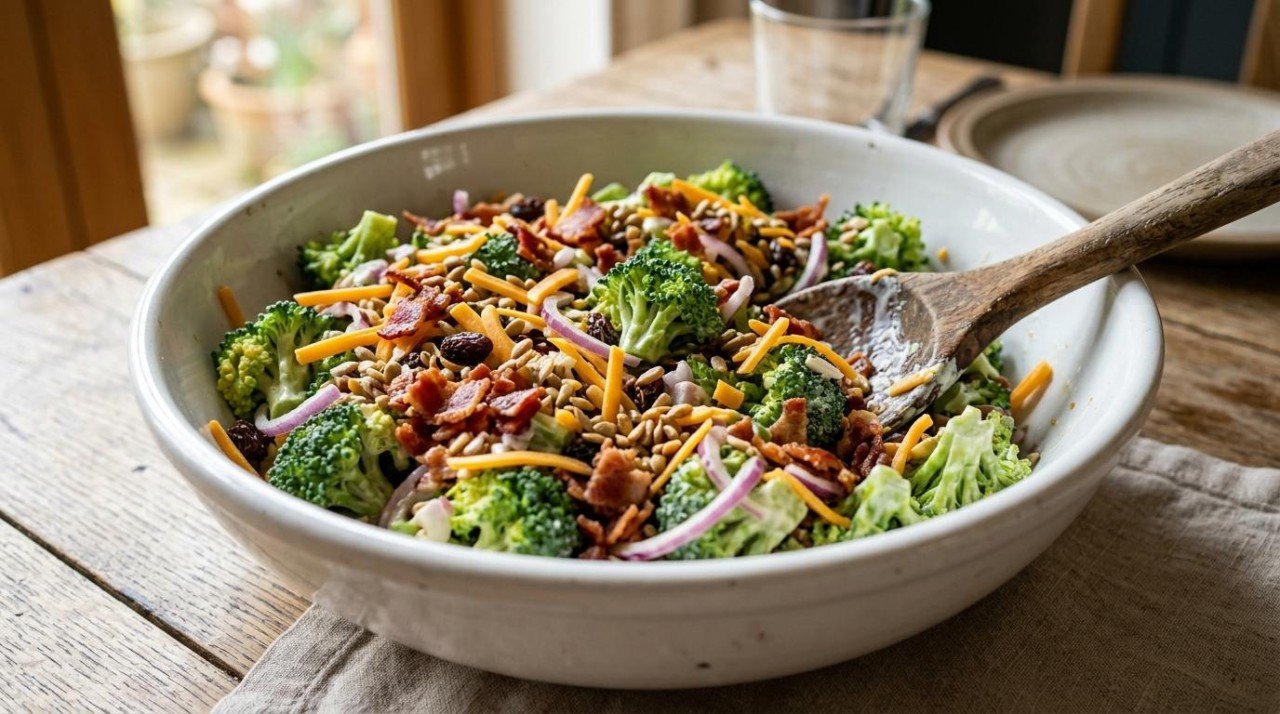
Broccoli salad is the dish that converts people. Somebody brings it to a cookout, somebody else says they do not like raw broccoli, and twenty minutes later the bowl is scraped. It works because it is a genuinely clever piece of construction: crunchy raw florets, sharp cheddar, salty bacon, sweet raisins, and a tangy dressing holding all of it together.
It also has the best starting ingredient of any potluck side in America. Raw broccoli is where sulforaphane actually comes from, and almost nobody eats broccoli raw. So we ran a representative version - the mayonnaise-and-sugar build you will find on The Girl Who Ate Everything, Brown Eyed Baker and a hundred church cookbooks - through Eat Well Planner's Nutrition Score. It came back at 40 out of 100.
Our version scores 76. That is thirty-six points, and the surprise is where they came from. We assumed, like the internet assumes, that the bacon was the problem. We halved the bacon as our first move and the score did not budge - not one point. The bacon only became worth cutting after we fixed the thing that was actually wrong, which was the two cups of dressing sitting on top of all that broccoli.
The original: what is in it and how it scores
The standard build, for eight servings: about 6 cups (600 g) of raw broccoli florets, 8 slices of bacon cooked and crumbled, 1 cup of shredded cheddar, 1/2 cup of raisins and half a red onion, dressed with 1 cup of mayonnaise, 1/4 cup of granulated sugar and 2 tablespoons of cider vinegar. That is the moderate version, incidentally - both of the recipes linked above use a full 1/2 cup of sugar, so if anything we scored the original generously.
Nutrition Score: 40/100. Per serving: 372 calories, 9.5 g protein, 2.6 g fiber, 6.4 g added sugar, 28.9 g total fat, 7.0 g saturated fat, 450 mg sodium.
What is already excellent: the broccoli, and the fact that it is raw. Even at 40, this dish delivers 75% of the Daily Value for vitamin C and a full 101% for vitamin K per serving. Raw matters more than usual here. Broccoli does not contain sulforaphane directly - it stores a precursor called glucoraphanin, and sulforaphane is only formed by an enzyme, myrosinase, that is released when the plant tissue is chopped or chewed. That enzyme is heat-sensitive. Cook the broccoli and you inactivate it: in the study linked above, cooked broccoli produced essentially no more sulforaphane than raw (0.58 versus 0.57 micromoles per gram) precisely because the enzyme was gone. A salad of raw, chopped broccoli is one of the few ways Americans reliably eat this vegetable in the state where that chemistry works.
What drags it down: the dressing, by a wide margin. A cup of mayonnaise across eight servings is about 27 g of mayo per person, which is where most of the 28.9 g of fat and a large chunk of the 7.0 g of saturated fat come from. The quarter cup of sugar adds 6.4 g of added sugar per serving on top of the raisins - it is dessert-level sweetening applied to a vegetable. The score flags saturated fat as a weakness and raises a sodium caution at 450 mg per serving, 20% of the FDA's 2,300 mg daily limit, for something most people eat two scoops of.
And fiber, at 2.6 g per serving, is the quiet disappointment. This is a bowl of broccoli. It should be doing better than 9% of the FDA's 28 g Daily Value. The reason it is not is that half the volume of the finished dish is dressing.
The upgrades
We built these one at a time in the Recipe Playground, re-scoring after every change, so each number below is the real movement that swap caused at that point in the build.
1. Rebuild the dressing around Greek yogurt
- Swap: 1 cup mayonnaise becomes 3/4 cup plain Greek yogurt plus 1/3 cup mayonnaise, with the cider vinegar raised to 3 tablespoons and a teaspoon of Dijon whisked in
- Score impact: +11 points (40 to 51) - the biggest single move in this post
- What it changes: Total fat per serving falls from 28.9 g to 15.2 g, saturated fat from 7.0 to 5.1 g, calories from 372 to 260, and protein goes up
- What it costs you: Tang. The dressing is noticeably sharper, which is why the honey in swap 2 matters
Mayonnaise is emulsified oil - it is roughly 75% fat and carries about 1 g of protein per 100 g. Plain Greek yogurt is strained cultured milk at roughly 10 g of protein per 100 g and a fraction of the fat. Swapping most of one for the other in a cold dressing is close to a free trade nutritionally, and unlike a hot sauce there is no risk of the yogurt splitting, because nothing here ever gets warm.
The reason we kept a third of a cup of mayo instead of going all-yogurt is flavor, not nutrition - we tested the all-yogurt version and it is in the skipped list below. The extra tablespoon of vinegar and the Dijon are doing real work: yogurt is acidic in a lactic, dairy way, and the salad needs the brighter acetic edge that the classic dressing got from vinegar cutting through fat. If you want to go deeper on the trade, we have full guides to mayonnaise substitutes and what Greek yogurt can and cannot replace.
2. A tablespoon of honey instead of a quarter cup of sugar
- Swap: 1/4 cup (50 g) granulated sugar becomes 1 tablespoon (21 g) honey
- Score impact: +6 points (51 to 57)
- What it changes: Added sugar per serving drops from 6.3 g to 2.2 g
- What it costs you: Almost nothing, once the raisins are accounted for
The classic dressing sweetens against the mayonnaise, not against the broccoli. Take out two-thirds of the fat and you no longer need dessert-grade sugar to balance it - a tablespoon of honey plus the raisins already in the bowl is plenty. This is the swap most people can make tonight without telling anyone.
Honey is still added sugar, and we are not going to pretend otherwise; the Dietary Guidelines ceiling is less than 10% of daily calories, or about 50 g on a 2,000-calorie day. The point is that going from 6.4 g to 2.2 g per serving matters when this is a side dish, not the meal. We compared them properly in our guides to white sugar substitutes and honey substitutes.
3. Add a third of a cup of sunflower seeds
- Swap: Add 1/3 cup (40 g) unsalted sunflower seed kernels, stirred in at the end
- Score impact: +7 points (57 to 64)
- What it changes: Fiber up, vitamin E and magnesium added, and a fourth plant in a dish that only had three
- What it costs you: Nothing. It makes the salad better
This is the rare upgrade that is pure addition - we did not take anything away, and the score went up seven points. Sunflower seeds are a genuine nutrient bargain: vitamin E, magnesium, a little more fiber, and unsaturated fat that improves the fat profile rather than adding to the problem.
Culinarily they also solve something. Once you thin the dressing with yogurt, the salad loses a little of the heavy, coating richness that made the original satisfying. Seeds put crunch back in a way that reads as more generous, not less. Stir them in just before serving so they stay crisp - sitting in dressing overnight softens them.
4. Now halve the bacon
- Swap: 8 slices of cooked bacon becomes 4
- Score impact: +5 points (64 to 69) - and exactly 0 points when we tried it first
- What it changes: Sodium per serving drops from 350 mg to 270 mg, saturated fat from 5.3 to 4.8 g
- What it costs you: Less bacon in each bite. Chop it finer and you will barely register the difference
This is the most interesting result in the post. Halving the bacon on the original recipe - the very first thing every healthy-broccoli-salad article tells you to do - moved the score from 40 to 40. Zero. The bacon's sodium and saturated fat were rounding errors next to a cup of mayonnaise and a quarter cup of sugar; cutting it just made a badly built salad slightly smaller.
Once the dressing was fixed, the same cut was worth five points, because bacon was now a meaningful share of what was left. That is the general lesson: the value of a swap depends entirely on what else is in the bowl. Order matters, and the internet's default order for this dish is backwards. If you want the full picture on what bacon actually costs and what replaces it, our bacon substitutes guide covers the options - but for this salad, less bacon beats different bacon.
5. More broccoli, same amount of dressing
- Swap: 6 cups of florets becomes about 8 cups (600 g to 800 g), with the dressing unchanged
- Score impact: +3 points (69 to 72)
- What it changes: Fiber from 3.2 to 3.8 g per serving, and vitamin C reaches a full 100% of the Daily Value
- What it costs you: A drier, less saucy salad on day one. It fixes itself overnight
The cheapest upgrade here is arithmetic. You already halved the fat in the dressing; use the room to change the ratio instead of banking it. Two large heads instead of one and a half, and every forkful is more vegetable and less sauce.
Use the stems too. Peel the woody outside off the stalks and dice the pale core - it is sweeter and crunchier than the florets and it is the part most people throw away. Chilling matters more at this ratio: give the salad at least an hour in the fridge, ideally three, so the dressing loosens and spreads.
6. Less cheddar, but make it sharp
- Swap: 1 cup shredded cheddar becomes 3/4 cup shredded sharp cheddar
- Score impact: +4 points (72 to 76)
- What it changes: Saturated fat per serving from 4.8 g to 4.1 g, sodium from 280 mg to 250 mg
- What it costs you: A quarter cup of cheese, which sharp cheddar covers for
A modest trim, and the last one we were willing to make. Aged sharp cheddar carries considerably more flavor per gram than mild, which is what lets you use less without the salad tasting like you used less. Shred it coarsely, or dice it into small cubes - cubes hold their shape in dressing where fine shreds go soft and disappear into it. Our cheddar cheese guide has more on why sharpness is the lever here.
Take the Guesswork Out of Eating Well
Eat Well Planner helps you organize your favorite recipes, plan balanced meals, and automatically generate shopping lists — all in one place. Whether you're tracking macros, managing dietary restrictions, or just trying to stop asking "what's for dinner?", we've got you covered.
Our AI-powered tools can adapt any recipe to your dietary needs, help you discover new meals you'll love, and even log your nutrition effortlessly. It's meal planning made simple.
Start Organizing Your Meals — FreeWhat we kept, and where we stopped
Three things stayed in the bowl on purpose.
The raisins. Every "healthy broccoli salad" recipe wants to cut them. We tested it: dropping from 1/2 cup to 1/3 cup lost two points. Raisins bring potassium, iron and a little fiber alongside their sugar, and they are the only thing making the sweet-salty contrast that defines this dish. Leave them alone.
Real bacon and real cheddar. Halved and trimmed, but present. We ran the version with the cheese taken out entirely, and it scores 88 - twelve points above where we stopped. That is a lot of points, and we are not taking them, because a bowl of raw broccoli in yogurt dressing with raisins and sunflower seeds is a perfectly nice salad that is not broccoli salad. Dropping the bacon too scores 78. Both are on the table if you want them; neither is the dish people come back for seconds of.
A third of a cup of mayonnaise. See below - we tested going without and it bought a single point.
The healthier version: full recipe
Nutrition Score: 76/100. Serves 8. No cautions - the sodium flag from the original is gone.
Ingredients
- 1 3/4 lb (800 g) broccoli florets, cut small, from about 2 large heads - roughly 8 cups, stems peeled and diced
- 1/2 medium red onion (about 80 g), finely diced
- 1/2 cup (75 g) raisins
- 3/4 cup (85 g) sharp cheddar, coarsely shredded or diced small
- 4 slices bacon, cooked crisp and crumbled (about 35 g cooked)
- 1/3 cup (40 g) unsalted sunflower seed kernels
- 3/4 cup (180 g) plain Greek yogurt
- 1/3 cup (70 g) mayonnaise
- 3 tablespoons apple cider vinegar
- 1 tablespoon (21 g) honey
- 1 teaspoon Dijon mustard
- 1/4 teaspoon black pepper
Instructions
- Cook the bacon until crisp, drain it on paper towels and crumble. Set aside.
- Cut the broccoli into small bite-size florets - smaller than you think, about 1/2 inch, so the dressing reaches everything. Peel the stalks and dice the tender cores.
- Whisk the Greek yogurt, mayonnaise, cider vinegar, honey, Dijon and black pepper in a large bowl until completely smooth. Taste it on its own: it should be sharper than you want, because the broccoli will mute it.
- Add the broccoli, red onion, raisins and cheddar. Toss until every piece is coated.
- Cover and refrigerate at least 1 hour, ideally 3. The salad will look dry at first and loosen as it sits.
- Just before serving, stir in the sunflower seeds and the crumbled bacon so both stay crisp. Taste and add a little more vinegar if it needs waking up. It should not need salt - the bacon and cheddar handle that.
Per serving, original versus improved
- Nutrition Score: 40 to 76
- Calories: 372 to 245
- Saturated fat: 7.0 g to 4.1 g
- Sodium: 450 mg to 250 mg
- Added sugar: 6.4 g to 2.2 g
- Fiber: 2.6 g to 3.8 g
- Protein: 9.5 g to 10.8 g
- Vitamin C: 75% to 100% of the Daily Value
- Plant points: 3 to 4 of a weekly 30
The dimension scores move even further than the headline number: gut health from 37 to 75, heart health from 40 to 73, weight management from 41 to 83.
Swaps we tested and skipped
- Dried cranberries instead of raisins: -15 points. The single worst thing we tried, and it was on our own shortlist going in. Sweetened dried cranberries nearly quadrupled the added sugar per serving, from 2.2 g to 8.3 g, and pulled the score from 72 down to 57. If your recipe calls for craisins, this is the change to make in the other direction.
- Cutting the raisins to 1/3 cup: -2 points. Covered above. Less fruit is not automatically better.
- Dropping the last of the mayonnaise: +1 point. An all-yogurt dressing (1 cup of Greek yogurt, no mayo) scores 77 against our 76. One point, in exchange for a dressing that tastes distinctly like yogurt. Not worth it.
- Adding a tablespoon of olive oil: 0 points. We thought a little good fat might improve the fat profile enough to register. It did not move the score at all.
- Halving the bacon before fixing the dressing: 0 points. The headline finding, and the reason we reordered the whole post.
- Adding a cup of chickpeas: +4 points. This one genuinely works - fiber goes to 5.2 g per serving and it adds a fifth plant. We left it out of the main recipe because chickpeas in broccoli salad is a different dish, not a healthier version of this one. If that does not bother you, add them.
Make it fit other diets
This salad adapts easily. For a vegetarian version, drop the bacon and add 1/2 teaspoon of smoked paprika to the dressing plus a pinch of salt - you lose the texture but keep the smoke. Losing the bacon on its own scores 78, two points above our version. For dairy-free, unsweetened coconut or almond yogurt works in the dressing, though you will want the full Dijon and vinegar to cover the flavor; replace the cheddar with an extra 2 tablespoons of sunflower seeds and a pinch of salt rather than a cheese substitute. It is already gluten-free as written, assuming your Dijon and bacon are.
In the app, you do not have to work any of that out yourself - Recipe Variations rewrites a saved recipe for a dietary need in one step, with the substitutions already worked into the ingredient list and method, and the AI Recipe Chat will argue the trade-offs with you if you want a second opinion.
Do this to your own recipes
Nothing above required us to be clever. It required a score, a way to change one ingredient at a time, and the willingness to keep the number that came back even when it contradicted what we expected - which it did, twice.
That is what Eat Well Planner's Make It Healthier does. Import a recipe from a URL, an Instagram reel or a YouTube video, and the app scores it, then proposes swaps with the nutritional gain verified by a calculator before you ever see the suggestion - so nothing gets recommended that does not actually help. Apply what you like as a new variation and keep the original. The Recipe Playground is where the per-swap numbers in this post came from: change one ingredient, watch the score and the delta update live, and find out for yourself whether the bacon was ever the problem.
Take the salad you always bring to the cookout and run it. You may find the thing everyone tells you to cut is not costing you anything, and the thing nobody mentions is costing you eleven points.