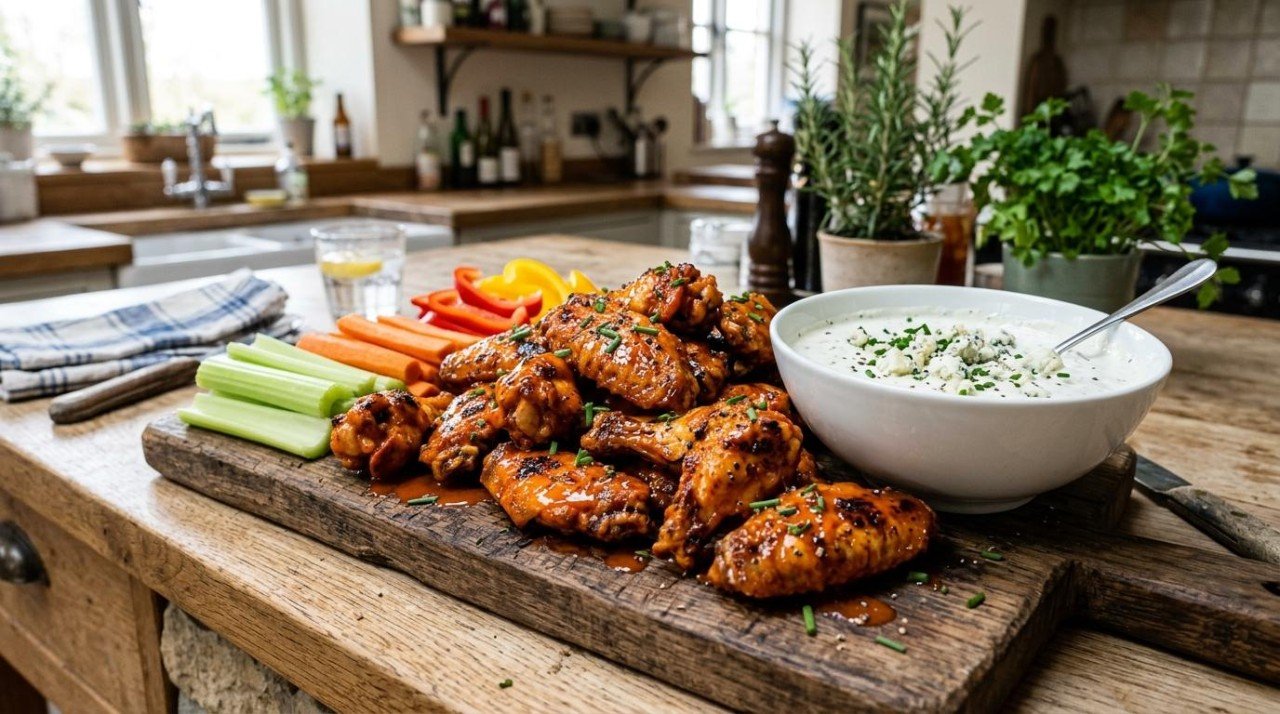
Buffalo wings are one of the few American dishes with a birth certificate. In 1964, at the Anchor Bar in Buffalo, New York, co-owner Teressa Bellissimo cooked leftover wings in hot sauce as a late-night snack and sent them out with celery sticks and blue cheese dressing. Six decades later the format has not changed at all, which is the highest compliment a recipe can get.
We ran a standard version through our Nutrition Score - two pounds of wings, deep-fried, tossed in a butter-and-hot-sauce emulsion, with bottled blue cheese and a couple of celery sticks on the side - and it came back at 35 out of 100.
We rebuilt it to 57. Same skin, same heat, same real blue cheese, 215 fewer calories a serving and nearly half the saturated fat. But the interesting part is which swaps did the work. The celery was worth more than anything else on the list. And skipping the deep fryer - the change every healthy-wings article leads with - was worth minus one point.
The standard platter: what is in it and how it scores
Here is the version we scored, built to serve four people as the main event:
- 2 lb of chicken wings, split and deep-fried (they pick up roughly 40 g of frying oil)
- 6 tablespoons of butter melted into 1/2 cup of cayenne pepper hot sauce
- 1/2 cup of bottled blue cheese dressing
- 2 stalks of celery, which mostly get moved around the plate
Per serving: about 768 calories, 42.5 g of protein, 67 g of total fat, 20 g of saturated fat, roughly 700 mg of sodium, and 0.6 g of fiber.
Before we take it apart, the genuine strengths. Wings are real chicken, not a formed product, and 42 g of protein per serving is a serious number - more than half a day's worth. The dish also delivers about 80% of a day's niacin and 66% of a day's vitamin B6. The hot sauce is essentially free: vinegar, cayenne, and salt, with no meaningful calories. Buffalo sauce is not the problem here, which is worth saying out loud because it is usually the first thing people try to cut.
What holds the score at 35 is short and specific:
- Saturated fat: 20 g per serving, 85% of a day's worth. Flagged very high. The AHA suggests keeping saturated fat under about 6% of calories, roughly 13 g a day on a 2,000-calorie diet. One serving passes that on its own, and close to half of it comes from the sauce rather than the chicken.
- Fiber: 0.6 g. On a 768-calorie plate. Adults need at least 25 to 35 g a day and most Americans get about 15.
- Vitamin C: flagged as a weakness. There is nothing green on the plate except a garnish nobody finishes.
- Plants: 1.25. That is the whole platter, on a 30-plants-a-week scale.
Notice what is not on that list. Sodium came in at about 30% of the daily limit - high, but not the disaster wings are usually accused of. And calories, at 768, are high but not out of line for a main course. The score is not punishing this dish for being fried chicken. It is punishing it for being a plate with no plants on it.
The upgrades: five swaps, 22 points
Each swap is scored on top of the one before it, in the order we made them, so the deltas add up to the real total. They are ordered by impact. If you only make one change, make the first one - and it is not the one you are expecting.
1. Make the vegetables a real part of the platter
- Swap: 2 sad celery stalks → 4 celery stalks, 3 carrots, and a large red bell pepper, all cut into sticks
- Score impact: +10 points (35 to 45)
- What it changes: Fiber from 0.6 g to 2.9 g, plants from 1.25 to 3.25, vitamin C from a flagged weakness to a strength
- What it costs you: Ten minutes of knife work. Nothing at the table.
This swap adds about 36 calories per serving and the score still goes up 10 points, more than any other change we made. The Nutrition Score is not a calorie counter - it cares what the food is made of, and a platter where a third of the volume is raw vegetables is a different food from a platter of chicken and dressing, whatever the calorie column says.
The technique that makes the difference is stupidly simple: cut them thick, cut them early, and store them in cold water in the fridge until serving. Celery and carrot sticks that have sat in ice water for an hour are snappy and cold, and people eat them the way they eat chips. Limp room-temperature celery is the reason this ingredient has a reputation as garnish. The red pepper is there because it carries most of the vitamin C, and because sweet crunch is a genuinely good foil for cayenne heat. Going from 1.25 plants to 3.25 on one platter also matters on its own terms - people who eat more than 30 different plants a week have measurably more diverse gut bacteria than people who eat 10 or fewer.
2. Build the blue cheese dip on Greek yogurt
- Swap: 1/2 cup bottled blue cheese dressing → 2/3 cup plain Greek yogurt whisked with 1/3 cup real crumbled blue cheese, lemon juice, and garlic powder
- Score impact: +5 points (45 to 50)
- What it changes: 83 fewer calories a serving, protein up from 43.5 g to 49 g, and the dip goes from mostly soybean oil to mostly dairy protein
- What it costs you: A slight tang. It is thicker and more assertively cheesy than the bottled kind.
Bottled blue cheese dressing is an oil emulsion with blue cheese in it. Homemade blue cheese dip is dairy with blue cheese in it. That distinction is worth 5 points, and note what it is not worth: saturated fat barely moved, from 20 g to 19.7 g, because we kept the same real cheese. The gain here is the oil leaving and the protein arriving, not the cheese getting lighter.
Mash about half the crumbles into the yogurt with a fork and leave the rest whole - you get a creamy base plus distinct pockets of blue cheese, which reads as more cheesy than the same amount stirred in smooth. The lemon juice matters: yogurt is tangier than mayonnaise-based dressing but flatter, and acid plus a little garlic powder gets it back to tasting like a dip rather than like yogurt. If you want other angles on this, our guides to mayonnaise substitutes and Greek yogurt substitutes cover the full range, including what to do if you dislike yogurt entirely.
3. Cut the butter in the sauce to a single tablespoon
- Swap: 6 tablespoons of butter → 1 tablespoon of butter plus 1 1/2 tablespoons of olive oil
- Score impact: +6 points (50 to 56)
- What it changes: Saturated fat from 19.7 g to 12.4 g per serving - from 84% of a day's worth down to 53%
- What it costs you: A thinner sauce. This is the swap with a real texture cost, and it needs technique to survive.
This is the biggest nutritional lever in the dish and the one most people skip, because butter is what makes Buffalo sauce Buffalo sauce. Six tablespoons across four servings is roughly 9 g of saturated fat per person before anyone has eaten a piece of chicken.
Here is why the last tablespoon stays. Buffalo sauce is an emulsion, and butter is the emulsifier: America's Test Kitchen ran a butter sauce two ways and found the emulsified version clung to food while the melted version slipped right off. So whisk the butter in cold, a piece at a time, off the heat, into the warmed hot sauce - do not just melt it. Then whisk in the olive oil, which carries the fat volume without the saturated fat. Be honest with yourself about the result: it is a looser sauce than a butter-heavy one, it clings to hot wings but not to cold ones, and you should toss and serve immediately. Our butter substitutes guide has the full ratio table if you want to push it further.
4. Rebuild the heat instead of pouring more hot sauce
- Swap: 1/2 cup hot sauce → 4 1/2 tablespoons hot sauce, 2 tablespoons apple cider vinegar, 1 1/2 teaspoons cayenne, and 1 1/4 teaspoons smoked paprika
- Score impact: +2 points (56 to 58)
- What it changes: Sodium from 26% to 23% of the daily limit, plant points from 3.5 to 4
- What it costs you: Nothing, if you taste as you go. It is arguably a better sauce.
Bottled hot sauce is the biggest sodium source you actually control in this dish. But the heat and the tang in that bottle come from cayenne and vinegar, and both are available separately without the salt. Cutting the bottled sauce by about 40% and replacing the volume with cider vinegar and ground cayenne keeps the burn and the acidity, and the smoked paprika adds a roasted depth that plain hot sauce does not have.
Only 2 points, but sodium is worth chasing where it is cheap: the AHA recommends no more than 2,300 mg a day, ideally 1,500, while Americans average over 3,100. We also do not salt the wings themselves at any point in this recipe. The sauce and the blue cheese carry plenty.
5. Bake them instead of deep-frying (and know what that is worth)
- Swap: Deep-fried → tossed in baking powder and baked on a rack, or air-fried
- Score impact: -1 point (58 to 57)
- What it changes: 89 fewer calories and 10 g less total fat per serving - but sodium rises from 23% to 30% of the daily limit
- What it costs you: Time, mostly. Done properly the skin is genuinely crisp.
This is the swap every healthy-wings article leads with, and on our scoring it goes backward. Two reasons. The frying oil that gets poured away was carrying unsaturated fat, and omega-3 ALA goes from a listed strength to a flagged weakness the moment the fryer comes out of the picture. And the baking powder that makes oven wings crisp is itself a sodium source - it gives back more than swap 4 saved. We found exactly the same thing with fried chicken: skipping the fryer is not automatically an upgrade.
Do it anyway. A point on the score is not worth much against 89 calories and 10 g of fat per serving, and it is the difference between wings you make on a Tuesday and wings you make twice a year. The technique that makes it work: pat the wings bone dry, toss them with baking powder (not baking soda), and bake on a wire rack so the fat drips away and air reaches every side. Baking powder raises the pH of the skin, which aids browning and draws out moisture; use the aluminum-free kind, because the other kind can leave a metallic flavor. Published recipes range from about 1/3 to 1 1/2 teaspoons per pound; we use 1 teaspoon per pound and would not go higher, because baking powder is a sodium source. A two-stage bake - 30 minutes at 250F to render the fat, then 425F to crisp - is what gets you shatter rather than chew.
What we kept on purpose
The skin stays. All of it. Skinless wings are not wings, and we did not bother scoring the idea - the skin is the entire texture of the dish.
The real blue cheese stays - 1/3 cup of it, not a low-fat imitation - because it is the flavor the dip is named after and a third of a cup across four people is not the problem.
And the last tablespoon of butter stays, which is a decision we can put a number on. We scored a version with no butter at all, the whole sauce built on olive oil: 61 points. That is 4 points above where we stopped. We left them on the table because at zero butter the sauce loses the dairy note and the emulsion that makes it cling, and at that point you have hot sauce on chicken rather than Buffalo wings. If you would rather have the 4 points, that version is right there and we are not going to argue with you.
Take the Guesswork Out of Eating Well
Eat Well Planner helps you organize your favorite recipes, plan balanced meals, and automatically generate shopping lists — all in one place. Whether you're tracking macros, managing dietary restrictions, or just trying to stop asking "what's for dinner?", we've got you covered.
Our AI-powered tools can adapt any recipe to your dietary needs, help you discover new meals you'll love, and even log your nutrition effortlessly. It's meal planning made simple.
Start Organizing Your Meals — FreeThe healthier version: 57 out of 100
Serves 4. About 20 wing pieces with dip and a vegetable platter.
- 2 lb (900 g) chicken wings, split into drumettes and flats
- 2 teaspoons aluminum-free baking powder
- 4 1/2 tablespoons (70 g) cayenne pepper hot sauce, such as Frank's RedHot
- 2 tablespoons apple cider vinegar
- 1 tablespoon cold butter, cut into small pieces
- 1 1/2 tablespoons olive oil
- 1 1/2 teaspoons cayenne pepper, or to taste
- 1 1/4 teaspoons smoked paprika
- 2/3 cup (150 g) plain Greek yogurt
- 1/3 cup (40 g) crumbled blue cheese
- 2 teaspoons lemon juice
- 1/2 teaspoon garlic powder
- 4 celery stalks (200 g), cut into sticks
- 3 medium carrots (200 g), cut into sticks
- 1 large red bell pepper (150 g), cut into strips
- Pat the wings completely dry with paper towels. Toss them with the baking powder until every piece has a thin, even dusting, then arrange them skin side up and not touching on a wire rack set over a rimmed baking sheet. If you have time, leave them uncovered in the fridge for 1 to 8 hours - the drier the skin, the crisper the result.
- Heat the oven to 250F. Bake the wings on a lower-middle rack for 30 minutes to render the fat out of the skin.
- Raise the oven to 425F, move the pan to an upper-middle rack, and bake 40 to 50 minutes more, turning the wings once, until deep golden and audibly crisp. (Air fryer: skip the low-temperature stage and cook at 400F for 20 to 25 minutes, shaking the basket a couple of times.)
- While they bake, make the dip: mash half the blue cheese into the Greek yogurt with a fork, then stir in the rest along with the lemon juice and garlic powder. Refrigerate until serving.
- Cut the celery, carrots, and bell pepper into thick sticks and keep them in a bowl of cold water in the fridge. Drain just before serving.
- Make the sauce in the last five minutes: warm the hot sauce, vinegar, cayenne, and smoked paprika in a small saucepan over low heat. Take it off the burner and whisk in the cold butter one piece at a time until glossy, then whisk in the olive oil.
- Tip the hot wings into a large bowl, pour the sauce over, and toss hard to coat. Serve immediately, with the dip and the vegetable platter alongside.
Per serving, original versus improved:
- Nutrition Score: 35 → 57
- Calories: 768 → 553
- Protein: 42.5 g → 49.1 g
- Total fat: 67 g → 36 g
- Saturated fat: 20 g (85% DV) → 11.1 g (47% DV)
- Fiber: 0.6 g → 3.3 g
- Sodium: about 700 mg → about 700 mg
- Plants: 1.25 → 4
That sodium line is not a typo. Cutting the bottled hot sauce saved about 80 mg a serving, and the two teaspoons of baking powder added roughly 180 mg back. If sodium is your priority, deep-fry them after all, or skip the baking powder and rely on an overnight air-dry in the fridge for crispness - either route lands closer to 520 mg a serving.
The improved version also picks up nutrient highlights it did not have before: good source of fiber, excellent source of vitamin C (67% DV), vitamin A (65% DV), protein (61% DV), and calcium (34% DV).
Swaps we tested and skipped
Cauliflower "wings." We scored the identical build with cauliflower in place of the chicken: 58. One point above our actual wings. For that one point you give up 38 g of protein per serving - it drops from 49 g to 11 g - and you are eating a different dish. Cauliflower wings are a genuinely good snack. They are not a healthier version of Buffalo wings, they are a substitute for Buffalo wings, and the score does not think much of the trade.
Serving less chicken. Dropping from 2 lb to 1.5 lb of wings cut saturated fat from 11.1 g to 9.7 g per serving and moved the score to 56 - one point down, because protein per serving fell with it. Shrinking the portion is the intuitive move and it does nothing here. Fix what is on the wings, not how many there are.
Low-fat blue cheese. We did not bother scoring this one, and that is the honest reason it is here: the blue cheese in the whole dip works out to roughly 2 g of saturated fat per serving. There is nothing there worth chasing.
Make it fit other diets
- Dairy-free: drop the tablespoon of butter and build the sauce entirely on olive oil - on its own that change scores 61 - then make the dip with a thick unsweetened plant yogurt plus a dairy-free blue-style cheese, or skip the dip and serve a cashew-lemon sauce.
- Gluten-free: this recipe already is - just check your hot sauce and baking powder labels, since both occasionally sneak in wheat-derived ingredients.
- Vegetarian: the cauliflower version above, with the dip and platter as written. Add a bowl of edamame to claw back some of the protein.
In Eat Well Planner you do not have to work any of these out by hand. Ask the AI recipe chat to make this dairy-free and it rewrites the whole recipe with the swaps already in place, then rescores it so you can see what the variation cost or gained.
Do this to your own recipes
Every number in this post came out of the app. We built the original in the Recipe Playground, changed one thing at a time, and watched the score move - which is how we found out the celery was worth 10 points and the air fryer was worth minus one. That is the whole method, and it works on anything you cook.
Import a recipe from a URL, an Instagram reel, or a YouTube video and Eat Well Planner scores it automatically. Then Make It Healthier proposes swaps like these, with a calculator verifying the real nutritional gain before a suggestion is ever shown to you - so you find out which changes actually matter for the dish in front of you, instead of guessing that it must be the frying.