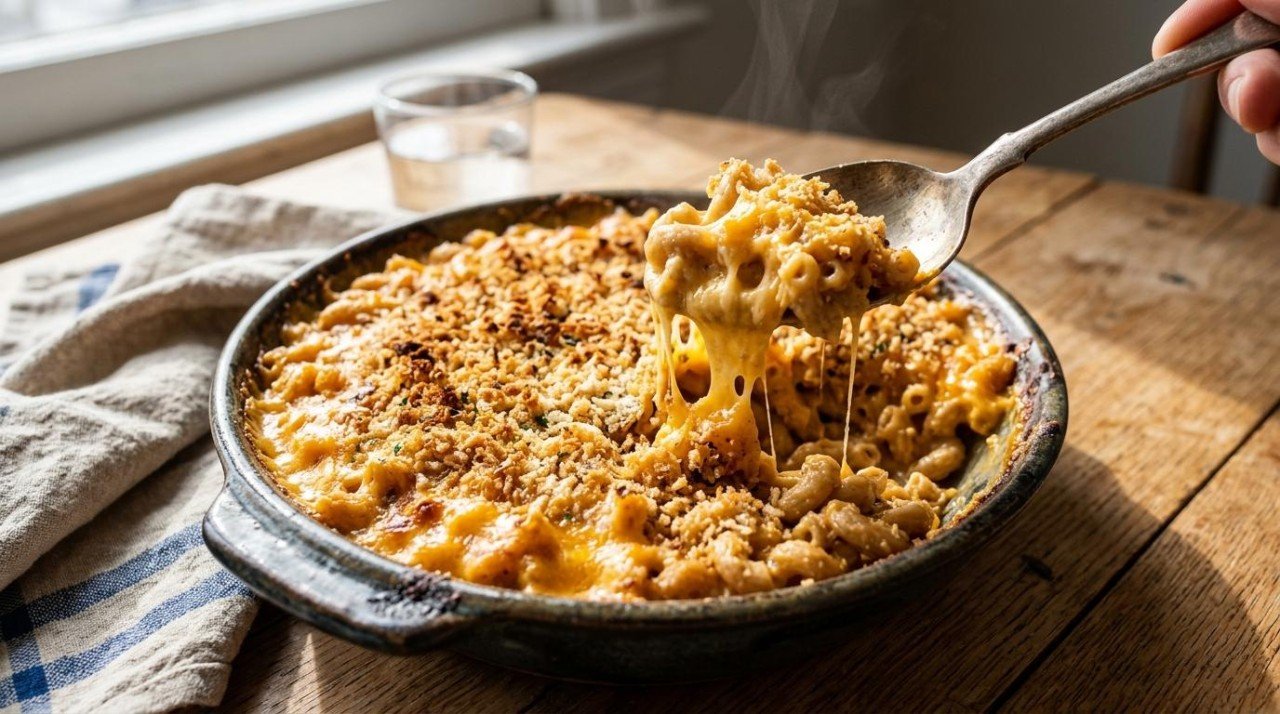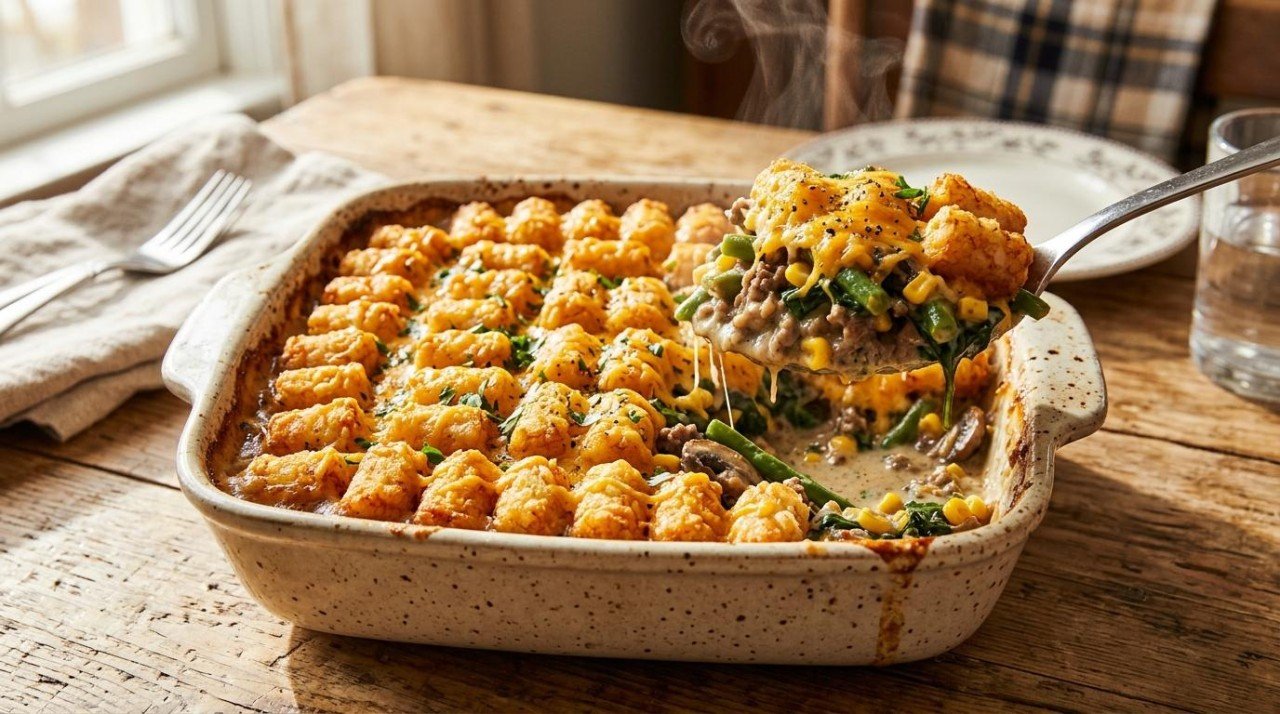
Tater tot casserole is a dish that shows up when people need feeding. Church basements, funeral lunches, the night after a new baby comes home. In Minnesota and the Dakotas it is called hotdish, and the format goes back to the 1930s — the first written record is generally credited to a 1930 Mankato church cookbook, back when the starch was macaroni. The tots arrived later and never left, because a lid of crisp golden potato over a creamy beef filling is a genuinely great idea.
So we ran a standard version through Eat Well Planner's Nutrition Score — the same number a visitor sees on any public recipe page. It came back 35 out of 100, with sodium and saturated fat both flagged at over half a day's value in one serving.
We rebuilt it to 61. The tot layer is still there, still crisp, still covering the whole pan. And here is the part that surprised us: we tested cutting the tots twice, once at the start of the build and once at the end. Both times the score moved by exactly zero points. The tots were never the problem.
The original: what's in it and how it scores
Here is the standard version we scored, for eight people:
- 1 lb ground beef
- 1 medium yellow onion, chopped
- 1 can (10.5 oz) condensed cream of mushroom soup
- 1/2 cup whole milk
- 2 cups (8 oz) shredded cheddar
- 1 bag (32 oz) frozen tater tots
- 1/2 teaspoon salt, 1/2 teaspoon black pepper
Nutrition Score: 35/100. Per serving that is about 549 calories, 20.3 g protein, 3.2 g fiber, 11.9 g saturated fat, and 1,280 mg sodium. Three things hold it back:
- Sodium, flagged very high at 56% of a day's value in one helping. The Dietary Guidelines cap sodium at less than 2,300 mg a day, so a single serving of this uses up more than half of it before anything else you eat. The canned soup is the loudest offender, but the tots and the cheese are quietly right behind it.
- Saturated fat, also flagged very high at 51% of a day's value — 11.9 g, against a guideline of less than 10 percent of daily calories. Eight ounces of cheddar and a pound of regular ground beef account for nearly all of it.
- Almost nothing green. 3.2 g of fiber, and 2.25 plant points out of a weekly target of 30. Onion is the only vegetable in the pan, and half a small onion per person is not a vegetable serving.
What is already fine, though, is more than you would guess. Per serving the original is an excellent source of vitamin B12 (67% DV), phosphorus (47%), zinc (36%), vitamin B6 (36%), niacin (30%), iron (23%), riboflavin (23%), and thiamine (21%), with 20.3 g of protein. That is the beef and the dairy doing real work. Nobody needs to apologize for this dish. It is dense in things people are often short of — it is just carrying too much sodium and saturated fat along with them.
The upgrades
Six changes, tested one at a time in this order, each built on the last. The score deltas below are cumulative — they are what each swap was worth at that point in the build. If you only make one change, make the first one. It is worth more than the next three combined.
1. Build actual vegetables into the base
- Swap: Add 10 oz green beans, 1 cup frozen corn, and 2 packed cups baby spinach to the meat layer
- Score impact: +10 points (35 to 45)
- What it changes: Fiber from 3.2 g to 4.8 g, plant points from 2.25 to 5.25, and vitamin K becomes one of the score's three listed strengths
- What it costs you: Nothing. Green beans in hotdish are traditional — you are arguably making it more authentic
This is the single biggest lever in the whole post, and it is an addition rather than a subtraction. Nothing gets taken away from anyone's plate. Plenty of old hotdish recipes already call for a can of green beans, so if this feels like an outsider's idea, it is not.
The spinach is the sneaky part. Two packed cups look like a lot in the bowl and disappear to nothing in the pan, and they are what pushed vitamin K into the score's top three strengths — the original had too little to register on the label at all, the finished version delivers 48% of a day's value. Chop it roughly and stir it in at the end of the vegetable step — nobody has ever picked spinach out of a tater tot casserole, because by then it is not visible. The three vegetables together also more than double the plant points, which matters if you are chasing the 30-plants-a-week pattern the American Gut Project associated with more diverse gut bacteria.
2. Ditch the canned soup for a scratch mushroom sauce
- Swap: Canned condensed cream of mushroom soup + 1/2 cup milk → 8 oz cremini mushrooms, 1 tbsp butter, 3 tbsp flour, 1 2/3 cups milk, garlic powder, thyme
- Score impact: +1 point (45 to 46)
- What it changes: Sodium drops from 56% to 46% of a day's value; sodium stops being the recipe's worst flag
- What it costs you: Six minutes and one extra pan-washing. The sauce is better
One point. This is the swap every healthy-casserole article leads with, and on its own it moved the needle almost not at all — because trading a can of soup for a butter-and-flour sauce with real cheese in it swaps sodium for saturated fat, and the score notices both. Sodium fell by 230 mg a serving, which is real, but saturated fat went up slightly and the two roughly canceled.
We kept it anyway, for two reasons. First, it changed which problem was biggest: after this swap saturated fat became the top flag, which is what made swaps 3 and 4 pay off the way they did. Second, it tastes better, and browned cremini in a thyme-scented béchamel is not a sacrifice. Cook the mushrooms with the beef until the pan goes dry and the edges brown — that is where the savory depth comes from, and skipping it is the only way this version comes out worse than the can. If you want the sauce technique on its own, we used the same roux-and-milk approach in the healthier beef stroganoff. And if you need to build it without dairy milk, the milk substitutes guide covers which ones actually thicken.
3. Less beef, leaner beef, stretched with the mushrooms
- Swap: 1 lb regular ground beef → 12 oz lean (90/10) ground beef, with the mushrooms making up the bulk
- Score impact: +4 points (46 to 50)
- What it changes: Saturated fat from 12.8 g to 11.3 g per serving, sodium down another 180 mg, 46 fewer calories
- What it costs you: Less than you think, because the mushrooms are already in the pan doing the job
A quarter less beef sounds like the swap that gets noticed, and it would be if the pan were emptier. It is not — there are eight ounces of finely chopped mushrooms in there, and that is the whole trick. Mushrooms are the standard partner for this because they bring glutamates that read as meaty. A 2014 study in the Journal of Food Science found that a taco blend with 50 to 80 percent of the beef replaced by mushrooms had enhanced overall flavor, and that the 80-percent-mushroom blend with 25 percent less salt matched the flavor intensity of the full-salt version.
Chop the mushrooms fine — pea-sized, not sliced — so they melt into the texture of the meat rather than sitting in it as separate pieces. If beef is not what you have, the ground beef substitutes guide covers what else fills the slot and what each swap changes.
4. Measure the cheese, and make it sharp
- Swap: 2 cups (8 oz) mild shredded cheddar → 1 cup (4 oz) sharp cheddar
- Score impact: +6 points (50 to 56)
- What it changes: Saturated fat from 11.3 g to 8.6 g per serving, 58 fewer calories, sodium down another 100 mg
- What it costs you: This one you will notice — but less than halving it suggests
Second-biggest swap in the build, and the only one with a genuine flavor cost. Halving the cheese is halving the cheese. What makes it survivable is going sharp: cheddar aged longer has had more time for its proteins to break down into the amino acids that read as savory and tangy, so four ounces of a good sharp cheddar carries further than eight ounces of the mild orange stuff.
Split it, too. Stir half into the hot sauce off the heat, where it makes the filling creamy and gets tasted in every bite, and scatter the other half over the tots for the last five minutes of baking, where it gets seen. Cheese you can see is doing a different job than cheese you can taste, and four ounces can just about do both if you spend it in two places. The cheddar substitutes guide has the other options if sharp cheddar is not in the fridge.
5. The tot layer: we cut it, and nothing happened
- Swap: 32 oz bag of tots → 24 oz, a complete single layer
- Score impact: +0 points (56 to 56)
- What it changes: 67 fewer calories and 120 mg less sodium per serving — but also less fiber and potassium, and the score treats it as a wash
- What it costs you: Nothing at 24 oz. Below that, the dish
This is the section the whole post exists for. Every version of this recipe on the internet tells you to cut back on the tots, and we tested it twice. Early in the build, halving them from 32 oz to 16 oz scored 35 — exactly where we started. At the end of the build, dropping from 32 oz to 24 oz scored 56, exactly where we already were. Twice, the change everyone assumes is the point of the exercise bought precisely nothing.
It makes sense once you look at what the tots actually contribute. They are the only ingredient here with meaningful potassium and a share of the fiber, so removing them takes something out along with the fat and salt, and the score reads the whole picture rather than the calorie count alone. We settled on 24 oz because it is a complete single layer over a 9x13 pan with none of the doubling-up that makes the middle ones steam instead of crisp. You could put the whole 32 oz bag back and the number would not move.
Take the Guesswork Out of Eating Well
Eat Well Planner helps you organize your favorite recipes, plan balanced meals, and automatically generate shopping lists — all in one place. Whether you're tracking macros, managing dietary restrictions, or just trying to stop asking "what's for dinner?", we've got you covered.
Our AI-powered tools can adapt any recipe to your dietary needs, help you discover new meals you'll love, and even log your nutrition effortlessly. It's meal planning made simple.
Start Organizing Your Meals — Free6. Add a can of white beans
- Swap: Stir one 15 oz can of white beans, drained and rinsed, into the filling
- Score impact: +5 points (56 to 61)
- What it changes: Fiber from 4.5 g to 6.0 g, protein back up to 20.5 g, iron becomes a top-three strength, plant points to 6.75
- What it costs you: Nothing detectable. They read as texture, not as beans
The last five points came from the cheapest ingredient in the recipe. White beans in a creamy beef filling go almost unnoticed — they are soft, mild, and about the size of the corn already in there — and they put back the protein the smaller beef portion cost us, which is why the improved version lands at essentially the same protein as the original with a third less meat.
The fiber gain is the real story: 6.0 g per serving, up from 3.2. Most Americans get about 15 g of fiber a day against a recommendation of 25 to 35 g, and Harvard's Nutrition Source links higher intakes to lower heart disease risk, better blood sugar control, and greater fullness after eating. Rinse the beans well — the scored version used them unrinsed, so the real sodium is likely a little lower than the number we published.
What we kept (on purpose)
The full tot layer, obviously. Real cheddar, not a low-fat version — the melt is the point, and the measured amount of the good stuff beat a bigger pile of the diet stuff in every version we tried. A tablespoon of real butter in the roux, because a béchamel wants it and one tablespoon across eight servings is not what is driving the numbers. And beef, ground and browned, because the B12, zinc, and iron in the original score are the beef and we were not interested in a version without it.
We stopped at 61. The obvious next move would be dropping the cheese to two ounces or the beef to eight, and at that point you are eating a vegetable bake with tots on it, which is a fine dinner and a different recipe.
The healthier version: full recipe
Nutrition Score: 61/100. Serves 8.
- 12 oz (340 g) lean ground beef (90/10)
- 8 oz (227 g) cremini mushrooms, chopped fine
- 1 medium yellow onion (about 1 cup chopped)
- 10 oz (300 g) green beans, cut into 1-inch pieces (frozen is fine)
- 1 cup (150 g) frozen corn
- 2 packed cups (60 g) baby spinach, roughly chopped
- 1 can (15 oz) white beans, drained and rinsed
- 1 tablespoon butter
- 3 tablespoons all-purpose flour
- 1 2/3 cups milk
- 1/2 teaspoon garlic powder
- 1/2 teaspoon dried thyme
- 4 oz (1 cup) sharp cheddar, shredded, divided
- 24 oz (680 g) frozen tater tots
- 1/2 teaspoon salt, 1/2 teaspoon black pepper
- Heat the oven to 425F.
- Brown the beef with the mushrooms and onion in a 12-inch ovenproof skillet over medium-high heat, breaking up the meat, 10 to 12 minutes. Keep going past the point where the mushrooms release their water — you want the pan dry and the edges browned. Drain off any fat.
- Stir in the green beans and corn and cook 3 minutes. Add the spinach a handful at a time until wilted, then the white beans, salt, and pepper. Scrape it all into a bowl and set aside.
- Melt the butter in the same pan over medium heat. Whisk in the flour and cook 1 minute, until it smells toasty. Whisk in a splash of the milk until completely smooth, then the rest. Simmer, whisking, 3 to 4 minutes, until it thickens enough to coat a spoon.
- Off the heat, stir in the garlic powder, thyme, and half the cheddar. Return the meat and vegetables to the pan and stir to combine, then spread level. (Or transfer everything to a 9x13 baking dish.)
- Arrange the frozen tots over the top in a single layer, edges touching but never overlapping. Do not thaw them, and do not cover the dish — covering traps steam and the tots go soft.
- Bake 30 to 35 minutes, until the tots are deep golden and the filling bubbles at the edges. Scatter the remaining cheddar over the top and bake 5 minutes more.
- Let it sit 10 minutes before serving so the filling sets.
Per serving, original vs. improved:
- Nutrition Score: 35 → 61
- Calories: 549 → 464
- Protein: 20.3 g → 20.5 g
- Fiber: 3.2 g → 6.0 g
- Saturated fat: 11.9 g (51% DV) → 7.9 g (34% DV)
- Sodium: 1,280 mg (56% DV) → 770 mg (33% DV)
- Plant points: 2.25 → 6.75
The improved version rates as an excellent source of vitamin B12 (56% DV), phosphorus (50%), vitamin K (48%), biotin (46%), iron (40%), vitamin B6 (39%), niacin (36%), zinc (35%), riboflavin (35%), potassium (27%), protein (25%), calcium (23%), folate (22%), fiber (20%), and magnesium (20%) — most of which the original also delivered, now without the sodium bill.
Swaps we tested and skipped
- Halving the tots (16 oz instead of 32). Scored 35 — no change at all — and it turns the lid into a scattering. Rejected on both counts.
- Shredded roasted potato instead of tots. This one actually worked: swapping the tot layer for 1 1/2 lb of shredded russet tossed with a tablespoon of olive oil scored 65, nine points above our final version, and cut saturated fat to 6.2 g. We rejected it anyway. A crisp shredded-potato crust is a good casserole and it is not tater tot casserole, and a makeover that has to delete the title ingredient to win is not a makeover. If you want those nine points and do not mind losing the tots, the swap is right there and it is genuinely delicious.
- Low-fat cheddar. Not scored in the end, because it failed the kitchen test first — it never gave us the browned, pulled top that four ounces of real sharp cheddar does. Measuring good cheese beat stretching bad cheese every time.
Make it fit other diets
- Gluten-free: replace the roux with 2 tablespoons cornstarch whisked into cold milk, and check the tot bag — most are gluten-free, but not all.
- Dairy-free: unsweetened plain soy milk thickens closest to dairy in a roux; the cheese is the harder loss, so lean on extra mushrooms and a teaspoon of Dijon for savoriness.
- Vegetarian: drop the beef, double the mushrooms to 1 lb, and add a second can of beans — brown lentils work too.
In the app, any of these is one step: open the recipe, ask Recipe Variations for a gluten-free or vegetarian rewrite, and you get a full version with the swaps already worked into the ingredient list and the instructions, rather than a note telling you to figure it out.
Do this to your own recipes
Every number in this post came out of Eat Well Planner. We scored the original, changed one thing, scored it again, and kept whatever earned its place — which is exactly why we can tell you the tot swap is worth nothing and the green beans are worth ten points, instead of guessing like everyone else.
You can run the same process on the recipe your family actually makes. Import it from a URL, an Instagram reel, or a photo of a recipe card, and the Nutrition Score tells you where it stands and which factors are dragging. Make It Healthier then proposes swaps for that specific recipe, with a calculator verifying the real nutritional gain before a suggestion is ever shown to you. And if you want to argue with it — keep the full pound of beef, put the whole bag of tots back — the Recipe Playground lets you change ingredients and watch the score move per edit, so you can see what your version costs and make it up somewhere else.
Your grandmother's hotdish does not need to be replaced. It needs green beans.