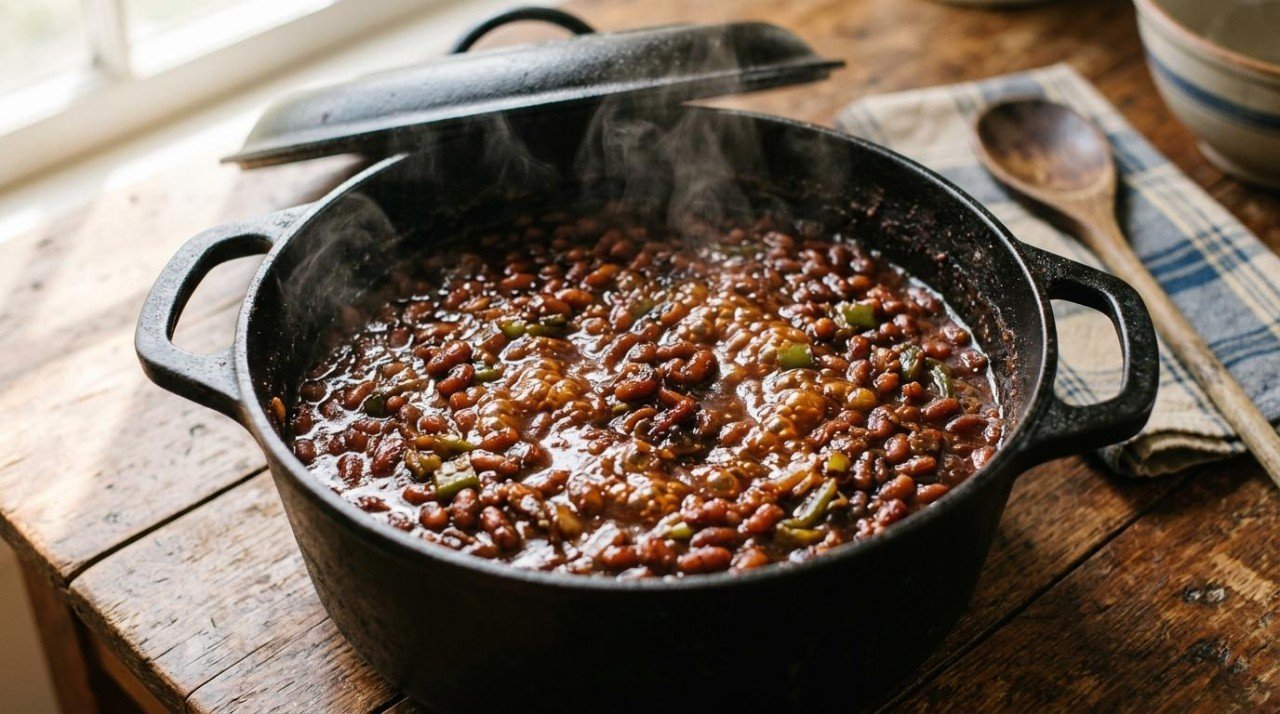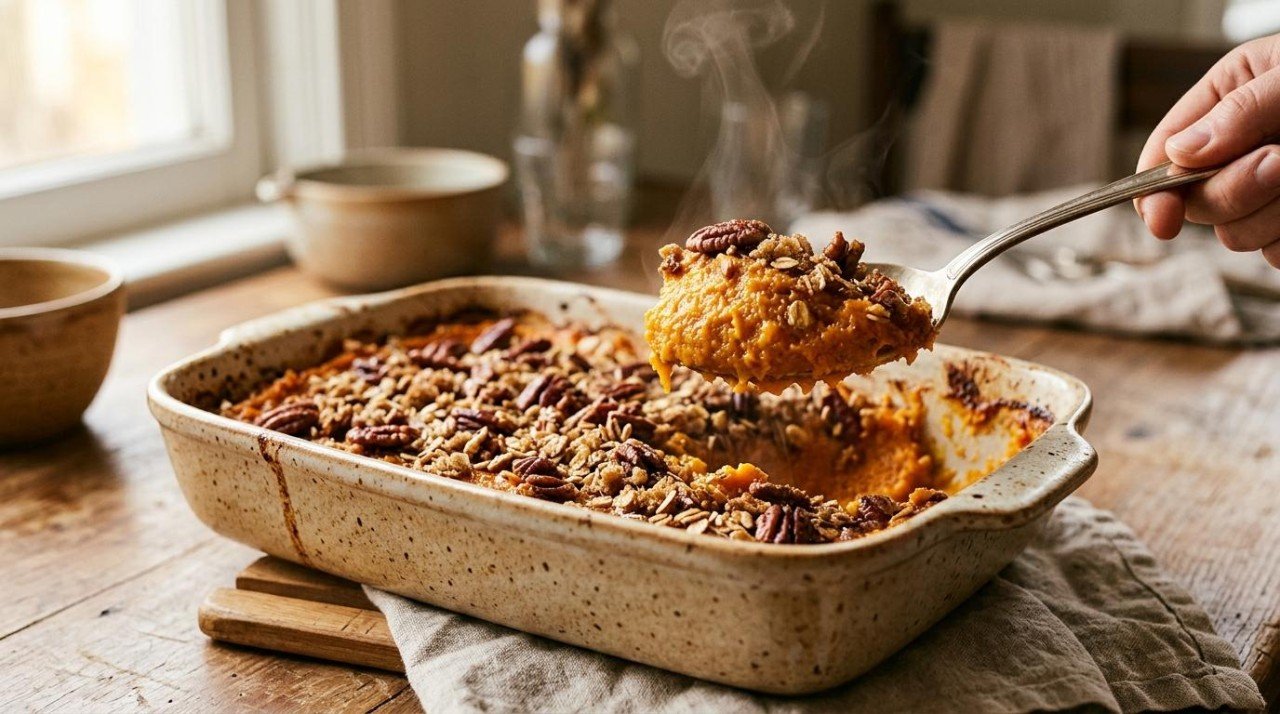
Sweet potato casserole is the dish that always confuses me a little. A sweet potato is one of the genuinely great vegetables — orange-fleshed ones are one of the top sources of beta-carotene there is. And then, once a year, we mash it with a stick of butter, three quarters of a cup of brown sugar, and a bag of marshmallows, and serve it next to the turkey as a side dish.
That is not an accident of taste, by the way. The marshmallow topping was invented as an ad. In 1917 the Angelus Marshmallows company hired Janet McKenzie Hill, founder of the Boston Cooking School Magazine, to write a booklet of recipes using their product, and it contained the first documented appearance of mashed sweet potatoes baked with a marshmallow topping. A hundred years later it is a tradition.
We ran the standard version through our Nutrition Score and got 34 out of 100. Then we rebuilt it to 73 — still a scoopable, spiced, orange-gold casserole with a crunchy sweet topping, still worth putting on the table. Here is every swap, what each one was actually worth, and the point where we stopped on purpose.
The standard casserole: what is in it and how it scores
The version we scored is the one most recipes land on, built to serve ten as a side:
- 3 lb of sweet potatoes, peeled, boiled, and mashed
- 1 stick (1/2 cup, 113 g) of butter
- 3/4 cup packed brown sugar
- 1/2 cup evaporated milk
- 2 eggs, 1 teaspoon vanilla, 1 teaspoon cinnamon, 1/2 teaspoon salt
- 4 cups (about 7 oz) of mini marshmallows over the top
Per serving that comes out at 348 calories, 4.7 g protein, 57.6 g of carbohydrate, 3.8 g of fiber, 11.8 g of fat, and about 220 mg of sodium.
Before the diagnosis, the good news, because there is a lot of it. This dish is not junk. Even in its most sugared form it lands as an excellent source of vitamin A, and a serving carries 22% of a day's potassium and 23% of a day's vitamin C. The sweet potato underneath all of that is still doing real work. Sodium is genuinely fine at 220 mg, which is rare for a holiday side. Nothing here is ultra-processed except the marshmallows.
The problem is one number, and it is a big one:
- Added sugar: 28 g per serving — 106% of a day's reference amount. Flagged very high. One scoop of a side dish is a full day of added sugar. For context, the American Heart Association's ceiling is 24 g a day for women and 36 g for men, and this is before anyone touches the pie.
- Saturated fat: 6.2 g, 26% of a day's worth. Flagged high. That is the stick of butter.
- Fiber: 3.8 g. Not bad, but peeling the potatoes throws some away, and there is nothing else in the dish contributing any.
- Plants: 1.25 different plants in the entire casserole. Sweet potato, and a dusting of cinnamon.
The sugar arrives twice — once as brown sugar stirred into the mash, once as marshmallows on top — which turns out to be the whole story of this makeover. We tested each source on its own against the untouched original, and neither did much: cutting the brown sugar alone scored 38, and cutting the butter alone also scored 38. Four points each. When a dish is 106% of a day's added sugar, removing one of the two sugar sources just leaves you sitting on the other one. They only pay out when they go together.
The upgrades: four swaps, 39 points
Each swap below is scored on top of the one before it, in the order we made them, so the deltas add up to the real total. If you only make one change, make the first one — it is the biggest single mover when applied on its own, and it is the one people notice least.
1. A pecan-oat crumble instead of the marshmallows
- Swap: 4 cups mini marshmallows → 3/4 cup chopped pecans + 1/2 cup rolled oats + 1 tablespoon maple syrup + 1 tablespoon of butter
- Score impact: +6 points (34 to 40)
- What it changes: Added sugar from 28 g to 17.2 g per serving; fiber from 3.8 g to 4.8 g; plant points from 1.25 to 3.25
- What it costs you: The toasted marshmallow ceiling, which for some families is the entire point. You gain crunch, which the original does not have at all.
Marshmallows are about 60% sugar by weight, and 7 oz of them across ten servings is 12 g of added sugar per person doing nothing but sitting on top. Pecans and oats put back texture and bring their own case: nuts are one of the most consistently good bets in nutrition research, with people eating an ounce five or more times a week showing a 14% lower risk of cardiovascular disease in a cohort of over 210,000 health professionals.
Worth flagging honestly: this swap raises calories, from 348 to 371 a serving, because pecans are dense. The score went up anyway, because 23 calories of pecan is not the same thing as 23 calories of marshmallow. If calories are your main lever rather than food quality, swap 3 is the one you want.
2. Orange instead of brown sugar
- Swap: 3/4 cup packed brown sugar → 1/4 cup fresh orange juice + the finely grated zest of 1 orange
- Score impact: +12 points (40 to 52)
- What it changes: Added sugar from 17.2 g to 1.2 g per serving — the caution flag clears entirely; 60 fewer calories; plant points to 4.25
- What it costs you: Real sweetness, if you make it without changing anything else. This swap only works if you also change how you cook the potatoes.
This is the swap that needs a technique to survive, and the technique is: roast the sweet potatoes whole in their skins instead of peeling and boiling them. Sweet potatoes contain beta-amylase, an enzyme that converts their starch into maltose as they heat. It is temperature-sensitive — one study of sweet potato varieties found activity relatively stable at 65 degrees C and largely destroyed by 85 degrees C, with maltose climbing as the flesh passed through that window. A slow roast walks the inside of the potato up through that range for an hour. Boiling water blasts past it. Same vegetable, noticeably different sweetness.
Two honest caveats. First, the score does not know how you cooked the potato — the +12 here is entirely the sugar coming out, and roasting is what makes that removal taste acceptable rather than punishing. Second, Harvard's Nutrition Source notes that boiling with the skin on retains beta-carotene well, so roasting is a flavor decision, not a nutrient one. We think it is worth it, because it is the difference between cutting the sugar and getting away with it.
The orange does the rest. Zest carries aromatic oils that read as sweetness without any sugar at all, and the juice's acidity sharpens everything the cinnamon and vanilla are doing. If you want to keep a little brown sugar for the sake of it, we scored that too: 2 tablespoons stirred back into the finished recipe drops it from 73 to 66. Seven points for two tablespoons across ten servings. (Our brown sugar substitutes guide covers the rest of the options if you would rather swap than cut.)
3. Three tablespoons of butter instead of a stick
- Swap: 1/2 cup (113 g) butter → 3 tablespoons (42 g), split between the mash and the crumble
- Score impact: +17 points (52 to 69)
- What it changes: Saturated fat from 6.8 g to 3.5 g per serving, clearing the last caution flag; 53 fewer calories; sodium from 200 mg to 160 mg
- What it costs you: Less than you would think, because the roasted sweet potato is already rich and the pecans bring their own fat.
The biggest single delta in the build, and it lands here rather than first for the same reason the sugar cut was only worth 4 points on its own: with a very-high added sugar flag still active, a saturated fat improvement has nowhere to show up. Clear the sugar and the fat swap suddenly counts for triple.
Technique matters more than quantity. Beat 2 tablespoons into the sweet potato while it is still hot, so it emulsifies through the whole mash, and save the last tablespoon for the crumble, where melted butter is what makes oats and pecans clump and toast instead of scattering. (See our butter substitutes guide if you want to push further, though see below for what that is actually worth here.)
4. Greek yogurt instead of evaporated milk
- Swap: 1/2 cup evaporated milk → 1/2 cup plain Greek yogurt
- Score impact: +4 points (69 to 73)
- What it changes: Protein from 5.8 g to 6.2 g per serving, saturated fat from 3.5 g to 3.1 g, 8 fewer calories
- What it costs you: A slight tang, which honestly improves the dish now that the sugar is gone.
The smallest swap on the list, included because it is free and because it pulls in the same direction as the orange: a casserole this sweet used to need no acidity at all, and one that is not sugared benefits from a little. Yogurt proteins are fragile because of the lactic acid already in them, and clump when heated — but that is a risk in thin sauces, not here. A mash this starchy, bound with egg, holds it fine. Stir it in when the potato has cooled to warm rather than steaming, and it will not break. (Both our evaporated milk and Greek yogurt guides cover the swaps in either direction.)
Take the Guesswork Out of Eating Well
Eat Well Planner helps you organize your favorite recipes, plan balanced meals, and automatically generate shopping lists — all in one place. Whether you're tracking macros, managing dietary restrictions, or just trying to stop asking "what's for dinner?", we've got you covered.
Our AI-powered tools can adapt any recipe to your dietary needs, help you discover new meals you'll love, and even log your nutrition effortlessly. It's meal planning made simple.
Start Organizing Your Meals — FreeWhat we kept, and where we stopped
The 3 tablespoons of butter stay. We priced that decision: dropping them entirely takes the casserole from 73 to 77. Four points, for the ingredient that makes a mashed root vegetable taste like a holiday side rather than baby food. We would rather have the butter, and now you know exactly what it costs instead of having to guess.
The tablespoon of maple syrup in the crumble stays too — it is the only added sugar left in the dish at 1.2 g a serving, and it is doing structural work, binding the oats and pecans so they toast into clusters. And the pecans stay at a generous 3/4 cup, because the crunch is what replaces the marshmallow experience, not just the marshmallow calories.
The healthier version: full recipe (scores 73/100)
Serves 10. Roasted sweet potato mashed with orange, cinnamon and Greek yogurt, under a toasted pecan-oat crumble.
For the filling
- 3 lb orange-fleshed sweet potatoes (about 4 medium), scrubbed, left whole and unpeeled
- 2 tablespoons unsalted butter
- 1/2 cup plain Greek yogurt
- 2 large eggs, beaten
- 1/4 cup fresh orange juice
- Finely grated zest of 1 large orange
- 1 teaspoon vanilla extract
- 3/4 teaspoon ground cinnamon
- 1/2 teaspoon fine salt
For the topping
- 3/4 cup pecans, roughly chopped
- 1/2 cup old-fashioned rolled oats
- 1 tablespoon unsalted butter, melted
- 1 tablespoon maple syrup
- 1/4 teaspoon ground cinnamon
- Pinch of salt
- Put the whole sweet potatoes on a foil-lined baking sheet and place them in a cold oven. Set it to 350 degrees F and roast for 60 to 75 minutes, until a knife slides through with no resistance and syrup is leaking onto the foil. Starting cold gives the enzymes longer in the range where starch turns to maltose.
- Let the potatoes cool until you can handle them, then split them and scoop the flesh into a large bowl. Discard the skins. Mash until smooth.
- Beat in the 2 tablespoons of butter while the potato is still hot, then the orange juice, zest, vanilla, cinnamon and salt. Taste — it should already taste sweet. Let it cool to just warm.
- Stir in the Greek yogurt, then the beaten eggs, until evenly combined.
- Spread the mixture into a lightly buttered 9 x 13-inch or 2-quart baking dish and smooth the top.
- Toss the pecans, oats, melted butter, maple syrup, cinnamon and salt together until the oats look damp, then scatter the crumble evenly over the casserole.
- Bake at 350 degrees F for 25 to 30 minutes, until the filling is set and the topping is golden and fragrant. Tent with foil if the pecans darken before the center sets.
- Rest for 10 minutes before serving.
Per serving, original vs. improved:
- Nutrition Score: 34 → 73
- Calories: 348 → 250
- Added sugar: 28.0 g (106% of a day, flagged very high) → 1.2 g (no flag)
- Saturated fat: 6.2 g (26%, flagged high) → 3.1 g (no flag)
- Fiber: 3.8 g → 4.9 g
- Protein: 4.7 g → 6.2 g
- Sodium: 220 mg → 160 mg
- Different plants: 1.25 → 4.25
The finished casserole carries no caution flags at all, and registers as an excellent source of vitamin A, vitamin C and potassium, and a good source of fiber, phosphorus, riboflavin, thiamine, vitamin B6, biotin, magnesium, iron, choline and zinc. Gut health went from 40 to 87 on the app's dimension breakdown; heart health from 35 to 65. On fiber specifically, 4.9 g is a real contribution against the 25 to 35 g a day most of us should be getting and mostly are not, and those 4.25 different plants count toward the 30 plants a week target the app's Plant Points tracker uses.
Swaps we tested and skipped
- Halving the marshmallows. The obvious compromise: keep 2 cups instead of 4, scatter some pecans between them. On the original recipe that scored 36 — two points. Half a bag of marshmallows is still most of the problem.
- Putting the marshmallows back on the finished version. Every other swap made, marshmallow topping instead of the crumble: 45. The topping alone is worth 28 points on this dish. If you make one change to your family recipe, make it that one.
- Swapping half the sweet potato for cauliflower. A common "lighten it up" trick. It scored 76 — three points better than our version, while dropping fiber from 4.9 g to 4.4 g and, more to the point, halving the amount of sweet potato in the sweet potato casserole. Three points is not worth the dish.
- Cutting the butter to zero. Worth 4 points (73 to 77), listed here rather than as an upgrade because we do not think it is a trade most people want. Take it if you do.
Make it fit other diets
For a vegan version, swap the Greek yogurt for a thick unsweetened coconut or soy yogurt, use olive oil or a plant butter in both the mash and the crumble, replace the maple syrup as is (it already is), and drop the eggs — the roasted potato is dense enough to hold without them, it will just be softer. For gluten-free, use certified gluten-free rolled oats; nothing else in the recipe contains gluten. In the app you can skip the mental arithmetic entirely: ask Recipe Variations to make any saved recipe dairy-free or vegan and it rewrites the whole thing with the swaps worked in, then re-scores it so you can see what the version you actually plan to cook is worth.
Do this to your own recipes
Nothing in this post came from intuition. We built the original in the app, read its score and its flags, then changed one thing at a time in the Recipe Playground and watched the number move — which is how we found out that the sugar cut was worth 4 points alone and 12 in sequence, and that a full stick of butter was worth 17 once the sugar was gone. That ordering is not something you can guess.
You can do the same to the recipe your family actually uses. Import it from a URL, a photo, or an Instagram reel, and Make It Healthier proposes swaps like these with the nutritional gain verified by a calculator before the suggestion ever reaches you. Then keep it as a new variation, so the original stays exactly where it is, in case someone at the table asks.
Bring the makeover to the rest of the table too — we did the same thing to mashed potatoes and gravy (32 to 61) and to apple pie. Eat Well Planner is free to use.