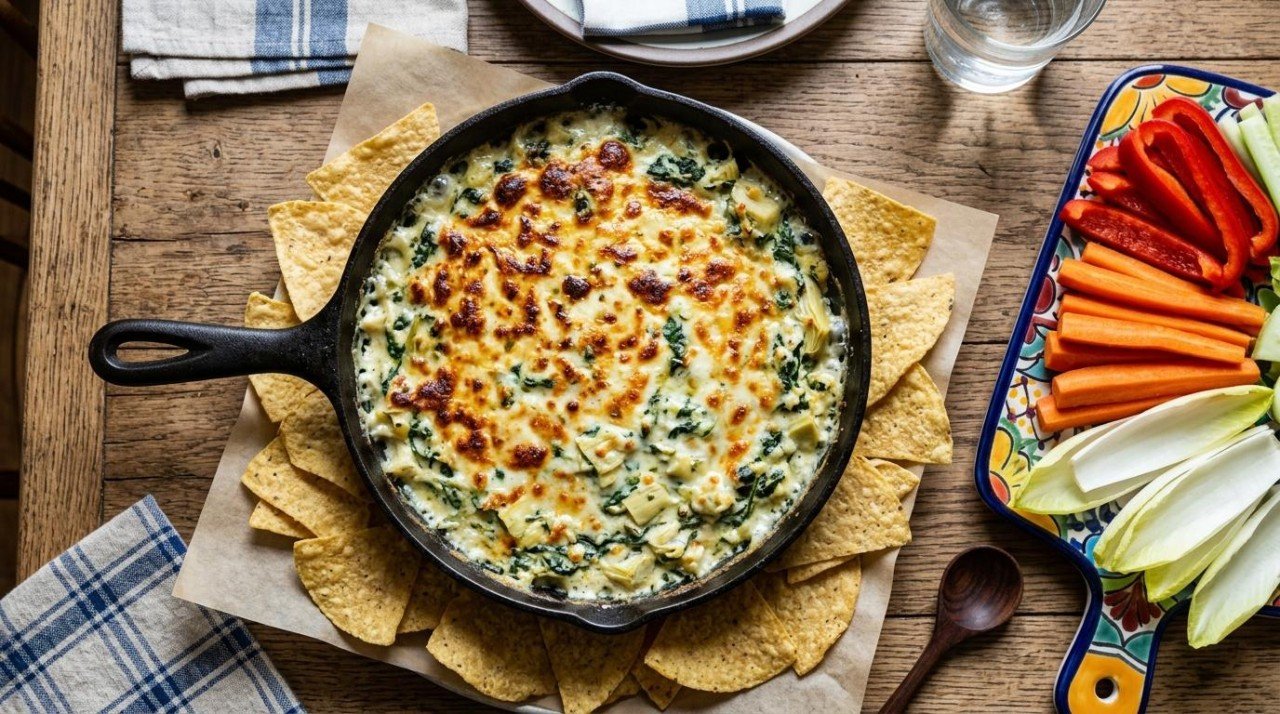
Spinach artichoke dip is the appetizer that makes a table go quiet. It arrives bubbling in a small cast iron skillet, someone breaks the browned top with a chip, and the conversation pauses for a second. The restaurant version is widely credited to Houston's, and the New Orleans food writer Tom Fitzmorris reckons the copying that followed makes it possibly the most copied dish in culinary history. He is not far off. It is on the menu at chains, at neighborhood bars, and in a foil pan at approximately every potluck in America.
We scored a standard party version against production nutrition data using Eat Well Planner's Nutrition Score - the dip plus the bag of tortilla chips it gets eaten with, because that is the actual dish. It came out at 40 out of 100, with saturated fat flagged very high and 3.1 g of fiber to show for a recipe with two vegetables in its name.
Then we rebuilt it, scoring every single change. The finished platter scores 79. It is still hot, still creamy, still has a browned parmesan lid, and the chips are still on the table. The result that reorganized the whole makeover: the half teaspoon of salt, the ingredient nobody thinks about, was worth more points than any vegetable we added.
The original: what is in it and how it scores
Here is the version we scored, built for eight: 8 oz cream cheese, 1/2 cup sour cream, 1/2 cup mayonnaise, 1 cup shredded mozzarella, 1/2 cup grated parmesan, one 10 oz box of frozen chopped spinach, one 14 oz can of artichoke hearts, 2 cloves of garlic, and 1/2 teaspoon of salt, baked and served with an 8 oz bag of tortilla chips.
Per serving that is 435 calories, 11.2 g protein, 3.1 g fiber, 32.9 g total fat, 12.1 g saturated fat, and about 840 mg of sodium. Two cautions fire: saturated fat at 51% of a day, flagged very high, and sodium at 36%, flagged high. The whole dish counts as 2.25 plants.
What is already good is worth saying, because it is real and it is the reason this recipe is not a lost cause. The original is an excellent source of vitamin K (168% DV, almost entirely from the spinach), calcium (27%), vitamin A (27%), and phosphorus (37%). There is essentially no added sugar. Spinach and artichokes are genuinely excellent foods and the score gives them full credit.
The problem is the ratio. Three different dairy fats are stacked in the base - cream cheese, sour cream, and mayonnaise - and between them they deliver almost 33 g of fat per serving before you count the two cheeses on top. Meanwhile the vegetables in the recipe's name amount to one box of spinach and one can of artichokes shared eight ways. They are not the dish. They are seasoning for the dish.
One number reframed everything for us. We scored the dip on its own, without the chips: 42. With a sliced baguette instead of chips: 43. What you dip with barely registers at this stage, because when the dip itself is a fat bomb, nothing you scoop it with is the story. Remember that, because it changes completely by the end.
The upgrades, in the order we tested them
Each swap below was applied on top of the one before it and rescored, so the deltas are cumulative and in this exact order. They sum to the full 39-point move. If you only make one change, make the first one.
1. Mayonnaise and sour cream out, Greek yogurt and blended cottage cheese in
- Swap: 1/2 cup mayonnaise and 1/2 cup sour cream, replaced with 10 oz plain Greek yogurt and 3/4 cup cottage cheese blended completely smooth
- Score impact: +8 points (40 to 48)
- What it changes: Saturated fat 12.1 g to 9.5 g per serving; 81 calories off each serving; protein 11.2 g to 16.5 g
- What it costs you: A little of the round, oily richness mayonnaise brings. You get tang in exchange, which this dip suits
These two go together because they were doing the same job badly. Mayonnaise is roughly 680 calories per 100 g and contributes almost nothing besides fat; sour cream is 196 calories per 100 g and 10.7 g of saturated fat. Greek yogurt lands at 67 calories with 10 g of protein, and blended cottage cheese gives you thick, mild body with 11 g of protein. The two together do the structural work of both originals and add 5 g of protein per serving while removing fat.
The technique matters more than the swap does. Blend the cottage cheese until it is genuinely smooth - a food processor or an immersion blender, run longer than feels necessary. Under-blended cottage cheese is grainy, and grainy is the one way to lose this. If you want other routes, we have full guides to mayonnaise substitutes and sour cream substitutes, and a piece on picking a Greek yogurt that will not let you down.
2. The cream cheese comes out too, with an egg and a spoon of cornstarch in its place
- Swap: All 8 oz of cream cheese out; 1 large egg and 1 tablespoon of cornstarch in
- Score impact: +7 points (48 to 55)
- What it changes: Saturated fat 9.5 g to 4.1 g per serving; another 84 calories gone
- What it costs you: This is the swap that changes the dip most. The finished thing is lighter and tangier than the version you grew up on. It is still creamy, but it is not identical
We did not plan to take all of it out. Cream cheese is 343 calories and 19.7 g of saturated fat per 100 g, and we assumed a measured 2 to 4 oz would earn its keep as an anchor. It does not. We tested putting 2 oz back at the very end of the build and it cost 4 points. That is a real price for a real thing, and if the classic flavor is the whole point for you, spend it knowingly - the cream cheese substitutes guide covers the middle ground.
The egg and cornstarch are not padding, they are insurance. Yogurt proteins are fragile and, as Ricardo's food chemistry column explains, they clump together and squeeze out whey when heated, which is exactly the weeping you get when someone swaps yogurt into a baked dip and calls it done. The same article notes that cornstarch works because its "large, bulky molecules" physically block the proteins from finding each other. One tablespoon plus one egg holds the whole thing together in a 375F oven. Squeeze the spinach genuinely dry, too - that water has to go somewhere.
3. A can of white beans, blended invisible
- Swap: Add one 15 oz can of cannellini beans, drained, rinsed, and blended completely smooth into the base
- Score impact: +6 points (55 to 61)
- What it changes: Fiber 3.1 g to 4.6 g per serving; protein 15.7 g to 17.9 g; plant points 2.25 to 3.25
- What it costs you: Nothing detectable if you blend them properly. Under-blend and you get a faintly chalky dip
Blended white beans are thick, mild, and slightly starchy, which is precisely the texture job cream cheese was doing. This is how the previous swap stays affordable. It also adds 36 calories a serving and buys back a lot: legumes are one of the most consistently useful things you can add to anything. Harvard's Nutrition Source reports a cohort study in which people eating legumes four or more times a week had a 22% lower risk of heart disease, and a meta-analysis of 11 trials in which pulses lowered LDL cholesterol by about 6%.
Rinse them. University of Tennessee researchers found that draining alone cuts sodium by 36% and draining plus rinsing cuts it by 41%, and sodium is about to become the main event in this recipe.
4. Twice the spinach, twice the artichoke, and frozen hearts instead of canned
- Swap: One 10 oz box of spinach becomes two; one 14 oz can of artichoke hearts becomes about 14 oz of frozen artichoke hearts, thawed and drained
- Score impact: +3 points (61 to 64)
- What it changes: Fiber 4.6 g to 6.9 g per serving; protein to 20.2 g; vitamin K from 150% DV to 294%
- What it costs you: Nothing except a second box of spinach and five more minutes of squeezing
Three points feels small for doubling both vegetables, and that is the honest finding: the vegetables were never what was wrong with this recipe. They were just outnumbered. Doubling them makes the dish look and taste like what it claims to be - you get spinach and artichoke in every scoop instead of every third one - but the nutritional gain is modest because they were already carrying the score's strengths.
The frozen-instead-of-canned part is quiet but worth it. Canned artichoke hearts carry about 290 mg of sodium per 100 g from the packing brine; frozen ones carry almost none. Artichokes also happen to be a real source of inulin-type fructans, the prebiotic fiber your gut bacteria ferment - a study extracting inulin from globe artichoke found that five Lactobacillus species and four Bifidobacterium species all grew on it. If you can only find canned, buy them, drain them, and rinse them.
5. A vegetable board next to the chips - not instead of them
- Swap: Add 2 red bell peppers, 4 carrots, 4 celery stalks, and 2 heads of endive, cut and actually put on the table
- Score impact: +3 points (64 to 67)
- What it changes: Plant points 3.25 to 7.25; vitamin C from 27% DV to 80%; vitamin A from 30% to 61%; fiber to 8.7 g
- What it costs you: Ten minutes with a knife, and cutting enough that it reads as food rather than garnish
The word "instead" is doing no work here. The chips stay. What changes is that there is now something else to reach for, and endive in particular is built for this job - the leaves are stiff, boat-shaped, and hold a heavy dip better than a chip does.
This is the swap that moves plant diversity, which is its own thing worth tracking. The American Gut Project found that the number of distinct plant species someone eats predicts gut microbial diversity better than any diet label, with people eating more than 30 plant types a week showing more short-chain-fatty-acid-producing bacteria than people eating fewer than 10. Four new plants from one cutting board is a good afternoon's work. We wrote about what that actually does inside your body here, and Plant Points in the app counts exactly this.
6. Half the mozzarella, and the parmesan stays where you taste it
- Swap: 1 cup of shredded mozzarella becomes 1/2 cup; the 1/2 cup of parmesan stays, all of it on top
- Score impact: +2 points (67 to 69)
- What it changes: Saturated fat 4.2 g to 3.4 g per serving; 21 calories off
- What it costs you: Slightly less cheese pull. You will not miss it, because the browned top is unchanged
Mozzarella stirred through a dip is mostly texture and calories - it melts into the base and disappears. Parmesan is the opposite: it is intensely savory, it browns, and every gram of it lands on your tongue because it is sitting on the surface. Keeping all the parmesan and halving the mozzarella keeps the part you notice and trims the part you do not. It is only 2 points, but it is 2 free points, which is the best kind. The parmesan substitutes guide has options if you need a swap for the lid.
7. The salt shaker stays in the cupboard
- Swap: The 1/2 teaspoon of added salt comes out; 1 small onion, 2 tablespoons of lemon juice, and 1 teaspoon of red pepper flakes go in
- Score impact: +10 points (69 to 79) - and 9 of those 10 are the salt alone
- What it changes: Sodium 840 mg to 580 mg per serving, and the sodium caution drops from 36% of a day's worth to 25%
- What it costs you: Genuinely nothing, because the parmesan, the beans, and the acid are covering it
This is the strangest result in the whole build and the reason the makeover ended where it did. Half a teaspoon of salt across eight servings is 260 mg a head. We had already tried removing it in the middle of the build, right after the vegetables went in, and it was worth zero points. At the end, the identical removal is worth nine.
That is not a glitch, it is how thresholds work. When everything else about a serving is still marginal, shaving 260 mg of sodium changes nothing that the score can see. Once the fat is fixed, the fiber has tripled, and the vitamins are all in range, sodium is the last thing standing between this dish and a good number - and 260 mg is suddenly the difference. It is a useful lesson about your own cooking: the swap that does nothing today may be the swap that does the most after you have fixed three other things.
The aromatics, scored on their own without touching the salt, were worth exactly nothing - the tenth point only appears when both changes are made together. That is honest, and it also understates them, because they are not there for the score. They are there so that removing the salt does not cost you anything you can taste. Lemon juice and heat both read as "seasoned" to your tongue in a way sodium usually gets credit for - which is the whole argument of our piece on salt, fat, acid, and heat. Harvard's Nutrition Source notes that Americans average about 3,400 mg of sodium a day against a chronic-disease limit of 2,300 mg. A party dip is a reasonable place to give some back.
Take the Guesswork Out of Eating Well
Eat Well Planner helps you organize your favorite recipes, plan balanced meals, and automatically generate shopping lists — all in one place. Whether you're tracking macros, managing dietary restrictions, or just trying to stop asking "what's for dinner?", we've got you covered.
Our AI-powered tools can adapt any recipe to your dietary needs, help you discover new meals you'll love, and even log your nutrition effortlessly. It's meal planning made simple.
Start Organizing Your Meals — FreeWhat we kept, and where we stopped
The parmesan stayed, all of it, on top. The mozzarella stayed, at half. The garlic stayed. The tortilla chips stayed at a full 8 oz bag, which is 1 oz a head - and the reason why is in the tested-and-skipped section below, because it surprised us. There is no cauliflower in this recipe, no fake cheese, and nothing you have to explain to a guest.
Where we stopped: this dip still carries a high-sodium caution at 25% of a day's worth per serving, and the score's remaining complaints are low vitamin D and low omega-3 EPA and DHA. Those two are effectively unreachable in a vegetarian baked dip - there is no version of spinach artichoke dip that contains oily fish - so 79 is close to the ceiling for the dish as a dish. Chasing further would mean making something else.
The healthier version: full recipe
Nutrition Score: 79 out of 100. Serves 8, dip and dippers together.
For the dip
- Two 10 oz packages frozen chopped spinach, thawed and squeezed very dry
- About 14 oz (400 g) frozen artichoke hearts, thawed, drained, and roughly chopped
- 10 oz (280 g) plain Greek yogurt
- 3/4 cup (170 g) cottage cheese
- One 15 oz can cannellini beans, drained and rinsed
- 1 large egg
- 1 tablespoon cornstarch
- 1 small yellow onion, finely chopped
- 2 cloves garlic, minced
- 2 tablespoons lemon juice
- 1 teaspoon red pepper flakes
- 1/2 cup (56 g) shredded low-moisture mozzarella
- 1/2 cup (50 g) grated parmesan
- Black pepper to taste. No added salt
For the table
- 8 oz tortilla chips
- 2 red bell peppers, cut into wide planks
- 4 medium carrots, cut into sticks
- 4 celery stalks, cut into sticks
- 2 heads endive, leaves separated
- Heat the oven to 375F. Squeeze the thawed spinach in a clean kitchen towel until no more water comes out, then squeeze it again. Press the thawed artichoke hearts dry and chop them roughly.
- In a food processor, blend the cottage cheese, the drained and rinsed beans, the egg, and the cornstarch until completely smooth with no visible curds or bean skins. This takes longer than you think - give it a full minute and scrape the sides.
- Add the Greek yogurt and lemon juice and pulse just to combine. Do not over-process once the yogurt is in.
- Scrape the base into a large bowl and fold in the spinach, artichokes, onion, garlic, red pepper flakes, mozzarella, and black pepper. Taste it; it should already read as seasoned. Add more lemon or pepper flakes before you reach for salt.
- Spread into a 9-inch pie dish or a 10-inch skillet and scatter all the parmesan over the top.
- Bake 25 to 30 minutes, until the edges bubble and the parmesan is browned in patches. If you want more color, run it under the broiler for 60 to 90 seconds and watch it the whole time.
- Rest 5 minutes before serving - it sets as it cools. Serve with the chips and the cut vegetables together on one board.
Per serving, original versus improved:
- Nutrition Score: 40 to 79
- Calories: 435 to 344
- Protein: 11.2 g to 19.5 g
- Fiber: 3.1 g to 9.0 g
- Total fat: 32.9 g to 11.3 g
- Saturated fat: 12.1 g to 3.4 g
- Sodium: about 840 mg to about 580 mg
- Plant points: 2.25 to 8.5
The improved version is an excellent source of vitamin K (329% DV), vitamin C (83%), vitamin A (60%), folate (53%), phosphorus (53%), iron (44%), magnesium (40%), riboflavin (40%), vitamin B6 (39%), potassium (34%), calcium (34%), and fiber (30%). The original earned seventeen nutrient highlights in total; this one earns twenty-two, and far more of them at the excellent-source tier.
Swaps we tested and skipped
- Dropping the cottage cheese and going all Greek yogurt. Scores 82 - three points better than what we published. We rejected it anyway. Two cups of Greek yogurt as the entire base of a baked dip is the single most likely way to end up with a weeping, curdled pan, because there is nothing but starch standing between those proteins and the heat. Blended cottage cheese is curd-based and far more forgiving. Three points is not worth a broken dip.
- Putting 2 oz of cream cheese back. Drops the score from 79 to 75. Listed here so you can make the trade deliberately rather than by accident.
- Taking the chips away entirely. Drops the score from 79 to 67 - a 12-point loss, the worst single result we recorded. Tortilla chips are milled whole corn, and the bag carries real fiber, magnesium, iron, and vitamin E into the serving. Once the dip itself is no longer a fat bomb, subtracting food from the plate only subtracts nutrition. This is the mirror image of the first thing we found: at the start, the chips were irrelevant; at the end, they were load-bearing.
- ...but do not read that backwards. Out of curiosity we scored the same recipe with 12 oz of chips instead of 8 and it went to 81. That is where we stop trusting the number. The score reads a serving against daily values, so piling on more of a decent food keeps nudging it upward past the point where anyone would call it an improvement. Eight ounces for eight people is a real serving. Twelve is just more chips.
- An all-parmesan lid, no mozzarella. 79 to 78. Slightly worse, and you lose the melt. Not worth it.
- Cutting the salt earlier. Worth exactly 0 points when we tried it midway through the build, and 9 at the end. Same half teaspoon, same recipe, different order.
Make it fit other diets
For gluten-free, this recipe already is - check that your tortilla chips are certified, and swap the cornstarch for arrowroot if you prefer. For vegan, the base rebuilds around blended silken tofu and unsweetened plain plant yogurt with the beans doing the same structural work, plus nutritional yeast in place of the parmesan; expect to lose the browned top. For a higher-protein version, folding in shredded rotisserie chicken turns it into a main.
You do not have to work those out by hand. In Eat Well Planner, ask the AI recipe chat to make any saved recipe vegan or gluten-free and it rewrites the whole thing with the substitutions worked in, then rescores it so you can see what the change cost.
Do this to any recipe you love
Nothing here required guessing. We took the version of this dip that everybody makes, scored it against real nutrition data, read the diagnosis, and changed one thing at a time until the numbers stopped moving - and the two most useful things we learned, that the chips were not the problem and the salt was worth nine points, were both things we would have gotten wrong from intuition.
You can run the same process on your own recipes. Import a recipe into Eat Well Planner from any URL, Instagram reel, or YouTube video, and it gets a Nutrition Score with the same breakdown we used here. Make It Healthier then proposes swaps like these, with a calculator verifying the actual nutritional gain before a suggestion is ever shown to you. If you would rather drive it yourself, the Recipe Playground lets you change one ingredient and watch the score move, which is exactly how every delta in this post was produced. It is free, and your family's dip recipe is a good place to start.