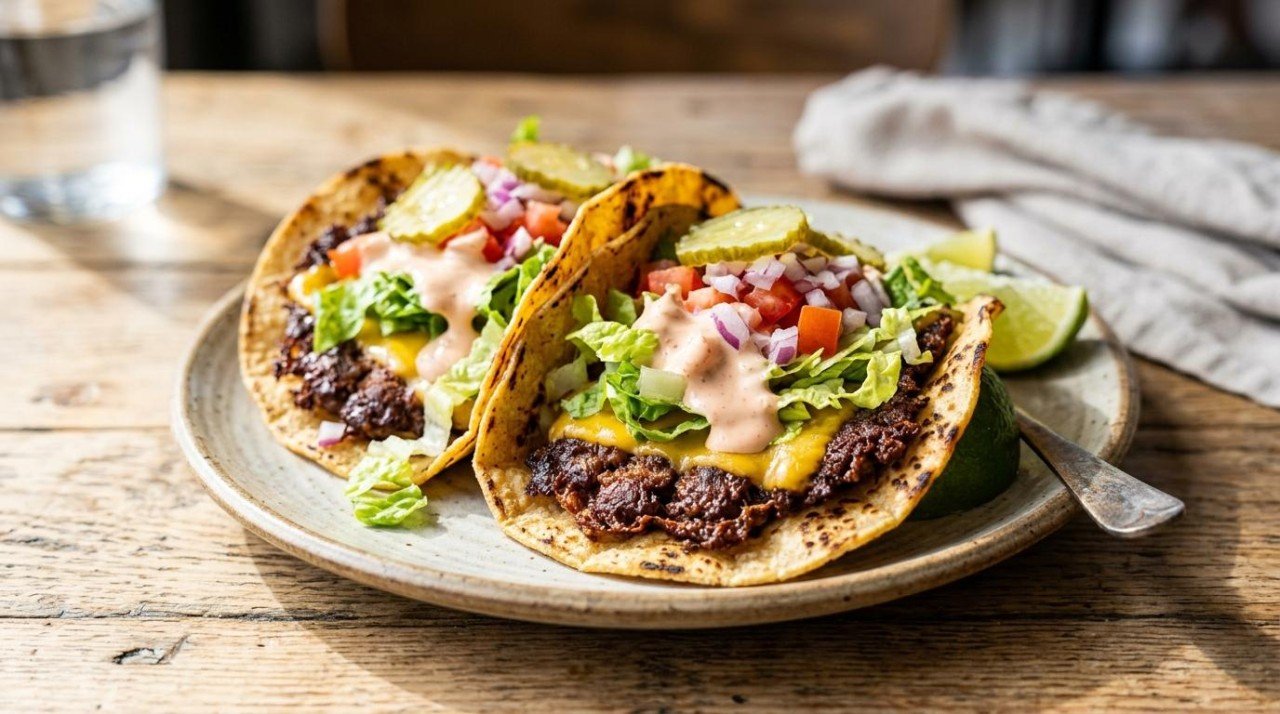
In March 2023, Brad Prose of Chiles and Smoke posted a video of a ball of ground beef being smashed onto a flour tortilla on a hot griddle. The beef welds itself to the tortilla, the edges go lacy and crisp, cheese melts over the top, and the whole thing gets folded with burger sauce and pickles. The videos have racked up more than 250 million combined views, and the smash burger taco has been in permanent rotation on home griddles ever since.
Worth knowing: the mashup was not invented on TikTok. As The Takeout reported, taco scholar Jose Ralat points out that Mexican and Mexican American cooks have made tacos de hamburguesa for decades — beef patties on good corn tortillas with a tangy sauce. That detail turns out to matter for this makeover, and we will come back to it.
We ran the viral build through Eat Well Planner's Nutrition Score, the same at-a-glance number a visitor sees on any public recipe page. It came back 34 out of 100, at 995 calories per serving. So we rebuilt it — keeping the crispy welded beef edges, the melt, the tangy sauce, the fold — and got it to 56 out of 100 with roughly half the calories. That is 22 points, and every swap below carries the real, verified score change it earned.
The original: what's in it and how it scores
Here is the viral version we scored, for four people (eight tacos):
- 1 1/2 lb (24 oz) 80/20 ground beef, rolled into 3 oz balls
- 8 small flour tortillas
- 8 slices American cheese (about 5 oz)
- Burger sauce: 1/2 cup mayonnaise, 1/4 cup ketchup, 2 tablespoons sweet pickle relish, 1 teaspoon yellow mustard, onion and garlic powder, 1/4 teaspoon salt
- Pickles and shredded lettuce
Nutrition Score: 34/100. Now the diagnosis, because knowing why a recipe scores the way it does is what lets you fix your own. Per serving (two tacos), the original runs about 995 calories, 42 g protein, 24.2 g saturated fat, 2,380 mg sodium, and 2.9 g fiber. Three things hold it back:
- Saturated fat is very high — 24.2 g per serving, or 103% of a day's worth. The American Heart Association recommends no more than about 13 grams a day on a 2,000-calorie diet, so one sitting here is closer to two days' worth. That is 6 oz of 80/20 beef, two slices of American cheese, and a quarter cup of mayo-based sauce, all stacking.
- Sodium is very high — 2,380 mg per serving, a full day's allowance in one meal, against an AHA ceiling of 2,300 mg and an ideal closer to 1,500 mg. It is spread across a lot of small contributors: the tortillas, the cheese, the sauce, the pickles, and the salt on the beef.
- Barely any fiber or plants — 2.9 g of fiber and 2.5 plant points, with a flag for low vitamin C. Aside from a handful of shredded lettuce, there is nothing green on the plate.
What is already fine, and worth defending? Quite a lot. Protein is excellent at 42 g, and the beef makes this an outstanding source of vitamin B12 (166% of the daily value), iron (92%), zinc (76%), and niacin (70%). Unlike a lot of viral food, this is real cooking with real ingredients — beef, a tortilla, a griddle, and a sauce you stir together yourself. The problem is proportion, not concept.
The upgrades
Five swaps, applied cumulatively in this order. One structural thing to watch as you read: the score is gated by two very high flags, saturated fat and sodium. Until both of those clear, the number moves slowly no matter how much fat you strip out. That is why the first swaps look modest and the last one looks enormous — it is not that lettuce beats leaning the beef, it is that the earlier swaps unlocked the gate.
1. Lean the beef, and use a pound instead of a pound and a half
- Swap: 1 1/2 lb 80/20 ground beef → 1 lb 90/10, rolled into 2 oz balls
- Score impact: +4 points (34 → 38)
- What it changes: 231 fewer calories per serving, saturated fat from 24.2 g to 14.4 g, total fat from 70.6 g to 45.3 g, trans fat down by two-thirds — and protein holds steady at about 43 g
- What it costs you: A little richness. The crust does most of the flavor work in this dish anyway
This is the single biggest lever in the makeover, and it barely moves the score — which is exactly why we show you the numbers. It strips out 10 g of saturated fat and 231 calories per serving while protein stays put, and the score creeps up 4 points because sodium is still pinned in the red. Do this one even if you do nothing else.
The reason 2 oz of beef still makes a proper taco is the smash itself: pressed out thin, a 2 oz ball covers a 6-inch tortilla edge to edge, which is the entire reason this technique exists. And a patty that thin cooks through in about two minutes, so there is far less time for leaner beef to dry out than there would be in a thick 90/10 burger. Be honest about the trade, though — 90/10 renders less fat onto the tortilla, so get your pan properly hot and let the crust develop before you touch it. For leaner and part-plant options, our ground beef substitutes guide has the ratios.
2. Rebuild the special sauce on Greek yogurt
- Swap: 1/2 cup mayo + 1/4 cup ketchup → 1/2 cup plain Greek yogurt + 2 tablespoons mayo, no ketchup, double the mustard, no added salt
- Score impact: +3 points (38 → 41)
- What it changes: 131 fewer calories per serving, sodium from 2,150 mg to 1,760 mg, added sugar from 6.5 g to 3.2 g, and protein up to 45 g
- What it costs you: Very little, as long as you keep the two tablespoons of real mayonnaise
The ketchup is the surprise here. If you are chasing that Big Mac flavor, you do not need it — and arguably should not have it. Former McDonald's corporate chef Mike Haracz has said plainly that the real sauce contains no ketchup or tomato at all; the pink comes from paprika and the tang from mustard, vinegar, and sweet relish. Dropping it makes the sauce more faithful, not less, and takes most of the added sugar with it.
Plain Greek yogurt takes over the body of the sauce and brings protein along with it, which is why it is the workhorse of our mayonnaise substitutes guide. We kept two tablespoons of real mayo on purpose: it holds the emulsion together and keeps this tasting like burger sauce rather than seasoned yogurt. We did test dropping it entirely — the score did not move at all, so there was no reason to give up the flavor.
3. Corn tortillas instead of flour
- Swap: 8 small flour tortillas → 8 six-inch corn tortillas
- Score impact: +3 points (41 → 44)
- What it changes: Sodium from 1,760 mg to 1,300 mg per serving, 83 fewer calories, fiber from 2.9 g to 4.2 g, and a whole grain plus a plant point added
- What it costs you: Corn tortillas are more fragile. This swap needs one technique change
The sodium math is stark. A flour tortilla carries roughly 331 mg of sodium against about 20 mg for a comparable corn tortilla, with 30% fewer calories and 75% more fiber on the corn side. Multiply that by eight tortillas. Corn also counts as a whole grain — the Whole Grains Council notes that traditional alkali treatment (nixtamalization) is what liberates the niacin in corn, which is why masa-based cultures avoided pellagra. And corn is what tacos de hamburguesa were always built on before the griddle videos started.
Now the honest part. Flour genuinely is the easier tortilla here: as Inspired Taste found in testing, flour tortillas "are quite a bit more pliable than corn, which helps prevent cracking". The fix is to stop smashing against a hot pan. Use the pre-flatten method instead: put the beef ball on the tortilla on your counter and press it out to the edges there, then transfer the whole thing to the griddle beef-side down. Nothing gets crushed against hot metal, and the beef is already bonded. Warm the tortillas slightly first and they will behave. If corn still cracks on you, whole wheat flour tortillas are a legitimate fallback — see below — and our tortilla substitutes guide covers the rest.
4. Half the cheese, and make it real cheese
- Swap: 8 slices American cheese (about 5 oz) → 3 oz sharp cheddar, thinly sliced
- Score impact: +2 points (44 → 46)
- What it changes: Sodium from 1,300 mg to 910 mg per serving, saturated fat from 10.6 g to 9.1 g
- What it costs you: Slice it thin and you keep the melt. American does melt a shade smoother
Here is the honest finding: the points came from using half as much cheese, not from changing the type. We scored American cheese at the same 3 oz and it came out at exactly the same final number, 56 either way. So if you love the American slice, keep it — the score does not care, and we are not going to invent a reason for you to feel bad about it.
We went with sharp cheddar for two reasons that are not about points. It simply tastes like more per gram, so halving the cheese does not read as half on the tongue. And it swaps a processed cheese product for actual cheese, landing 180 mg per serving lower on sodium into the bargain. Our cheddar substitutes guide covers which cheeses melt properly if you want to go a different direction — melt is not optional in this dish.
5. Pile on the fresh stuff
- Swap: A handful of shredded iceberg → 3 cups shredded romaine, a diced tomato, red onion, cilantro, and lime
- Score impact: +10 points (46 → 56) — the biggest jump in the makeover
- What it changes: Fiber from 4.2 g to 5.6 g, plant points from 3.5 to 5.75, clears the low vitamin C flag, and adds vitamins A and K
- What it costs you: Five minutes of chopping, and it makes the taco better
Ten points from vegetables looks absurd next to 4 points for cutting 10 g of saturated fat, and it is worth understanding why. The first four swaps pulled saturated fat and sodium out of the very high band and into merely high. Once both gates cleared, the score was finally free to respond to everything else on the plate — and there was almost no plant food there at all. Tomato and lime bring the vitamin C the original had none of, romaine brings vitamins A and K, and the plant count finishes at more than double where the original started, which is what feeds your weekly plant total.
Treat it like a burger salad rather than a garnish: shred the romaine finely so it packs into the fold, dice the tomato and onion small so nothing slides out, and hit it with lime right before you eat.
Take the Guesswork Out of Eating Well
Eat Well Planner helps you organize your favorite recipes, plan balanced meals, and automatically generate shopping lists — all in one place. Whether you're tracking macros, managing dietary restrictions, or just trying to stop asking "what's for dinner?", we've got you covered.
Our AI-powered tools can adapt any recipe to your dietary needs, help you discover new meals you'll love, and even log your nutrition effortlessly. It's meal planning made simple.
Start Organizing Your Meals — FreeWhat we kept (on purpose)
A makeover that guts the dish is a failed makeover. We kept real beef, real cheddar, two tablespoons of real mayonnaise, the pickles, and above all the technique — the smash, the crust, the fold. We also stopped on purpose: cutting the cheese to 2 oz scored 60, four points higher than where we landed, and we passed, because at that point the melt goes patchy and a smash burger taco without a proper melt is not the dish anyone came for.
Nor are we going to oversell the finish. At 56, this recipe still carries high sodium and high saturated fat flags. That is the honest ceiling for a cheeseburger folded into a tortilla. The last remaining knock is low vitamin D, which is hard to fix here without adding something that does not belong.
The healthier version: full recipe
Nutrition Score: 56/100. Serves 4 (makes 8 tacos). About 15 minutes of prep, 10 minutes of cooking.
For the sauce:
- 1/2 cup (120 g) plain Greek yogurt
- 2 tablespoons (30 g) mayonnaise
- 2 tablespoons (30 g) sweet pickle relish
- 2 teaspoons yellow mustard
- 1/2 teaspoon onion powder
- 1/4 teaspoon garlic powder
For the tacos:
- 1 lb (454 g) 90/10 ground beef
- 3/4 teaspoon fine salt, plus black pepper
- 8 corn tortillas (6-inch)
- 3 oz (90 g) sharp cheddar cheese, thinly sliced or shredded
- 3 cups (150 g) romaine lettuce, finely shredded
- 1 large tomato (about 150 g), diced small
- 1/3 cup (40 g) red onion, finely diced
- Small handful fresh cilantro, chopped
- 1 tablespoon lime juice, plus wedges to serve
- 1/2 cup (60 g) dill pickle slices
- Stir the Greek yogurt, mayonnaise, relish, mustard, onion powder, and garlic powder together in a small bowl. Refrigerate while you work. (A pinch of smoked paprika is traditional for color if you want it.)
- Toss the diced tomato, red onion, cilantro, and lime juice together with a grind of black pepper. Set aside.
- Divide the ground beef into 8 balls, about 2 oz each. Season them all over with the salt and plenty of black pepper.
- Warm the corn tortillas briefly, in a dry skillet or a few seconds in the microwave under a damp towel, so they are pliable and will not crack.
- Working on your counter rather than in the pan, set a beef ball in the center of each tortilla and press it out flat, almost to the edges, with a burger press, a heavy spatula, or the flat bottom of a measuring cup.
- Heat a cast iron skillet or griddle over medium-high until properly hot. Lay the tacos beef-side down and cook, undisturbed, 2 to 3 minutes, until the edges are lacy and deeply browned.
- Flip, lay the cheddar over the beef, and cook another 1 to 2 minutes, until the tortilla toasts and the cheese melts. Work in batches rather than crowding the pan.
- Build each taco with sauce, shredded romaine, the tomato mixture, and pickles. Fold, and serve with lime wedges.
Per serving, here is the before and after:
- Nutrition Score: 34 → 56
- Calories: about 995 → about 531 (down roughly 47%)
- Saturated fat: 24.2 g → 9.2 g (down 62%, from 103% of the daily value to 39%)
- Sodium: about 2,380 mg → about 910 mg (down 62%)
- Total fat: 70.6 g → 24.5 g
- Trans fat: 1.5 g → 0.4 g
- Fiber: 2.9 g → 5.6 g
- Added sugar: 6.5 g → 2.2 g
- Protein: 42.0 g → 42.9 g (held, with a third less beef)
- Plants on the plate: 2.5 → 5.75
Swaps we tested and skipped
- Fat-free cheddar (scored 65). Nine points higher than where we landed, and rejected without much agonizing. Fat-free cheese does not melt — it softens into something rubbery and weeps. The melt cascading over a crisp beef edge is half of why this dish went viral, so nine points is not enough to buy it.
- Whole wheat flour tortillas (scored 54). Two points below corn, but a genuine judgment call rather than a rejection. They deliver noticeably more fiber (8.7 g per serving versus 5.6 g) and are far more forgiving to smash against. They also push sodium back to about 1,320 mg and saturated fat to 12.3 g, which is what costs them the points. If corn keeps cracking on you, take this trade happily.
- 93/7 ground turkey (scored 56). An exact tie with 90/10 beef, so it is a preference, not an upgrade — though protein drops from 42.9 g to 37.0 g per serving. If you like turkey, use turkey; if you want the beefy crust, the score gives you no reason to give it up.
- American cheese at the same 3 oz (scored 56). Also an exact tie, as covered above. Halving the cheese is what earned the points. The type is yours to choose.
Make it fit other diets
Gluten-free: you are already there — corn tortillas are naturally gluten-free, just check the relish and cheese labels. Dairy-free: use a plain unsweetened plant yogurt in the sauce and skip or replace the cheddar; you will lose the melt, so lean harder on the sauce and pickles for richness. Lower-carb: people often ask about lettuce wraps, but our healthier cheeseburger makeover found that dropping the whole-grain base actually lowered the score, because you throw away its fiber and plant point. In Eat Well Planner you do not have to reason this out by hand — ask the AI recipe chat to make this dairy-free and it rewrites the whole recipe with the swaps already worked in.
Do this to any recipe you love
None of this was guesswork. Every score and delta in this post came from Eat Well Planner's Make It Healthier tool, which proposes swaps like these and runs a calculator to verify the real nutritional gain before it shows you the suggestion — so you never chase a change that does not actually help. We tested each one in the Recipe Playground, watching the score move per edit, which is how we caught the things intuition gets wrong here: that leaning the beef is the biggest real change but the smallest score change, that cheddar and American score identically, and that a pile of chopped vegetables outweighed all of it once the flags cleared.
The next viral recipe will be along shortly. When it is, paste the TikTok, Instagram, or YouTube link straight into Eat Well Planner, let it pull out the ingredients and nutrition, and see the score before you decide how you feel about it. Then hit Make It Healthier and find out which swaps are worth making — and which ones would just ruin dinner.