Somewhere around the middle of 2024, a lot of people who had spent their whole lives avoiding cottage cheese started buying it by the tub. The reason was a flatbread: blend cottage cheese with eggs, spread the batter thin on parchment, bake it, and you get a flexible, foldable, flourless bread that holds together like the real thing. Good Morning America covered it in June 2024, by which point baked cottage cheese wraps had racked up tens of millions of posts on TikTok, and featured the version from recipe developer Nicole Keshishian Modic of KaleJunkie.
It deserved the attention. Two real ingredients, ten minutes of actual work, and it does what it claims — a flatbread carrying serious protein. The comment sections filled up with the word "healthy," and nobody really argued.
So we ran it through our Nutrition Score. The viral flatbread gets 39 out of 100, which is not the number anyone expects, including us. The short version of what we found: the flatbread itself climbs from 39 to 80 on three changes to the batter, and the finished meal we built on it scores 89 — without it ever stopping being the flatbread you saw on your phone.
The viral flatbread: what is in it and how it scores
The canonical version is about as simple as a recipe gets. One cup (8 oz) of cottage cheese, 2 large eggs, a teaspoon each of garlic powder and Italian seasoning, blended completely smooth, poured onto a parchment-lined sheet pan, and baked at 350°F for 35 to 40 minutes until the top sets. It makes two flatbreads, and most people eat one as a serving.
Scored per serving, that is 39/100: 174 calories, 18.9 g protein, 6.6 g carbohydrate, 0.1 g fiber, 3.1 g saturated fat, 440 mg sodium, zero added sugar.
A flatbread is a base, so the fair question is what it is replacing. We scored those too, at the portion you would actually use:
- Two slices of white sandwich bread (2 oz): 36
- The viral cottage cheese flatbread (1 of 2): 39
- One large flour tortilla (2.5 oz): 45
- Two slices of 100% whole wheat bread (2 oz): 72
That reframes the whole recipe. The flatbread edges out white bread, loses to a plain flour tortilla, and is not in the same conversation as whole wheat. What the internet has been treating as a health food is, nutritionally, a very good protein source shaped like a bread.
Why it scores 39
There is no fiber and there are no plants. At 0.1 g per flatbread, this is close to the lowest-fiber thing you can make from whole ingredients — dairy and egg contain none. Gut health comes in at 27/100 on 0.5 plant points, against a weekly target of 30. That matters, because only about 7% of American adults hit the daily fiber recommendation and most of us get around 15 g against a 25 to 35 g target. Trading bread for a flatbread with no fiber moves you the wrong way on the nutrient we are shortest on.
It is saltier than it tastes. Cottage cheese is a salted product — a standard tub runs around 700 mg of sodium per cup, landing the plain flatbread at 440 mg per serving. That is roughly 19% of the 2,300 mg daily maximum before you put a single thing on it, and sodium shows up as a weakness in the breakdown even on the naked flatbread.
What is genuinely fine, because we are not going to invent problems: 18.9 g of protein for 174 calories is excellent, and the micronutrients beat what "two ingredients" suggests — 41% of the Daily Value for vitamin B12, 38% phosphorus, 37% riboflavin, 34% choline, 24% biotin. Zero added sugar. No caution triggered. The protein claim that made this recipe famous is completely true. The problem is that protein is the only thing it does.
What people put on it is where this is won or lost
Nobody eats a bare flatbread, so we scored the three ways it actually gets used, each as one full serving:
- As a pizza (1/4 cup marinara, 1/2 cup shredded mozzarella, 12 slices of pepperoni): 37, down 2 points. 487 calories, 14 g saturated fat (59% DV, flagged very high), 1,460 mg sodium (63% DV, very high).
- As a wrap (3 oz deli turkey, 1 tbsp mayo, lettuce, tomato): 48, up 9. Still 1,220 mg sodium and 0.9 g fiber.
- With everything bagel seasoning and cream cheese (1 tsp seasoning, 2 tbsp cream cheese): 35, down 4.
The pizza build is the most popular use of this recipe and it is the one that makes it worse — arithmetic, not a moral failure of pepperoni. You started with a base already carrying 440 mg of sodium and no fiber, then added three more salty, fiber-free things. The everything-bagel version is worth splitting apart, though: the seasoning on its own scores 42, up 3 points, since sesame and poppy seeds bring a little fiber and minerals with them. It is the 2 tbsp of cream cheese that costs 7. Season freely; the spread is the decision.
The upgrades
Everything below was applied cumulatively, in this order, and re-scored at each step. Each delta is what that change was worth at that point in the build.
1. Put spinach in the batter
- Swap: Add 2 packed cups (2 oz) fresh spinach to the blender
- Score impact: +15 points (39 to 54)
- What it changes: Vitamin K from nothing to 121% DV per serving, plant points 0.5 to 1.5, gut health 27 to 42
- What it costs you: The flatbread turns pale green. Flavor-wise, almost nothing
The highest-value change to the recipe is also nearly free, which is why its most-copied version already does it — the spinach take is the one Modic gave GMA, and in her own post she describes it as sturdy and crack-resistant rather than more fragile. Two cups look like a lot going into a blender and collapse to about two tablespoons of volume. Add it raw with everything else; skip frozen spinach unless you squeeze it bone dry, because the batter is wet enough already that extra water will keep it from setting in 40 minutes.
2. Two tablespoons of ground flaxseed
- Swap: Add 2 tbsp ground flaxseed to the batter
- Score impact: +9 points (54 to 63)
- What it changes: Fiber from 0.1 g to 2.2 g per serving, omega-3 ALA to 90% DV, gut health 42 to 56
- What it costs you: A faint nuttiness and brown flecks. The texture firms slightly, which helps for wrapping
Fiber is the structural gap and no amount of dairy or egg can fix it, so it has to come from elsewhere. Ground flaxseed is the cheapest fix available: one tablespoon (7 g) carries about 2 g of fiber and 2 g of polyunsaturated fat including omega-3s. Use ground, not whole — the same review notes whole flaxseeds may pass through the digestive system largely undigested, while grinding makes the ALA accessible. It earns its place structurally too: flax absorbs liquid and gels, so rest the batter about 5 minutes before spreading and the flatbread comes out sturdier and less prone to tearing when folded.
3. Switch to low-sodium cottage cheese
- Swap: Standard cottage cheese to low-sodium or no-salt-added
- Score impact: +17 points (63 to 80)
- What it changes: Sodium from 470 mg to 240 mg per serving, and every caution clears
- What it costs you: Real flavor. You will taste this one, and it needs compensating for
This is the most interesting number in the post. Tested on its own against the original recipe, the same swap is worth only +7 points. Applied last, after the spinach and the flax, it is worth 17 — because by then sodium is the only thing still holding the recipe back, and removing it lets the rest of the score off the leash. Heart health goes 60 to 81, longevity 61 to 80.
The products are easy to find: Friendship's no-salt-added tub runs 45 mg per half cup and Hood's 60 mg, against roughly 350 mg for a standard tub. Be honest about the trade — unsalted cottage cheese tastes flat, and if you change nothing else you will notice. Lean on the aromatics already in the recipe, double the garlic, and finish with an acidic topping. A reduced-sodium tub like Breakstone's at 220 mg splits the difference; our cottage cheese substitutes guide covers what else works in a blended batter.
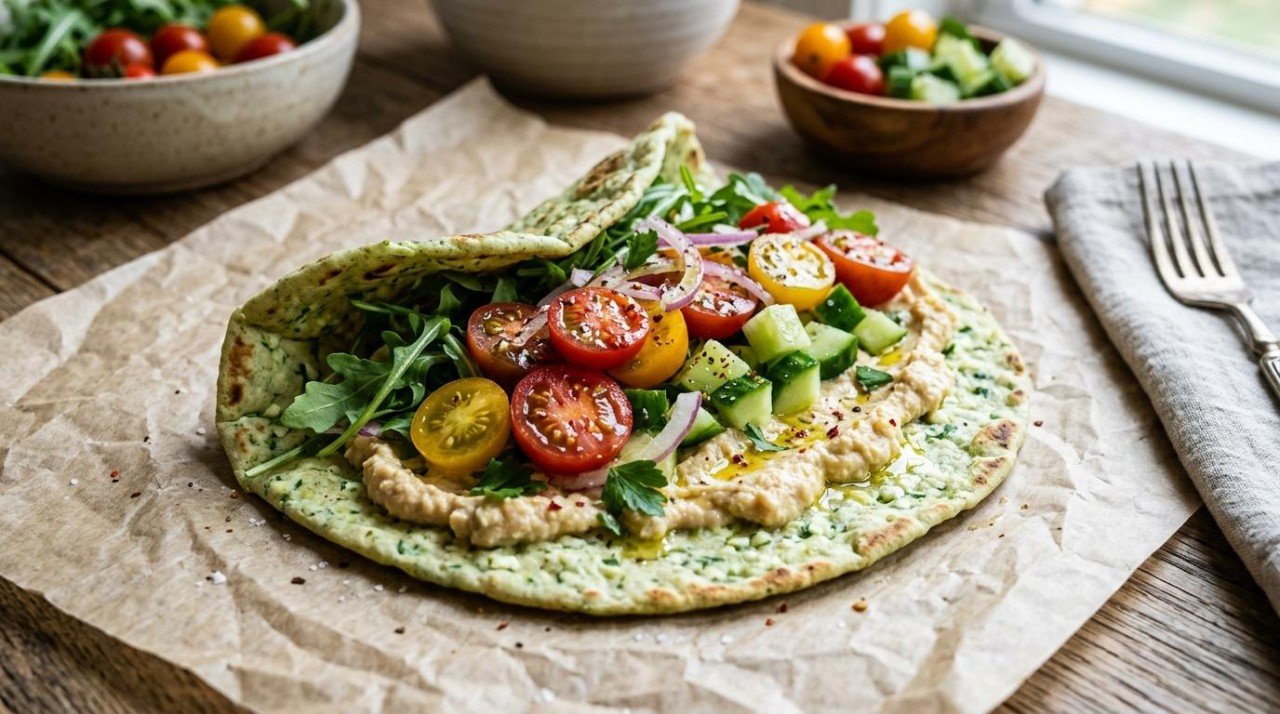
4. Top it like a salad, not like a pizza
- Swap: Marinara, mozzarella and pepperoni for hummus, cherry tomatoes, cucumber, arugula, red onion, olive oil and lemon
- Score impact: +9 points (80 to 89)
- What it changes: Fiber to 7.3 g per serving, plant points 2.5 to 7.5, vitamin C from nothing to 32% DV, and a bread becomes a meal
- What it costs you: It is not pizza. Very good, but a different dish than the one you would have made
The flatbread is a vehicle and everything upstream was about building a better one; this step decides what the meal is. Hummus does the heavy lifting, supplying the fiber and the creaminess in one move and filling the role cream cheese was playing without the saturated fat.
Seven and a half plant points in one sitting is a quarter of the weekly target — the kind of thing the American Gut Project found predicts gut microbial diversity better than any diet label, with people eating more than 30 plant types a week showing more short-chain-fatty-acid-producing bacteria than those eating under 10. We wrote up what that does inside your body here.
Take the Guesswork Out of Eating Well
Eat Well Planner helps you organize your favorite recipes, plan balanced meals, and automatically generate shopping lists — all in one place. Whether you're tracking macros, managing dietary restrictions, or just trying to stop asking "what's for dinner?", we've got you covered.
Our AI-powered tools can adapt any recipe to your dietary needs, help you discover new meals you'll love, and even log your nutrition effortlessly. It's meal planning made simple.
Start Organizing Your Meals — FreeWhat we kept (on purpose)
We kept the whole eggs. Swapping 2 whole eggs for 4 egg whites is the reflexive "healthier" move, and we tested it: 3 points worse, because the yolks carry the choline, vitamin D, B12 and EPA/DHA, and the saturated fat they cost does not outweigh that. (More in our guide to egg substitutes in baking.) We kept the cottage cheese as cottage cheese, changing the salt and not the fat, and kept the method exactly — same blender, same parchment, same 350°F, same 40 minutes. We stopped short of psyllium husk, which would firm the flatbread further but pushes the texture toward rubbery. This is still a weeknight recipe with a blender and a sheet pan.
The healthier version: full recipe
Nutrition Score: 89/100. The flatbread alone scores 80; built into the meal below, 89.
Makes 2 flatbreads (2 servings). Prep 15 minutes, bake 40 minutes.
For the flatbread:
- 1 cup (8 oz) low-sodium or no-salt-added cottage cheese
- 2 large eggs
- 2 packed cups (2 oz) fresh spinach
- 2 tbsp ground flaxseed
- 1 tsp garlic powder (or 2 cloves fresh garlic)
- 1 tsp Italian seasoning
- Plenty of freshly ground black pepper
For the topping:
- 1/2 cup hummus
- 1 cup cherry tomatoes, halved
- 1/2 large cucumber (about 3.5 oz), diced
- 1 1/2 cups arugula
- 1/4 small red onion, sliced paper thin
- 2 tsp olive oil
- 1 tbsp lemon juice
- Heat the oven to 350°F and line a 9x13-inch sheet pan with parchment paper.
- Blend the cottage cheese, eggs, spinach, ground flaxseed, garlic powder, Italian seasoning and black pepper until completely smooth and pale green, about 1 minute. Scrape down the sides and blend again if any curd remains — undissolved curd makes a patchy flatbread.
- Let the batter rest 5 minutes so the flaxseed hydrates and thickens it slightly.
- Pour onto the parchment and spread into an even rectangle roughly 1/4 inch thick, right to the edges of the pan.
- Bake 35 to 40 minutes, until the surface is set and dry to the touch and the edges have pulled away from the parchment and browned.
- Cool on the pan at least 10 minutes before peeling it off the parchment. This is the step people skip and regret — warm flatbread tears, cooled flatbread lifts off clean. Cut in half crosswise.
- Whisk the olive oil and lemon juice with a pinch of pepper, then toss with the tomatoes, cucumber, arugula and red onion.
- Spread 1/4 cup hummus over each flatbread, pile the dressed salad on top, and fold or eat open-faced.
Per serving, original versus improved:
- Nutrition Score: 39, to 80 for the upgraded flatbread, to 89 for the finished meal
- Calories: 174, 223, 445
- Protein: 18.9 g, 22.2 g, 28.2 g
- Fiber: 0.1 g, 2.2 g, 7.3 g
- Sodium: 440 mg, 240 mg, 520 mg for the whole meal — against 1,460 mg for the pizza version
- Saturated fat: 3.1 g, 3.6 g, 5.7 g
- Added sugar: zero, in every version
- Plant points: 0.5 to 7.5
The finished meal also lands at "good source of" or better for 23 nutrients, including 164% DV vitamin K, 97% omega-3 ALA, 71% phosphorus, 47% iron and 25% fiber.
Swaps we tested and skipped
Crumbled feta on top: 89 down to 67. The biggest surprise of the build. Two ounces across the two flatbreads — a restrained-looking scatter — costs 22 points, taking sodium from 520 to 840 mg per serving and saturated fat from 5.7 to 9.4 g, re-triggering both cautions we had just cleared. Halving it to 1 oz still costs 13. We wanted this one to work. For the salty-briny note, chopped olives or more lemon gets closer than you would think; the feta substitutes guide has the rest.
Egg whites instead of whole eggs: 80 down to 77. Covered above.
A lighter pizza build. No configuration beat the salad version, because the problem is not the type of cheese — a pizza topping contributes no fiber and a lot of sodium however you arrange it. If pizza is what you want, make the upgraded flatbread and take the topping cost knowingly; you are still starting from an 80-point base instead of a 39-point one.
Make it fit other diets
The recipe is already gluten-free and vegetarian as written, which is most of why it went viral. The two adjustments people actually ask for:
- Dairy-free or vegan: there is no honest swap. Cottage cheese is the structure of this flatbread, and plant-based versions do not set the same way — you want a different recipe, and a chickpea flour socca gets you to the same place.
- Higher protein still: blend in 2 tbsp of unflavored whey or casein isolate, or serve a soft-boiled egg alongside rather than changing the batter.
For either, the app's Recipe Variations feature rewrites a saved recipe end to end for a dietary requirement in one step, and the AI recipe chat will talk through substitutions with the full recipe in context.
Do this to any recipe you love
Every number here came out of Eat Well Planner's own tools. Import a recipe — from a URL, an Instagram reel, or a TikTok or YouTube video, which matters for viral recipes that never had a written version — and the app extracts the ingredients and nutrition, scores the result, then Make It Healthier proposes swaps with a calculator verifying the real nutritional gain before any suggestion reaches you. Nothing arrives on vibes. The per-swap deltas above came from the Recipe Playground, where you change one ingredient at a time and watch the score move live. Keep the feta and see what it costs, then find the nine points somewhere else.
The viral flatbread was never a bad recipe. It was an incomplete one: a genuinely great protein source that the internet mistook for a complete food. Give it fiber, give it plants, take out the salt it did not need, and put something green on top, and it becomes what everyone already believed it was.