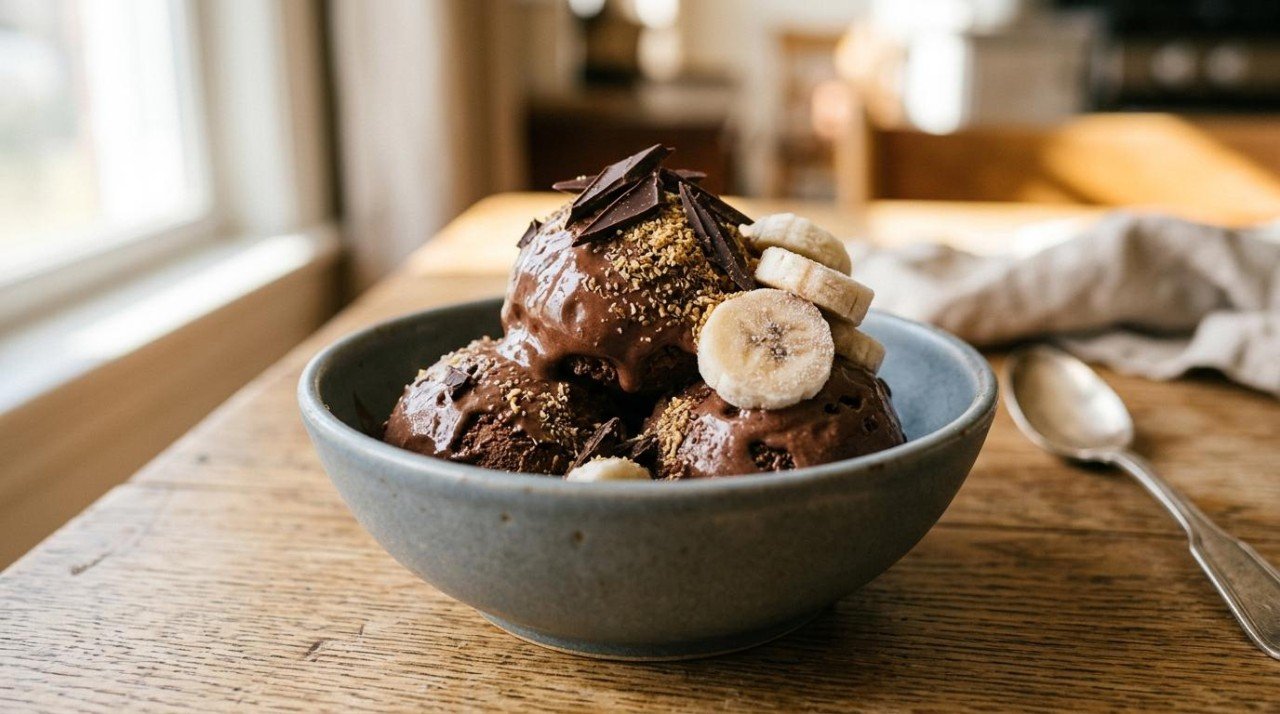
Cottage cheese ice cream is one of the few viral food trends that survived contact with reality. Blend a tub of cottage cheese completely smooth, freeze it, and you get something genuinely scoopable with more protein than most protein bars. Creator Lainie Kates (@lainiecooks) posted her version in spring 2023, and by early May that year videos under the hashtag had close to 260 million views on TikTok. Three years later it is still on everyone's feed.
So we scored it. The four-ingredient version everyone copies — cottage cheese, honey, peanut butter, chocolate chips — comes back at 30 out of 100 on our Nutrition Score. Not because of the cottage cheese. Because of the quarter cup of honey, which delivers 107% of the Daily Value for added sugar in a bowl of what everyone calls a healthy dessert.
Here is the good news: the fix is almost entirely about who does the sweetening. Same dish, same protein, same chocolate-peanut butter flavor — 70 out of 100, with every swap scored one at a time so you can see what each one buys you.
The viral version: what is in it and how it scores
The version that gets copied most is Lainie's peanut butter chocolate chip cheesecake style, and what we scored is its most widely republished form: 16 oz of cottage cheese, 1/4 cup of honey, 2 tablespoons of peanut butter, and 2 tablespoons of chocolate chips, blended smooth and frozen, serving three.
Score: 30/100. Per serving: 317 calories, 19.5 g protein, 1.2 g fiber, 28.2 g added sugar (107% DV), 4.3 g saturated fat, 530 mg sodium.
We also scored a fully loaded bowl — that base plus three crushed chocolate sandwich cookies and a chocolate syrup drizzle, which is what half the videos show. It scores 30 as well: 408 calories and 40 g of added sugar, or 152% DV. That is the most useful thing the score told us. The cookie crumble and the syrup are not what breaks this dessert; the honey already did, and the toppings cost you another 90 calories for free.
The diagnosis is more sympathetic than you might expect:
- The protein is real. 19.5 g per serving is not a marketing claim, it is what a tub of cottage cheese does. That part of the trend is honest.
- The added sugar is the whole problem. One serving exceeds the entire Daily Value. The American Heart Association's limits are 24 g a day for women and 36 g for men, and honey counts as added sugar just like table sugar.
- There is no fiber and almost no plant matter. 1.2 g per serving against a target of 25 to 35 g a day, and one plant point out of a weekly 30.
- Sodium is quietly high. 530 mg per serving, from the cottage cheese itself. In a dessert. Nobody thinks to check, and the chronic disease risk reduction ceiling is 2,300 mg a day.
- Calcium, B12, riboflavin, and phosphorus are genuinely good — 27% DV of B12, 39% DV of phosphorus. We are not going to break any of that.
One more number worth having: the bare base on its own, 16 oz of cottage cheese and a teaspoon of vanilla, scores 40. Better than the finished dessert, but no star, because it still has zero fiber, zero plants, and the same sodium. So "just eat it plain" is not the answer either. The base needs help, just not a quarter cup of honey's worth.
The upgrades: 30 to 70
Each swap below was scored on top of the one before it, in this order, against production nutrition data, and the deltas sum to exactly the +40 total. If you only make one change, make the first — it is worth more than the other four combined. If you make two, add the flaxseed.
1. Swap the honey for two frozen bananas
- Swap: 1/4 cup honey → 2 medium ripe bananas, sliced and frozen
- Score impact: +16 points (30 → 46)
- What it changes: Added sugar falls from 28.2 g to 5.0 g per serving, fiber doubles, potassium climbs
- What it costs you: It tastes faintly of banana. With cocoa and peanut butter in the mix most people read that as "chocolate peanut butter," but it is there
Frozen banana does two jobs at once, which is why it is worth so much. It sweetens, so the honey has nothing left to do — and honey, maple syrup, agave, and date syrup all count as added sugars, so swapping one syrup for another barely moves the score. And it thickens, so the texture does not go thin when the honey comes out.
The trade-off is real. Sugar lowers the freezing point of a frozen dessert, and that is a large part of what keeps ice cream soft rather than solid. Take out 23 g of sugar per serving and yours freezes harder. Banana gives some of it back, since freezing point depression depends on the number of dissolved particles and fruit sugars are small molecules, but not all of it. The fix is technique: freeze it in a shallow pan so it sets in two to three hours, and let it sit out 10 to 15 minutes before scooping.
2. Add 2 tablespoons of unsweetened cocoa powder
- Swap: Add 2 tablespoons unsweetened cocoa powder
- Score impact: +4 points (46 → 50)
- What it changes: Fiber up to 3.7 g per serving, and magnesium up by a third, for 8 calories
- What it costs you: Nothing, if you removed the honey first. On a honey-sweetened base it tastes flat and muddy
This is the swap that makes the banana disappear. Cocoa is intensely bitter and intensely chocolate, and it recruits the banana's sweetness into reading as dessert rather than fruit. It is also roughly a third fiber by weight, which is why 2 tablespoons moves that line as much as it does.
Use unsweetened cocoa, not a hot chocolate mix, which is mostly sugar. Natural or Dutch process both work; Dutch process is darker and less acidic, which suits a dairy base.
3. Swap the chocolate chips for half an ounce of dark chocolate
- Swap: 2 tablespoons semisweet chocolate chips → 1/2 oz dark chocolate (70% or higher), finely chopped
- Score impact: +7 points (50 → 57)
- What it changes: Added sugar drops from 5.0 g to 1.7 g per serving, and calories fall by 14
- What it costs you: Less sweetness in the chocolate bits, more bitter snap
Semisweet chips are close to half sugar by weight, and they are engineered to hold their shape, which in a frozen dessert means little waxy pellets. A chopped bar of 70% gives you thin shards that shatter against the spoon instead. Less sugar, better texture, fewer calories. Chop it fine and fold it in after blending, or it turns to brown dust.
4. Add 2 tablespoons of ground flaxseed
- Swap: Add 2 tablespoons ground flaxseed
- Score impact: +8 points (57 → 65)
- What it changes: Fiber to 4.6 g per serving and ALA omega-3 to 0.92 g, which is 58% DV
- What it costs you: A faint nuttiness and a slightly denser set. In a cocoa base, close to undetectable
This is the surprise of the build: two tablespoons of a seed most people forget they own, worth eight points, because it lands on the two things the original was weakest at. Be honest about which omega-3, though. Flax provides ALA, the plant form, and Harvard's Nutrition Source is measured about it, noting that ALA alone may offer modest protection against cardiovascular disease and type 2 diabetes. It is not a stand-in for the EPA and DHA in oily fish.
It has to be ground — whole flaxseed largely passes through undigested. Buy it pre-ground and keep it in the freezer, since it goes rancid quickly.
5. Buy the low-sodium cottage cheese
- Swap: Regular cottage cheese → low-sodium cottage cheese
- Score impact: +5 points (65 → 70)
- What it changes: Sodium falls from 530 mg to 230 mg per serving, and protein rises to 22.9 g
- What it costs you: Nothing in a sweet application. In a savory one you would miss the salt
Cottage cheese is a salty food we have collectively agreed to treat as a blank canvas. In a dessert that salt is doing nothing you want, and the low-sodium tubs tend to run slightly higher in protein per gram as a bonus. It is the laziest five points in this post: no technique, no flavor change, just a different tub. The catch is availability — if your store does not carry it, you stop at 65 and the dessert is still good.
Take the Guesswork Out of Eating Well
Eat Well Planner helps you organize your favorite recipes, plan balanced meals, and automatically generate shopping lists — all in one place. Whether you're tracking macros, managing dietary restrictions, or just trying to stop asking "what's for dinner?", we've got you covered.
Our AI-powered tools can adapt any recipe to your dietary needs, help you discover new meals you'll love, and even log your nutrition effortlessly. It's meal planning made simple.
Start Organizing Your Meals — FreeWhat we kept (on purpose)
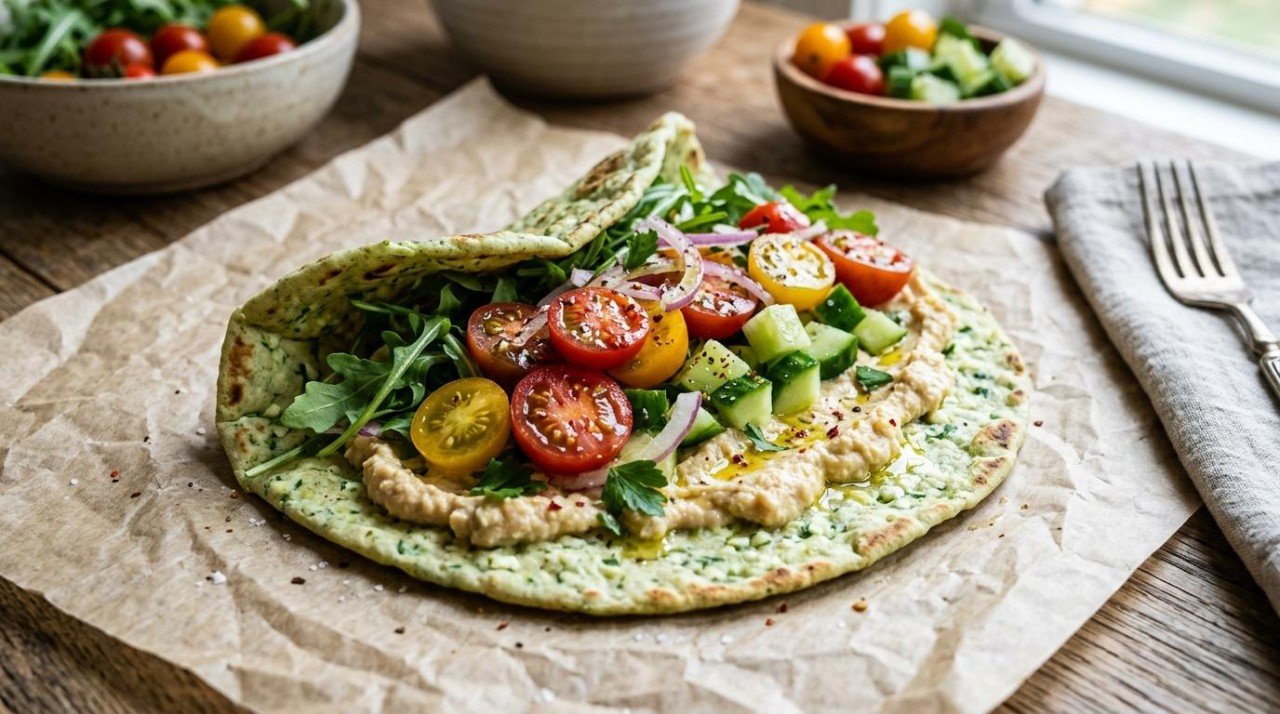
The cottage cheese. Obviously — it is the dish. The protein is the entire reason this dessert is interesting, and 22.9 g per serving is what makes a bowl of ice cream behave like a snack you are not hungry after. If you want to know what else that tub can do, we have a guide to cottage cheese substitutes and a scored makeover of the viral cottage cheese flatbread.
The peanut butter, at the same 2 tablespoons. It is the flavor that makes people finish the bowl, and cutting it saves very little — the fat here is not what was holding the score down. Use a natural peanut butter whose ingredient list reads "peanuts, salt."
Real chocolate, in a measured amount. Measured is the operative word — the viral bowls are not ruined by chocolate, they are ruined by chocolate poured straight from the bag. That is where we stopped. Everything past this point improved the number and damaged the dessert.
The healthier version: full recipe
Score: 70/100. Chocolate peanut butter cottage cheese ice cream, three servings.
One honest warning first: this is not premium ice cream, and no technique will make it premium ice cream — it has a fraction of the fat and sugar that make a pint of the real thing behave the way it does. What it is, blended properly and tempered before scooping, is a thick, cold, chocolatey, genuinely satisfying frozen dessert with 23 g of protein in it. Judged as gelato it will disappoint you, and pretending otherwise is how these recipes lose people at the first spoonful.
Ingredients
- 16 oz (2 cups) low-sodium cottage cheese
- 2 medium ripe bananas (about 8 oz peeled), sliced and frozen
- 2 tablespoons natural peanut butter
- 2 tablespoons unsweetened cocoa powder
- 2 tablespoons ground flaxseed
- 1 teaspoon vanilla extract
- 1/2 oz dark chocolate (70% or higher), finely chopped
Instructions
- Slice the bananas into coins, spread them on a plate or small sheet pan, and freeze until solid, at least 2 hours or overnight.
- Add the cottage cheese, frozen banana, peanut butter, cocoa powder, ground flaxseed, and vanilla to a high-powered blender or food processor.
- Blend until completely smooth, scraping down the sides two or three times. This takes 2 to 3 minutes. Graininess you can still feel on your tongue means it is under-blended, not that cottage cheese is grainy.
- Fold in the chopped dark chocolate by hand.
- Spread into a loaf pan or 8-inch square pan, no more than about an inch deep. Cover and freeze 2 to 3 hours, until firm but not solid.
- Let it sit at room temperature 10 to 15 minutes before scooping, or closer to 20 if it froze overnight.
Per serving, original versus improved
- Nutrition Score: 30 → 70
- Calories: 317 → 335
- Protein: 19.5 g → 22.9 g
- Fiber: 1.2 g → 4.6 g
- Added sugar: 28.2 g → 1.7 g
- Saturated fat: 4.3 g → 5.0 g
- Sodium: 530 mg → 230 mg
- Omega-3 (ALA): 0.04 g → 0.92 g
- Plant points: 1 → 3
Two of those lines go the wrong way and we are not hiding them. Calories went up by 18, because flaxseed and dark chocolate are not free, and this was never a calorie-cutting exercise. Saturated fat went up 0.7 g, and it is the one caution the improved version still carries, at 21% DV.
Swaps we tested and skipped
Nonfat cottage cheese: 69, down one point. The swap everyone assumes is obvious, and the score disagreed. Saturated fat does fall usefully, from 5.0 g to 3.0 g — but the nonfat tubs we scored are not low-sodium, so sodium jumps back to 660 mg and cancels the gain. Add the icier set you get with less fat and you are paying texture for nothing.
Cacao nibs instead of dark chocolate: 73, up three points. Technically the best-scoring chocolate, because nibs are unsweetened. But they do not melt and do not soften, so you get gravel where you wanted a shard dissolving on the spoon. Not worth three points, unless you already like nibs.
Greek yogurt instead of cottage cheese: 84, up fourteen points. The highest-scoring swap we tested, and the one we are most confident rejecting. Plain Greek yogurt scores dramatically better, mostly on sodium, at 100 mg per serving. It is also no longer cottage cheese ice cream — it is frozen yogurt, tangier and with less protein, at 20.2 g. If you would rather have frozen yogurt, have frozen yogurt. We are just not calling it this recipe.
If you do want to push past 70: adding 1 cup of frozen raspberries takes it to 76, with 7.8 g of fiber and a fourth plant point. That one is legitimate. We left it out because raspberry, chocolate, banana, and peanut butter is a lot of flavors in one bowl — but drop the peanut butter and chocolate raspberry is a better-tasting direction.
Make it fit other diets
- Dairy-free or vegan: there is no cottage cheese without dairy, so the honest answer is a different dessert — blended silken tofu or thick coconut yogurt with the same cocoa, banana, and flaxseed. Expect a softer set.
- Nut-free: sunflower seed butter, tablespoon for tablespoon. The closest match in fat and texture.
- Lower saturated fat: nonfat cottage cheese, no chopped chocolate, keep the cocoa. You lose on sodium and gain on saturated fat.
You do not have to work these out by hand. Ask AI Recipe Chat for a dairy-free rewrite of this exact recipe and Recipe Variations produces the full adapted version, substitutions already worked in, ready to score.
Do this to any recipe you love
Nothing here required guessing. We put the viral recipe into Eat Well Planner, read its Nutrition Score, and used Make It Healthier to propose swaps — a calculator verifies the real nutritional gain before a suggestion is ever shown to you — then ran each one through the Recipe Playground to watch the score move swap by swap. That is where every number above came from, including the three we rejected.
Do the same with whatever is on your feed this week: paste the URL, or import the TikTok or Instagram reel straight into the app, and score it before you cook it. Sometimes the recipe is better than it looks. Sometimes a quarter cup of honey is doing 40 points of damage, and you were never going to spot that by reading the ingredient list.