Cowboy butter is one of those sauces that sounds made up and then turns out to be exactly as good as promised: butter melted down with garlic, lemon, Dijon, cayenne, smoked paprika, and a fistful of herbs. Nobody is quite sure where it started. The Daily Meal reports that many credit a Southern-style diner in New York called Mr. Donahue's, since closed, and that it took off on TikTok thanks to the creator @JortsKitchen. Somewhere in there, someone cubed a steak, seared it hard, and served it with the butter in a bowl for dipping, and cowboy butter steak bites became a genre.
It earns the hype. There is no packet, no breading, no sauce from a jar — it is a hot pan, real steak, and a compound butter you build from scratch. The dipping ritual is the whole point: you spear a charred cube, drag it through the sauce, and the sauce is the reward.
It also came back from Eat Well Planner's Nutrition Score at 31 out of 100 — the same at-a-glance number that shows on any public recipe page. So we rebuilt it. We kept the steak, kept the sauce, kept the dipping, and landed at 69 out of 100. That is 38 points, and every swap below carries the real score change it earned, in the order we applied it.
The original: what's in it and how it scores
Viral versions vary, but they converge on the same build. Here is the one we scored, for four people:
- 2 lb ribeye, cut into 1-inch cubes
- Seasoning: 1 teaspoon garlic powder, 2 teaspoons salt, black pepper
- Cowboy butter: 14 tablespoons (just under two sticks) unsalted butter, 5 cloves garlic, 1 shallot, 3 tablespoons lemon juice, 1 tablespoon Dijon mustard, fresh parsley and chives, 1 teaspoon thyme, 1 teaspoon cayenne, 1/2 teaspoon red pepper flakes, 1/2 teaspoon smoked paprika
Nutrition Score: 31/100. Now the diagnosis, because knowing why a recipe scores the way it does is what lets you fix your own. Per serving it runs about 984 calories, 44 g protein, 43.6 g saturated fat, 1,310 mg sodium, and 1.2 g of fiber. Three things drag it down, and the biggest one is not the one people expect.
- Saturated fat, flagged very high at 185% of the daily reference. 43.6 g in one serving. The American Heart Association recommends less than 6% of daily calories from saturated fat, roughly 13 grams a day on a 2,000-calorie diet — so a single plate here is more than three days' worth. It splits almost evenly between two sources: 3 1/2 tablespoons of butter per person, and a half-pound of ribeye per person.
- Sodium, also flagged very high at 1,310 mg. That is more than half the AHA's 2,300 mg daily cap, and close to the entire 1,500 mg they name as the better target for most adults. Almost all of it comes from 2 teaspoons of salt, which is good news — that is a dial, not an ingredient.
- Nothing else is on the plate. 1.2 g of fiber and 3.25 plant points, and every one of those plant points is a seasoning — garlic, shallot, lemon, parsley, chives. The skillet is 100% animal protein and fat. This is the real reason it scores 31 rather than 45.
And what is already fine, because manufacturing problems is not the job: 44 g of protein per serving, 231% of the daily value for vitamin B12, 86% for zinc, 83% for B6, and 58% for iron. Zero added sugar. Nothing ultra-processed anywhere in it. The sauce is garlic, citrus, mustard, herbs, and spices — that is real cooking, and none of it needed changing.
The upgrades
Four swaps, ordered by what they earned. If you only make the first one, you get most of the movement.
1. Fill the skillet with vegetables
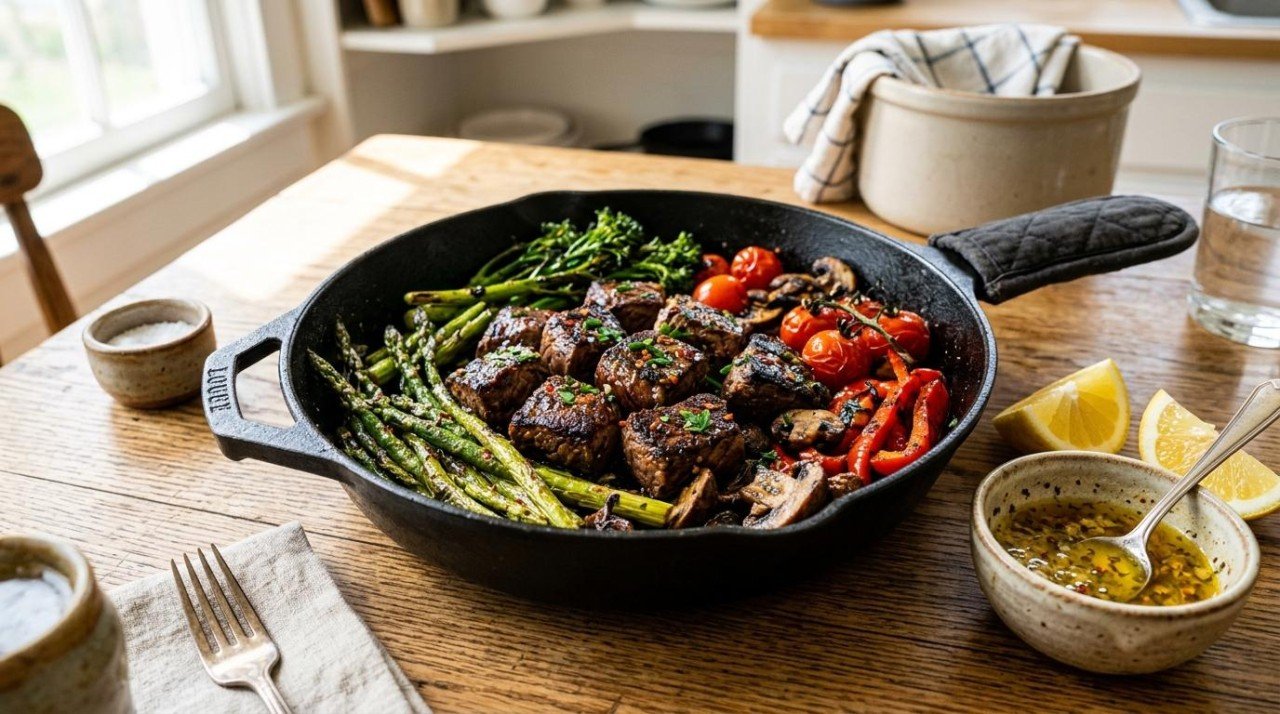
- Swap: Steak alone in the pan → steak plus cremini mushrooms, red bell pepper, red onion, asparagus, cherry tomatoes, and broccolini, all charred in the same skillet
- Score impact: +16 points (31 → 47)
- What it changes: Fiber from 1.2 g to 6.7 g, plant points from 3.25 to 9.25, and the potassium, vitamin C, and vitamin K that were missing entirely
- What it costs you: Nothing on the plate, about eight minutes of knife work, and one extra round of cooking in batches
This is the biggest single move in the post and it takes nothing away. The insight is that cowboy butter is a dipping sauce, and a dipping sauce is only as good as the number of things you can dip in it. Charred asparagus and blistered cherry tomatoes are outstanding in garlic-lemon butter. Cremini mushrooms in particular sear like meat and soak up sauce better than the steak does.
Cook them in batches over high heat and get real color on them — the goal is char, not steam. A crowded pan gives you gray, wet vegetables, which is how this swap gets a bad reputation. Six different plants in one skillet also does a lot of work for gut bacteria diversity, which is the whole idea behind eating 30 different plants a week.
2. Top sirloin instead of ribeye
- Swap: 2 lb ribeye → 2 lb top sirloin, same weight, same 1-inch cubes
- Score impact: +5 points (47 → 52)
- What it changes: Saturated fat from 43.7 g to 30.7 g per serving, calories from 1,059 to 775, and protein up from 49.8 g to 57.2 g
- What it costs you: A little richness, and about 30 seconds of margin for error — sirloin is less forgiving if you walk away
Ribeye's appeal is the intramuscular fat, and in a steak you eat with a knife and fork that matters. In inch cubes tossed in a butter sauce, it matters much less: the sauce is already supplying the fat and the flavor, so the marbling is doing a job that is being done twice.
The trade-off is real, though. Sirloin has less fat to protect it, so it goes from medium-rare to tough faster. Cut the cubes a full inch so they have some mass, get the pan properly hot, sear two minutes a side without touching them, and pull at 130F. Do that and the difference is small. Overshoot and you will notice.
3. Rebuild the cowboy butter on olive oil
- Swap: 14 tablespoons of butter → 2 tablespoons butter plus 4 tablespoons olive oil
- Score impact: +5 points (52 → 57)
- What it changes: Saturated fat from 30.7 g to 11.0 g per serving, and calories from 775 to 594
- What it costs you: A slightly thinner sauce and a greener, more peppery edge — this is the swap you will actually taste
This is the one the recipe is named for, so we cut it as far as the dish would take and stopped. Two tablespoons of real butter across four servings still reads as butter, because butter's flavor compounds are potent and the sauce is finished off the heat, where they survive. Olive oil brings its own grassy bitterness, which lands well against the lemon, Dijon, and cayenne already in there — closer to a chimichurri than to a beurre blanc, but recognizably the same sauce.
It is also the swap with the strongest evidence behind it. A 2025 study in JAMA Internal Medicine followed 221,054 US adults for up to 33 years and found that replacing 10 g a day of butter with an equivalent amount of plant-based oils was associated with an estimated 17% lower total mortality. If you want the full picture on which fat does which job, we cover it in the butter substitutes and olive oil substitutes guides.
4. Halve the salt, double the lemon and garlic
- Swap: 2 teaspoons salt → 1 teaspoon; 5 cloves garlic → 10; 3 tablespoons lemon juice → 5
- Score impact: +12 points (57 → 69) applied at this point in the build
- What it changes: Sodium from 1,330 mg to 750 mg per serving, clearing the very high flag
- What it costs you: Genuinely nothing, if you add the acid and the garlic at the same time
Cutting salt in half normally makes food taste flat, and that is why most people will not do it. The fix is to replace what salt was doing rather than just removing it. Acid and pungency both read as "seasoned" on the palate, so doubling the lemon juice and the garlic covers the gap almost completely. Add the lemon off the heat so it stays bright rather than cooking down.
The vegetables help here too, in a way that does not show up as flavor. All that produce took potassium from 780 mg to 1,660 mg per serving, and the AHA notes that potassium eases tension in blood vessel walls and increases how much sodium you clear in urine — we go deeper on that in the other half of the salt equation. And if you are out of fresh lemons, the lemon juice substitutes guide has the ratios that work here.
Take the Guesswork Out of Eating Well
Eat Well Planner helps you organize your favorite recipes, plan balanced meals, and automatically generate shopping lists — all in one place. Whether you're tracking macros, managing dietary restrictions, or just trying to stop asking "what's for dinner?", we've got you covered.
Our AI-powered tools can adapt any recipe to your dietary needs, help you discover new meals you'll love, and even log your nutrition effortlessly. It's meal planning made simple.
Start Organizing Your Meals — FreeWhat we kept (on purpose)
The butter stays. Not a spread, not a "buttery" anything — 2 tablespoons of real unsalted butter, which is the difference between cowboy butter and salad dressing.
The entire spice and herb profile stays exactly as written: cayenne, red pepper flakes, smoked paprika, Dijon, thyme, parsley, chives. None of it costs a single point, all of it is why the sauce tastes like something. The 2 lb of steak stays too, for reasons covered in the skipped swaps below. And the dipping ritual stays — half the sauce goes over the pan, half goes into a bowl on the table.
Here is where we stopped: at 69, the app still flags saturated fat as high (47% of the daily reference) and sodium as high (33%). Both moved down a full severity level from very high, and neither will go further without taking out the butter or the steak. That is the honest ceiling for a dish called cowboy butter steak bites.
The healthier version: full recipe
Nutrition Score: 69/100. Serves 4. About 25 minutes of prep, 20 minutes of cooking.
- 2 lb (907 g) top sirloin steak, cut into 1-inch cubes
- 1 teaspoon garlic powder
- 1 teaspoon fine salt, divided
- 1 teaspoon black pepper, divided
- 8 oz (227 g) cremini mushrooms, halved
- 1 large red bell pepper (about 180 g), cut into 1-inch squares
- 1 small red onion (about 120 g), cut into wedges
- 8 oz (227 g) asparagus, trimmed and cut into 2-inch lengths
- 7 oz (200 g) broccolini, cut into 2-inch lengths
- 1 pint (250 g) cherry tomatoes
- 4 tablespoons (55 g) olive oil, divided
- 2 tablespoons (28 g) unsalted butter
- 10 cloves garlic (about 40 g), finely minced
- 1 small shallot (about 30 g), finely minced
- 5 tablespoons (75 g) fresh lemon juice, from about 2 lemons
- 1 tablespoon Dijon mustard
- 1/4 cup (8 g) fresh parsley, finely chopped
- 2 tablespoons (6 g) fresh chives, finely chopped
- 1 teaspoon dried thyme
- 1 teaspoon cayenne pepper
- 1/2 teaspoon crushed red pepper flakes
- 1/2 teaspoon smoked paprika
A note on the heat: 1 teaspoon of cayenne plus the flakes is the viral spec and it is genuinely spicy. Start at 1/2 teaspoon if that is not your thing — spices carry no meaningful weight in the score either way.
- Pat the steak very dry and cut it into 1-inch cubes. Toss with the garlic powder, 1/2 teaspoon of the salt, and 1/2 teaspoon of the pepper. Leave it on the counter while you prep the vegetables — dry, room-temperature meat browns far better than cold, wet meat.
- Make the cowboy butter. Warm the butter with 2 tablespoons of the olive oil in a small pan over low heat. Add the garlic and shallot and cook about 1 minute, until fragrant but not colored. Take it off the heat, then stir in the lemon juice, Dijon, parsley, chives, thyme, cayenne, red pepper flakes, smoked paprika, and the remaining 1/2 teaspoon each of salt and pepper. Set aside.
- Heat 1 tablespoon of the olive oil in a large cast-iron skillet over high heat until it shimmers. Add the broccolini and asparagus and cook 3 to 4 minutes, tossing once, until blistered and still crisp. Move to a plate.
- Add the mushrooms to the dry pan and leave them alone for 3 minutes, until the undersides are deeply browned, then toss and cook 2 minutes more. Add the bell pepper and red onion and cook 3 minutes. Add the cherry tomatoes and cook 1 to 2 minutes, just until a few split. Move everything to the plate.
- Add the last tablespoon of olive oil and let the pan get very hot. Sear the steak in two batches in a single layer, 2 minutes per side without moving it, until deeply browned and about 130F at the center for medium-rare. Crowding the pan is the one mistake that ruins this dish.
- Kill the heat, return the steak and all the vegetables to the skillet, and spoon over about half the cowboy butter. Toss for 30 seconds, until everything is glossy.
- Serve straight from the skillet with the remaining cowboy butter in a small bowl for dipping.
Per serving, original versus improved:
- Nutrition Score: 31 → 69
- Calories: 984 → 604
- Protein: 44 g → 57 g
- Saturated fat: 43.6 g → 11.0 g
- Sodium: 1,310 mg → 750 mg
- Fiber: 1.2 g → 6.9 g
- Potassium: 780 mg → 1,660 mg
- Vitamin C: 12% → 118% of the daily value
- Plant points: 3.25 → 9.25
The improved version comes back as an excellent source of vitamin B12 (189% DV), vitamin K (160%), vitamin C (118%), B6 (114%), iron (112%), niacin, phosphorus, zinc, and protein — and, for the first time, of fiber.
Swaps we tested and skipped
Three changes that looked obvious and did not survive contact with the numbers. All three were scored against the finished 69-point version.
- Drop the butter entirely and go all olive oil — scored 78, up 9 points. The single best-scoring change we found, and we turned it down anyway. The dish is named for the butter. If we published a 78-point recipe with no butter in it, we would be handing you a different dinner and calling it a makeover. Make it if you want the number; just know that is the trade.
- Cut the steak from 2 lb to 1 1/2 lb — scored 67, down 2 points. This one genuinely surprised us. Trimming the portion drops calories to 524, but it also drops protein from 57 g to 45 g, and the score falls. Once the vegetables are in the pan, the steak is no longer the problem, so shrinking it costs more than it saves.
- Stir Greek yogurt into the sauce — scored 70, up 1 point. A perennial "healthy swap" suggestion, and here it buys you one point for a sauce that is worse. Nonfat Greek yogurt splits when it meets a hot pan, and cowboy butter is served warm over just-seared steak. One point is not worth a curdled sauce. If you want yogurt in your life, the Greek yogurt substitutes guide covers where it does and does not hold up.
Make it fit other diets
Dairy-free: drop the 2 tablespoons of butter and use 6 tablespoons of olive oil total. That is the 78-point version above, and it works — it just becomes a herb-and-garlic oil rather than cowboy butter. Vegetarian: swap the steak for 2 lb of king oyster or portobello mushrooms cut into 1-inch pieces and seared hard; the sauce was always the star, and mushrooms take a char better than most things. Lower sodium still: take the salt to 1/2 teaspoon and add another tablespoon of lemon plus a little more Dijon.
In Eat Well Planner, you do not have to work these out by hand. Recipe Variations will rewrite the whole recipe for a given diet in one step, and the AI Recipe Chat answers substitution questions with the full recipe already in context.
Do this to any recipe you love
Nothing here required giving up the dish. The steak stayed, the sauce stayed, the dipping stayed, and the score moved 38 points — mostly because we put more things in the pan, not fewer.
That is the process the app runs on. Import any recipe from a URL, an Instagram reel, or a YouTube video and it comes back scored, with the same breakdown we used for the diagnosis above. Make It Healthier then proposes swaps like these, with a calculator verifying the actual nutritional gain before a suggestion is ever shown to you — no guessing, no vibes. The Recipe Playground is where the per-swap deltas in this post came from, and it works on your recipes too: keep the ribeye if you love the ribeye, watch what it costs, and make it up somewhere else.
Next time a steak recipe crosses your feed, import the video and score it before you cook it. It takes about ten seconds, and it is a much better way to decide than the comments section.