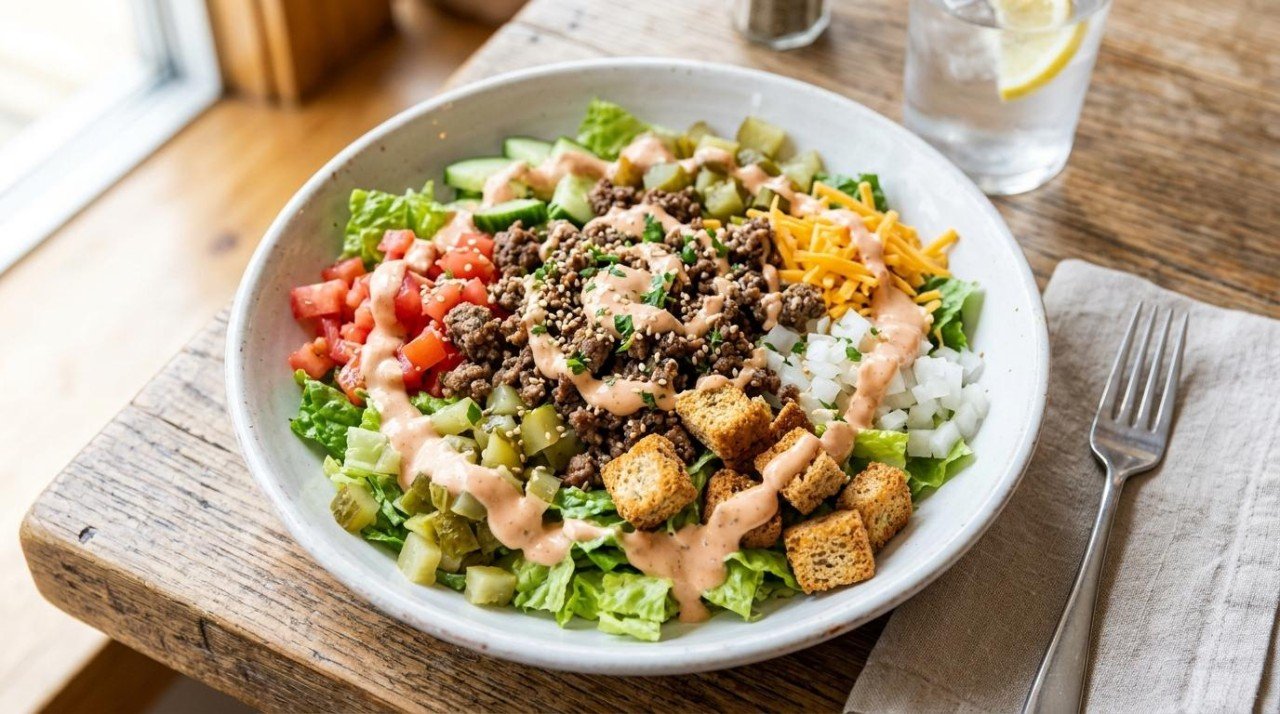
The Big Mac salad is the burger without the bun: seasoned ground beef over shredded lettuce with cheddar, pickles, diced onion, and a homemade special sauce poured over the top. It has been a staple of low-carb food blogs for years (Whole Lotta Yum says its version has been one of its most popular reader recipes since 2019), and then TikTok got hold of it and the "Big Mac bowl" went everywhere. It's easy to see why. It tastes like the drive-through, it comes together in 20 minutes, and it lets you eat the whole burger and skip the carbs.
That last bit is the part we wanted to test. "Low carb" gets treated as shorthand for "healthy," so we ran the standard version through Eat Well Planner's Nutrition Score, the same 0 to 100 number a visitor sees on any public recipe page. It scored 35 out of 100. Then we scored the exact same fillings piled onto sesame buns, a homemade Big Mac, and that scored 39. Leaving the bun off cost the bowl 4 points.
So we rebuilt it, keeping the beef, the cheddar, the pickles, and the sauce, and got it to 73. That's 38 points higher, about 190 fewer calories, six times the fiber, and more protein. Every swap below carries the real score change it earned. The biggest single jump came from putting some bread back in.
The original: what's in it and how it scores
Here's the standard version we scored. It serves four and follows the shape of the most-shared recipes:
- 1 lb 80/20 ground beef, browned with 1/2 teaspoon salt, onion powder, and garlic powder
- About 6 cups shredded iceberg lettuce
- 1 cup shredded cheddar (4 oz)
- Diced dill pickles, diced white onion, and a sprinkle of sesame seeds
- Special sauce: 1/2 cup mayonnaise, 2 tablespoons sweet pickle relish, 1 tablespoon ketchup, 1 teaspoon sugar, mustard, vinegar, and paprika
Nutrition Score: 35/100. Per serving, that's about 645 calories, 53 g fat, 17.4 g saturated fat, 1,060 mg sodium, 28 g protein, and 0.9 g of fiber. Here's what pulls the score down:
- Saturated fat is very high: 17.4 g, or 74% of a day's worth in one bowl. Without a bun to dilute it, nearly all of it comes from three places: the 80/20 beef, a full cup of cheddar, and half a cup of mayo.
- Sodium is high: 1,060 mg, close to half the 2,300 mg daily limit the Dietary Guidelines set, before the rest of your day.
- There's almost no fiber: under a gram. Most of the bowl's volume is iceberg lettuce, which is mostly water.
For perspective, third-party nutrition trackers list a McDonald's Big Mac at around 540 calories and 10 g of saturated fat. Exact figures vary by country and year, but the homemade "lighter" salad carries more of both than the burger it's named after. The bun was never the main problem. The portion of fat that replaced it was.
Some things are already good. Protein is solid at 28 g, and the beef makes the bowl an excellent source of vitamin B12, zinc, and iron. It's also real cooking, with no packets or boxes. The concept works, so we kept the dish and changed the proportions.
The upgrades
We applied seven swaps cumulatively, in this order. One thing to keep in mind as you read: the score holds back while the very high saturated fat flag is up, so some swaps are worth more late in the chain than they look early on. Where that happened, we give both numbers.
1. Swap the iceberg for romaine, tomato, and cucumber
- Swap: 6 cups iceberg → 1 large head romaine, 2 tomatoes, and 1 small cucumber
- Score impact: +9 points (35 → 44)
- What it changes: Fiber from 0.9 g to 3.4 g, plant points from 4.75 to 6.75, and vitamin A, vitamin C, and potassium all climb
- What it costs you: Nothing, and the bowl looks a lot more like a meal
This is the easiest win, so it comes first. Romaine has the same cold crunch as iceberg but more to it nutritionally, and the tomato and cucumber bring the juiciness a Big Mac gets from its toppings. A Big Mac has no tomato, but the salad is better with it. It's also the swap you'd miss most if you undid it: putting iceberg back into the finished recipe cost 13 points and brought back a "low vitamin C" flag.
2. Rebuild the sauce on Greek yogurt and drop the ketchup
- Swap: 1/2 cup mayo + ketchup + sugar → 6 tablespoons plain Greek yogurt + 2 tablespoons mayo, with a little extra paprika for color
- Score impact: +5 points (44 → 49)
- What it changes: 134 fewer calories per serving, total fat from 54 g to 39 g, added sugar roughly halved, and a little more protein
- What it costs you: A slightly tangier sauce. The relish, mustard, and paprika carry the Big Mac flavor
You don't need the ketchup, and it isn't authentic anyway. Former McDonald's corporate chef Mike Haracz has said the real sauce has no ketchup in it. It gets its tang from mustard, vinegar, and sweet relish, and its pink color from a small amount of paprika. Taking out the ketchup and the teaspoon of sugar makes the sauce closer to the original, not further from it.
Greek yogurt makes up most of the sauce, which is why it leads our mayonnaise substitutes guide. We kept 2 tablespoons of real mayo on purpose (more on that below), because it keeps the sauce rich and emulsified. Without it, the sauce tastes like seasoned yogurt. For more on cooking and mixing with it, see our Greek yogurt guide.
3. Use 95% lean beef
- Swap: 1 lb 80/20 ground beef → 1 lb 95/5
- Score impact: +4 points (49 → 53). Putting 80/20 back into the finished recipe costs 15 points
- What it changes: 133 fewer calories per serving, saturated fat from 15.2 g to 8.8 g (out of the "very high" band), and protein up to 35.5 g
- What it costs you: A little richness. In a crumble covered in sauce, it's hard to notice
This is the biggest real change in the makeover. The +4 understates it because sodium was still holding the score back at this point in the chain. The put-back number tells you more: once everything else is fixed, going back to 80/20 costs 15 points.
Lean beef is also easiest to use in exactly this kind of dish. You're browning crumbles and covering them in sauce, not shaping a juicy patty, so a few minutes over medium-high heat with the onion and garlic powder gives you plenty of browned flavor. Brown it in a hot pan without crowding and leave it alone long enough to get a crust. Our ground beef substitutes guide covers turkey and part-plant options if you want to go further.
4. Use half as much cheese, and make it sharp
- Swap: 1 cup shredded mild cheddar (4 oz) → 1/2 cup finely shredded sharp cheddar (2 oz)
- Score impact: +2 points (53 → 55). Putting the full cup back at the end costs 10 points
- What it changes: 57 fewer calories, saturated fat from 8.8 g to 6.2 g, and about 90 mg less sodium per serving
- What it costs you: Very little, as long as it's sharp and shredded fine
Sharp cheddar has more flavor per bite, so half the amount doesn't taste like half. Shred it on the fine side of a box grater so it covers more of the bowl. This one also looks small in the chain (+2) and large in hindsight (−10), which is the pattern this makeover keeps showing. Our cheddar substitutes guide covers other options.
5. Skip the added salt
- Swap: 1/2 teaspoon salt on the beef → none
- Score impact: +6 points (55 → 61). Putting the salt back at the end costs 12 points
- What it changes: Sodium from 810 mg to 520 mg per serving, and "high sodium" drops off the score's list of weaknesses
- What it costs you: Taste it before you decide. Most people won't miss it
A Big Mac salad already has plenty of salty ingredients: dill pickles, sweet relish, cheddar, mustard, and mayo. The half teaspoon of salt on the beef adds sodium without adding much flavor you'd notice once everything is mixed. Season the beef with onion powder, garlic powder, and plenty of black pepper, then taste the finished bowl. If you really need salt, a pinch (about 1/8 teaspoon) cost only 3 points in our tests. With the average American eating about 3,400 mg of sodium a day, this is an easy place to cut some.
6. Bring back the bun, as whole wheat croutons
- Swap: No bread → 4 slices of 100% whole wheat bread, cubed, tossed with 1 tablespoon canola oil, and baked
- Score impact: +11 points (61 → 72), the biggest jump in the makeover
- What it changes: Fiber from 3.4 g to 5.2 g, protein up to 36 g, another plant point, and more B vitamins, magnesium, and omega-3 ALA
- What it costs you: The "low carb" label. Carbs rise from 14 g to 27 g per serving
The trend's whole premise is dropping the bun, and the bread turned out to be the most valuable thing we could add. We tested it expecting a small penalty for the carbs. Instead the score jumped, because 100% whole wheat bread brings fiber, minerals, and a whole grain to a bowl that had almost none. Dry-toasted croutons were worth +8 on their own, and the tablespoon of canola oil that makes them crisp added the rest.
We used whole wheat on purpose. In our tests, croutons made from a white hamburger bun scored 2 points below the same amount of whole wheat. The score isn't rewarding carbs in general. It's rewarding whole grains.
If you're eating low carb for a medical reason, skip the croutons and stop at 63 (sesame seeds included). That bowl has 11.1 g of net carbs per serving, slightly fewer than the original's 11.4 g, and scores 28 points higher. You don't need croutons to get most of this makeover.
7. Use a full tablespoon of sesame seeds
- Swap: A pinch of sesame seeds → 1 tablespoon, toasted
- Score impact: +1 point (72 → 73)
- What it changes: A little more fiber and minerals
- What it costs you: Nothing. Toasted, they taste like the bun
It's a small change, but toasting the seeds in a dry pan for two minutes is what makes the bowl taste like a sesame bun. Do it while the croutons bake.
Take the Guesswork Out of Eating Well
Eat Well Planner helps you organize your favorite recipes, plan balanced meals, and automatically generate shopping lists — all in one place. Whether you're tracking macros, managing dietary restrictions, or just trying to stop asking "what's for dinner?", we've got you covered.
Our AI-powered tools can adapt any recipe to your dietary needs, help you discover new meals you'll love, and even log your nutrition effortlessly. It's meal planning made simple.
Start Organizing Your Meals — FreeWhat we kept (on purpose)
We kept real beef, real cheddar, and the dill pickles, which you can't take out of a Big Mac without losing what it is. We also kept the 2 tablespoons of real mayonnaise in the sauce. A sauce made with only yogurt scored one point higher (74), and we passed on it. It tastes like yogurt, and a small amount of fat on a salad does real work: in a study in the American Journal of Clinical Nutrition, people absorbed essentially none of the carotenoids from a romaine, spinach, tomato, and carrot salad eaten with fat-free dressing. Absorption rose with reduced-fat dressing and was higher still with full-fat. One point isn't worth a sauce nobody likes.
Some flags remain at 73. Saturated fat and sodium are both still marked "high," just no longer "very high," and vitamin D is low. That's about the ceiling for a cheeseburger in a bowl.
The healthier version: full recipe
Nutrition Score: 73/100. Serves 4. About 15 minutes of prep and 15 minutes of cooking.
For the special sauce:
- 6 tablespoons (90 g) plain nonfat Greek yogurt
- 2 tablespoons (28 g) mayonnaise
- 2 tablespoons (30 g) sweet pickle relish
- 1 teaspoon yellow mustard
- 1 teaspoon apple cider vinegar or white wine vinegar
- 1 teaspoon paprika
- 1/4 teaspoon onion powder
For the croutons:
- 4 slices (120 g) 100% whole wheat bread, cut into 1/2-inch cubes
- 1 tablespoon canola oil
For the bowl:
- 1 lb (454 g) 95% lean ground beef
- 3/4 teaspoon onion powder
- 3/4 teaspoon garlic powder
- Black pepper
- 1 large head romaine (about 300 g), chopped
- 2 medium tomatoes (about 300 g), diced
- 1 small cucumber (about 150 g), diced
- 1/2 cup (80 g) finely diced white onion
- 2 medium dill pickles (about 100 g), chopped
- 2 oz (57 g) sharp cheddar, finely shredded (about 1/2 cup)
- 1 tablespoon (9 g) sesame seeds
- Heat the oven to 375°F. Toss the bread cubes with the canola oil on a baking sheet and bake 12 to 15 minutes, stirring once, until crisp and golden. Let them cool on the pan.
- While the croutons bake, stir together all of the sauce ingredients. Refrigerate until serving. It thickens and the flavors come together as it sits.
- Toast the sesame seeds in a dry skillet over medium heat for 1 to 2 minutes, shaking the pan, until golden and fragrant. Move them to a small bowl.
- In the same skillet over medium-high heat, add the beef and break it into large pieces. Let it brown without stirring for 3 to 4 minutes, then sprinkle with the onion powder, garlic powder, and plenty of black pepper and keep cooking, breaking it into crumbles, until browned and cooked through. Taste, and add a small pinch of salt only if it needs it.
- Divide the romaine, tomatoes, and cucumber among four bowls. Top with the warm beef, onion, pickles, and cheddar.
- Spoon the sauce over each bowl, then add the croutons and sesame seeds just before serving so the croutons stay crunchy.
Per serving, before and after:
- Nutrition Score: 35 → 73
- Calories: about 645 → about 459
- Saturated fat: 17.4 g → 6.8 g (from 74% of the daily value to 29%)
- Total fat: 53.4 g → 22.1 g
- Sodium: about 1,060 mg → about 650 mg
- Fiber: 0.9 g → 5.5 g
- Protein: 27.8 g → 36.4 g
- Added sugar: 4.2 g → 3.3 g
- Carbs: 12.3 g → 27.8 g (14.8 g without the croutons)
- Plant points: 4.75 → 7.75
The finished bowl is also a good source of vitamin A (46% of the daily value, up from 14%), vitamin C (21%), and potassium (30%, up from 18%), and it adds three more plants toward your 30 plants a week.
Swaps we tested and skipped
- An all-yogurt sauce (scored 74). One point higher, and we passed, for the flavor and carotenoid reasons above.
- 90/10 beef instead of 95/5 (scored 67). Six points lower. That's a reasonable choice if 95% lean is hard to find or you want a little more richness, but the cost is real. If you're choosing between the two, 93/7 falls in between.
- Olive oil on the croutons (scored 71). Two points below canola, mostly because canola has more omega-3 ALA. Both are fine, so use whichever you have.
- White bun croutons. Two points below the same amount of whole wheat, with less fiber. If you're adding bread, use whole wheat.
- The homemade Big Mac (scored 39). The original fillings on sesame buns beat the original salad by 4 points. It isn't a swap we'd recommend on its own, but it's the clearest sign that leaving off the bun was never what made the bowl healthy.
Make it fit other diets
Keto or low carb: skip the croutons and keep everything else. That bowl scores 63, with fewer net carbs than the original. Dairy-free: use a plain unsweetened plant yogurt in the sauce and leave out the cheddar. The pickles and sauce will carry the flavor. Gluten-free: make the croutons from a whole grain gluten-free bread, or use toasted chickpeas for crunch. In Eat Well Planner, you can ask the AI recipe chat to make this dairy-free or gluten-free, and it rewrites the whole recipe with the swaps worked in. If you like this kind of makeover, our healthier taco salad and healthier cheeseburger got the same treatment.
Score any viral recipe before you cook it
Every score and swap in this post came from Eat Well Planner's Make It Healthier tool. It suggests swaps like these and checks the actual nutritional gain with a calculator before showing you the suggestion. We tested each swap in the Recipe Playground, where the score updates with every edit. That's how we found the results we didn't expect: that the bunless bowl scores below the burger, that 80/20 beef costs 15 points once the rest of the bowl is fixed, and that the biggest gain came from putting bread back in.
When the next viral recipe shows up in your feed, paste the TikTok, Instagram, or YouTube link into Eat Well Planner. It pulls out the ingredients and nutrition, and you can see the score before you shop. Then tap Make It Healthier to see which swaps are worth making.