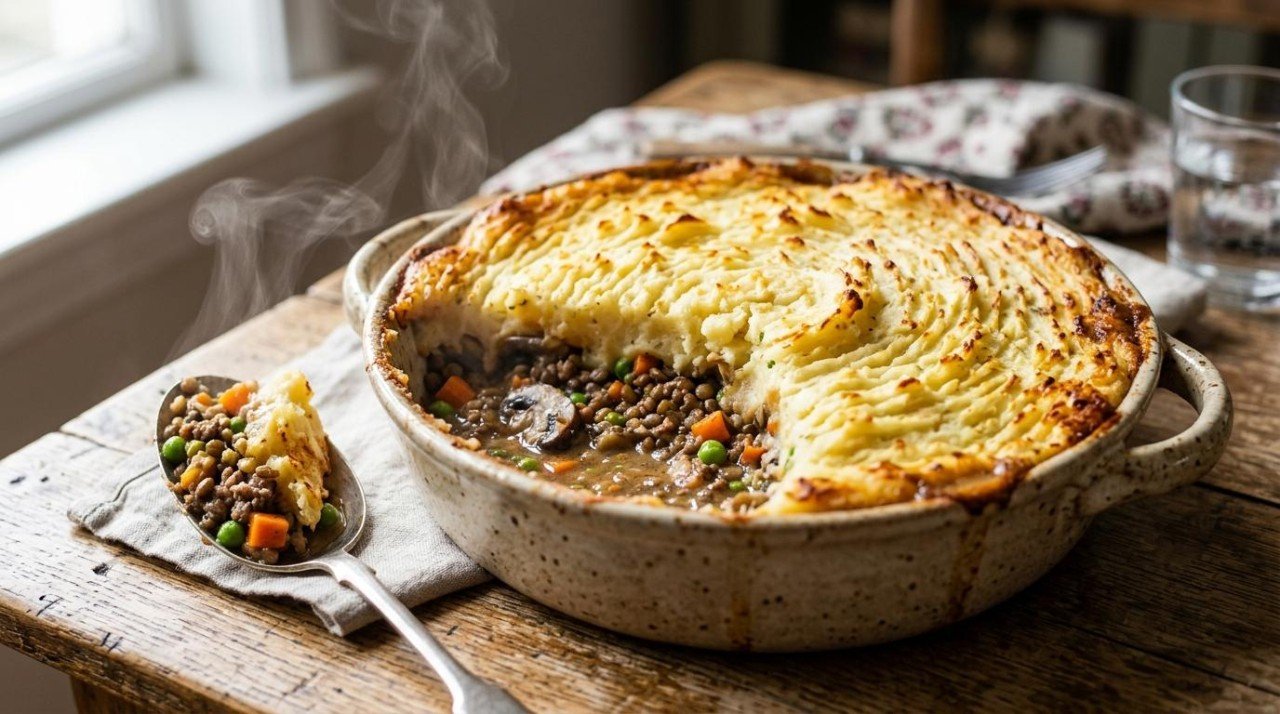
Shepherd's pie is cold-weather comfort in a casserole dish: a savory, gravy-bound layer of meat and vegetables under a blanket of mashed potato, baked until the top goes golden and the edges bubble. It is thrift food that became love food. The potato-topped meat pie was born in Britain and Ireland when the potato gave poorer households a cheap crust for stretching yesterday's roast into another dinner - cottage pie shows up in print by 1791, and the first shepherd's pie recipe appears in Edinburgh in 1849. (The lamb-versus-beef rule you may have heard - lamb for shepherd's pie, beef for cottage pie - is a modern convention the two names ignored for most of their history. Most American kitchens make it with beef and call it shepherd's pie, so that is the version we scored.)
We were not out to reinvent it. We built a standard version - a pound and a half of 80/20 ground beef in a broth-and-tomato gravy with onion, carrot, and peas, topped with russet mash whipped with butter and heavy cream - and ran it through the Eat Well Planner Nutrition Score. It came back at 47 out of 100. Middle of the road: genuinely loaded with protein, iron, and B12, but weighed down by one big number and one stubborn one.
So we kept going. Same dish, same layers, same comfort, one swap at a time, re-scoring against live nutrition data after each change. The finished version scores 81 - thirty-four points higher - with a fifth of the saturated fat, less than half the sodium, and more fiber, protein, and plants. Here is every change and exactly what it was worth.
The original: what's in it and how it scores
The version we scored is the one most of us make: about 1.5 pounds of 80/20 ground beef browned and simmered with a diced onion, two carrots, a cup of peas, garlic, tomato paste, Worcestershire, and a cup of beef broth thickened with a little flour - then topped with 2 pounds of russet potatoes mashed with half a stick of butter and half a cup of heavy cream. Six servings. Here is what one of them looks like on the numbers:
- Nutrition Score: 47 / 100
- Calories: about 596
- Saturated fat: about 17.4 g
- Sodium: about 1,370 mg
- Fiber: about 4.5 g
- Protein: about 26 g
- Plant points: 5.25
The score flags two things, and the first one is the whole story. Saturated fat lands at about 17.4 g a serving - roughly 74% of the American Heart Association's daily target of about 13 g in a single helping, before any butter on the roll. It comes from three places stacked on top of each other: the 80/20 beef, the half stick of butter, and the half cup of heavy cream in the mash. Saturated fat is the lever with the most health behind it, because it is what raises LDL cholesterol - so this is where most of the points are hiding.
The second flag is sodium: about 1,370 mg a serving, roughly 60% of the 2,300 mg daily limit, from the added salt, the canned broth, and the Worcestershire together. Most Americans already eat about 3,100 mg a day, so this is a number worth pulling down.
What is already good is worth saying out loud, because it is why this dish earns its place. A serving delivers about 26 g of protein and scores excellent for vitamin B12, vitamin B6, and iron, with a solid 4.5 g of fiber and a plant-point count of 5.25 from the vegetables already in it. This is not junk food we are rescuing. It is a nutrient-dense dinner with two numbers pulling it down - and both of them are fixable without touching what makes shepherd's pie shepherd's pie.
The upgrades
Four swaps, ordered from the biggest win downward. A reader who makes only the first two has already done most of the work. Every score change below is cumulative - each swap stacked on the last, in this order, and re-scored against production nutrition data.
1. Lean the beef and cut it with lentils
- Swap: 1.5 pounds of 80/20 beef to 1 pound of lean 90/10 beef plus 1 cup of cooked brown lentils
- Score impact: +8 points (47 to 55)
- What it changes: Saturated fat drops from about 17.4 g to about 10.8 g a serving, fiber climbs from 4.5 g to 6.9 g, protein nudges up, and calories fall by about 100
- What it costs you: Almost nothing - lentils vanish into the gravy and read as more meat, not less
Two things happen here at once. Leaning the beef from 80/20 to 90/10 cuts saturated fat directly, and replacing a third of the meat with cooked lentils swaps high-fat beef for a food that is all fiber and plant protein and zero cholesterol. Brown and green lentils hold their shape and soak up the gravy, so the filling stays hearty and spoonable - it eats like a meatier version of itself. Lentils are one of the best sources of soluble fiber, the kind that forms a gel in the gut and traps fats before they are absorbed, which is part of how it lowers cholesterol. This is the highest-value change in the post and it does double duty: less of the thing dragging the score down, more of the thing lifting it. If you want the full breakdown of lean blends and meat-stretchers, our guide to ground beef substitutes walks through the ratios, and it is the same move behind our healthier meatloaf.
2. Rebuild the mash without the cream
- Swap: Half a stick of butter and half a cup of heavy cream to 2 tablespoons of olive oil and 3/4 cup of 2% milk
- Score impact: +13 points (55 to 68)
- What it changes: Saturated fat drops from about 10.8 g to about 3.8 g a serving - clearing the saturated-fat caution entirely
- What it costs you: A slightly less rich mash, and a savory-fruity note from the olive oil instead of straight butter - most people do not miss the cream once it is baked under gravy
This is the swap that does the heavy lifting on the dish's single worst number. The classic mash gets its richness from butter and cream, which are close to pure saturated fat - and in a topping this generous, that adds up fast. Olive oil gives you a silky, well-seasoned mash with heart-healthy monounsaturated fat instead, and warm 2% milk keeps it creamy without the cream. The AHA specifically recommends swapping saturated fats for unsaturated oils like olive oil to lower cardiovascular risk, so this is exactly the trade the score is rewarding. Keep the potatoes hot and the milk warm when you mash, and do not overwork them, and you will not miss the butter. If you would rather keep a little butter for flavor, our butter substitutes and heavy cream substitutes guides cover the ratios for a partial swap.
3. Bring the sodium back to earth
- Swap: Added salt from 1.5 teaspoons to 0.5 teaspoon, and canned broth to low-sodium beef broth
- Score impact: +12 points (68 to 80)
- What it changes: Sodium drops from about 1,380 mg to about 570 mg a serving, downgrading the last major caution
- What it costs you: A little up-front saltiness - but the Worcestershire, tomato paste, and browned mushrooms carry so much savoriness you can afford to
Sodium was the other number holding the dish back, and two easy changes cut it by more than half. Regular canned broth is one of the sneakiest sodium sources in the kitchen - a single cup can carry 800 mg or more - so switching to a low-sodium carton takes a big bite out of the total before you have changed the flavor at all. Then you simply salt with a lighter hand, because a shepherd's pie built on Worcestershire, concentrated tomato, and deeply browned aromatics does not need much added salt to taste seasoned. Getting a serving from 1,370 mg down to 570 mg is a real dent in a day when most people are running 800 mg over the line already.
4. Fold mushrooms into the base
- Swap: Add 6 ounces of finely chopped cremini mushrooms to the filling
- Score impact: +1 point (80 to 81)
- What it changes: Adds a plant point and a little more fiber, and deepens the savory, meaty flavor
- What it costs you: Nothing - if anything the filling tastes richer and more satisfying
This one is a small mover on the score but an easy yes in the kitchen. Finely chopped, hard-browned mushrooms bring natural glutamate - the same umami that makes the dish taste meaty - so the leaner filling reads as more savory, not less. They stretch the meat a little further and add moisture that keeps a leaner filling from drying out. Researchers have found that mushrooms are just as satiating as meat gram for gram, and blending them into ground beef lowers calorie, saturated fat, and sodium intake while people stay just as full. It is the lowest-risk flavor upgrade in cooking, and it is why the finished dish carries real plant variety instead of the modest count it started with.
Take the Guesswork Out of Eating Well
Eat Well Planner helps you organize your favorite recipes, plan balanced meals, and automatically generate shopping lists — all in one place. Whether you're tracking macros, managing dietary restrictions, or just trying to stop asking "what's for dinner?", we've got you covered.
Our AI-powered tools can adapt any recipe to your dietary needs, help you discover new meals you'll love, and even log your nutrition effortlessly. It's meal planning made simple.
Start Organizing Your Meals — FreeWhat we kept (on purpose)
The finished pie is still real beef in a real gravy under a real potato crust - browned, layered, baked golden, and scooped out in steaming spoonfuls. We did not reach for a meatless crumble or a fat-free topping, because the point was never to make a different dish. It was to make this one score better while it stays unmistakably shepherd's pie.
We also left the potatoes as potatoes. The trendy move is to swap half the mash for cauliflower, and we tested it honestly (see below) - but russet mash is the soul of this dish, and the numbers did not reward giving it up. We kept the peas and carrots that were always there, kept the Worcestershire and tomato paste doing the savory work, and drew the line at the point where the next change would have started making something that was no longer the dish you came for.
The healthier version: full recipe
Final Nutrition Score: 81 / 100. Serves 6.
For the filling:
- 2 tablespoons olive oil, divided
- 1 medium onion, diced
- 2 medium carrots, diced (about 1 cup)
- 6 oz cremini mushrooms, finely chopped
- 2 cloves garlic, minced
- 1 lb lean ground beef (90/10)
- 2 tablespoons tomato paste
- 2 tablespoons all-purpose flour
- 1 tablespoon Worcestershire sauce
- 1 cup low-sodium beef broth
- 1 cup cooked brown or green lentils (from about 1/2 cup dry, or canned and rinsed)
- 1 cup frozen peas
- 1 teaspoon fresh thyme (optional)
- Black pepper to taste
For the mash:
- 2 lb russet potatoes, peeled and cut into chunks
- 3/4 cup 2% milk, warmed
- 1/2 teaspoon salt
- Black pepper to taste
- Heat the oven to 400°F. Put the potatoes in a pot, cover with cold water, bring to a boil, and cook until fork-tender, 15 to 20 minutes.
- Meanwhile, warm 1 teaspoon of the olive oil in a large skillet over medium-high heat. Cook the onion, carrots, mushrooms, and garlic until softened and the mushrooms have released their water and it has cooked off, about 8 minutes.
- Add the ground beef and brown it, breaking it up, about 5 minutes. There will be very little fat to drain from lean beef.
- Stir in the tomato paste and flour and cook 1 minute. Add the Worcestershire, broth, and lentils, and simmer until thickened, about 8 to 10 minutes. Stir in the peas and thyme, season with pepper, and remove from the heat.
- Drain the potatoes and mash them with the remaining olive oil, the warm milk, the salt, and pepper until smooth.
- Spread the filling in a 2-quart baking dish. Spoon the mash over the top and spread to the edges, then rough up the surface with a fork so it browns.
- Bake for 25 minutes, until the filling bubbles at the edges. For a golden top, broil for the last 2 to 3 minutes, watching closely.
- Rest 10 minutes before serving so the layers set.
Here is one serving, original versus improved:
- Nutrition Score: 47 to 81
- Calories: about 596 to about 404
- Saturated fat: about 17.4 g to about 3.5 g
- Trans fat: about 1 g to about 0.3 g
- Sodium: about 1,370 mg to about 570 mg
- Fiber: about 4.5 g to about 7.6 g
- Protein: about 26 g to about 29 g
- Plant points: 5.25 to 7.25
Every problem number came down and nothing good was lost. Protein went up, fiber climbed by two-thirds, and the saturated fat - the whole reason the original scored where it did - fell by about 80%. The one caution that remains is sodium, now down to a much gentler 570 mg a serving; if you are watching it closely, unsalted broth and a lighter hand still will trim it further.
Swaps we tested and skipped
Half-cauliflower mash. The most popular "healthy shepherd's pie" tip online is to replace half the potato with cauliflower. We tested it - and the score went down two points, to 79. Cauliflower is a fine vegetable, but here it traded away the potassium and heft of the russet mash for very little in return, and it made the topping looser and wetter, more puree than the sturdy potato crust that browns into peaks. The all-potato mash, made with olive oil instead of cream, already scored better and tastes like the dish. This is exactly the kind of "healthy" swap the score is good at catching: it sounds virtuous, but the numbers said keep the potatoes.
All-turkey filling. Swapping beef for ground turkey is the usual lighter-meat advice, but once the lean-beef-and-lentil blend had already solved the saturated fat, turkey had little left to add and gave up the deep, beefy flavor the gravy is built on. The blend keeps the taste and the numbers both.
Make it fit other diets
A few quick adjustments cover the most common requests:
- Dairy-free: Mash with unsweetened soy or oat milk instead of dairy - see our milk substitutes guide for which ones stay creamy.
- Gluten-free: Thicken with cornstarch instead of flour, and use a gluten-free Worcestershire (most contain barley malt vinegar).
- Traditional lamb: Ground lamb makes it a richer, more classic shepherd's pie - it runs a little higher in saturated fat, so lean into the lentils and mushrooms to balance it.
- Vegetarian: Drop the beef and double the lentils with the mushrooms and a splash more broth for a hearty meatless version.
You do not have to work these out by hand. In Eat Well Planner, the AI Recipe Chat and Recipe Variations can rewrite this exact recipe as dairy-free, gluten-free, or vegetarian in one step, with the substitutions already worked in and the nutrition recalculated.
Do this to any recipe you love
None of these numbers are guesses. Every score and delta in this post came from the same tool you can use on your own recipes: import a recipe from any website, Instagram reel, or YouTube video, and Eat Well Planner scores it against real nutrition data. Then Make It Healthier proposes swaps like these - and a calculator verifies the actual nutritional gain before you ever see the suggestion, so nothing is hand-waved. Want to keep the cream in the mash and make up the difference elsewhere? The Recipe Playground lets you change one ingredient at a time and watch the score move live. Keep the dish you love. Just check the numbers first.