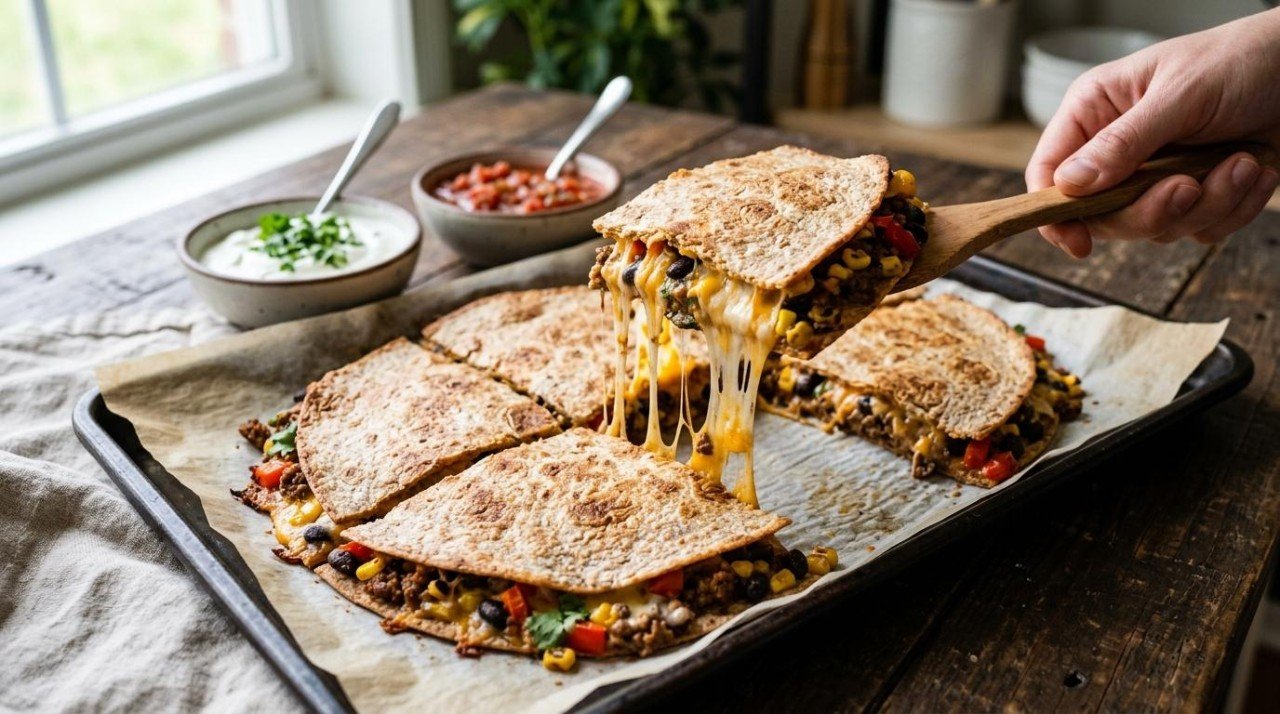
The sheet pan quesadilla is one of the smartest things the internet has done to dinner. You fan a ring of big flour tortillas around a rimmed sheet pan so half of each one hangs over the edge, pile the filling into the middle, fold the overhang back in over the top, press a second sheet pan down on it, and bake. Twenty-five minutes later you pull out one enormous golden quesadilla, cut it into squares, and feed a whole table off a single pan. It went around TikTok and Instagram in dozens of near-identical versions, and no single creator really owns it, which is part of why it spread so fast: everyone who made it thought of it as theirs.
It is also, in its most-shared form, a pound of cheese. We built a representative version, the plain beef-and-cheese one from the cheese-pull videos, and ran it through Eat Well Planner's Nutrition Score, the same at-a-glance number that shows up on any public recipe page. It came back 34 out of 100.
Here is the promise: same tray, same fold, same crackly top, same pull when you lift a square. We got it to 58 out of 100. That is 24 points, and every swap below carries the real, verified score change it earned, in the order we made it. One of them raised the saturated fat and the score went up anyway. We will get to that.
The original: what's in it and how it scores
Versions vary a lot. Some already include black beans, peppers, or salsa mixed into the filling, and if yours does, you are ahead of this post already. We modeled the plainest and most-repeated one, the beef-and-cheese tray, scored for six servings:
- 8 burrito-size flour tortillas (about 10 inches)
- 1 pound 80/20 ground beef
- 1 packet (1 oz) taco seasoning
- 1 pound shredded Mexican blend cheese (about 4 cups)
- 2 tablespoons butter, brushed over the top
- 1/2 cup sour cream and 1/2 cup salsa, to serve
Nutrition Score: 34/100. Per serving that works out to about 856 calories, 38.8 g protein, 4.4 g fiber, 53 g total fat, 26.1 g saturated fat, and 1,770 mg sodium. Now the diagnosis, because knowing why it scores that way is what lets you read your own recipes.
- Saturated fat is the headline. 26.1 g per serving is 111% of a day's limit in a single sitting. The Dietary Guidelines cap saturated fat at less than 10% of daily calories, and the American Heart Association goes further at 7%. A pound of cheese split six ways is 2.7 oz each, and that plus 80/20 beef plus a butter brush is where all of it comes from.
- Sodium is very high — 1,770 mg, about 77% of the 2,300 mg daily limit. Most Americans already run near 3,400 mg a day, mostly from packaged food rather than the salt shaker, which is exactly what a seasoning packet and a pound of pre-shredded cheese are.
- 4.4 g of fiber and 1.25 different plants for 856 calories. The half cup of salsa is doing most of the plant work by itself.
Now notice what is not wrong here, because manufacturing problems is how healthy-recipe articles lose people. This is genuinely nutrient-dense food. Per serving it is an excellent source of vitamin B12 (136% DV), phosphorus (98%), iron (76%), calcium (68%), zinc (66%), riboflavin (56%), niacin (51%), and protein (48%). It has just 1.9 g of added sugar, and when we tested the swaps it turned out to be coming from the tortillas and the seasoning packet, not the salsa. Nothing in it is fake. It is real beef, real cheese, real tortillas, cooked in a real oven. The problem is proportion, not ingredients: a lot of two rich things and almost nothing else. So we are not going to gut it. We are going to fill the empty half of the pan.
The upgrades
Six swaps, in the order we built and scored them. If you only make one change, make the first one. It is also the only one that adds something to the pan rather than taking something away.
1. Layer in a pound of vegetables
- Swap: Nothing removed. Add 1 diced red bell pepper, 1 diced onion, and 1 cup of corn to the filling
- Score impact: +7 points (34 → 41)
- What it changes: Plant variety from 1.25 to 4.25 different plants, fiber 4.4 g to 5.5 g, and it clears the low vitamin C flag entirely
- What it costs you: Six minutes in the skillet, and nothing at all on the plate
Seven points for adding things is the best trade in this entire post, and it is the one people skip because it feels like it should not count. It does. The one technique that matters: cook the vegetables in the pan before they go in, over medium-high heat, until the moisture has driven off and the edges catch some color. Wet vegetables steam the tortillas from the inside and you lose the crisp bottom, which is the whole reason to use a sheet pan. Dry, charred vegetables do not.
Worth noticing: this did not move the saturated fat at all, and the score still climbed 7. The flag capping the score is still standing after this swap. It just also had 7 points of low-hanging fruit sitting next to it.
2. Stretch the beef with a can of black beans
- Swap: 1 pound of 80/20 ground beef → 1/2 pound of 93/7 lean beef plus one 15 oz can of no-salt-added black beans, drained
- Score impact: +5 points (41 → 46)
- What it changes: Saturated fat 26.1 g to 21.0 g, fiber 5.5 g to 9.1 g, calories 892 to 811, and protein holds steady at 38.5 g
- What it costs you: Almost nothing. Seasoned black beans vanish into taco filling
This is the swap that always earns its keep, and the protein number is why: halving the beef would normally cost you protein, but the beans backfill it, so you get less saturated fat and more fiber for free. Beans are also doing real work beyond the score. Harvard's Nutrition Source notes that eating legumes about four times a week tracked with a 14% lower risk of coronary artery disease, and that substituting plant proteins like legumes for red meat improved cholesterol, triglycerides, and blood pressure. Mash a few beans against the pan as they warm so they bind the filling instead of rolling out of the fold. If you want the full menu of ways to lighten ground beef, we went through them in the ground beef substitutions guide.
3. Half the cheese, twice the flavor
- Swap: 1 pound (4 cups) of shredded Mexican blend → 6 oz (about 1 1/2 cups) of sharp cheddar, grated fine
- Score impact: +5 points (46 → 51)
- What it changes: Saturated fat 21.0 g to 13.7 g, calories 811 to 653, sodium 1,750 mg to 1,390 mg
- What it costs you: This is the honest one. It is less cheese, and you will notice if you go looking for it
There is no version of this where you cut the cheese by more than half and nobody notices. What you can do is make every gram count. Grate a block of sharp cheddar yourself on the small holes rather than buying pre-shredded: finer shreds spread further and melt into a continuous sheet from a much thinner layer, so it still pulls. And sharp cheddar is aged longer than a mild blend, which is why it tastes stronger, so less of it reads as more. Scatter half under the filling and half over it, going right out to the edges, so every square gets glue on both sides. More options in the cheddar cheese substitutions guide.
4. Ditch the taco seasoning packet
- Swap: 1 oz seasoning packet → 1 tablespoon chili powder, 2 teaspoons cumin, 2 teaspoons smoked paprika, 1 teaspoon each garlic and onion powder, 2 teaspoons oregano, 1/4 teaspoon salt
- Score impact: +2 points (51 → 53)
- What it changes: Sodium 1,390 mg to 1,200 mg, added sugar 1.9 g to 1.3 g, and another 1.25 plant points from the herbs and spices
- What it costs you: Nothing. It tastes better, and you control the heat
Only two points, and that is worth explaining rather than hiding. Sodium is still the flag standing at this point in the build, so cutting 190 mg out of it moves the number a little, not a lot. The swap is still obviously right, it just is not a hero. A packet is mostly salt with spices along for the ride; your own blend is mostly spices with a pinch of salt along for the ride, and it is a 30-second job with things already in your cabinet.
5. Whole wheat tortillas
- Swap: 8 burrito-size flour tortillas → 8 burrito-size 100% whole wheat tortillas
- Score impact: +3 points (53 → 56)
- What it changes: Fiber 9.5 g to 15.5 g per serving, an excellent source at 53% DV, plus another plant point and a little less sodium
- What it costs you: A nuttier, slightly grainier flavor, and they crack more easily when you fold them cold
Here is the interesting one. This swap actually raised the saturated fat, 13.7 g to 15.6 g per serving, because the whole wheat tortillas carry more fat than the white ones. The score still went up 3 points, because six extra grams of fiber outweighed two grams of saturated fat. That is the kind of thing you cannot eyeball, and it is why we score every swap instead of trusting the vibe that whole wheat is simply better at everything.
Fiber is the reason to do it anyway. Most Americans get about 15 g of fiber a day against a 25 to 35 g target, and refining flour strips out virtually all of it, along with more than half the B vitamins and 90% of the vitamin E. Practical note: warm the tortillas for ten seconds before you fold them and they behave like the white ones. See the tortilla substitutions guide if whole wheat is not your thing.
6. Fix the brush and the topping
- Swap: 2 tablespoons of butter brushed on top → 1 tablespoon of olive oil, and sour cream → plain nonfat Greek yogurt
- Score impact: +2 points (56 → 58)
- What it changes: Saturated fat 15.6 g to 11.7 g (66% of the daily limit down to 50%), calories 654 to 614, protein back up to 32 g
- What it costs you: Greek yogurt is tangier and thinner than sour cream, which some people prefer and some people do not
Two small changes at the two ends of the dish. Olive oil browns a tortilla just as well as butter does and you need less of it, so the top still crackles. For the yogurt, the fix for the texture gap is to treat it like a sauce rather than a substitute: stir in a squeeze of lime and a pinch of salt and it stops reading as yogurt and starts reading as crema. Both guides are worth a look if you want the fuller picture: sour cream substitutions and butter substitutions.
Take the Guesswork Out of Eating Well
Eat Well Planner helps you organize your favorite recipes, plan balanced meals, and automatically generate shopping lists — all in one place. Whether you're tracking macros, managing dietary restrictions, or just trying to stop asking "what's for dinner?", we've got you covered.
Our AI-powered tools can adapt any recipe to your dietary needs, help you discover new meals you'll love, and even log your nutrition effortlessly. It's meal planning made simple.
Start Organizing Your Meals — FreeWhat we kept, and where we stopped
The cheese stayed real, the beef stayed beef, and the second sheet pan still goes on top as a press. We also kept a fat brush on the lid rather than baking it dry, because that is what turns the top from pale and papery into something worth eating.
The interesting stopping point is the cheese, and the numbers make it plain. Holding everything else at the final build, we scored four cheese quantities:
- 8 oz of sharp cheddar: 57
- 6 oz (what we used): 58
- 5 oz: 60
- 4 oz: 61
So there are three more points available past 6 oz. We did not take them, because below about an ounce of cheese per serving the tray stops holding together. Cheese is not a topping in a quesadilla, it is the adhesive, and a sheet pan quesadilla that will not seal is a pile of hot tortilla shrapnel. Three points is not worth that. This is also the reason saturated fat is still flagged at 50% of the daily limit in the finished dish, and we would rather say so than pretend a cheese-based tray bake can end up anywhere else.
The healthier version: full recipe
Nutrition Score: 58/100. Serves 6.
- 8 burrito-size (10-inch) 100% whole wheat tortillas
- 1/2 pound (8 oz) 93/7 lean ground beef
- 1 can (15 oz) no-salt-added black beans, drained and rinsed
- 1 large red bell pepper, diced
- 1 medium white onion, diced
- 1 cup corn kernels (fresh, frozen, or drained canned)
- 1 tablespoon chili powder
- 2 teaspoons ground cumin
- 2 teaspoons smoked paprika
- 1 teaspoon garlic powder
- 1 teaspoon onion powder
- 2 teaspoons dried oregano
- 1/4 teaspoon salt
- 6 oz sharp cheddar cheese, grated fine (about 1 1/2 cups)
- 1 tablespoon olive oil
- 1/2 cup plain nonfat Greek yogurt
- 1/2 cup salsa
- Heat the oven to 425F. Brush a rimmed half sheet pan lightly with a little of the olive oil.
- Cook the onion, bell pepper, and corn in a large skillet over medium-high heat until the moisture has cooked off and the edges are charred in spots, 6 to 8 minutes. Do not rush this part; it is what keeps the finished quesadilla crisp.
- Add the lean beef, break it up, and cook until no longer pink, about 5 minutes. Stir in the chili powder, cumin, smoked paprika, garlic powder, onion powder, oregano, salt, and a splash of water.
- Add the drained black beans and cook 2 to 3 more minutes, mashing some of them against the pan so they bind the filling. It should look glossy, not wet. Take it off the heat.
- Arrange 6 tortillas around the sheet pan in a ring, overlapping each other, with about half of each one hanging over the rim. Lay a seventh tortilla flat in the center to cover the gap.
- Scatter half the cheddar over the tortillas, right out to the edges. Spread the filling evenly over the top, then scatter the rest of the cheddar over the filling.
- Lay the last tortilla in the center, then fold the overhanging edges up and in over the filling, working around the ring and pressing each one down so it seals.
- Brush the top with the remaining olive oil. Set a second sheet pan on top as a press.
- Bake 20 minutes with the top pan on, then remove it and bake 5 minutes more, until the top is golden and crisp.
- Rest 5 minutes, then cut into 12 squares. Stir a squeeze of lime and a pinch of salt into the Greek yogurt and serve alongside the salsa.
Per serving, original against improved:
- Nutrition Score: 34 → 58
- Calories: about 856 → 614
- Saturated fat: 26.1 g → 11.7 g (111% of the daily limit → 50%)
- Sodium: about 1,770 mg → 1,090 mg (77% DV → 47%)
- Fiber: 4.4 g → 15.5 g (15% DV → 53%, now an excellent source)
- Total fat: 53 g → 25 g
- Protein: 38.8 g → 32 g (still 40% DV)
- Added sugar: 1.9 g → 0 g
- Plants on the plate: 1.25 → 7.5 different plants
Protein is the one number that went the other way, and it is worth saying out loud: you gave up about 7 grams when half the beef became beans. At 32 g a serving it is still an excellent source, and you got 11 grams of fiber for it. The finished tray is now an excellent source of phosphorus, iron, thiamine, B12, B6, fiber, folate, calcium, riboflavin, zinc, niacin, vitamin C, protein, and magnesium. Seven and a half different plants in one dinner is also a quarter of a week's worth toward the 30 different plants a week that the gut microbiome research points at.
Swaps we tested and skipped
- Fat-free cheddar. This scored 68, ten points higher than what we published, and we still rejected it. Fat is what lets a cheese melt: it sits inside the casein protein mesh and softens it, and stripping it out leaves a rigid protein matrix that resists melting and flowing altogether. A quesadilla that does not melt is not a quesadilla, it is a folded tortilla with grated rubber in it. Ten points is not enough to buy that.
- Lean ground turkey instead of lean beef. Scored 58. An exact tie. Once the beef is already 93/7 and half of it is beans, turkey has nothing left to fix, and you would be trading away iron, zinc, and B12 for it. Use turkey if you prefer turkey, not because it is healthier here.
- Dropping the beef entirely and doubling the beans. Also 58. Another exact tie: fiber climbs to 19.1 g, protein drops to 27.9 g, and the score lands in the same place. That is genuinely good news, just not an upgrade.
Make it fit other diets
This one bends easily. Vegetarian: skip the beef and use two cans of black beans, which we scored above at an identical 58. Gluten-free: the tortillas are the only gluten in the dish, so use large gluten-free wraps and warm them well before folding, since they are the most crack-prone of the lot. Dairy-free is the hard one here and we will not pretend otherwise: cheese is the structural adhesive, so a dairy-free version needs a plant-based cheese that genuinely melts, plus mashed beans as backup glue. In Eat Well Planner you do not have to work these out by hand. Ask the AI recipe chat to make this recipe vegetarian or gluten-free, or use Recipe Variations, and it rewrites the whole thing with the swaps built in and rescores it.
Do this to any recipe you love
Nothing here was estimated. Every score and every delta came out of Eat Well Planner's Make It Healthier, which proposes swaps like these and runs a calculator over each one to verify the real nutritional gain before it shows you the suggestion, so you never chase a change that does not actually pay. We tested each version in the Recipe Playground, watching the score move one edit at a time, which is how we caught the two most useful facts in this makeover: that whole wheat tortillas raise the saturated fat and are still worth it, and that the last three points of cheese are the ones you should refuse.
You can point the same tools at whatever you cook. Saw the sheet pan quesadilla on TikTok or Instagram? Paste the video straight into Eat Well Planner and it imports the recipe, scores it, and shows you where the easy points are hiding before you ever preheat the oven. Keep the pan. Keep the fold. Keep the pull. Just fill the empty half.